Global Reference Hub
Every city that legalized the multiplex, and what actually happened
Across three continents, governments handed ordinary single-family lots the right to become three, four, six, even ten homes. This hub profiles 24 of those reforms in detail: the rules, the dates, the real permit numbers, and the lawsuits and repeals. The pattern is blunt: legalizing density is the easy part. Building the homes is not.
The short version
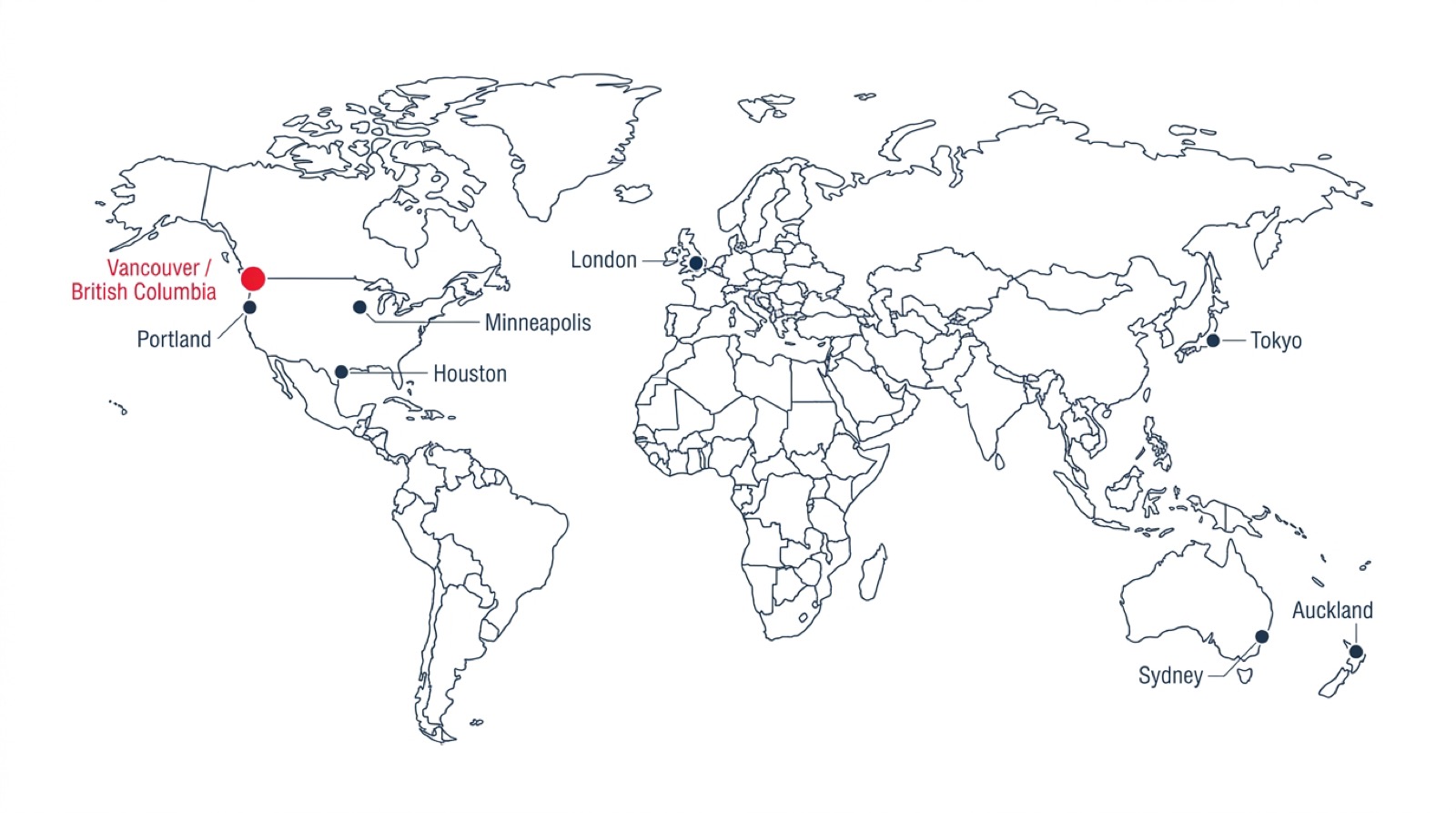
- This hub profiles 24 cities, states, provinces, and countries that legalized multiplex or "missing middle" housing, from Auckland to Vancouver, Tokyo to Calgary.
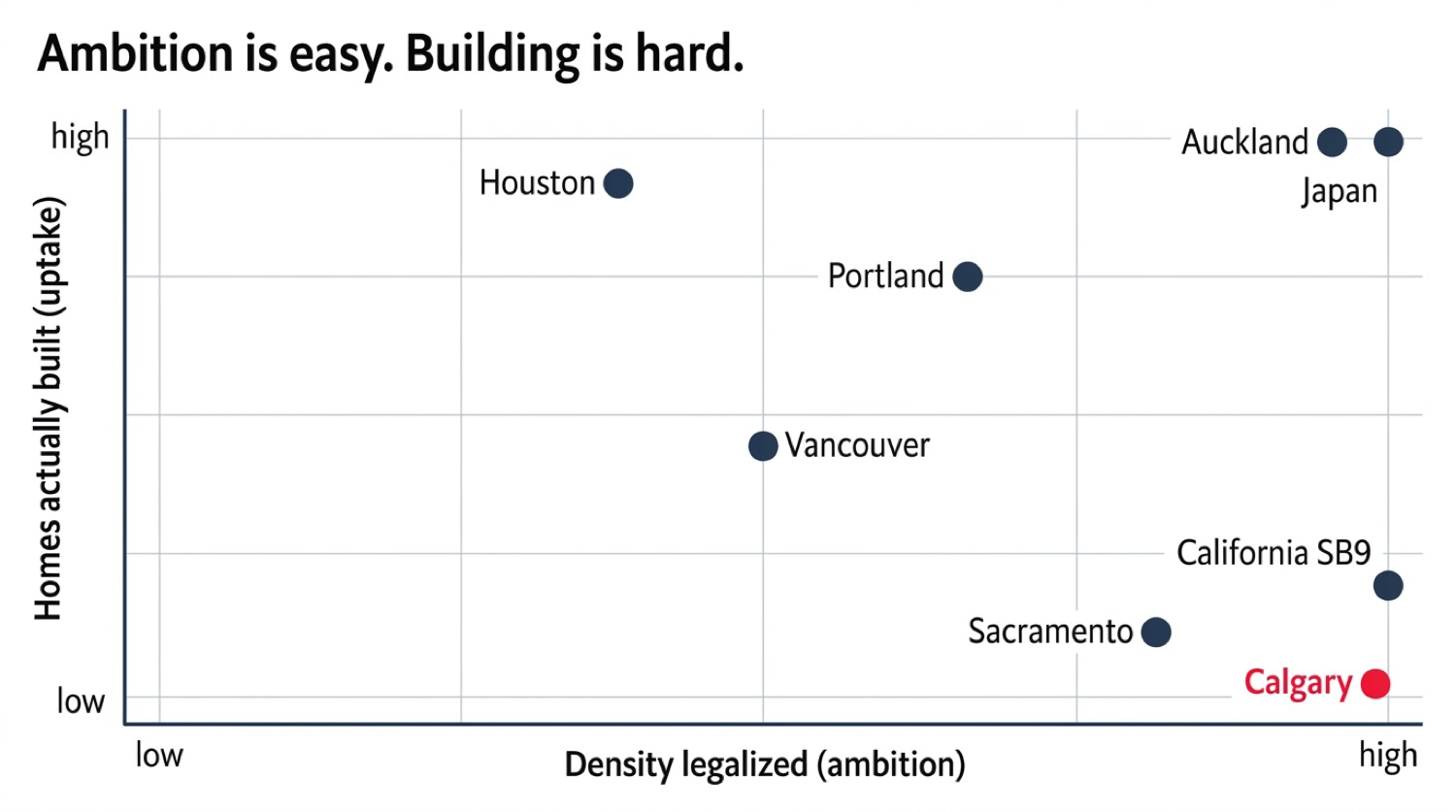
- The clearest lesson: legalizing density is easy; building the homes is not. Many reforms that legalized thousands of homes produced very few.
- The strongest results on the evidence come from Auckland, Japan, and Portland, places that paired legalization with enough floor area and durable politics.
- Several reforms were reversed or watered down: Calgary and Gainesville repealed theirs, and New Zealand made its national mandate partly optional.
What 24 reforms teach in three lines
It can work
Auckland added ~21,808 homes in five years and cut 3-bed rents 26–33%. Tokyo's stock nearly tripled since 1963. Done at scale, upzoning builds homes and softens rents.
Permission isn't production
California SB 9 was modeled for ~700,000 homes and delivered 266 projects. Sacramento built zero mid-size projects in 18 months. The math, not the map, decides what gets built.
Durability is fragile
Calgary repealed its rezoning in 2026. Gainesville reversed in months. Arlington is void in court. New Zealand made its mandate optional. Reforms can be unwound before they pay off.
United States
The first big US city to end single-family-only zoning — then defend it in court.
The first US state to effectively end exclusive single-family zoning.
Called 'the best low-density zoning reform in US history' — with the data to back it.
Projected to unlock ~700,000 homes. Delivered 266 projects in two years.
A mandatory, transit-tiered upzone that bans parking minimums near frequent transit.
Backyard cottages now out-permit new houses two to one.
No zoning, one rule change, ~80,000 new homes.
1,309 homes approved under the three-unit HOME rule; the small-lot path is slower.
Struck down, reinstated, voided, and reinstated again — now in effect but under review.
Poised to be Florida's first city to end single-family zoning — undone by an election.
First California city to allow multi-unit housing in every neighborhood — and built zero 3-to-20-unit projects in 18 months.
The city that invented single-family zoning in 1916 legalized middle housing in 2025.
Canada
A province forcing 3–6 homes onto single-family lots by statute — the model for this whole site.
Six strata homes or eight rental homes on a standard lot — VanPlex's home market.
Three units provincewide, four in Toronto — but the city balked at six.
Eight units on a mid-block lot — the most permissive blanket zone of any major Canadian city.
Canada's blanket-upzoning reversal: adopted 2024, repealed 2026.
Four units on every serviced lot — no rezoning, no hearing, no agreement.
International
The world's best evidence that upzoning lowers rents — and it's peer-reviewed.
A national by-right upzone — then a national walk-back.
Even the most restrictive residential zone allows small apartments — by design.
A by-right 800-metre radius around 171 town centres and stations.
Meet the standards near a station and you skip the objections.
The cautionary counter-case: by-right conversions, but a documented quality backlash.
Want them all in one table?
The Global Scorecard ranks every reform on ambition, real uptake, and durability, so you can see at a glance which legalizations turned into housing and which became cautionary tales.
Open the Global Scorecard →Questions people ask
Which city has the best multiplex zoning reform?
On the evidence, Auckland, New Zealand. Its 2016 upzoning is the most-studied on Earth and peer-reviewed work found it added about 21,808 homes in five years and lowered 3-bedroom rents by roughly 20–35%. Portland and Japan are the other standouts for measurable, durable results, because both give small buildings enough floor area to actually pencil out.
Did any city repeal its multiplex zoning?
Yes. Calgary repealed its 2024 citywide rezoning in April 2026, and Gainesville, Florida reversed its reform within about six months in 2023. New Zealand made its national mandate optional for Auckland and Christchurch after the 2023 election. Arlington, Virginia was voided in court, then reinstated on appeal, and is in effect in 2026 while under Supreme Court review.
Does legalizing more units actually produce housing?
Not by itself. California SB 9 was modeled to make about 700,000 homes feasible but produced only 53 approved units across 13 cities in its first year, and Sacramento built zero mid-size projects in its first 18 months. Legalization is necessary but not sufficient. Financing, construction cost, and floor-area limits decide what actually gets built.
How does British Columbia compare to the rest of the world?
BC's Bill 44 is among the most ambitious mandates anywhere: a province forcing 3 to 6 homes onto single-family lots, scaled by transit, with no city opt-out. It most resembles Washington's HB 1110 and New Zealand's MDRS. The open question is durability and real uptake, which is exactly what these other cities reveal.
What is "missing middle" housing?
Missing middle housing means the range of home types between a single detached house and a large apartment tower: duplexes, triplexes, fourplexes, townhouses, and small courtyard or cottage clusters. These were common in older neighbourhoods but were made illegal in much of North America by single-family-only zoning. The reforms on this hub are mostly about making that middle range legal again.
Which cities ended single-family-only zoning?
Minneapolis was the first big US city (2020), followed by Oregon and California statewide, Washington State, Berkeley, Edmonton, and others. British Columbia did it province-wide through Bill 44. "Ending single-family-only zoning" does not ban houses. It means those same lots may also hold two or more homes.
Why do so many reforms legalize homes that never get built?
Because a unit limit on a map does not build anything on its own. Minneapolis legalized triplexes citywide but only about 1% of its new homes came from 2-to-4-unit buildings, because the building-size rules were too tight. The reforms that actually produced middle housing (Portland, Auckland) gave smaller buildings enough floor area, removed parking mandates, and let owners sell the homes separately.
Which reform produced the most homes?
Auckland stands out for measured results: roughly 21,808 extra homes in five years from its 2016 upzoning. Japan, through its permissive national zoning, lets Tokyo build well over 100,000 homes a year, more than some entire countries. Houston, with no zoning at all, produced tens of thousands of townhomes by cutting its minimum lot size.
Do these reforms lower rents or home prices?
The best evidence says yes, where enough gets built. Auckland saw 3-bedroom rents fall sharply against a comparison group, and Minneapolis held rent growth to about 1% while the rest of Minnesota rose 14%. New middle-housing homes also sell for far less than new single houses, often $250,000 to $300,000 less in Oregon and Portland. Where little gets built, the price effect is small.
How many units do these reforms usually allow?
It varies widely. Most allow 2 to 4 homes on a lot, often more near transit. Some go further: British Columbia allows up to 6 near frequent transit, Seattle up to 6 (and more with bonuses), and Edmonton up to 8. California SB 9 allows up to 4 through a lot split. The number on paper matters far less than the floor area and financing behind it.
Are these reforms the same as zoning, and how is Japan different?
Most North American and Australasian reforms change local zoning to allow more homes. Japan is the outlier: it sets zoning nationally through 12 permissive, nested use zones, so most residential land allows small apartments and shops by right. That centralized, permissive system is a big reason Tokyo builds so much housing and has kept it relatively affordable.
What should a homeowner take from all of this?
Two things. First, the legal right to build more homes now exists in far more places than most owners realize, so check your own lot. Second, do not assume the maximum. On most lots the real limit is floor area, land cost, and financing, not the headline unit count, so the honest number is often lower than the law allows. Run the specific lot before you commit.
See What Your Own Lot Can Do
These reforms are global. The opportunity is local. Enter any BC address to see the units your lot is zoned for and whether the project actually pencils.