Can you build a townhouse in Victoria? Yes, and meeting the code skips the objection fight.
Victoria took two swings at slow housing approval at once. One is a statewide rulebook: meet the numbers and your townhouse gets approved with no neighbour appeal. The other is upzoning land near about 60 Melbourne activity centres so taller buildings can go up close to trains and trams. This is what each track allows in 2026, and how they fit together.
or more off planning assessment time when a project meets every deemed-to-comply standard, before you count the tribunal appeal it also avoids.
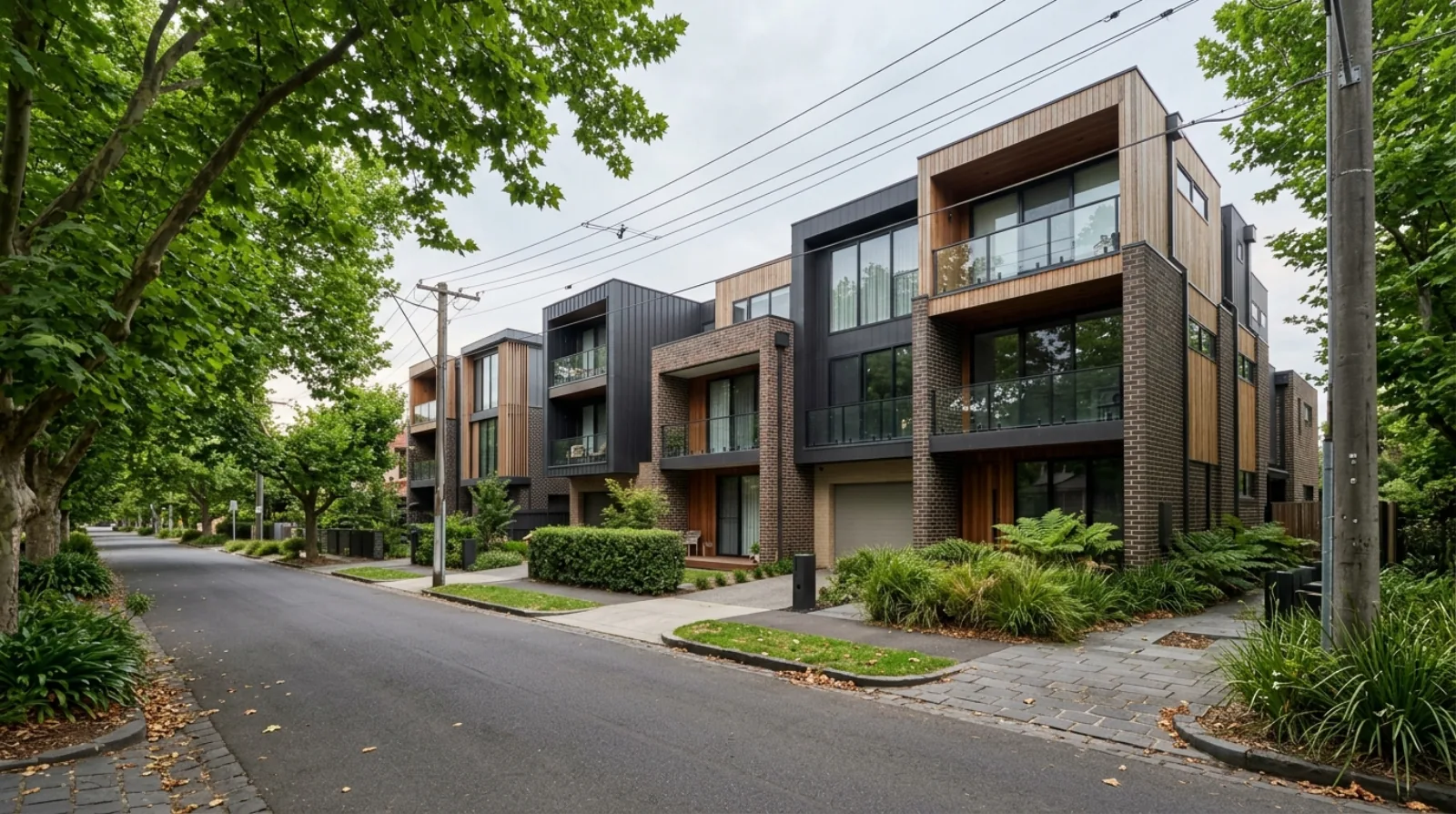
The 30-second answer
- Victoria has two main tracks: a statewide "deemed-to-comply" code for townhouses and low-rise buildings, and upzoning of land near about 60 activity centres in Melbourne.
- If a townhouse or low-rise project (up to 3 storeys) meets every rule in the Townhouse and Low-Rise Code, neighbours cannot appeal it at the state tribunal (VCAT). The code took effect on 31 March 2025.
- A Mid-Rise Code for 4-to-6-storey apartment buildings took effect on 16 April 2026, using the same deemed-to-comply idea.
- A second small home up to 60 square metres (a granny flat) needs no planning permit on most lots since December 2023. A building permit is still required.
- Meeting the code can cut planning permit assessment time by at least 60 percent, on top of the time saved by skipping a tribunal appeal.
Two tracks, one goal: build homes faster
Most coverage mixes these two reforms together, but they work in different ways and it helps to keep them apart. One track changes how you get approved; the other changes how much you can build near transport.
Track 1: The code
Build a townhouse without the objection fight
Meet the numbers, skip the appeal.
The Townhouse and Low-Rise Code sets clear "deemed-to-comply" standards: front setback, tree canopy, sunlight, room size, storage, ventilation. If your project of 2 or more homes up to three storeys meets every standard that applies, the council must approve it, and objectors cannot take the decision to the state tribunal (VCAT). This is a direct answer to the old problem where a single neighbour objection could add many months of delay.
- Applies to
- 2+ homes, up to 3 storeys, statewide
- In force since
- 31 March 2025
- The trade
- Meet every standard, get no third-party appeal
- Time saved
- At least 60% off assessment time
Track 2: The centres
Mid-rise near ~60 activity centres
Higher limits close to trains and trams.
Around about 60 "activity centres", town centres and shopping strips near train stations and tram lines in Melbourne, the state is rezoning land to allow taller apartment buildings than the surrounding streets. These 60 centres are meant to hold more than 300,000 new homes by 2051. A separate Mid-Rise Code (in force 16 April 2026) applies the same deemed-to-comply idea to 4-to-6-storey apartment buildings, so mid-rise near a centre can also skip the objection fight if it meets the rules.
- Centres
- ~60 across Melbourne
- Homes targeted
- 300,000+ by 2051
- Mid-Rise Code
- 4–6 storeys, in force 16 Apr 2026
- What changes
- Higher height limits near the centre
How they fit together: the codes apply across the whole state, so a compliant townhouse or mid-rise building skips the objection fight anywhere. The activity centres raise the height limit in about 60 spots near Melbourne's trains and trams. Near a centre, the Mid-Rise Code and the higher limit line up: you can build taller and skip the appeal if you meet the rules.
Townhouse & Low-Rise Code
- Up to 3 storeys, 2 or more homes on a lot.
- Statewide, in force since 31 Mar 2025.
- No third-party appeal if you meet every standard.
Mid-Rise Code
- 4 to 6 storeys apartment buildings.
- In force 16 Apr 2026 (Amendment VC300).
- Same deal: meet the rules, skip the appeal.
Small second home
- Up to 60 m², a granny flat.
- No planning permit on most lots (since Dec 2023).
- Can rent it, but cannot sell it separately.
The activity centres, stage by stage
The upzoning near centres is rolling out in stages. Together the roughly 60 centres are meant to hold more than 300,000 new homes by 2051, all close to existing train and tram lines.
Plans finalised 2024
Includes Broadmeadows, Camberwell Junction, Chadstone, Frankston, Moorabbin, Niddrie, Preston, Ringwood.
Plans finalised 31 Mar 2026
Includes Carnegie, Oakleigh, Hawthorn, Blackburn, Mitcham, Toorak, Malvern, Hampton, Sandringham.
Under review, expected mid-2026
Includes South Yarra, Prahran, Brunswick, Coburg, Caulfield, Bentleigh, Heidelberg.
What it has done so far: early days, told honestly
New homes Victoria targets statewide by 2051, with 70% aimed at areas already built up.
Homes the ~60 activity centres are meant to hold by 2051, near trains and trams.
Cut in planning assessment time for a project that meets every deemed-to-comply standard.
Honest caveat: these are targets and design goals, not proven results yet. The townhouse code is only about a year old, the Mid-Rise Code started in April 2026, and most activity centre plans were finalised in 2026. It is too early for reliable "homes actually built" figures, so the numbers above are goals and rule changes, clearly labelled as such, not counts of completed homes.
How Victoria got here
The reforms rolled out in a fast sequence between 2023 and 2026, each one adding another piece of the "meet the rules, skip the fight" system.
- Sep 2023
Victoria's Housing Statement sets a target of 2.24 million new homes statewide by 2051, with 70% of growth in areas that are already built up.
- Dec 2023
Amendment VC253 removes the planning permit requirement for a small second home (granny flat) up to 60 square metres on most lots.
- 2024
Plans for the 10 pilot activity centres are finalised after community consultation.
- 31 Mar 2025
The Townhouse and Low-Rise Code takes effect: deemed-to-comply standards for buildings up to 3 storeys, with no third-party appeal for compliant projects.
- 19 Mar 2026
Amendment VC300 is gazetted, introducing the Mid-Rise Code for 4-to-6-storey apartment buildings.
- 31 Mar 2026
Plans for the 25 Stage 1 activity centres are finalised.
- 16 Apr 2026
The Mid-Rise Code commences operation.
- Mid-2026
The 23 Stage 2 activity centres are under review, bringing the total toward about 60 centres.
If you own land in Melbourne or Victoria
Start with two checks. First, is your lot inside or near one of the roughly 60 activity centres? If it is, your height limit may be well above the surrounding streets, and a mid-rise building could be an option. Second, can your project meet every deemed-to-comply standard in the relevant code? If yes, you get the fast pathway with no tribunal appeal; if not, you drop back into the slower, discretionary process.
The cheapest win is the small second home: on most lots you can add a 60 square metre granny flat with no planning permit and rent it out, though you still need a building permit. Across all three, the lesson is the same: design to the exact numbers from the start, because in Victoria certainty now comes from hitting the rules, not from winning an argument with the neighbours.
Victoria housing reforms: questions people ask
Can I build a townhouse in Victoria without a fight from the neighbours?
Often, yes. Since 31 March 2025 the Townhouse and Low-Rise Code sets clear "deemed-to-comply" standards for projects of two or more homes up to three storeys. If your plans meet every standard that applies to your lot, the council must approve them, and neighbours cannot take the decision to the state tribunal (VCAT). Your project still goes to public notice so neighbours are told about it, but their objection can no longer stall it at the tribunal. If you miss even one standard, the normal review process and third-party appeal rights come back.
What is a "deemed-to-comply" standard?
It is a numeric rule you either meet or you do not. There is no discretion or argument about it. Examples in the code include a six-metre front setback, tree canopy and open space requirements, room sizes, storage, sunlight, and energy standards. If your design meets every deemed-to-comply standard that applies, the project is treated as compliant and the council cannot apply extra policies or weigh objections against it. This replaces the older system where an assessor could judge a project against broad "objectives" and a neighbour could dispute that judgement.
What are the two main tracks of Victoria's housing reform?
The first track is the statewide code: the Townhouse and Low-Rise Code for buildings up to three storeys, and the newer Mid-Rise Code for four-to-six-storey apartments. Both use deemed-to-comply standards, so a compliant project skips the objection fight anywhere in the state. The second track is the activity centres program: around 60 town centres near train stations and tram lines in Melbourne where the state raises the height limits so taller buildings are allowed. In short, the code changes how you get approved, and the activity centres change how much you can build near transport.
How many activity centres are there, and what are they?
About 60 activity centres have been identified across Melbourne. An activity centre is a town centre or shopping strip near a train station or tram line, a place with jobs, shops and services already in place. The rollout came in stages: 10 pilot centres with plans finalised in 2024, 25 Stage 1 centres finalised on 31 March 2026, and 23 Stage 2 centres under review in mid-2026. Together the 60 centres are meant to hold more than 300,000 new homes by 2051.
What is the Mid-Rise Code and when did it start?
The Mid-Rise Code is a set of deemed-to-comply planning rules for apartment buildings of four to six storeys in Victoria's residential areas. It was introduced by Amendment VC300, gazetted on 19 March 2026, and it commenced operation on 16 April 2026. Like the townhouse code, a proposal that meets the standards has its third-party appeal rights removed and must be approved. It extends the same "meet the rules, skip the fight" approach from low-rise up into mid-rise heights, which matters most near the activity centres.
Do I need a planning permit to build a granny flat in Victoria?
In most cases, no. Since Amendment VC253 in December 2023, a small second home of 60 square metres or less on the same lot as an existing house does not need a planning permit, as long as your lot has no flooding, environmental, or other special planning controls over it. You do still need a building permit, which checks siting, safety, and design. The rule is aimed at making it faster and cheaper to add one extra small home in a back garden.
How big can a granny flat be, and can I sell or rent it?
It can be up to 60 square metres and must have its own kitchen, bathroom, and toilet. You can rent it to anyone, including someone outside your family, which makes it a real income option. You cannot subdivide it or sell it separately from the main house. It stays part of the one property title. There is no car parking space required, and it must not be connected to piped natural gas, which pushes new second homes toward all-electric.
Does the code apply everywhere in Victoria or just Melbourne?
The Townhouse and Low-Rise Code and the Mid-Rise Code apply across the state of Victoria, not only Melbourne. So the "meet the rules, skip the objection" pathway is available in regional cities and towns too, wherever the relevant residential zones apply. The activity centres program, on the other hand, is a Melbourne program. The roughly 60 centres are all in metropolitan Melbourne, near its train and tram network. That is the key split: the codes are statewide, the higher height limits are centred on Melbourne's transport hubs.
How much time does the code actually save?
The Victorian Government says meeting the deemed-to-comply standards can cut planning permit assessment time by at least 60 percent. On top of that, a compliant project avoids the state tribunal (VCAT) appeal stage entirely, which on its own can add many months. The saving is real, but it is conditional: it only applies if your design meets every standard. Miss one, and you drop back into the slower, discretionary process where the time saving disappears.
What is the catch with losing objection rights?
The trade is deliberate and it has drawn criticism. Neighbours are still told about a project through public notice, but if it meets every code standard they cannot appeal the council's decision at the tribunal. Supporters say this stops a single objection from adding months of delay to housing the city needs. Critics, including some councils and resident groups, argue it reduces local say over what gets built next door. For an owner or builder, the practical point is that certainty now comes from hitting the numbers, not from winning an argument.
How many homes is Victoria trying to build?
Victoria's Housing Statement, released in September 2023, set a target of 2.24 million new homes across the state by 2051. It also set a goal that about 70 percent of that growth should happen in areas that are already built up, rather than on the edges of the city. The activity centres program is the main tool for directing that infill growth to places near trains and trams, and the codes are the tool for making each project faster to approve. The target is long-term, so the early years are about setting up the rules, not hitting the full number yet.
Is this reform still in force in 2026, or has it been paused?
It is in force and still expanding as of mid-2026. The Townhouse and Low-Rise Code has been operating since March 2025, the Mid-Rise Code started in April 2026, and the granny flat rule has run since December 2023. The activity centres program is moving through its stages: the pilot and Stage 1 centres are finalised, and Stage 2 is under review. There is no repeal or general pause. The trend in 2026 is more centres and more code coverage, not less.
What should a Melbourne owner or builder do first?
Check two things about your lot before you design anything. First, is your lot inside or near one of the roughly 60 activity centres? If yes, your height limit may be well above the surrounding streets, and mid-rise may be on the table. Second, can your project meet every deemed-to-comply standard in the relevant code? If yes, you get the fast, appeal-proof pathway; if not, plan for the slower discretionary route. The single biggest lever is designing to the numbers from the start, because that is what removes the objection risk.
Compare Victoria with reforms doing the same thing
Official sources & studies
- Planning Victoria: Townhouse and Low-Rise Code (official guide) Primary
- Planning Victoria: Mid-Rise Code (official guide) Primary
- Victorian Government: Automatic approvals for townhouses and apartments Primary
- Victorian Government: Making the most of activity centres Primary
- Planning Victoria: Small second dwellings (granny flats) Primary
- Victorian Government: Making it easier to build a granny flat Primary
- Victoria's Housing Statement (2.24M homes target) Primary
- Victorian Premier: "Automatic" approvals to deliver townhouse revolution
- ArchitectureAU: New reforms legislated for Victorian apartment buildings
See how Melbourne (Victoria) compares to the rest of the world
VanPlex tracks every major multiplex reform on Earth — what each city legalized, what actually got built, and what survived. Put Melbourne (Victoria) next to 23 other cities on one scorecard.
Building in British Columbia instead? See what a BC lot allows →