Can you turn an office into flats in England without full planning permission? Yes.
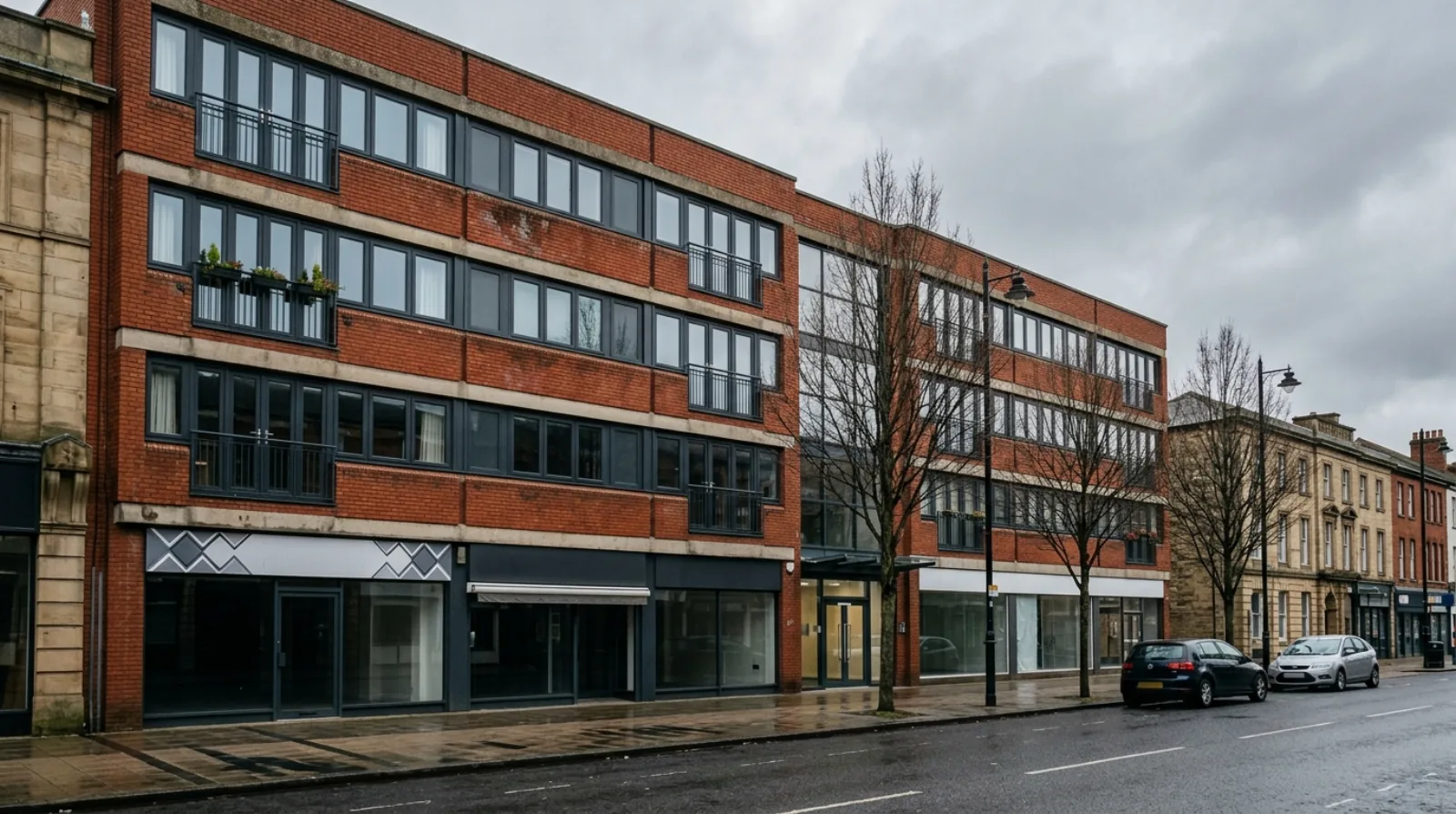
England has no zoning. Building normally means asking a council, case by case. But a set of national rules called permitted development lets you skip the full application to turn offices and shops into homes. It built homes fast, and a government-commissioned study found many of them were poor quality. This is the cautionary tale of the hub.
of permitted-development homes met national space standards, against 73% of homes built through full planning (UCL / MHCLG, 2020). Speed came at a cost.
The 30-second answer
- England has no zoning. It runs a discretionary, plan-led system where a council weighs each application against its local plan and national policy.
- Permitted development rights (PD or PDR) are the exception. National rules let some changes happen without a full planning application, using a lighter "prior approval" check.
- Turning offices into homes (Class O) became a permanent permitted development right in 2016. Turning most high-street commercial units into homes (Class MA) started in August 2021.
- A 2020 UCL-led study for the government found only 22% of permitted-development homes met national space standards, against 73% of homes built through full planning.
- Before August 2020 there was no rule that a converted home even needed a window, so some units were built with no natural light.
- All of this is still in force in 2026. Labour’s 2024–25 reforms changed the planning system around PD (new housing targets, "grey belt", a new Planning and Infrastructure Act), but they did not remove the main PD rights.
The quality cost of building fast
This is the heart of the English story, and the warning for any place thinking about a fast-track path. When England let offices and shops become homes without a full planning application, it also switched off the check that normally guards quality: floor area, natural light, outdoor space, unit mix. The government’s own commissioned study, led by UCL, measured what came out the other side.
of permitted-development homes met national space standards
vs 73% of full-planning homes
UCL / MHCLG (Jul 2020)of the converted homes had any private or shared outdoor space
the rest had none
UCL / MHCLG (Jul 2020)windows were required in a converted home before August 2020
some units were built windowless
UCL Bartlett (2020)homes made by change-of-use PD, 2015/16–2022/23 (about 89% from offices and shops)
fast, but with the quality problem above
House of Commons LibraryWhat speed delivered
About 102,830 homes from change-of-use permitted development between 2015/16 and 2022/23, with roughly 89% from former offices and shops. The office route alone hit about 17,751 homes in its 2016/17 peak. As pure supply, it worked.
What speed cost
Only 22% met space standards, only 3.5% had any outdoor space, and before August 2020 a converted home did not even need a window. The lesson: the planning check you remove for speed is often the same check that protects quality.
The normal system: plan-led, case by case
England does not zone land. Each council writes a local plan, and every application is weighed against that plan and national policy, then decided one by one. It is flexible but slow and uncertain. Two similar sites can get different answers.
This is called a discretionary, plan-led system. It is the default for almost all building.
The exception: permitted development
- Class O: offices to homes, permanent since 2016.
- Class MA: most high-street commercial units to homes, since Aug 2021 (loosened 2024).
- Class AA: up to two extra storeys, since Aug 2020, capped at 18m.
- Prior approval: a lighter check on a short, fixed list of matters, not the full scheme.
Where England stands in 2026
Class O, Class MA and Class AA are all still live under the GPDO 2015. Rules were tightened (space standards, natural light) but not removed.
Revised NPPF (Dec 2024) brought back mandatory housing targets and defined "grey belt". The Planning and Infrastructure Act became law on 18 Dec 2025.
Legislated in 2023 but the rules to run them were never made. As of mid-2026 the tool exists in law but no one can use it.
A further draft NPPF went out for consultation in December 2025, with a final version expected in summer 2026. The reforms reshaped the system around permitted development. They did not repeal the main PD rights.
How England got here
The story runs from a fast, light-touch conversion right, through a documented quality problem, to a set of tightening rules and a new government’s wider reforms.
- 2013
Office-to-residential change of use (later called Class O) is introduced as a temporary permitted development right.
- 2015
The permitted development rules are consolidated into the General Permitted Development Order 2015 (GPDO), the single statutory instrument that still holds them.
- 2016
The office-to-residential right (Class O) is made permanent.
- Aug 2020
Upward-extension rights (Class AA) begin: up to two extra storeys on homes and on some commercial buildings, capped at 18m. A natural-light check is added for conversions submitted from 1 August 2020.
- 2021
National space standards start to apply to permitted-development homes. Class MA begins (from 1 August 2021): most Class E high-street commercial units can convert to homes.
- 2023
"Street votes", a resident-led way to approve gentle density, are written into the Levelling-up and Regeneration Act 2023, but the rules needed to run them are never made.
- Mar 2024
Class MA is loosened: the 1,500 sqm floorspace cap and the three-month vacancy rule are removed (effective 5 March 2024).
- Dec 2024
The new Labour government publishes a revised National Planning Policy Framework: mandatory housing targets return and "grey belt" land is defined for release.
- Dec 2025
The Planning and Infrastructure Act receives Royal Assent (18 December 2025). A further draft NPPF goes out for consultation, with a final version expected in summer 2026.
If you own a building in England
If you hold an office or a high-street commercial unit, permitted development can be a fast and cheaper route to homes. Class MA (or Class O for a former office) skips the full application and runs on a lighter prior-approval check. Confirm first that your building is not listed and not in an excluded protected area, because those are carved out.
The catch is quality, and it now cuts both ways. Since 2020 the council must be satisfied every habitable room gets adequate natural light, and national space standards apply since 2021. A conversion that would leave dark or undersized rooms can be refused at prior approval. So the modern permitted-development route is faster than full planning, but no longer a way around the basic quality floors.
England permitted development: questions people ask
Does England have zoning like the United States or Canada?
No. England does not zone land into fixed "you may build this here" categories. It runs a discretionary, plan-led system. Each council writes a local plan, and when you apply to build, an officer or a committee weighs your application against that plan and against national policy, then decides. This is more flexible than a zoning map but also slower and less certain, because two similar sites can get different answers. Permitted development rights are the main exception to this case-by-case system. They are national rules that grant permission in advance for certain changes.
What are permitted development rights (PD or PDR)?
Permitted development rights are a national grant of planning permission for specific kinds of building work and change of use, so you do not have to make a full planning application. They live in one statutory instrument, the General Permitted Development Order 2015 (the GPDO). For many of the bigger rights, such as turning offices or shops into homes, you still have to send the council a lighter "prior approval" request. In that check the council can only look at a short list of set matters, for example flooding, contamination, transport, and (since 2020) natural light, not the full range of issues a normal application would face. If the set matters are acceptable, the council must allow it.
Can I turn an office into flats in England without full planning permission?
Usually yes, through the office-to-residential right known as Class O. It was introduced in 2013 as a temporary measure and made permanent in 2016. It lets you change a building from office use to homes without a full planning application, subject to a prior-approval check. There are limits: listed buildings and some protected areas are excluded, and since 1 August 2020 the council must be satisfied that every habitable room will get adequate natural light. Class O covers the change of use only. It does not by itself grant permission to build new external windows or make major external changes, which is exactly how some early conversions ended up with poorly lit or windowless rooms.
What is Class MA, and how is it different from Class O?
Class MA is a newer right, in force for applications from 1 August 2021. It lets most high-street commercial units, such as shops, offices, cafes, gyms and similar uses that sit in the broad "Class E" category, change to homes without a full application. Class O is narrower: it covers only former offices. In March 2024 Class MA was loosened further, removing the earlier 1,500 sqm floorspace cap and the rule that the building had to have been vacant for three months first. So in 2026 Class MA is the wider and more commonly used route for turning town-centre commercial space into housing.
Can I add storeys to a building to create new homes?
Yes, within limits, through the upward-extension rights known as Class AA, in force from 31 August 2020. On a house you can add up to two storeys if it already has two or more storeys, or one storey on a single-storey house. On some detached commercial or mixed-use buildings of three storeys or more, you can add up to two storeys of new flats on top. The finished building must not be taller than 18 metres, and you still need prior approval from the council, which looks at matters such as the external appearance and the impact on neighbours. These rights are more constrained than the office-to-home conversions and have produced far fewer homes.
Why did permitted development get such a bad reputation?
Because it delivered homes fast but a share of them were poor quality, and the government’s own commissioned research said so. A UCL-led study published in July 2020 compared homes made by permitted development with homes built through full planning. It found only about 22% of the permitted-development homes met the national space standards, against about 73% of the full-planning homes. Only about 3.5% of the converted homes had any access to private or shared outdoor space. Some units, converted before the 2020 natural-light rule, had no windows at all. That gap in quality is the core cautionary lesson of the English approach: removing the planning check also removed the quality check.
How many homes did permitted development actually create?
A large number. The House of Commons Library reports that from 2015/16 to 2022/23, about 102,830 new homes in England were delivered through change-of-use permitted development, and roughly 89% of those came from converting offices and other commercial or retail buildings. The office route peaked early: about 17,751 office-to-home units were recorded in 2016/17 alone. So the speed argument is real. Permitted development did add tens of thousands of homes quickly. The argument against it is not that it built too little; it is that too many of the homes it built were substandard.
Are permitted development rights still in force in 2026?
Yes. As of July 2026 the main permitted development rights, Class O (office to home), Class MA (commercial to home), and Class AA (upward extensions), are all still in force under the General Permitted Development Order 2015. The rules have been tightened over time (national space standards since 2021, a natural-light check since August 2020) and Class MA was loosened in 2024, but the core rights have not been removed. The bigger 2024–25 changes happened in the wider planning system around PD, not to the PD rights themselves.
What did the Labour government change in 2024 and 2025?
The Labour government, elected in July 2024, focused on the plan-led system rather than on permitted development. In December 2024 it published a revised National Planning Policy Framework (NPPF) that brought back mandatory housing targets for councils, raised those targets for many high-demand areas, and defined "grey belt", meaning lower-quality green-belt land that can be released for housing under a set of conditions. It then passed the Planning and Infrastructure Act, which received Royal Assent on 18 December 2025 and changes how large projects and planning committees are handled. A further draft NPPF went out for consultation in December 2025, with a final version expected in summer 2026.
What is the "grey belt"?
Grey belt is a term the government introduced in the December 2024 NPPF for green-belt land that is poor in quality or already partly developed, for example scrubland, disused sites, or land next to existing built-up areas. The idea is that this lower-value land can be released for housing more readily than protected open countryside, provided the scheme meets "golden rules" such as delivering affordable homes, local infrastructure, and accessible green space. It is a way to raise housing supply without a blanket loss of green-belt protection. It is separate from permitted development, but it is part of the same push to build more homes.
Are "street votes" available yet?
No. Street votes are a proposed way for residents on a street to propose and then vote on a plan for gentle extra density on their own street, which would then gain planning permission if it passed. The power to create them was written into the Levelling-up and Regeneration Act 2023, but the detailed regulations needed to actually run a street vote have not been made. As of mid-2026 the tool exists in law but is not operational, so no one has used it. It stands as an example of a reform that was legislated but never switched on.
Is permitted development a good model for other places to copy?
It is the clearest cautionary example in this hub, and its lesson is about the price of speed. Permitted development proved that removing the full planning check can produce homes quickly and cheaply, tens of thousands of them. But it also proved that the same check that slows building is often the check that guards quality: floor area, light, outdoor space, and unit mix. When those guards were removed, a large share of the homes came out below standard, which drove a political backlash and later rule-tightening. Any fast-track path that copies the speed should keep hard quality floors from the start, not add them years later.
What is the difference between "planning permission" and "prior approval" in England?
A full planning permission is the normal route: the council can weigh the whole scheme, including design, density, amenity, impact on neighbours, and more, and can refuse it or attach conditions. Prior approval is the lighter check attached to many permitted development rights: the change of use is already permitted in principle, and the council can only assess a short, fixed list of matters set out in the GPDO. Because the list is limited, prior approval is faster and more predictable for the applicant, but the council has far less power to protect quality. This narrower check is exactly why permitted-development homes escaped some of the standards that full-planning homes had to meet.
Compare England with the reforms around it
Official sources & studies
- legislation.gov.uk: General Permitted Development Order 2015 (GPDO), the governing law Primary
- legislation.gov.uk: Class O (offices to dwellinghouses) Primary
- legislation.gov.uk: 2021 Order introducing Class MA (commercial to residential) Primary
- GOV.UK: Quality standard of homes delivered through change-of-use PD (research report) Primary
- UCL / MHCLG: full research report (PDF), quality of PDR homes Primary
- UCL Bartlett: government publishes UCL-led research on PD housing quality Primary
- GOV.UK: revised National Planning Policy Framework (NPPF) and reforms Primary
- GOV.UK: Planning and Infrastructure Act becomes law (Dec 2025) Primary
- House of Commons Library: Planning in England, permitted development and change of use
See how England (United Kingdom) compares to the rest of the world
VanPlex tracks every major multiplex reform on Earth — what each city legalized, what actually got built, and what survived. Put England (United Kingdom) next to 23 other cities on one scorecard.
Building in British Columbia instead? See what a BC lot allows →