Can you build townhouses in Auckland? Yes, and there is proof it worked.
In 2016 Auckland let townhouses, terraces and low-rise apartments on about three-quarters of the city in one step. It is now the most-studied upzoning anywhere. The peer-reviewed result is rare and clear: tens of thousands of extra homes, and rents that ended up far lower than they would have been. This is what the rules allow in 2026, and the evidence behind them.
of Auckland’s residential land was upzoned at once. It is the single largest upzoning researchers have been able to measure.
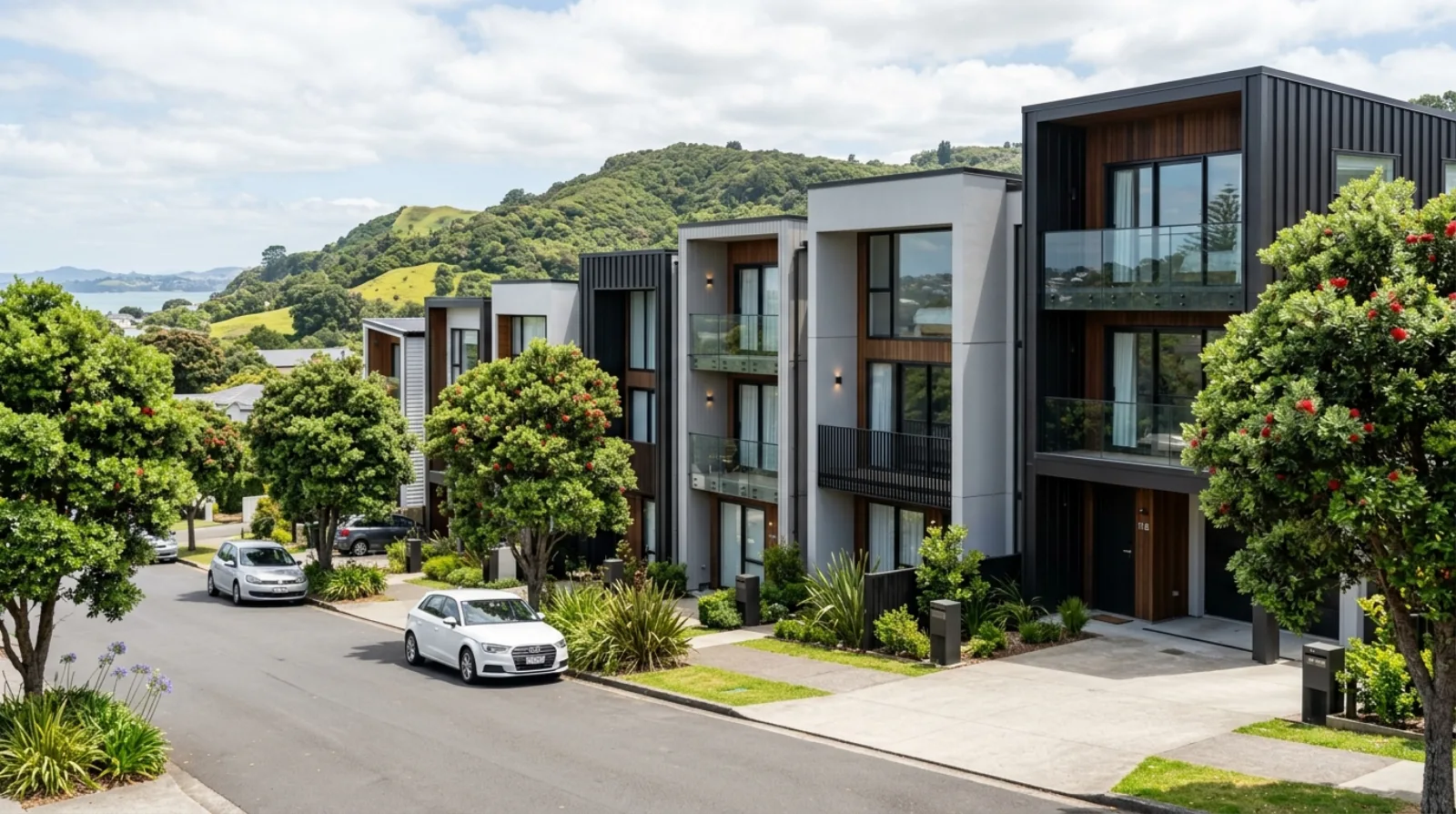
The 30-second answer
- Since 2016, the Auckland Unitary Plan allows townhouses, terraces and low-rise apartments up to 3 storeys, with up to 3 dwellings by right, across most of Auckland.
- The reform upzoned about three-quarters (~75%) of Auckland’s residential land, the largest single upzoning ever studied.
- Peer-reviewed research found it added about 21,808 extra homes in the first five years, roughly 4% of the city’s housing stock.
- Three-bedroom rents ended up 26–33% lower than they would have been without the reform, measured against 51 other New Zealand commuting zones.
- The rules are still in force in 2026. A March 2026 bill trimmed how much capacity the council must zone for, but kept the townhouse permission and pushed more height near transit.
The evidence, in three numbers
Most zoning arguments are about theory. Auckland is different: the effects were measured, published in peer-reviewed journals, checked by other researchers, and defended against a public critique. Each number below links to the study it comes from.
additional dwellings permitted in the first 5 years, about 4% of Auckland’s housing stock.
Greenaway-McGrevy & Phillips, Journal of Urban Economics (2023) →3-bedroom rents six years on, versus a synthetic control built from 51 NZ commuting zones.
Greenaway-McGrevy, Economic Policy Centre Working Paper 016 →the most-studied real-world upzoning on Earth: replicated, reviewed, and defended in print.
Greenaway-McGrevy, Economic Inquiry (2025) →Honest caveat: the exact size of the effect is debated at the edges. One economist argued it was overstated, and the authors answered in print. The direction the studies agree on is more homes and lower rents.
What the Unitary Plan lets you build
The plan sorts most of the city into a few residential zones. Two of them cover the bulk of Auckland’s houses and both allow up to three homes by right. A third, near centres and transit, allows apartments.
Mixed Housing Suburban
3 dwellings
Up to 3 homes, up to 3 storeys, by right. The most common zone across the suburbs. Height-at-boundary line of 2.5 m.
Mixed Housing Urban
3 dwellings
Also up to 3 homes and 3 storeys by right, closer to centres, with a slightly taller 3 m height-at-boundary line.
Terrace Housing & Apartments
5–7+ storeys
The highest-intensity zone, near town centres and rapid transit. Terraces and apartment buildings, well above three homes.
One thing that helped a lot
New Zealand’s national urban-development rules removed minimum car-parking requirements in Auckland. A new townhouse no longer has to include a set number of parking spaces. On a narrow lot, that is often the difference between fitting two homes or three.
Where the rules stand in 2026
The 2016 townhouse rights are still the law today, and none of the core upzoning has been repealed. On 8 May 2026, Plan Change 78, the council’s response to national density rules, became operative and added more intensification near centres and transit.
On 31 March 2026 the government introduced a bill that lowers how much housing capacity Auckland must zone for (from about 2 million dwellings down to a mandate that works out to roughly 1.6 million). This gives the council room to keep some suburbs lower-density. Where the council pulls back proposed extra intensification, the existing Unitary Plan zoning stays in place, so the up-to-three-dwellings rights remain. The same bill adds taller buildings around five City Rail Link stations. The direction is more growth near transit, not a rollback of townhouses.
How it unfolded
From the plan going operative in 2016, to the construction jump, to the peer-reviewed studies that made Auckland the reference case for upzoning worldwide.
- Nov 15, 2016
The Auckland Unitary Plan becomes operative in part. Most of the city is upzoned for townhouses, terraces and low-rise apartments.
- 2017–2022
Building consents jump from under 12,000 a year before the plan to over 20,000 in 2021 and 2022, driven by attached housing.
- 2021
Peer-reviewed work in Urban Studies finds upzoned land sold at a premium, a sign the new rights had real value.
- 2023
Greenaway-McGrevy & Phillips publish the construction study in the Journal of Urban Economics: ~21,808 extra homes in five years.
- 2024
Auckland Council reports 21,800 of the homes consented in 2016–2021 were directly due to the plan, about a third of all residential consents.
- 2025
Greenaway-McGrevy & So publish the rent study in Economic Inquiry: about 28% lower rents at six years, still ~23% lower by 2024.
- May 8, 2026
Plan Change 78 (Intensification), the council’s response to national density rules, becomes operative.
- Mar 31, 2026
A government bill lowers the housing capacity Auckland must zone for, but keeps the townhouse rights and adds more height around City Rail Link stations.
The everyday version of the rent result
Auckland rent growth, 2017–2024, the city that upzoned the most.
New Zealand rent growth over the same years, the national average.
The precise study result is stronger than this simple gap: measured against a synthetic control of 51 commuting zones, Auckland 3-bedroom rents ended up 26–33% below where they would have been. Sources: Auckland Council · Economic Inquiry (2025).
If you own a section in Auckland
In most suburbs your right to build up to three homes of up to three storeys is real and still in place in 2026. The first thing to check is your zone: Mixed Housing Suburban and Mixed Housing Urban both allow three dwellings by right, while the Single House zone stays low-density and Terrace Housing and Apartment Buildings allows far more near centres.
The built-form standards (height, setbacks, outlook and site coverage) decide how many homes actually fit, so confirm those for your specific site before you plan. If your section is near a City Rail Link station or a major centre, watch the 2026 changes closely: that is where the extra height is being added.
Auckland upzoning: questions people ask
Can I build townhouses in Auckland?
Yes. Across most of the city, in the Mixed Housing Suburban and Mixed Housing Urban zones, the Auckland Unitary Plan allows up to three dwellings by right, in a range of forms including detached houses, terraces and townhouses, up to three storeys. "By right" means that if your design meets the zone standards (height, setbacks, outlook, and so on) you do not need a resource consent for the extra units themselves. Near town centres and rapid transit, the Terrace Housing and Apartment Buildings zone allows even more height and density. This has been the law since the plan became operative in November 2016.
Did Auckland’s upzoning actually lower rents?
Yes, and this is the strongest evidence anywhere that upzoning lowers rents. Greenaway-McGrevy built a "synthetic control" (a statistical stand-in for what Auckland rents would have done without the reform) from 51 other New Zealand commuting zones. Three-bedroom rents ended up 26–33% lower than that counterfactual six years after the plan. A later peer-reviewed version in Economic Inquiry put the effect at roughly 28% at six years, easing to about 23% lower by 2024. In plain terms, adding a lot of new homes held rents well below where they would otherwise have gone.
How many extra homes did the reform add?
About 21,808 additional dwellings were permitted in the first five years, according to the Journal of Urban Economics study by Greenaway-McGrevy and Phillips. That is roughly 4% of Auckland’s entire housing stock added in five years, on top of what would have been built anyway. Auckland Council reached a similar figure independently: it found 21,800 of the homes consented between 2016 and 2021 were directly due to the plan, about one-third of all consents in residential zones over that time.
Why is Auckland the most-studied upzoning on Earth?
Two reasons. First, the scale: the plan upzoned about three-quarters of the city’s residential land in one step, so the change is large enough to measure clearly against the rest of the country. Second, New Zealand keeps clean, comparable data across its commuting zones, which lets researchers build a credible "what would have happened otherwise" comparison. The result is a body of peer-reviewed work, in the Journal of Urban Economics, Urban Studies, and Economic Inquiry, that reform advocates in the United States, Canada and elsewhere cite as real-world proof. A published critique argued the effect was overstated; a 2025 review paper, "Dispelling myths," answered it point by point and upheld the main findings.
What does the Auckland Unitary Plan permit on a normal lot?
In the two most common residential zones, Mixed Housing Suburban and Mixed Housing Urban, up to three dwellings are allowed as of right, up to three storeys, subject to the zone’s built-form standards. Mixed Housing Urban allows a slightly taller building at the boundary (a 3-metre height-at-boundary line, versus 2.5 metres in the Suburban zone). Around centres and transit, the Terrace Housing and Apartment Buildings (THAB) zone allows five, six or more storeys. The Single House zone is the main exception where intensity stays low.
Do I need parking for a new townhouse in Auckland?
For most of the city, no. New Zealand’s National Policy Statement on Urban Development removed minimum car-parking requirements in the larger urban areas, including Auckland, so the council can no longer force a set number of parking spaces per home. You may still build parking if you or your buyers want it, but it is not a legal requirement in the affected zones. Dropping the parking minimum matters most on a narrow site, where a required parking pad used to crowd out an extra unit.
Is the Auckland Unitary Plan still in force in 2026?
Yes. The townhouse rights from the 2016 plan are still the operative law in 2026, and none of the core upzoning has been repealed. On 8 May 2026, Plan Change 78, the council’s response to national density rules, became operative, layering more intensification on top. Separately, a government bill introduced on 31 March 2026 lowered the total housing capacity the council must zone for (from about 2 million dwellings to a mandate that works out to roughly 1.6 million). That bill trims how much blanket intensification is required in some suburbs, but it keeps the existing townhouse permissions and actually adds height around City Rail Link stations.
What changed in the March 2026 bill, and does it undo the reform?
No, it does not undo the reform. The bill reduces the minimum housing capacity Auckland must plan for, which gives the council more freedom to decide which suburbs stay lower-density. Where the council withdraws proposed extra intensification, the existing Auckland Unitary Plan zoning simply stays in place, so the up-to-three-dwellings rights remain. At the same time the bill legislates taller buildings around five City Rail Link stations (up to 15 storeys at some) and keeps a six-storey minimum near major transit and town centres. The direction is more growth focused on the city centre and transit, and less required upzoning in outer suburbs.
Is there any serious challenge to the "upzoning lowers rents" finding?
There is one well-known critique, from economist Cameron Murray, who argued the construction and rent effects were smaller or explained by other factors. The original authors responded in print, and a separate 2025 review paper, "Dispelling myths: Reviewing the evidence on zoning reforms in Auckland," went through the objections and concluded the main findings hold: the upzoning did increase construction and did lower rents. It is fair to say the exact size of the effect is debated at the edges, but the direction, more homes and lower rents, is supported across multiple peer-reviewed studies and by Auckland Council’s own data.
How much did rents rise in Auckland compared with the rest of New Zealand?
Between 2017 and 2024, Auckland rents rose about 22%, while rents across New Zealand as a whole rose about 34%. So Auckland, the city that upzoned most, had noticeably slower rent growth than the national average over the same years. That gap is the visible, everyday version of the more precise synthetic-control result: rents in Auckland ended up well below where they would have been without the extra supply.
How does Auckland compare with New Zealand’s national MDRS reform?
They are two different layers. The Auckland Unitary Plan came first, in 2016, and upzoned most of one city. The national Medium Density Residential Standards (MDRS), passed in 2021, tried to copy that idea across the whole country by letting three homes of three storeys on most urban lots. The MDRS mandate was later made optional for councils, so its national reach is now weaker. Auckland is the case that shows what happens when the upzoning is actually applied at scale and left in place long enough to measure.
What can a property owner outside New Zealand take from Auckland?
The clearest lesson is that scale is what makes upzoning work. Auckland did not just relax the rules on a few lots; it upzoned about three-quarters of the city at once, so builders had enough sites to add real volume, and that volume is what held rents down. Reforms that legalise density on paper but keep the buildings tight, or apply to only a sliver of the city, tend to build far fewer homes. When British Columbia, Japan and other places argue for wide, permissive zoning, Auckland is the real-world result they point to.
Compare Auckland with related reforms
Official sources & studies
- Auckland Unitary Plan: H4 Mixed Housing Suburban Zone (official rules) Primary
- Auckland Unitary Plan: H6 Terrace Housing and Apartment Buildings Zone (official rules) Primary
- Auckland Council: the Auckland Unitary Plan (operative in part) Primary
- Greenaway-McGrevy & Phillips: impact of upzoning on construction, Journal of Urban Economics (2023) Primary
- Greenaway-McGrevy: can zoning reform reduce housing costs? Economic Inquiry (2025) Primary
- Economic Policy Centre Working Paper 016: evidence from rents in Auckland Primary
- Dispelling myths: Reviewing the evidence on zoning reforms in Auckland (2025)
- Auckland Council: upzoning sparks more homes and improved affordability (2024)
- Motu Working Paper 24-07: reviewing the Auckland evidence
- 1News: government waters down Auckland housing mandates (Mar 2026)
See how Auckland compares to the rest of the world
VanPlex tracks every major multiplex reform on Earth — what each city legalized, what actually got built, and what survived. Put Auckland next to 23 other cities on one scorecard.
Building in British Columbia instead? See what a BC lot allows →