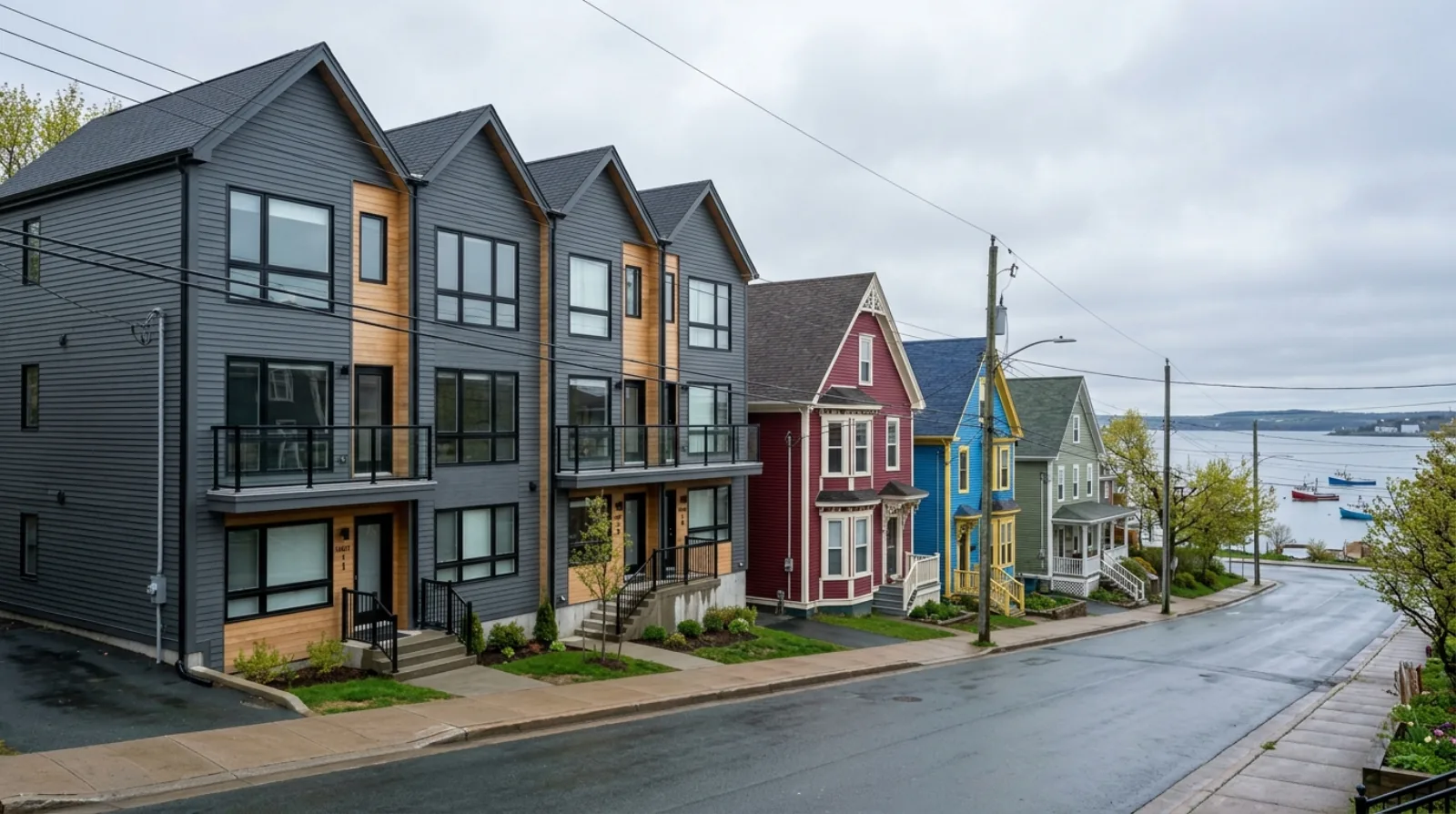
Can you build a fourplex in Halifax? Yes, on every serviced lot.
Since June 2024, Halifax has let you build at least four homes on any lot with city water and sewer: no rezoning, no public hearing, no development agreement. The reason it happened is the interesting part. A $79.3 million federal cheque paid for the change. This is what the rule allows in 2026, and what it has built so far.
units allowed as-of-right on every centrally serviced residential lot, one of the cleanest fully by-right fourplex rules in Canada.
The 30-second answer
- At least 4 dwelling units are allowed as-of-right on every centrally serviced residential lot in Halifax: no rezoning, no public hearing, no development agreement.
- The rule took legal effect on June 13, 2024, after Regional Council approved it on May 23, 2024.
- It was tied to a $79.3 million federal Housing Accelerator Fund deal signed with CMHC in October 2023.
- In the Regional Centre, the ER-3 zone allows up to 8 units on a large enough lot, still as-of-right.
- Parking minimums were dropped in the Regional Centre; in suburban areas a fourplex needs only about 1 space per 3 units.
- The reform is still in force in 2026 and has not been repealed or paused.
The Atlantic Canada catch-up: money for zoning
Most cities that ended single-house-only zoning did it after a long local fight, or because their province forced them. Halifax did it a different way. The federal government put money on the table through the Housing Accelerator Fund, and Halifax changed its zoning to collect it. The trade was direct: national money in, four-unit fourplexes out. Read the deal as a simple exchange.
federal Housing Accelerator Fund money
as-of-right on every serviced lot
This is the Halifax lesson for the rest of Canada: a funding deal can move zoning faster than years of local debate. Tie the money to the rule, and the rule changes.
What you can build
- 4 units by right on every centrally serviced residential lot.
- Up to 8 units on a large enough lot in the Regional Centre ER-3 zone.
- Backyard suites allowed. You can split the four homes across a main house and a suite.
- Little or no parking required: none in the Regional Centre; about 1 space per 3 units in suburban areas.
The limits to check
The four-unit right only covers lots with municipal water and sewer. Rural lots on wells and septic are out. The African Nova Scotian community of Beechville was deliberately excluded. And the number that fits your specific lot is set by the setbacks, height cap, and lot coverage for your zone, not by the four-unit floor. Confirm your zone and servicing with the city before you plan.
What it has built so far
Building in Halifax has climbed fast since the deal. The numbers below are from CMHC data reported by CBC. Most of the volume comes from larger apartment buildings, and strong population growth and separate provincial planning helped too, but the as-of-right rule made the small-scale end far easier to permit.
How it happened
From the federal cheque to the record building year, the change moved quickly, under two years from deal to law.
- Oct 12, 2023
Halifax and the federal government sign a $79.3 million Housing Accelerator Fund deal with CMHC. In return, Halifax promises faster permits and denser zoning.
- May 21–23, 2024
Regional Council holds a public hearing and, on May 23, approves the "urgent" Housing Accelerator Fund zoning changes at second reading.
- Jun 13, 2024
The changes take legal effect once the province signs off. From this day, at least 4 units are allowed as-of-right on every centrally serviced residential lot.
- May 16, 2025
The province designates the Highway 102 West lands (about 255 hectares) a Special Planning Area, letting Nova Scotia direct large-scale housing planning around Halifax.
- 2025
Halifax records its highest-ever year for multi-unit housing starts: 5,859 homes, up 51% on 2024.
Two governments are pushing housing at once
Halifax’s four-unit as-of-right rule covers every serviced residential lot. It is the broad, ground-level change that touches ordinary house lots across the municipality.
Under the Housing in the Halifax Regional Municipality Act, Nova Scotia can designate large sites, like the 255-hectare Highway 102 West lands in May 2025, and lead the planning itself, stepping past the normal municipal process.
Sources: Halifax: Special Planning Areas · Government of Nova Scotia (May 2025).
If you own a lot in Halifax
Your right to build at least four homes is real and settled, and it applies to any lot with city water and sewer. The first thing to check is your servicing and your zone. If you are in the Regional Centre and your lot falls in ER-3, you may be able to reach up to eight units without a rezoning, a much bigger opportunity than four.
Two things can quietly change the math. In the Regional Centre you owe no off-street parking, which frees up the lot and cuts the build cost. And Halifax has offered grant money, up to $13,000 per unit under its Second Unit Incentive Program, toward water and sewer costs for a new suite. Confirm your parcel’s exact zone, servicing, and any current grant terms with the city before you commit, because zoning drives the whole project math and there is no room for a guess.
Halifax fourplex zoning: questions people ask
Can I build a fourplex in Halifax?
Yes. On every centrally serviced residential lot in Halifax Regional Municipality, meaning a lot with municipal water and sewer, you can build at least four dwelling units as-of-right. "As-of-right" means you do not need a rezoning, a public hearing, or a development agreement to reach four units, as long as your plan meets the plain zoning rules for setbacks, height, and lot coverage. This has been the case since June 13, 2024. The real limit on your specific lot is the building envelope, how big a building the setbacks and height cap will fit, not the unit number itself.
What does "as-of-right" actually mean in Halifax?
It means the four-unit right is written straight into the zoning rules, so the city must approve a plan that follows those rules. You skip the slow steps that usually stop small projects: no rezoning application, no neighbourhood public hearing, and no negotiated development agreement. You still need a building permit, and your design still has to obey the setbacks, height, and lot-coverage rules for your zone. But the yes-or-no discretion is gone. That is the whole point of the reform: to make small housing quick and predictable to build.
How many units can I really fit on a Halifax lot?
At least four on any serviced lot, but the ceiling depends on where the lot sits. In the Regional Centre, the older core of Halifax and Dartmouth, the Established Residential 3 (ER-3) zone allows up to eight units on a lot as-of-right, if the lot is large enough and the building fits the built-form rules. Smaller ER-3 lots land nearer the four-unit end of that range. Outside the Regional Centre, most serviced suburban lots are set at the four-unit minimum. Before you plan, look up your exact zone, because the zone, lot size, and frontage together decide your real ceiling.
Why did Halifax change its zoning, and what is the Housing Accelerator Fund?
The Housing Accelerator Fund is a federal program run by CMHC that pays cities to remove barriers to building homes. In October 2023, Halifax signed a deal worth $79.3 million. In exchange for the money, Halifax agreed to speed up permits and loosen zoning, including the four-units-as-of-right rule. This is the distinctive part of the Halifax story: the city did not reform its zoning on its own, it traded a zoning change for national funding. The federal government effectively bought the density.
Is the four-unit rule still in force in 2026?
Yes. The zoning changes tied to the Housing Accelerator Fund took effect on June 13, 2024 and remain the law across Halifax's serviced areas in 2026. They have not been repealed, paused, or watered down. This is different from Calgary, where a similar blanket rezoning was partly reversed. In Halifax the four-unit right is settled, and the city's own housing numbers show building activity rising rather than stalling, so there is little political pressure to undo it.
Do I need to add parking for a new fourplex?
It depends on where the lot is. In the Regional Centre, the older core, the reform removed minimum parking requirements, so a new fourplex there does not have to include off-street parking. In the suburban serviced areas the rule is much lighter than before: roughly one parking space for every three units, not one per unit. This matters because a required parking pad can crowd out a fourth unit on a narrow lot. You can still build parking if your renters want it; the city just no longer forces the old amount on you.
Can I add a backyard suite as well?
Yes, and the four-unit total is flexible about how you split the homes. You could keep the main house, add a basement apartment, and put a backyard suite in the yard, or convert the main house to a duplex and add a backyard suite, as long as the lot stays at or under its unit limit and the buildings meet the setback and height rules. Backyard suites in most low- and medium-density zones are capped at about 90 square metres (roughly 968 square feet) of floor area, which is enough for a two-bedroom home. Check your zone for the exact side and rear setbacks before you design.
Which lots are covered, and which are not?
The four-unit right applies to residential lots inside Halifax's serviced areas: lots connected to, or eligible for, central municipal water and wastewater. Rural lots on wells and septic systems are not covered, because the extra homes need municipal services. There is also one deliberate carve-out: the African Nova Scotian community of Beechville was intentionally left out of the upzoning. Because the coverage turns on exact servicing and named exceptions, you should confirm your own parcel against the city's zoning tools rather than assume the rule applies.
Has the reform actually produced more housing?
The building numbers have gone up sharply. Halifax recorded its highest-ever year for multi-unit housing starts in 2025, with 5,859 homes started, up 51% on 2024, according to CMHC figures reported by CBC. About 81% of those starts were built for the rental market. An honest note: most of that volume comes from larger apartment buildings, not from four-unit projects alone, and other forces such as strong population growth and separate provincial planning also pushed building up. But the direction is clear, and the as-of-right rule made the small-scale end of that supply far easier to permit.
What are the Provincial Special Planning Areas around Halifax?
These are a separate provincial tool, not part of the city's four-unit rule. Under the Housing in the Halifax Regional Municipality Act, the province can designate certain lands as Special Planning Areas and take the lead on planning them, stepping past the normal municipal process. In May 2025 the province designated the Highway 102 West lands, about 255 hectares, for large-scale housing. The takeaway for an owner is that two levels of government are now pushing housing in Halifax at once: the city through the four-unit as-of-right rule, and the province through these designated areas.
Is there any grant money to help build a second unit?
Yes. Halifax runs a Second Unit Incentive Program that offers up to $13,000 in non-repayable grant money per unit, aimed at helping cover the water and wastewater connection costs for a new secondary unit. Programs like this change often, including their deadlines and budgets, so treat the amount as a starting point and confirm the current terms and application window directly with Halifax before you count on it. It is a real reason to check the city's housing pages while you plan, since a grant can meaningfully cut the cost of adding a unit.
How is Halifax different from other Canadian reforms?
Halifax is one of the cleanest fully as-of-right fourplex rules in the country. There is no public hearing and no development agreement needed to reach four units, which removes the discretionary steps where small projects usually stall. British Columbia reached a similar four-unit standard through a provincial law that forced every city to comply. Toronto and much of Ontario got to fourplexes through a mix of city and provincial action. Calgary tried a citywide version and then partly reversed it. Halifax stands out because a federal funding deal, not a provincial mandate or a local campaign, is what paid for the change.
Where can I confirm the rules for my exact property?
Use Halifax Regional Municipality's own zoning and permitting tools to look up your parcel's zone and servicing status, and read the Housing Accelerator Fund fact sheets the city published for each zone. Because the four-unit right turns on exact municipal servicing, on your specific zone (for example ER-1, ER-2, or ER-3 in the Regional Centre), and on named exceptions like Beechville, a general rule is not enough to plan a build. Confirm the parcel-level facts with the city before you spend money on design. When zoning drives the math of a project, the safe move is always to check the authoritative city record, never to assume.
Compare Halifax with other Canadian reforms
Official sources & studies
- City of Halifax: Housing Accelerator Fund (official) Primary
- City of Halifax: ER Zones (ER-1 / ER-2 / ER-3) fact sheets Primary
- City of Halifax: Special Planning Areas (official) Primary
- CMHC: $79.3M Housing Accelerator Fund deal with Halifax (official) Primary
- Government of Nova Scotia: new Special Planning Area designated (May 2025) Primary
- CBC News: Halifax approves zoning changes for thousands of homes
- CBC News: Halifax housing construction up sharply in 2025
See how Halifax compares to the rest of the world
VanPlex tracks every major multiplex reform on Earth — what each city legalized, what actually got built, and what survived. Put Halifax next to 23 other cities on one scorecard.
Building in British Columbia instead? See what a BC lot allows →