Can you build a fourplex in Berkeley? Yes, up to eight homes on a normal lot.
Here is the strange part. The city that invented single-family zoning in 1916 is the same city that, in 2025, made it legal to put up to eight homes on a standard lot. This page tells you exactly what the new rule allows in 2026, how the century-long turn happened, and what it has, and has not, built so far.
homes and 3 stories allowed by right on a typical 5,000-sq-ft lot, with ADUs on top, no parking required, everywhere but the fire-risk hills.
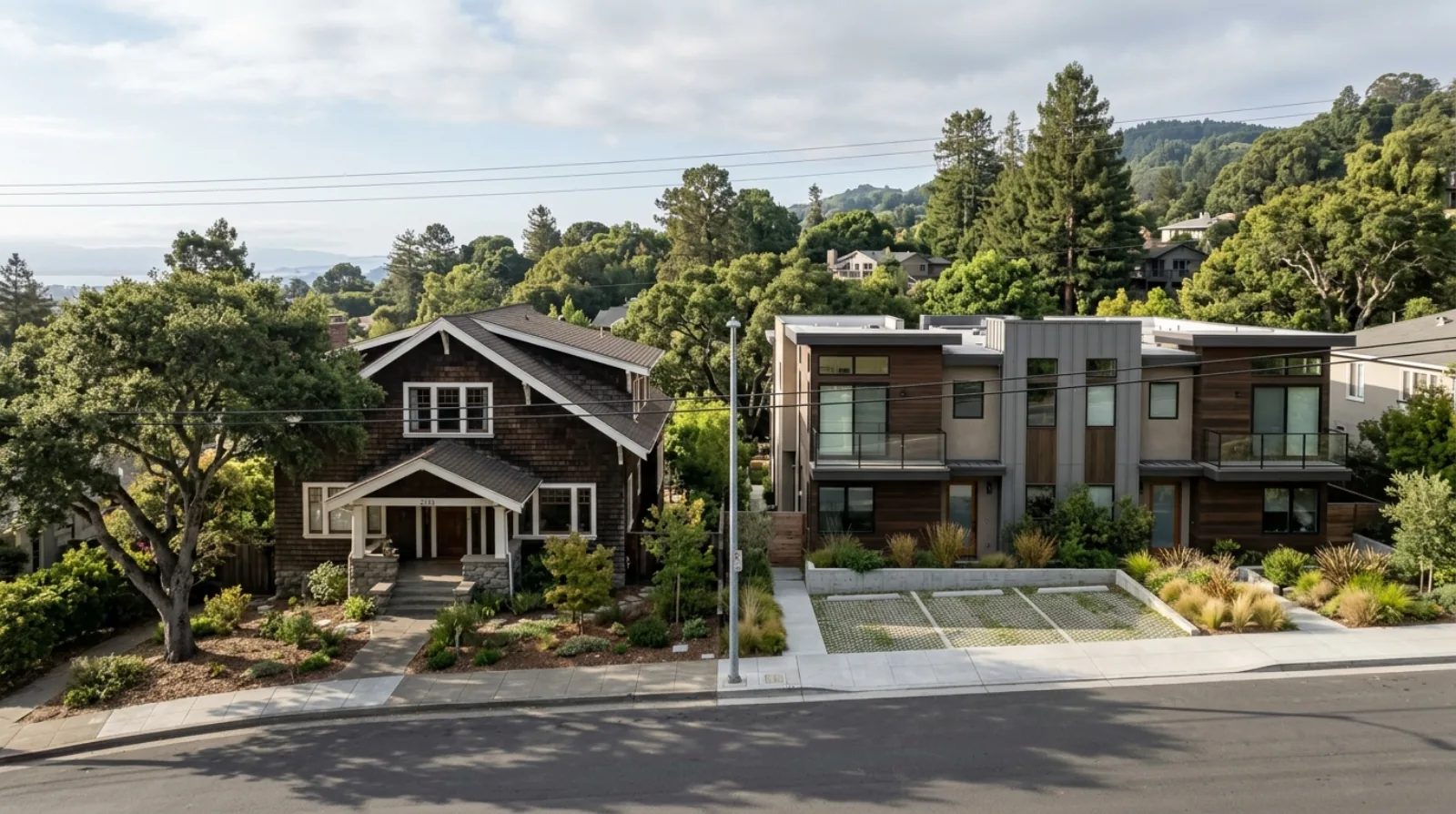
The 30-second answer
- Up to 8 homes and 3 stories are allowed by right on a typical 5,000-sq-ft Berkeley lot, not counting ADUs, since November 1, 2025.
- It applies citywide in the R-1, R-2, R-2A and MU-R zones, everywhere except the high fire-risk Berkeley Hills.
- Berkeley adopted the first single-family zoning in the United States in 1916, in the Elmwood district, with openly exclusionary intent.
- In February 2021 the City Council voted 9–0 to end that exclusionary zoning; the actual middle-housing rules did not take effect until late 2025.
- No off-street parking is required for the new units, and a qualifying application is approved in about 30 days with no public hearing.
- California’s SB 9 (2021) also lets most single-family owners add a second home or split their lot, but statewide uptake has been very low.
The bookend: the city that started the rule voted to end it
No other city carries this history. Berkeley wrote the first single-family zoning law in the country, and roughly a century later its own council voted to unwind it. The two dates below are the bookends of that story.
Berkeley invents single-family zoning
The Elmwood district ordinance banned anything but one house per lot. Its stated intent was to protect “the home against the intrusion of the less desirable and floating renter class.” It became the template copied across the United States.
KQEDBerkeley votes to end it
On February 23, 2021 the City Council voted 9–0 on a resolution to end exclusionary zoning, and set a target of December 2022. The same city that started the rule set out to unwind it, a century apart.
BerkeleysideThe 2021 vote was only a resolution, a statement of intent. It set a December 2022 target that came and went. The real ordinance that lets someone build did not take effect until November 2025, about two and a half years late. That gap is the honest story of the reform.
What the 2025 rule permits now
What you can build
- Up to 8 homes by right on a typical 5,000-sq-ft lot, ADUs not counted.
- Duplex to courtyard apartment: any small multi-family type that fits.
- No parking required, and a compliant project needs no public hearing.
- Up to ~12 homes when using California’s state density bonus for affordable units.
The envelope that really decides it
The eight-home figure is tied to a typical lot. What actually fits is set by the building envelope: a 35-foot (three-story) height cap, 60% maximum lot coverage, front and rear setbacks totalling at least 20 feet (5 ft minimum each), and a step-down to about 22 feet at the rear. On a small or oddly shaped lot, that envelope, not the unit number, is your real limit.
Where it stands in 2026
The rules took effect November 1, 2025 and remain the law as of July 2026.
Unlike Minneapolis, no court has blocked the ordinance. It rests on state housing law and the city’s Housing Element.
The high fire-risk Berkeley Hills are left out for now, pending wildfire evacuation studies.
What has it built so far? Honestly, too early to say
We will not publish a production number that does not exist yet. The rules only took effect on November 1, 2025, so by mid-2026 there is no meaningful permit or completion data to report. We have marked this as unknown rather than guess.
What we can say comes from similar reforms. Minneapolis legalized triplexes citywide and saw very few actually built. California’s SB 9, which also applies in Berkeley, produced only a trickle. The Terner Center at UC Berkeley found Los Angeles approved just 38 units, and estimated the law made new building feasible on only about 1.5% of single-family parcels. A fair expectation is that Berkeley’s early output will be modest while owners, lenders, and builders learn the new process. The legal change is real and settled; the building numbers will take years to show up.
From 1916 to today
The full arc of the reform: the century it took to turn the first single-family zoning law into the rule that legalized middle housing.
- 1916
Berkeley adopts the first single-family zoning in the US, in the Elmwood district, with openly exclusionary intent.
- Feb 23, 2021
City Council votes 9–0 on a resolution to end exclusionary zoning, setting a target of December 2022.
- Dec 2022
The original target passes with no ordinance in place. Drafting continues for two more years.
- Jun 26, 2025
The Middle Housing ordinance (No. 7,978-N.S.) passes its first reading unanimously.
- Jul 8, 2025
Second reading and final adoption: up to 8 units and 3 stories on a standard lot.
- Nov 1, 2025
The new rules take effect citywide, except the high fire-risk Berkeley Hills.
If you own a lot in the Berkeley flats
Your right to build up to eight homes is real and in force today. Start by confirming your zone (R-1, R-2, R-2A or MU-R) and check that your lot is not inside the high fire-risk Hills carve-out, because that decides whether the new rules apply at all.
Then look at your lot size and the envelope: 35-foot height, 60% coverage, the 20-foot combined setbacks, and the rear step-down usually decide how many homes actually fit. Two parts of the reform cost you nothing and remove the old delays: a compliant project needs no off-street parking and no public hearing, and the city aims to approve it in about 30 days. That is why some lots that never worked before may now pencil out.
Berkeley middle housing zoning: questions people ask
Can I build a fourplex or more in Berkeley now?
Yes. Since November 1, 2025 a typical 5,000-square-foot residential lot can hold up to eight homes in a building of up to three stories, and a fourplex is well within that limit. This is “by right,” which means if your plans meet the objective standards you do not need a public hearing, a variance, or a discretionary vote. The city must approve them. Accessory dwelling units (ADUs) are counted separately, so they can be added on top of the eight. The exact number of homes your lot can hold depends on its size and shape, since the real limit is the building envelope, not a flat unit cap.
How many units does Berkeley allow on a single lot?
Up to eight homes on a typical 5,000-square-foot lot, not counting ADUs, and the building can be three stories and up to 35 feet tall. On larger lots the number can be higher, and projects that use the state density bonus can reach roughly twelve homes. The rule applies in the R-1, R-2, R-2A and MU-R zones, which cover most of the flatter parts of the city. It does not apply in the high fire-risk Berkeley Hills, which the council carved out pending evacuation-route studies.
Did Berkeley really invent single-family zoning?
Yes. Berkeley’s 1916 Elmwood district ordinance is recognized as the first single-family zoning in the United States. It banned anything but one house per lot, and its stated intent was to protect “the home against the intrusion of the less desirable and floating renter class.” The developer Duncan McDuffie, who built nearby neighbourhoods with racial covenants, was a leading champion of the idea. The Berkeley model was then copied by cities across the country, which is why the 2025 reform carries so much symbolic weight. The city that started the rule is now unwinding it.
When did the new Berkeley middle housing rules take effect?
The rules took effect on November 1, 2025. The path to get there was long: the City Council voted 9–0 in February 2021 to end exclusionary zoning and set a target of December 2022, but the actual ordinance (No. 7,978-N.S.) was not adopted until July 8, 2025, after a first reading on June 26 and a second reading two weeks later. So the reform landed about two and a half years after the original target date. As of July 2026 the rules are fully in force and have not been paused or repealed.
Why did it take so long, from the 2021 vote to the 2025 rules?
The February 2021 vote was a resolution stating the council’s intent, not an actual change to the zoning code. Turning that intent into a working ordinance meant years of drafting, environmental review, planning-commission hearings, and negotiation over the details: height, setbacks, the fire-hills carve-out, and tenant protections. The original December 2022 target passed with nothing adopted, and it took until July 2025 to finish the real ordinance. The lesson many cities take from Berkeley is that a symbolic vote is quick and cheap, but the binding law that actually lets someone build is slow.
Do I need to provide parking for the new units?
No. The Middle Housing ordinance does not require any off-street parking for the new homes. You may still build parking if you or your tenants want it, but the city no longer forces you to. Removing the parking requirement frees up lot space for the building and garden, and it cuts construction cost. A required parking pad or garage can easily crowd out an extra home on a narrow lot. This is one of the most valuable parts of the reform for a small owner or builder.
Which zones and areas does the reform apply to?
It applies to lots zoned R-1, R-2, R-2A and MU-R, which cover most of Berkeley’s residential flats, including neighbourhoods near Downtown, the Elmwood district, Fourth Street, North Shattuck, Solano Avenue, Telegraph Avenue, the Lorin district, West Berkeley, and the San Pablo and University Avenue corridors. The ordinance also merged the old R-1A and R-2 low-density districts because they were so similar. The one big exception is the high fire-risk Berkeley Hills, where the council left the old rules in place while it studies wildfire evacuation routes.
How tall and how big can a middle housing project be?
The height limit is 35 feet, or three stories, and that cap cannot be exceeded with any extra permit. The building can cover up to 60% of the lot in most districts, and the front and rear setbacks must total at least 20 feet, with a minimum of 5 feet at the front and 5 feet at the rear. There is also a required step-down to about 22 feet at the rear of the property to protect neighbours’ light and privacy. Projects that use California’s state density bonus can go somewhat taller and denser in exchange for including affordable homes.
How fast and how cheap is the approval now?
A qualifying project that meets the objective standards is handled as a ministerial “Middle Housing zoning certificate,” which the city aims to approve in about 30 days, down from the old discretionary process that ran six to fifteen months. Because it is ministerial, there is no public hearing and no appeal on a compliant project, which removes the biggest source of delay and uncertainty. The city also reports the permit fees are 50% to 75% lower than the old discretionary permits. Faster, cheaper, and more certain approval is the practical heart of the reform.
Does the ordinance protect existing tenants?
Yes. If a project demolishes existing rental homes, they must be replaced one-for-one, and the existing tenants get a right of first refusal to move into a comparable new unit. These protections are meant to stop the reform from being used simply to push out current renters for higher-paying ones. If you own a lot with tenants, you should confirm exactly how these rules apply to your building before planning a project, because the replacement and re-rental terms can shape whether a redevelopment makes financial sense.
How does California’s SB 9 fit in with Berkeley’s rules?
SB 9 is a 2021 state law that lets most single-family owners across California add a second home or split their lot into two, which can produce up to four homes on what was one single-family parcel. It applies in Berkeley too, but Berkeley’s own Middle Housing ordinance is more generous, up to eight homes, so most Berkeley owners will use the city rule rather than SB 9. Statewide, SB 9 has produced very little: the Terner Center found Los Angeles received fewer than 250 applications and approved only 38 units in its first stretch, and estimated the law made new building feasible on only about 1.5% of single-family parcels. It is a useful backstop, but it is not what will drive Berkeley’s numbers.
How many middle housing homes has Berkeley actually built so far?
It is too early to know, and we will not guess. The rules only took effect on November 1, 2025, so by mid-2026 there is not yet published permit or completion data to report. Based on how similar reforms have gone elsewhere (Minneapolis legalized triplexes citywide and saw very few built, and California’s SB 9 produced only a trickle), it is reasonable to expect early production in Berkeley to be modest while owners, lenders, and builders learn the new process. We would rather flag this as unknown than publish a made-up figure. The honest read is that the legal change is real and settled; the building numbers will take years to show up.
Is the reform likely to be reversed or paused?
There is no active challenge as of July 2026. Unlike Minneapolis, whose 2040 plan was frozen for months by an environmental lawsuit, Berkeley’s Middle Housing ordinance has not been blocked in court, and it is backed by state housing law and the city’s 2023–2031 Housing Element, which gives it a firm legal footing. The one part left unsettled is the Berkeley Hills carve-out, which the council may revisit after its wildfire evacuation studies. For a flat-land lot, the right to build up to eight homes is real and in force today.
What should a Berkeley lot owner check before planning a project?
Start by confirming your zone (R-1, R-2, R-2A or MU-R) and whether your lot falls inside the high fire-risk Hills carve-out, because that decides whether the new rules apply at all. Then look at your lot size and shape, since the eight-home figure is tied to a typical 5,000-square-foot lot and the real limit is the building envelope: 35-foot height, 60% lot coverage, the 20-foot combined setbacks, and the rear step-down. Because a compliant project needs no parking and no public hearing, the math can work on lots that never penciled out before. Getting your zone and envelope right first will tell you how many homes your specific lot can actually hold.
Compare Berkeley with related reforms
Official sources & studies
- City of Berkeley: Middle Housing Zoning (official rules) Primary
- City of Berkeley, New zoning changes: faster, cheaper process (official) Primary
- City of Berkeley: Ordinance No. 7,978-N.S. (adopted Jul 8, 2025) Primary
- City of Berkeley: 2021 resolution to end exclusionary zoning (Feb 23, 2021) Primary
- KQED: Council OKs zoning overhaul (up to 8 units)
- KQED: The racist history of single-family zoning (1916 intent)
- Berkeleyside: apartments allowed across the flats
- Berkeleyside: council denounces racist history, begins process (Feb 2021)
- Terner Center (UC Berkeley): SB 9 turns one: low statewide uptake
See how Berkeley compares to the rest of the world
VanPlex tracks every major multiplex reform on Earth — what each city legalized, what actually got built, and what survived. Put Berkeley next to 23 other cities on one scorecard.
Building in British Columbia instead? See what a BC lot allows →