California legalized 700,000 homes. Year one built 53.
SB 9 let millions of California homeowners split their lot and build up to four homes where one stood. It is the sharpest example anywhere of the gap between what a law makes legal and what actually gets built, and it survived a court fight that nearly carved out the state’s biggest cities. Here is exactly what SB 9 allows you to do in 2026.
The 30-second answer
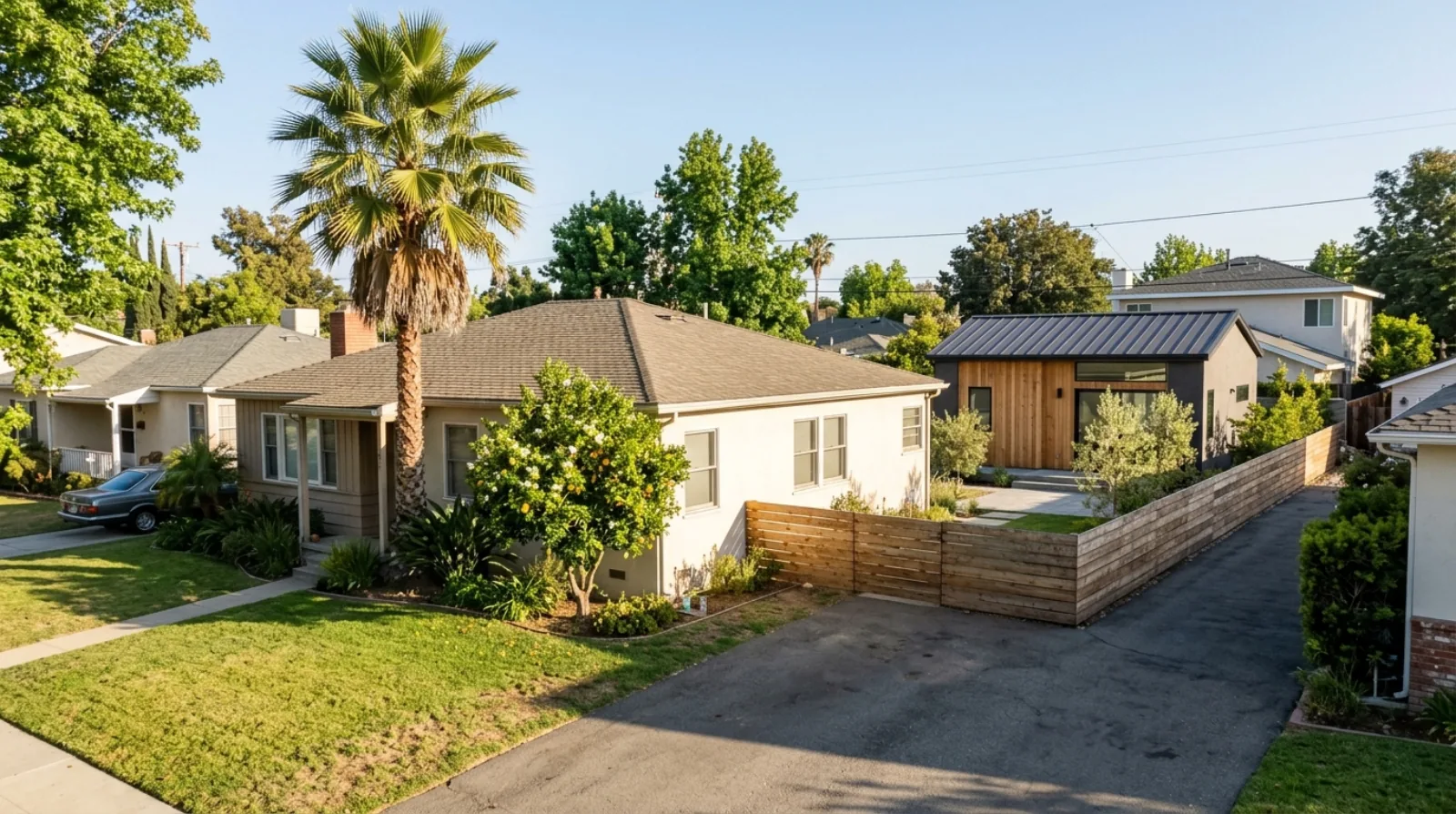
- SB 9 (the California HOME Act) lets an owner of a single-family lot add a second unit and split the lot in two: up to 4 homes from one lot.
- It applies statewide, including charter cities. A 2024 court ruling that exempted five charter cities was reversed on November 12, 2025.
- Qualifying projects get ministerial (staff-level) approval with no public hearing and no environmental review, and cities must decide within 60 days.
- A 2021 study estimated SB 9 made over 700,000 homes newly feasible, but in its first year only 53 units were approved across 13 studied cities.
- For a lot split you must sign an affidavit to live in one unit as your main home for at least 3 years.
The gap that defines SB 9
homes the Terner Center modeled as newly feasible when SB 9 passed
SB 9 units actually approved in the first year across 13 studied cities
In Los Angeles, the biggest city, zero lot splits were approved in 2022. The barriers were construction cost, owners without building expertise, and cities adding local hurdles, not the zoning. Source: Terner Center.
The two moves
- Add a unit: put two homes on a single-family lot.
- Split the lot: divide one lot into two (each ≥1,200 sq ft, neither below 40%).
- Do both: up to 4 homes from one original lot.
The conditions
- Lot split needs a 3-year owner-occupancy affidavit.
- Ministerial approval, 60-day city decision deadline.
- No recent tenants; no historic, fire, flood or fault-zone lots; rentals over 30 days only.
The legal rollercoaster
SB 9 was struck down for five charter cities in 2024, then reinstated statewide in late 2025. Here is how the fight went, and where it stands now.
- Sep 16, 2021
Governor Newsom signs SB 9, the California HOME Act.
- Jan 1, 2022
SB 9 takes effect statewide.
- Apr 22, 2024
A Los Angeles judge rules SB 9 unconstitutional as applied to five charter cities (Redondo Beach, Carson, Torrance, Whittier, Del Mar) under the state’s home-rule clause.
- Jan 1, 2025
SB 450 takes effect, strengthening SB 9. It states the law applies to charter cities and adds a firm 60-day decision deadline.
- Nov 12, 2025
The Court of Appeal reverses the 2024 ruling and sends the case back, so SB 9 again applies statewide. The constitutional question remains open on remand.
If you own a single-family lot in California
The right exists almost everywhere now, including in charter cities. But treat SB 9 as a tool with real friction, not a guaranteed windfall. Confirm your lot is eligible (no recent tenants, and not in a historic, high-fire, flood or fault zone), then decide whether you want the lot split, which triggers the three-year live-in rule, or just a second unit, which does not.
The reason so few SB 9 projects got built is construction cost and complexity, not permission. Price the build honestly before you count on it, and use the 60-day decision deadline to hold your city to a fast answer.
California SB 9: questions people ask
Is SB 9 still legal in California in 2026?
Yes. SB 9 applies statewide and is in force. The only ruling that ever limited it, an April 2024 decision exempting five charter cities, was reversed by the California Court of Appeal on November 12, 2025. The appellate court did not settle the underlying constitutional question; it sent the case back to the trial court to reconsider under the amended law (SB 450). So SB 9 is operative everywhere today, though a future trial-court ruling could reopen the charter-city issue.
Can I split my single-family lot under SB 9?
Yes, if your lot is in a single-family residential zone and meets the conditions. A lot split must create two parcels, each at least 1,200 square feet, and neither parcel can be smaller than 40% of the original lot, so it is close to an even split. The split is approved ministerially, meaning at staff level without a discretionary hearing, as long as your plans meet the objective standards.
How many homes can I get from one lot?
Up to four. SB 9 lets you put two units on a single-family lot, and separately lets you split the lot in two. Combine them, split the lot, then build two units on each of the two new parcels, and one original single-family lot becomes four homes. Many owners use only part of this, for example adding one unit without splitting, but four is the ceiling the law was designed around.
Do I have to live on the property?
Only if you do a lot split. For a lot split you must sign an affidavit stating you will live in one of the units as your principal residence for at least three years from the date of approval. Community land trusts and qualified nonprofits are exempt. If you simply add a second unit without splitting the lot, there is no owner-occupancy requirement.
Does SB 9 apply in my city if it’s a charter city?
Yes. Big charter cities like Los Angeles and San Diego are covered. SB 450, in force since January 1, 2025, explicitly states SB 9 applies to charter cities, and the November 2025 appellate reversal removed the one court order that had carved out five of them. As of 2026 there is no charter-city exemption in effect, though the trial court could revisit the question on remand.
How long does approval take now?
A city must approve or deny a complete SB 9 application within 60 days, or the application is deemed approved. This firm deadline came from SB 450 and took effect in 2025. It was added specifically because some cities were slow-walking or over-conditioning SB 9 projects, which was one reason so few got built in the early years.
Why did so few homes get built under SB 9?
Because legal permission did not overcome the economics. UC Berkeley’s Terner Center found that in SB 9’s first year, across 13 studied cities, only 53 units and 41 lot splits were approved, a tiny fraction of the 700,000 homes the law was modeled to make feasible. The barriers were high construction costs, most homeowners lacking the expertise or capital to act as builders, and many cities layering on local restrictions. In Los Angeles, the largest city, zero lot splits were approved in 2022.
What was the 700,000 figure about?
Before SB 9 passed, the Terner Center estimated that more than 700,000 new homes would become newly feasible to build if the law took effect. That figure measured what became legally and financially possible on paper. The Center itself warned it was unlikely anywhere near that many would actually be built. The gap between that 700,000 and the few dozen units approved in year one is the central lesson of SB 9: feasibility is not production.
Do I need a public hearing or environmental review?
No. Qualifying SB 9 projects receive ministerial approval, which means a staff-level sign-off against objective standards, with no discretionary public hearing and no review under the California Environmental Quality Act. This was meant to make the path fast and predictable. In practice, some cities added their own objective standards that slowed projects, which SB 450 then reined in.
Can I use SB 9 if I have tenants or had them recently?
No. SB 9 cannot be used on a property that has had tenants at any time in the previous three years, and it is blocked for 15 years on properties where units were withdrawn from the rental market under the Ellis Act. These rules exist to stop the law from being used to displace existing renters, so it is aimed at owner-occupied and long-vacant single-family properties.
Which properties are not eligible for SB 9?
SB 9 excludes historic properties and historic districts, farmland, wetlands and conservation land, high fire-hazard zones, floodplains, hazardous-waste sites, and earthquake fault zones. It also cannot be used to remove rent-controlled or recently tenanted housing. If your property is in any of those categories, SB 9 will not apply even if it is zoned single-family.
Can I short-term rent an SB 9 unit?
No. SB 9 requires that any rental of the units be for terms longer than 30 days, which rules out short-term vacation rentals like Airbnb. The law was written to add long-term homes, not to expand the short-stay market, so a plan that depends on nightly rentals will not qualify.
Could SB 9 still be struck down later?
Possibly, for charter cities. When the Court of Appeal reversed the 2024 ruling in November 2025, it did not decide whether SB 9 is constitutional. It sent the question back to the trial court to re-examine under the amended law. So a future trial-court decision could again find a problem for charter cities, and that could be appealed. For now, in 2026, SB 9 stands statewide, but the legal story is not fully closed.
Compare SB 9 with related reforms
Official sources & studies
- California Legislature: SB 9 full bill text Primary
- California HCD: SB 9 Fact Sheet Primary
- California Courts: City of Redondo Beach v. Bonta (B338990, Nov 12, 2025) Primary
- California Legislature: SB 450 (2024 amendment) Primary
- Terner Center: “California’s HOME Act Turns One” (first-year data + 700k model)
- CP-DR: Constitutionality of SB 9 will be reconsidered (Nov 2025)
See how California (statewide) compares to the rest of the world
VanPlex tracks every major multiplex reform on Earth — what each city legalized, what actually got built, and what survived. Put California (statewide) next to 23 other cities on one scorecard.
Building in British Columbia instead? See what a BC lot allows →