
Start Here | Capital Stack
The Multiplex Capital Stack, Explained
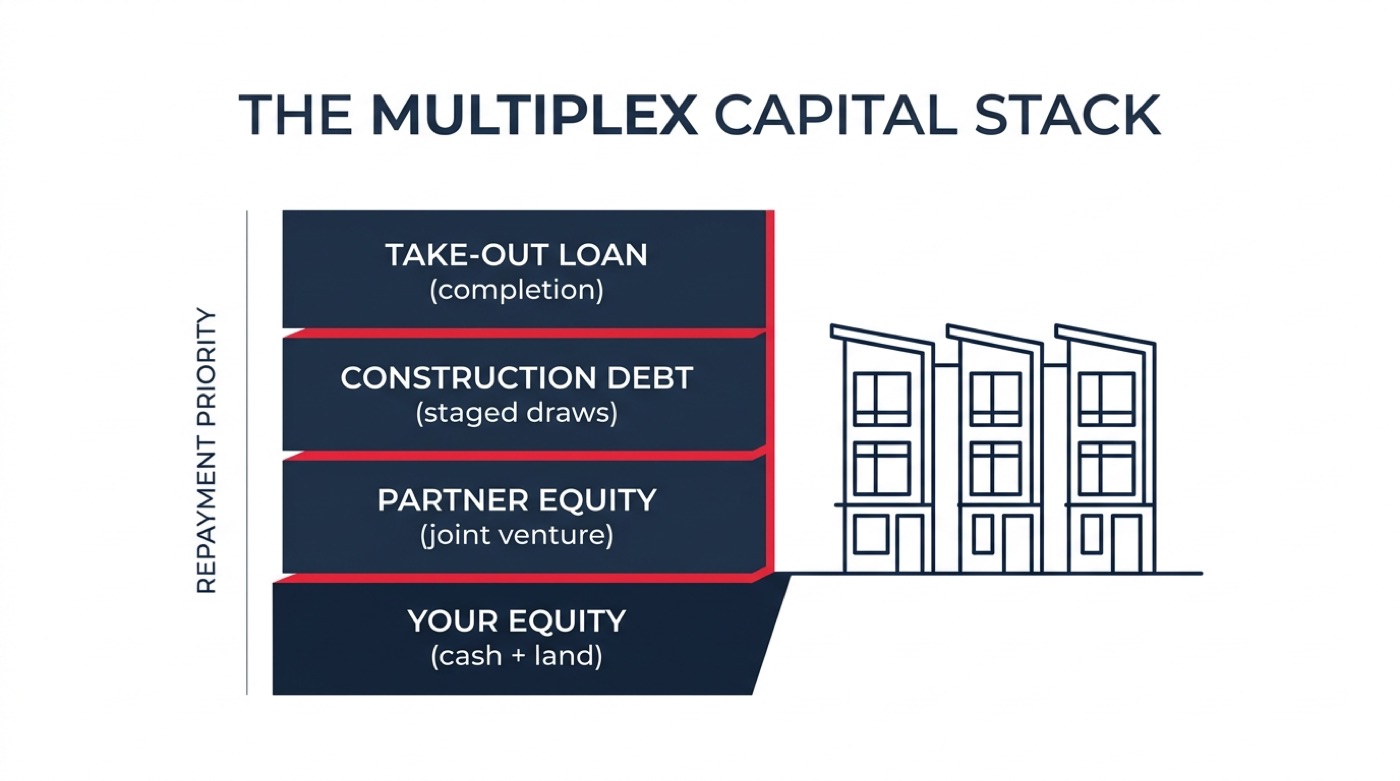
Capital stack is a simple idea with an intimidating name: it is the list of where every dollar in your project comes from, arranged by who gets paid back first. A small BC multiplex has four layers, and the ones you can actually reach depend less on your credit score than on one number, how many units you build.
The Short Version
- 01Four layers fund a multiplex: your equity, partner equity, construction debt, and the take-out loan that replaces the construction loan at completion.
- 02Debt is repaid before equity. That order is why loans are cheaper than partners.
- 03Up to 4 units, construction lending now exists off the shelf: Vancity advances up to 80% of project costs with interest-only payments for up to 18 months.
- 04At 5 or more rental units the project changes leagues: CMHC MLI Select insures up to 95% of cost on new construction, with amortization up to 50 years at the top points tier.
- 05Strata pre-sale deposits only become spendable construction money if the developer puts a REDMA deposit protection contract in place.
- 06For most homeowners the land is the largest equity contribution. A strong lot shrinks how much partner money you need to give up.
The Four Layers, Bottom to Top
Your equity
Cash, plus the value already sitting in the lot. For most BC homeowners the land is the biggest single contribution they make to the project. Lenders treat existing equity in the property as part of your stake, which is why a paid-off Vancouver lot can carry a project that a cash buyer could not fund.
Partner equity
Money or land a partner puts in for a share of the profit instead of interest. It has no monthly payment, which helps during construction, and it is the most expensive layer over the life of the deal because the partner shares the upside. The split and the order people get paid in live in the joint-venture agreement, not in any loan document.
Construction debt
A loan advanced in stages (draws) as the building goes up, with interest usually paid monthly on what has been drawn so far. This is the layer that changed in BC in late 2025: Vancity now offers a construction mortgage built for up to four units on a residential lot, at up to 80% of project costs, with interest-only payments for up to 18 months.
The take-out loan
The mortgage that pays off the construction loan when the building is done. If you keep 5 or more units as rental, the take-out can be a CMHC-insured MLI Select loan. If you live in one of up to 4 units, it can be a regular homeowner mortgage. If you sell strata units, the buyers' mortgages are the take-out, and their deposits arrive earlier.
Program terms above come from Vancity's Multiplex Construction Mortgage page and CMHC's MLI Select page. Both programs underwrite each application, so treat the maximums as ceilings, not promises.
Which Instrument Fits Which Project
The same unit-count line that runs through BC strata law runs through financing. Up to 4 units with the owner in one, you stay in homeowner-style lending. At 5 rental units you cross into commercial lending and MLI Select. Sell strata units and the pre-sale rules flip at the same threshold.
| Instrument | Fits when | The term that matters | Source |
|---|---|---|---|
| CMHC-insured homeowner mortgage | Buying or refinancing 1 to 4 units, you live in one | Insured purchase pricing is tiered by price band; the insured route disappears above the program's price cap | CMHC homeowner mortgage loan insurance |
| Credit union construction mortgage | Building up to 4 units on a residential lot, no incorporation | Vancity: up to 80% of project costs, interest-only during construction for up to 18 months | Vancity Multiplex Construction Mortgage |
| CMHC MLI Select (insured commercial loan) | 5 or more rental units, held as rental (no strata sale) | Up to 95% loan-to-cost on new construction and up to 50-year amortization at the 100-point tier | CMHC MLI Select |
| Pre-sale deposits | Selling strata units before or during construction | REDMA trust and rescission protections apply at 5 or more strata lots; below that, different rules | REDMA s. 1, s. 18, s. 21 |
| Joint-venture equity | A partner brings cash or land in exchange for a share of profit | Split and priority are set by the JV agreement, not by a lender | Covered in the VanPlex joint-venture hub |
The owner-occupied path, including how rental income from the other units feeds qualification, is covered in depth on our owner-occupied multiplex financing guide. The MLI Select points system has its own breakdown on the build-to-rent hub.
Everything in This Hub
START HERE
THE INSTRUMENTS
What Actually Drives the Cost of Money
We deliberately do not quote rates on this page. Construction lending is priced deal by deal, and any number printed here would be wrong by the time you read it. What stays constant is what moves the price:
How much of the cost you are borrowing
The closer a loan sits to the full cost of the project, the more the lender is exposed if something goes wrong, and the more the loan costs. This is why insured programs like MLI Select exist: CMHC takes the risk that lets the lender advance more.
How the project exits
A lender's real question is how they get repaid. A rental hold with an insured take-out is a clean answer. Strata sales depend on the market on completion day, which is why pre-sales and deposits matter to the construction lender, not just to you.
Who is building
A first-time builder with no completed projects pays more, or gets asked to hire a builder the lender trusts. The Vancity program is notable partly because it was written for homeowners, not for developers with a track record.
How long the money is out
Construction interest accrues every month the build runs. A permit delay is a financing cost, not just a schedule slip. This is why interest-only periods with a hard end date, like Vancity's 18 months, quietly shape the construction schedule.
Best For
- ✓ Homeowners deciding whether their project is a 4-unit or a 5-plus-unit build, because the stack changes shape at that line
- ✓ Landowners weighing a joint venture against borrowing more, layer by layer
- ✓ Anyone about to talk to a lender who wants to name the layers correctly in the first meeting
Usually Fails When
- ✕ You treat program maximums as entitlements. 80% and 95% are ceilings that underwriting has to confirm
- ✕ You give up equity before checking how much debt the project can safely carry
- ✕ You plan the stack before confirming zoning and unit count, which decide which instruments exist at all
What To Verify Before Spending Money
- → How many units your lot actually supports, with the address tool below
- → Whether your intended hold (sell strata, hold rental, live in one unit) matches the instrument you are counting on
- → Current program terms directly with the lender and CMHC, because maximums and criteria change
- → Whether a partner is bringing money you could have borrowed cheaper
Common Questions
What does capital stack mean? +
The capital stack is the list of every source of money in a project, arranged by who gets paid back first. In a small BC multiplex it usually has four layers: your own equity (cash and land), partner equity if you have a partner, a construction loan during the build, and the permanent mortgage or the strata buyers' money at the end. Debt gets repaid before equity, which is why lenders accept lower returns than partners.
How much of a multiplex build can I finance? +
It depends on which instrument your project fits, and unit count decides that. Vancity's Multiplex Construction Mortgage advances up to 80% of project costs for builds of up to four units on a residential lot. For rental projects of 5 or more units, CMHC MLI Select insures loans up to 95% of cost on new construction if the project scores enough points on affordability, energy efficiency, or accessibility. Neither number is automatic; both programs underwrite the borrower and the project.
Why does unit count matter so much for financing? +
Because the programs are split at the same line. Up to 4 units with the owner living in one, you are in homeowner-style lending, including CMHC-insured mortgages. At 5 or more rental units you move into commercial lending, where CMHC MLI Select applies, amortizations stretch to 50 years at the top tier, and the building must be held as rental rather than sold as strata. The pre-sale rules flip at the same threshold: REDMA's deposit and rescission protections apply at 5 or more strata lots.
Are strata pre-sale deposits part of the capital stack? +
Sometimes. Under REDMA, a developer can only use deposit money for construction after putting a deposit protection contract (a form of insurance) in place under section 19. Without it, deposits sit in trust until completion and mainly serve to prove demand to the construction lender rather than fund the build.
What is the cheapest layer of the stack? +
Ranked by cost over the life of a deal, your own equity has no contractual cost, senior construction debt is priced as interest, and partner equity is usually the most expensive because the partner takes a share of profit. That is why experienced builders borrow what the project can safely carry before giving up equity, and why a landowner with a strong lot often needs less partner money than they assume.
Related Reading
Official Sources Referenced
See What Your Lot Supports Before You Talk to a Lender
Unit count decides which financing instruments your project can reach. Enter any BC address to see zoning, allowed units, and a preliminary proforma.