
Is Vancouver’s multiplex boom creating oversupply? Here’s what the data actually shows about the next 1,000 units and who’s buying them.
The Question Everyone’s Asking: Are We Building Too Many Multiplexes?
If you’re watching Vancouver’s real estate market right now, you’ve probably noticed the wave of new multiplex developments and wondered: Is the market about to be flooded with inventory?
It’s a smart question. After all, Vancouver just legalized multiplexes citywide through Bill 44, and suddenly everyone from small builders to institutional investors is talking about fourplexes. The concern is reasonable: if too much supply hits the market at once, won’t prices crash?
The short answer: No. Here’s why the data tells a completely different story.
What’s Really Happening: It’s a Rotation, Not an Explosion
Let’s look at the actual numbers from the City of Vancouver building permit data:
The Historical Context
- Average annual residential permits (last 5 years): 6,980 units per year
- This includes single-family homes, duplexes, and condos combined
The Current Multiplex Pipeline
- Total multiplex applications in system: 518 projects
- Estimated new multiplex units: ~2,000 units total
- Currently approved: 40% (roughly 800 units)
- Actually under construction: 10-15% (150-300 units)
The Reality Check
At the current pace, Vancouver will complete approximately 1,000 new multiplex units per year.
This isn’t new supply. It’s replacement supply.
The Missing Middle Is Replacing the Extremes
What’s actually happening in Vancouver’s housing market is a product rotation, not a supply explosion:
What’s Decreasing:
- High-rise condo towers (slower approvals, higher costs)
- New single-family home construction (land too expensive)
What’s Replacing It:
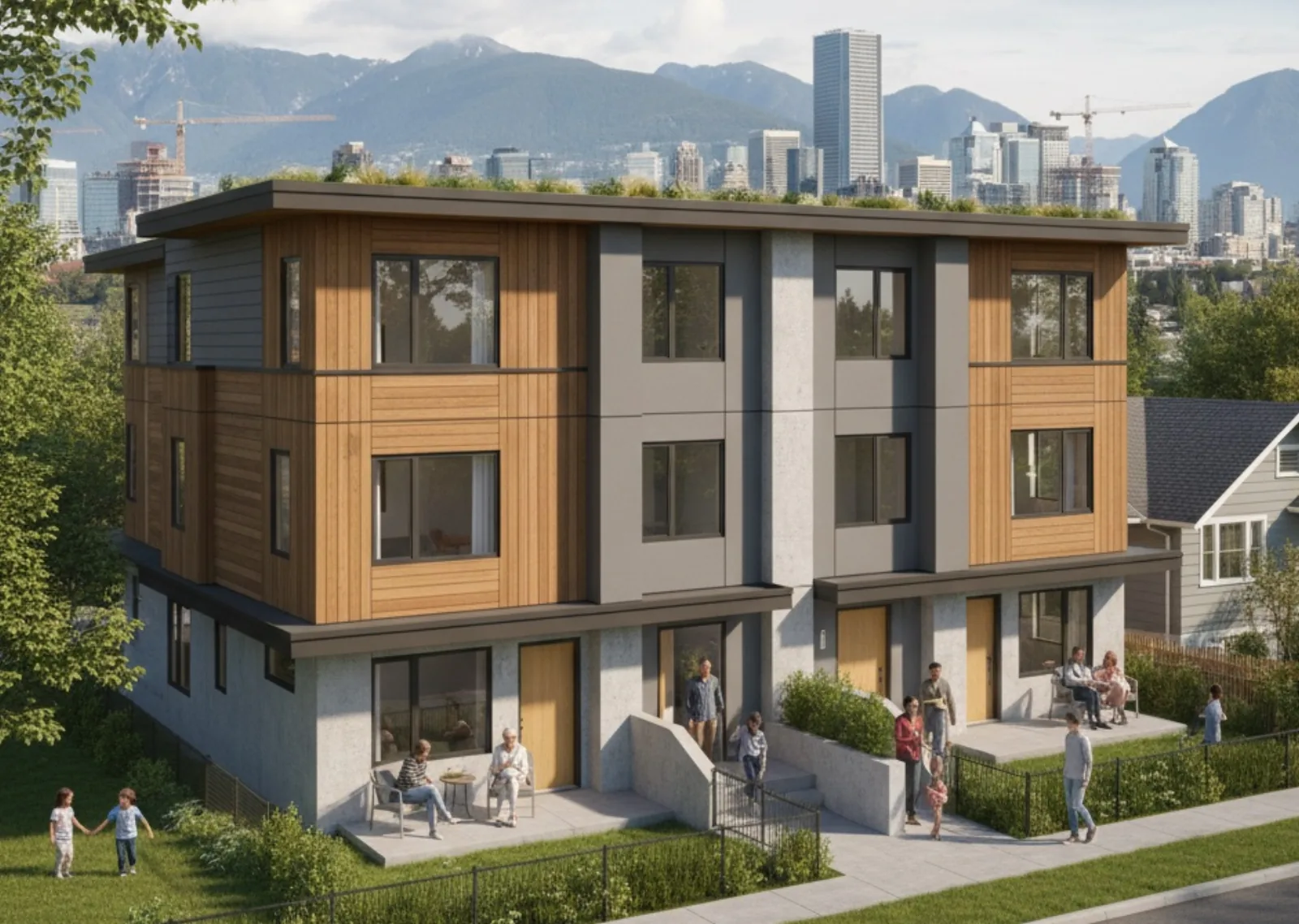
- Ground-oriented multiplex homes (2-6 units)
- Missing middle housing (townhomes, low-rise apartments)
- Attainable ownership in existing neighborhoods
The total pipeline remains steady at ~7,000 units per year. It’s just shifting from condos and single-family to multiplexes and missing middle housing.
The Real Question: Who’s Actually Buying These Multiplexes?
This is where market concerns often focus on the wrong buyer profile. The stereotype is “wealthy Boomers downsizing from $4-6M homes won’t want a fourplex with stairs.”
That’s partially true, but misses three other massive buyer segments:
1. Young Families Graduating from Condos
- Tired of strata fees and small spaces
- Can’t afford $2M+ single-family homes
- Want ground-oriented living with yards
- Looking for 2-3 bedroom units in the $800K-$1.2M range
2. Multi-Generational Families Using Bill 44
- Extended families staying together across multiple suites
- Parents on one floor, adult children on another
- Live-in caregivers or aging parents with independence
- 3-4 suite multiplexes with separate entrances
3. Downsizing Boomers Who Want Smart Design
- Yes, they’re cashing out of $4-6M homes
- No, they don’t all want stairs—which is why ground-level design matters
- Want to stay in familiar neighborhoods (Dunbar, Kitsilano, Point Grey)
- Looking for 1,500-2,000 sq ft on one level with quality finishes
4. Investors Seeking Cash Flow and Land Value
- Multi-family zoning increases land value 2-3x
- Rental income from 3-4 units covers mortgage
- Long-term hold strategy in established neighborhoods
- Bill 44 made this legal everywhere in Vancouver
The Design Solution: Ground-Level Living for Older Buyers
Here’s the key insight: smart multiplex design solves the “stairs problem” that concerns many older buyers.
Modern multiplex developments are increasingly incorporating:
- Main-floor primary suites with full accessibility
- Elevator-ready designs for 3-4 story buildings
- Universal design principles (wider doorways, no-step entries)
- Single-level lockoff suites perfect for aging in place
The Boomers downsizing from $4-6M homes aren’t looking at cheap fourplexes with steep stairs. They’re targeting well-designed, 2,000 sq ft main-floor units in $1.5-2.5M multiplexes on quiet Westside streets—exactly the neighborhoods they already know.
Why This Isn’t Oversupply—It’s Market Normalization
The fear of oversupply assumes two things that aren’t true:
Myth #1: “All these multiplexes are hitting the market at once”
Reality: With only 10-15% under construction, completions will be spread over 3-5 years. That’s 200-300 units annually from current projects, ramping up to 1,000 per year as more break ground.
Myth #2: “Vancouver is building more housing than before”
Reality: Vancouver’s total annual housing production remains flat at ~7,000 units. It’s just rotating from condos to multiplexes.
What’s actually happening:
- Condo starts are down (financing harder, construction costs up)
- Single-family starts are down (land too expensive)
- Multiplex starts are up (new zoning, better economics)
Net result: Same total supply, different product mix.
What This Means for Investors and Developers
If you’re deciding whether to invest in Vancouver multiplexes right now, here’s the opportunity:
The Absorption Timeline
- Current pipeline: 2,000 units over 3-5 years
- Historical condo absorption: 2,000-3,000 units per year
- Conclusion: The market can easily absorb this volume
The Buyer Pool Is Underestimated
Most people focus on one buyer type (downsizing Boomers) and miss the other three:
- Young families (largest segment, most motivated)
- Multi-generational households (fastest growing)
- Investors (highest intent, cash buyers)
The Design Advantage
Projects incorporating:
- Ground-level accessibility
- Multi-generational layouts
- Quality finishes in established neighborhoods
…will significantly outperform generic fourplexes on busy streets.
The Bottom Line: It’s Not Oversupply, It’s Right-Supply
Vancouver isn’t facing a multiplex glut. It’s experiencing a long-overdue correction toward housing people can actually afford and want to live in.
Key Takeaways:
- No inventory explosion: Total housing starts remain flat at ~7,000/year
- Product rotation: Fewer condos and SFH, more missing middle housing
- Diverse buyer base: Young families, multi-gen households, downsizers, and investors
- Design matters: Ground-level accessibility solves the “stairs concern”
- Market normalization: After decades of only condos or $3M+ homes, the middle is returning
The real risk isn’t oversupply. The real risk is building the wrong product for the wrong buyer in the wrong location.
Get those three things right—design for accessibility, target established neighborhoods, and understand your end buyer—and Vancouver’s multiplex market represents one of the strongest opportunities in Canadian real estate right now. The SSMUH overview explains which lots qualify under the new rules, and the investment overview covers what the return thresholds look like in practice.
Frequently Asked Questions
How many multiplexes are currently being built in Vancouver?
Approximately 150-300 multiplex units are under construction right now (10-15% of the 2,000-unit pipeline). At current pace, Vancouver will complete around 1,000 multiplex units per year.
Will Vancouver multiplexes cause housing oversupply?
No. The ~1,000 annual multiplex completions simply replace reduced condo and single-family home construction. Vancouver’s total housing output remains steady at approximately 6,980 units per year.
Who is buying multiplexes in Vancouver?
Four main buyer groups: (1) Young families graduating from condos, (2) Multi-generational families using Bill 44 to live together, (3) Downsizing Baby Boomers seeking ground-level living in familiar neighborhoods, and (4) Investors attracted by rental income and increased land values.
Are multiplex homes good for older buyers?
Yes, when designed properly. Modern multiplexes increasingly feature main-floor primary suites, universal design principles, and single-level layouts that work perfectly for aging-in-place. Boomers cashing out of $4-6M homes are seeking well-designed $1.5-2.5M multiplex units with ground-level accessibility.
What is Bill 44 and how does it affect Vancouver housing?
Bill 44 legalized multiplexes (up to 4-8 units depending on lot size) across all residential zones in Vancouver. This enables missing middle housing construction in established single-family neighborhoods, creating more attainable ownership options without changing neighborhood character.
When will Vancouver’s multiplex inventory hit the market?
Multiplex completions will be spread over 3-5 years. With only 40% of applications approved and 10-15% under construction, this represents a gradual market entry of 200-300 units annually, ramping to 1,000 per year as projects progress.
Is investing in Vancouver multiplexes a good idea right now?
For well-designed projects in established neighborhoods targeting the right buyer demographic (young families, multi-gen households, or quality-focused downsizers), the fundamentals are strong. The key is proper site selection, accessibility-focused design, and understanding your end buyer.
Ready to analyze a specific Vancouver property for multiplex potential? Use VanPlex’s free proforma calculator to see instant ROI projections, zoning analysis, and cash flow estimates for any Vancouver address.