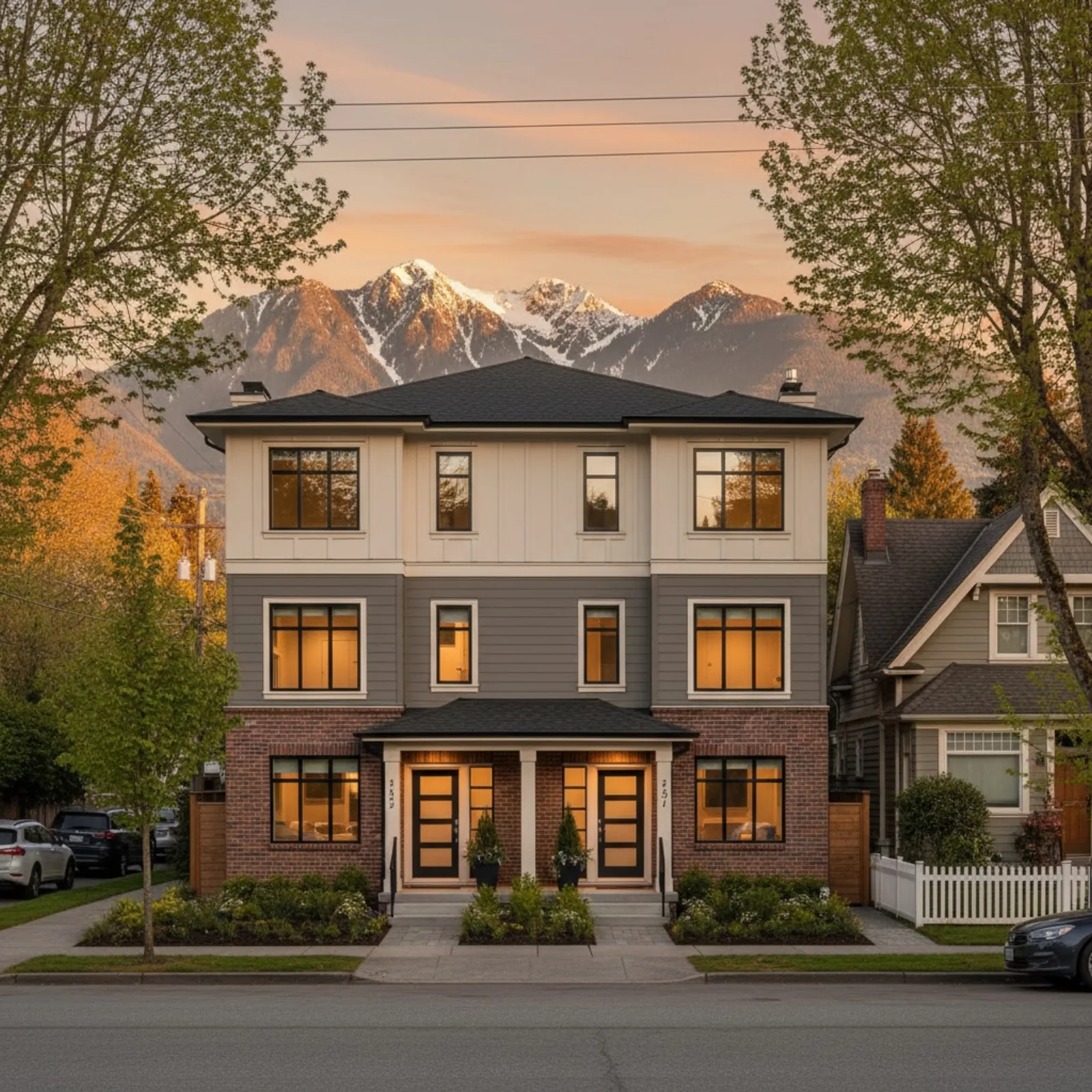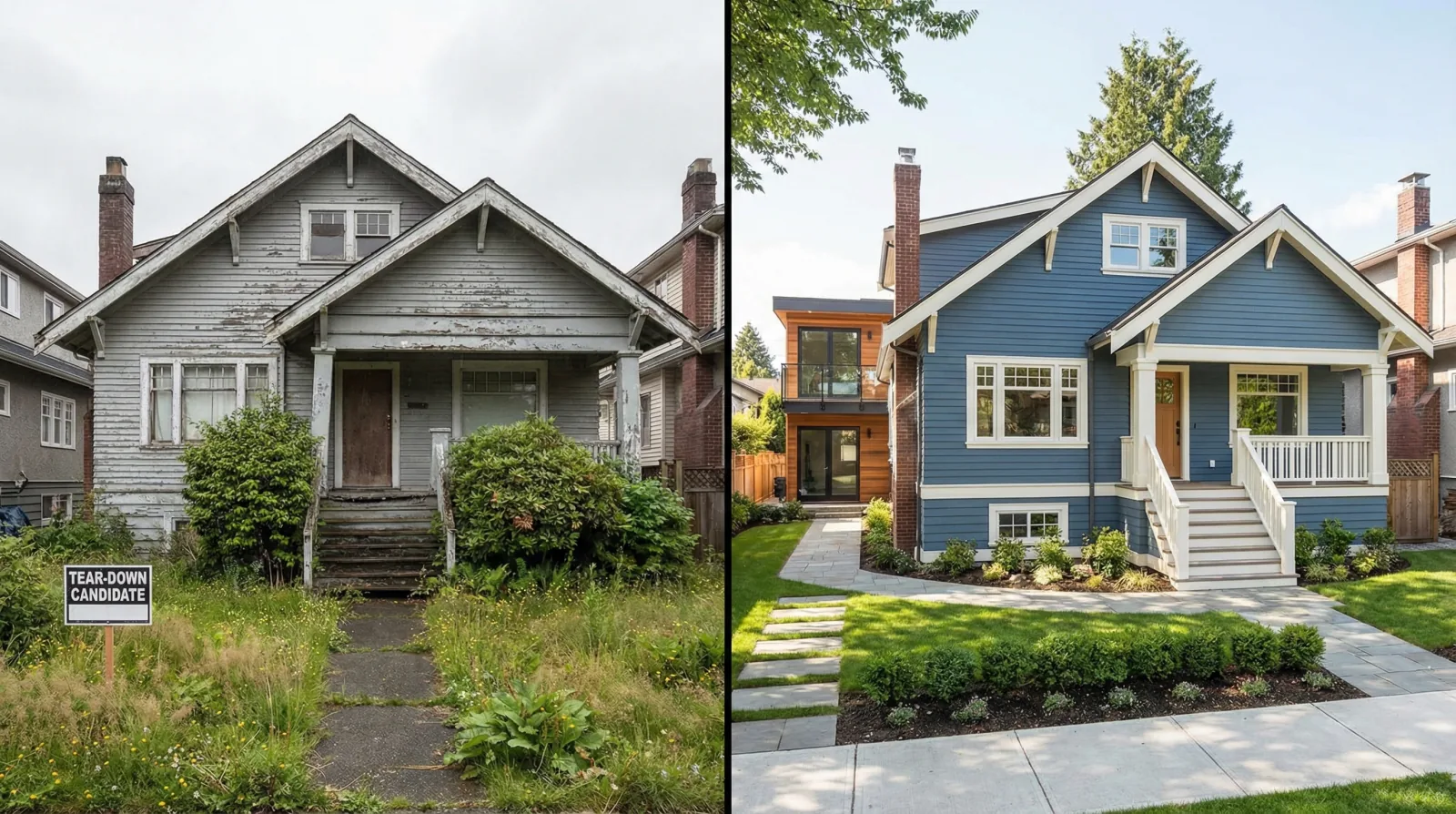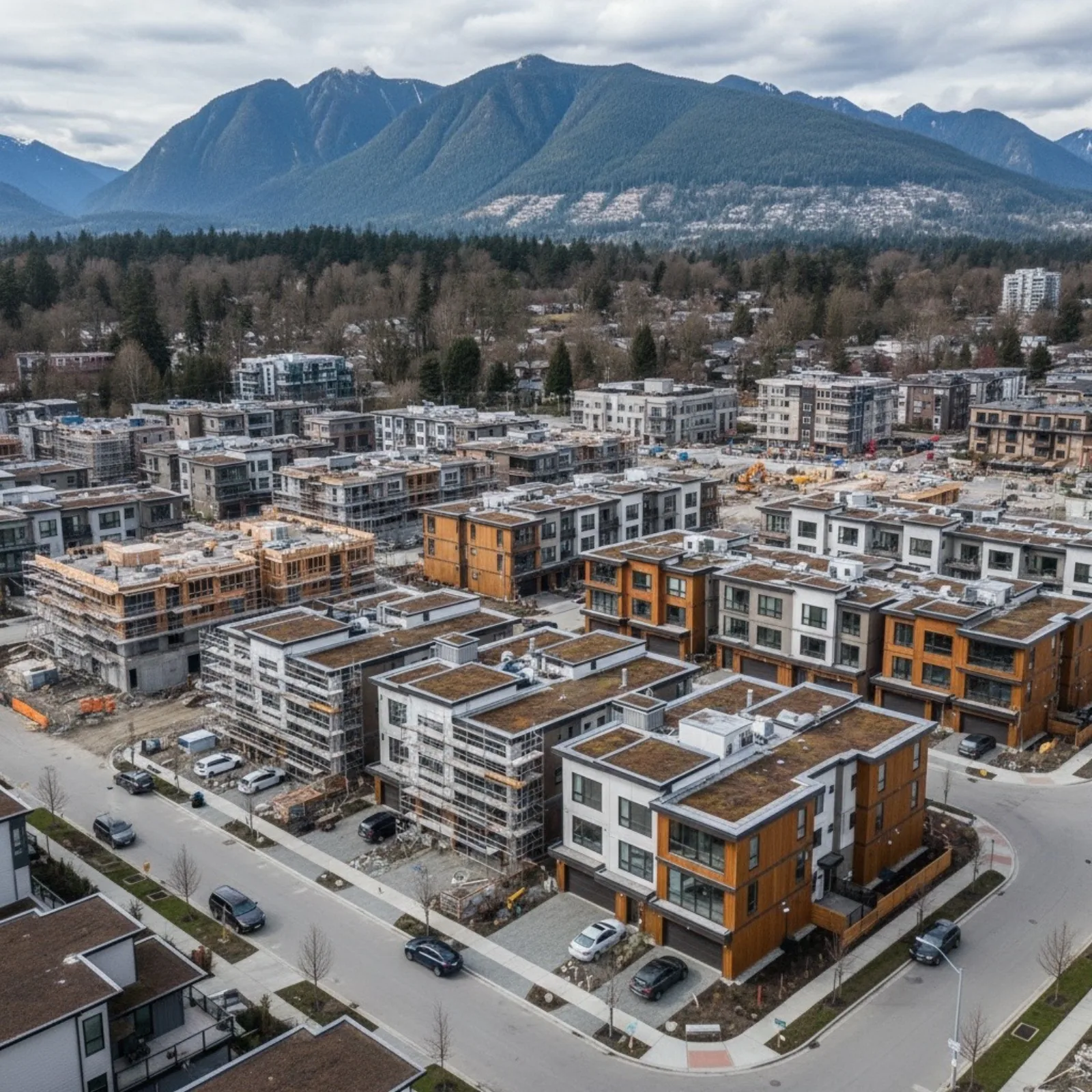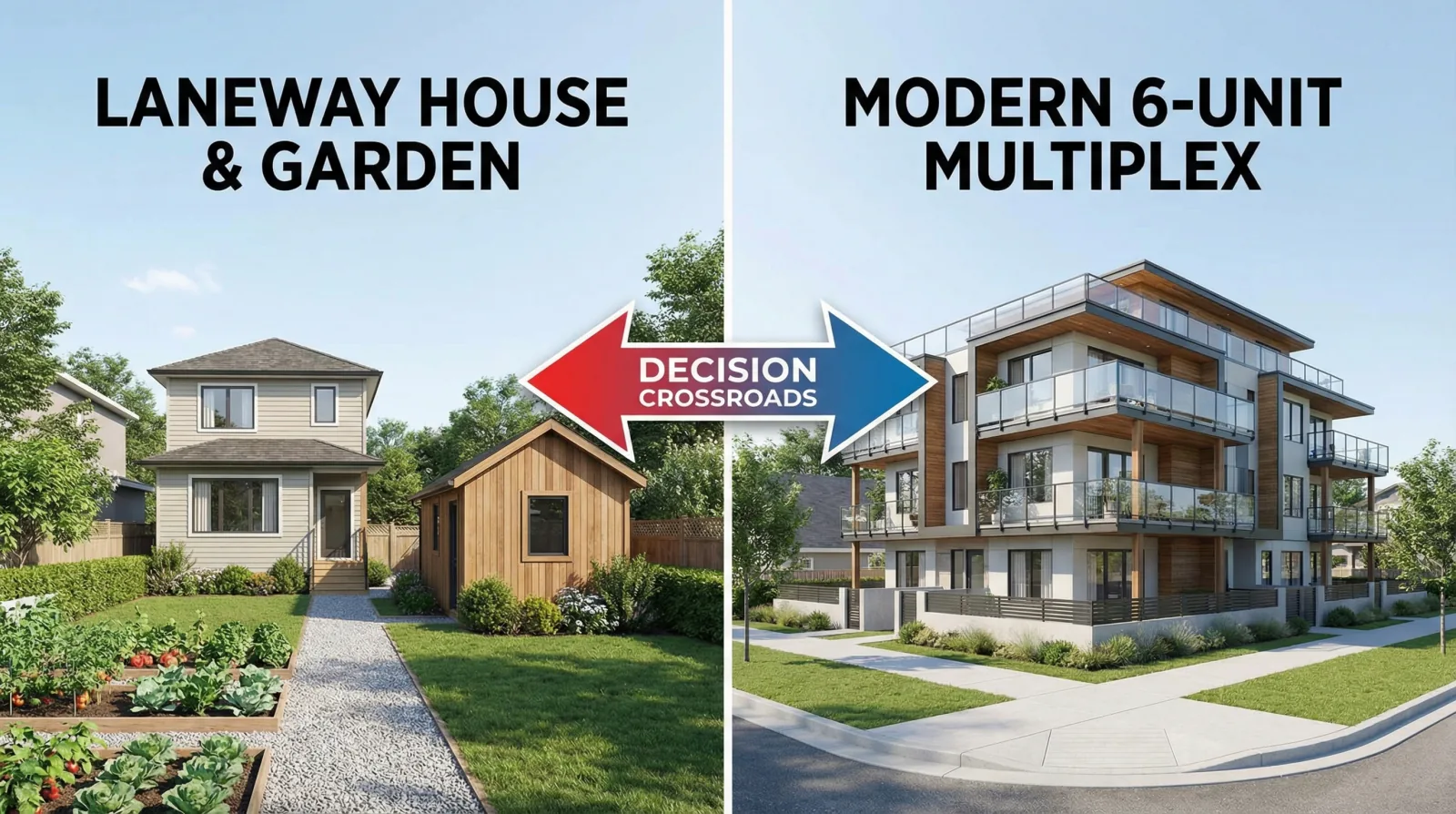

Your Vancouver lot qualifies for both. Under BC’s Bill 44 (SSMUH legislation), most single-family lots in Metro Vancouver can now accommodate either a laneway house or a small-scale multiplex of up to four to six units. Same lot. Two very different projects. Two very different outcomes.
This is the decision framework we use with homeowners every week. Five questions, honest answers, clear direction.
The five questions
Before comparing spreadsheets, answer these honestly. They matter more than the proforma.
1. Do you want to keep living in your current home?
This is the threshold question. A laneway house gets built in your backyard while you continue living in your main house. Your daily life is disrupted for 8-12 months of construction, but your home stays.
A multiplex means demolishing your existing home and building new. You need temporary housing for 18-24 months. When you move back, it’s into one unit of a new building — not your old house.
If keeping your home matters: laneway wins.
2. How much capital can you deploy?
A laneway house requires $300,000-$500,000. Most homeowners finance this through a HELOC or construction mortgage against their existing property. The equity is already there.
A multiplex requires $2.5M-$4.5M in total project cost. Even with CMHC MLI Select financing at 90-95% LTV, you need $125,000-$450,000 in equity or cash. The financing is more complex, the stakes are higher, and the approval process takes 3-6 months.
| Factor | Laneway House | Multiplex (4-6 units) |
|---|---|---|
| Total project cost | $300,000-$500,000 | $2,500,000-$4,500,000 |
| Financing | HELOC / construction mortgage | CMHC MLI Select / conventional |
| Equity required | $50,000-$100,000 | $125,000-$450,000 |
| Monthly carry during construction | $1,500-$3,000 | $8,000-$18,000 |
If you have limited capital or want to minimize financial exposure: laneway wins.
3. What’s your risk tolerance?
A laneway house is a low-risk project. The construction is straightforward (wood-frame, single-storey, well-understood by trades). The permitting is fast (3-5 months in Vancouver). If rental rates drop 20%, you’re out $500/month — uncomfortable but not catastrophic.
A multiplex is a real development project. Construction is more complex (multiple storeys, fire separations, elevator requirements for 4+ storeys). Permitting takes longer (4-9 months). If rental rates drop 20%, you’re out $3,000-$4,000/month — that can break your debt service coverage ratio.
The CMHC MLI Select program mitigates multiplex risk significantly with below-market interest rates and long amortization. But the program has requirements: rent must stay below 30% of area median income for specific unit counts, energy performance must hit Step Code targets, and you must maintain compliance for the life of the loan.
If you want a simpler, lower-stakes project: laneway wins. If you can stomach development risk for higher returns: multiplex wins.
4. What’s your timeline?
| Milestone | Laneway House | Multiplex |
|---|---|---|
| Design | 1-2 months | 2-4 months |
| Permitting | 3-5 months | 4-9 months |
| Construction | 6-10 months | 10-14 months |
| Lease-up | 1 month | 2-4 months |
| Total | 8-14 months | 18-24 months |
A laneway house can be generating rental income within a year of starting design. A multiplex takes nearly two years. If you need income soon — to cover rising mortgage costs, to fund a parent’s care, to offset a job change — the laneway’s speed advantage is material.
If time matters: laneway wins.
5. What are you optimizing for?
This is where the multiplex pulls ahead.
Monthly cash flow:
- Laneway: $2,200-$3,200/month gross rental income
- Multiplex (6 units): $14,000-$22,000/month gross rental income
Long-term wealth building:
- Laneway: Adds $200,000-$350,000 in property value
- Multiplex: Creates a $3M-$5M asset with $1.5M-$2.5M in equity at stabilization
Generational impact:
- Laneway: One additional unit for family or income
- Multiplex: Multiple units — one for you, one for parents, one for an adult child, plus income units
The multiplex is a fundamentally different financial instrument. It’s not an accessory dwelling. It’s a small apartment building. The income potential, equity creation, and long-term wealth are in a different category entirely.
If you’re optimizing for maximum financial return and long-term wealth: multiplex wins decisively.
When laneway wins clearly
Build a laneway house if three or more of these apply:
- You want to keep your existing home
- You have a parent who needs nearby housing within the next 12 months
- Your capital is limited to under $500,000
- You’re risk-averse and want a straightforward project
- You want rental income within a year
- Your lot is smaller (33-foot frontage) where a multiplex would be tight
The laneway house is the right answer for more families than they think. It’s not the “lesser” option. It’s the faster, simpler, lower-risk way to add housing and income to your property.
When multiplex wins clearly
Build a multiplex if three or more of these apply:
- You’re willing to demolish your existing home and temporarily relocate
- You have $200,000+ in equity or capital to deploy
- You want to create a multi-million dollar rental asset
- You can tolerate 18-24 months of development and carry costs
- You qualify for CMHC MLI Select financing
- Your lot is 40+ feet wide with lane access
- You’re thinking about long-term wealth, not just immediate income
The multiplex is a wealth-creation engine. CMHC’s MLI Select program — with its 50-year amortization, 95% LTV, and below-market rates — makes the economics work for homeowners who would never be able to access institutional-grade real estate financing otherwise.
The hybrid approach: the option most people miss
Here’s the play that sophisticated homeowners are making in 2026:
Step 1: Build a laneway house now ($350,000, 10 months). Start collecting $2,800/month in rent. House your aging parent. Generate income.
Step 2: Use the next 2-3 years to plan, design, and finance a multiplex. Watch the laneway house prove the rental market on your block. Build your comfort with being a landlord. Accumulate capital from the rental income.
Step 3: When you’re ready, demolish the main house (not the laneway) and build a multiplex in front. Keep the laneway generating income during construction.
This approach gives you income from day one, a proven rental track record for CMHC financing, and a phased path to a multi-unit property without betting everything on a single large project.
Not every lot geometry supports this sequence. But for standard Vancouver lots with lane access, it’s increasingly the smart play.
The decision matrix
| Factor | Laneway House | Multiplex | Winner |
|---|---|---|---|
| Keep existing home | Yes | No | Laneway |
| Total cost | $300K-$500K | $2.5M-$4.5M | Laneway |
| Monthly rental income | $2,200-$3,200 | $12,000-$22,000 | Multiplex |
| Timeline to income | 8-14 months | 18-24 months | Laneway |
| Long-term asset value | $200K-$350K added | $3M-$5M total | Multiplex |
| Risk level | Low | Medium-High | Laneway |
| CMHC financing available | No | Yes (MLI Select) | Multiplex |
| Aging parent solution | Excellent | Good (one unit) | Laneway |
| Wealth creation | Moderate | Significant | Multiplex |
There’s no wrong answer. There’s only the wrong answer for you.
For a deeper comparison, including financing scenarios and lot-specific analysis, visit our Laneway vs. Multiplex guide. Or run the numbers on your specific property with our proforma calculator.
Start with the questions, not the spreadsheet
Every homeowner who comes to us wanting a multiplex proforma on day one gets the same response: answer the five questions first. The spreadsheet will tell you what’s profitable. The questions tell you what’s right.
Your lot can support both. The question is which one supports your life.