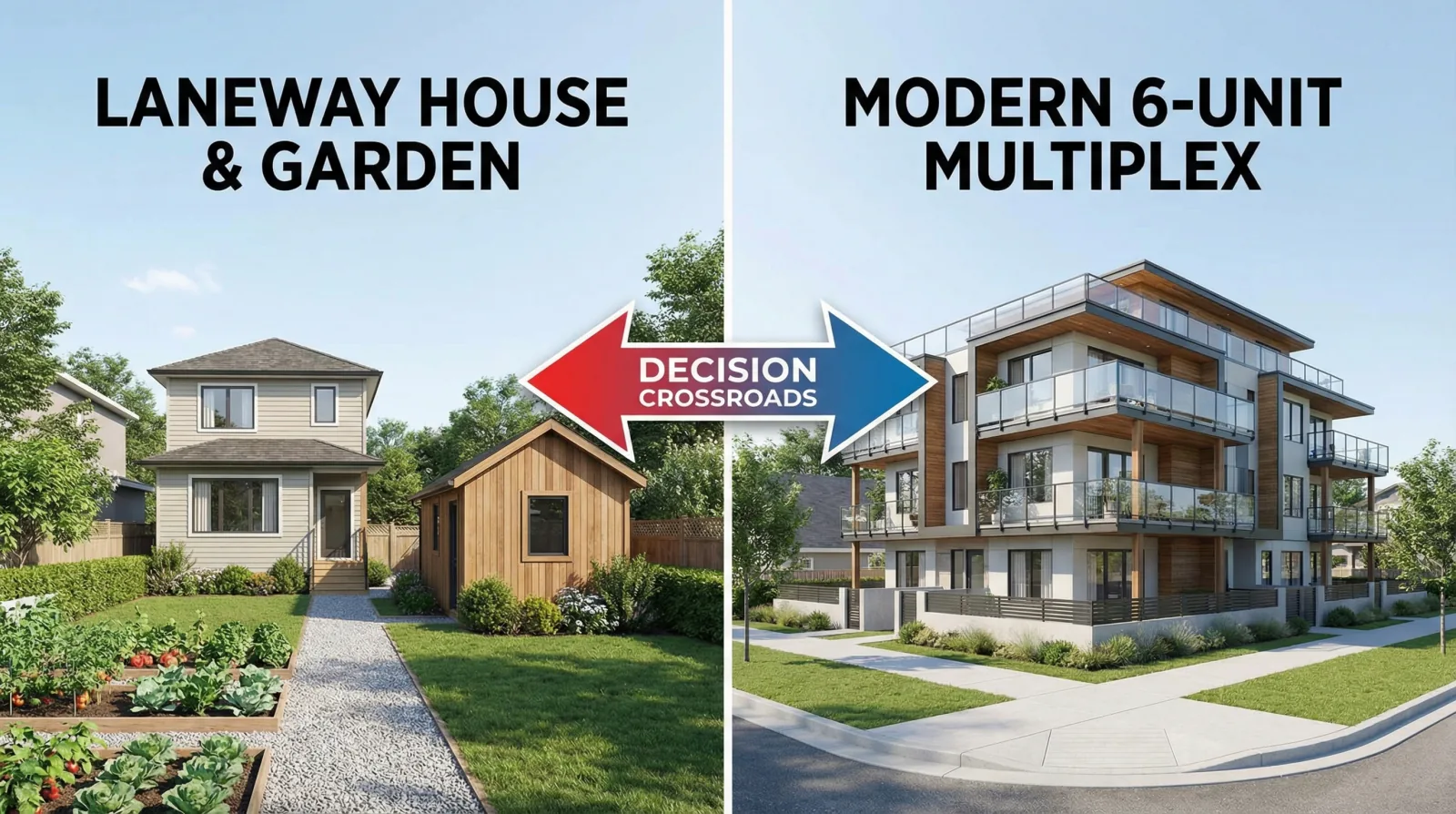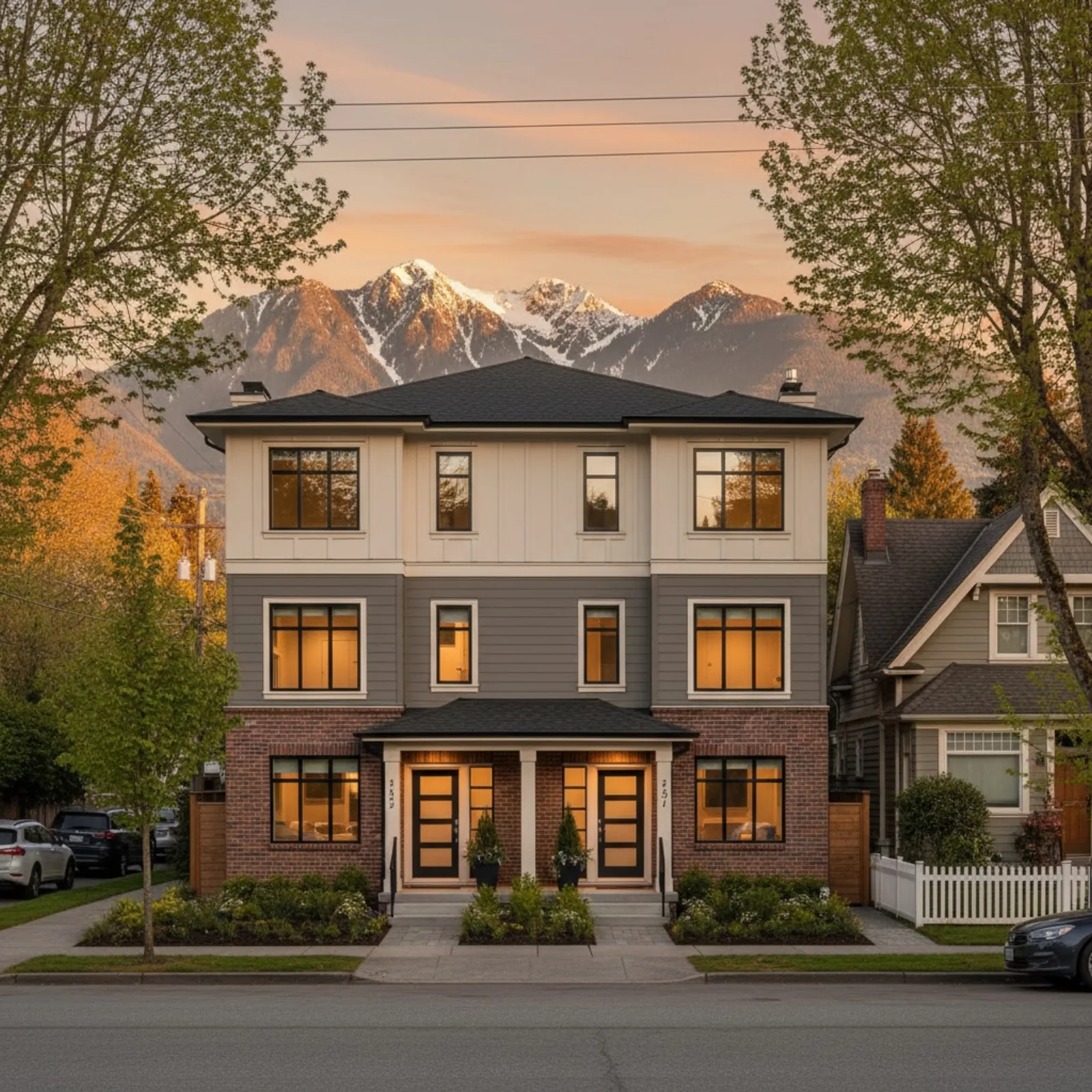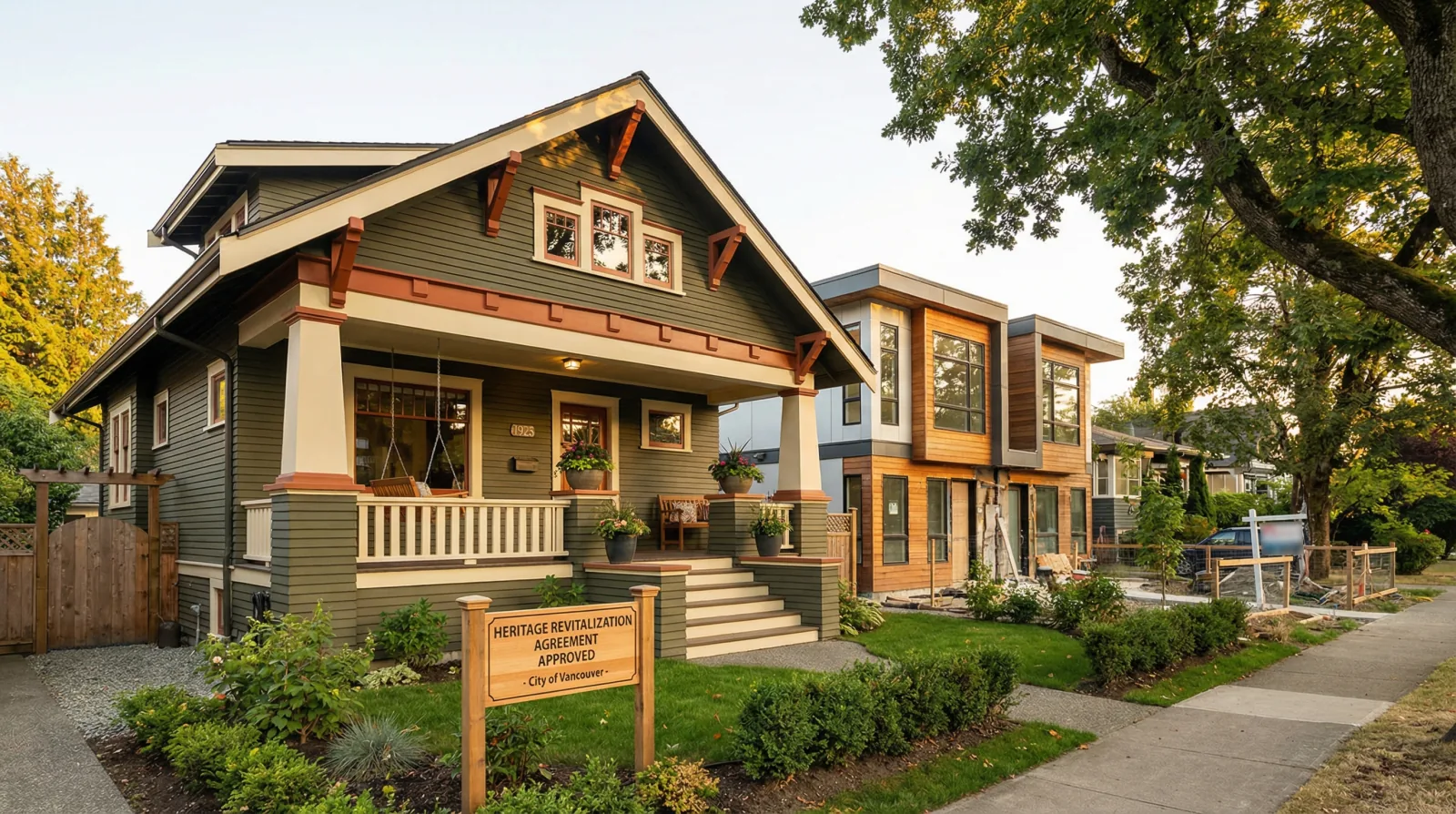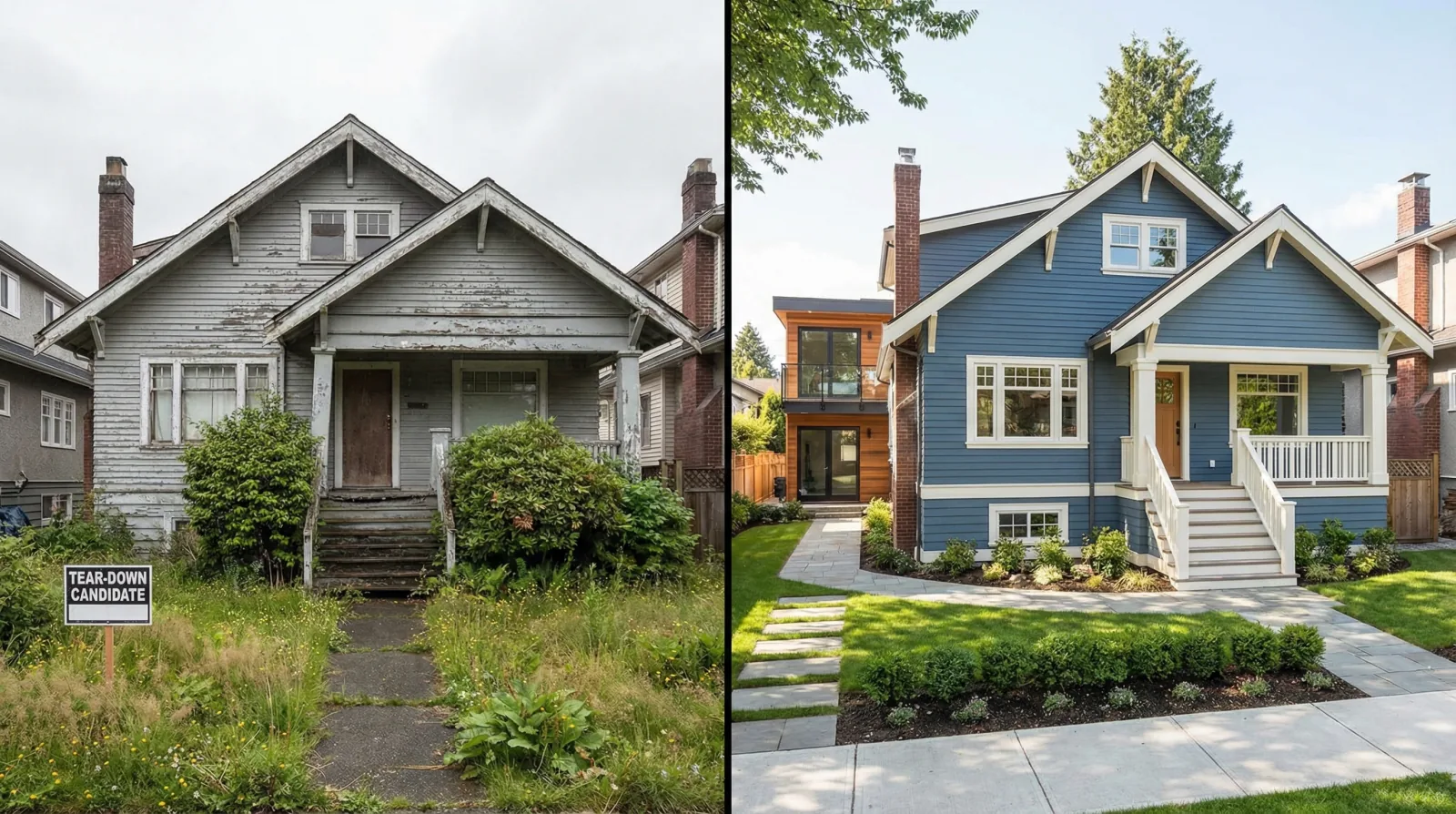

You own a 1925 Craftsman on a standard Vancouver lot. The default assumption from every developer who knocks on your door is the same: demolish it and build a six-plex. But that assumption deserves scrutiny. In a growing number of cases, your character home is worth more standing than demolished — if the Heritage Revitalization Agreement density bonus covers the restoration cost.
Here is how to run the numbers.
The Default Path: Demolish and Build New
Under current Vancouver zoning, you can demolish your character home and build a new multiplex of up to six units. The economics are straightforward:
- Demolition cost: $30,000 to $50,000
- New construction: $400 to $450 per square foot for a wood-frame six-plex
- Total project cost: $1.8M to $2.4M depending on unit count and finishes
- Timeline: 18 to 24 months from demolition to occupancy
- Revenue: 6 rental units generating $14,000 to $18,000 per month gross
This is the path most builders recommend because it is familiar. The design is unconstrained. The construction is standard. The pro forma is well understood.
But you lose the character home permanently. And you may be leaving money on the table.
The Alternative: Retain and Add Infill via HRA
A Heritage Revitalization Agreement lets you keep the character home and add density behind or beside it. The city grants bonus floor space ratio — typically 0.20 to 0.25 FSR above base zoning — in exchange for permanent heritage protection.
On a standard 33-by-122-foot lot, the HRA path looks like this:
- Heritage restoration: $150,000 to $300,000 depending on condition
- Infill construction: $400 to $450 per square foot for 2 to 3 new units
- Heritage consultant and HRA process: $15,000 to $25,000
- Total project cost: $900,000 to $1.5M
- Timeline: 18 to 24 months including HRA negotiation
- Revenue: Heritage home (1-2 units) plus 2-3 infill units generating $10,000 to $14,000 per month gross
Lower total investment. Fewer units. But the per-unit economics tell a different story.
The Real Comparison: Cost Per Unit
Demolish and build 6-plex:
- Total cost: $2.1M (midpoint)
- Units: 6
- Cost per unit: $350,000
- Monthly rent per unit: $2,500 average
- Gross yield on cost: 8.6%
Retain and build HRA infill (4 units total):
- Total cost: $1.2M (midpoint)
- Units: 4 (including heritage home units)
- Cost per unit: $300,000
- Monthly rent per unit: $2,800 average (heritage units command premium)
- Gross yield on cost: 11.2%
The retention path produces fewer units but at lower cost per unit and higher yield on invested capital. Add the 40 to 50 percent property tax exemption that comes with a Heritage Conservation Agreement, and the retention path saves an additional $3,000 to $6,000 per year in perpetuity.
When Retention Wins
The math favours keeping the character home in four scenarios:
The density bonus exceeds restoration cost. If the HRA grants 0.25 FSR bonus worth $300,000 in additional buildable area, and your restoration costs $200,000, you are $100,000 ahead before accounting for the tax exemption. This is the most common scenario for homes in good structural condition.
The tax exemption compounds over time. A $4,000 annual tax savings compounds to $60,000 over 15 years in nominal terms. For long-term hold strategies, this is not trivial.
Neighbourhood support is easier to secure. Heritage retention projects face less opposition than demolition projects. In neighbourhoods like Kitsilano and Grandview-Woodland, community sentiment strongly favours retention. Faster approval timelines and fewer objections translate to lower carrying costs.
The heritage home commands rental premium. Character homes with original Craftsman details, hardwood floors, and built-in cabinetry rent for 10 to 15 percent more than equivalent new-build units. Tenants will pay more for character — especially in neighbourhoods where it is disappearing.
When Demolition Wins
Retention is not always the right answer. Demolition makes more financial sense in three scenarios:
The home is severely deteriorated. If the foundation is compromised, the framing has extensive rot, or the building envelope has failed, restoration costs can exceed $400,000 — well beyond what the density bonus covers. At that point, demolition and rebuild produces a better outcome.
Restoration cost exceeds bonus value. Some homes require seismic upgrading, hazardous material abatement, and complete mechanical replacement that pushes restoration costs above the density bonus threshold. When the restoration bill exceeds $350,000 on a standard lot, the economics shift toward demolition.
Lot geometry favours a full rebuild. Corner lots, wide lots, and lots with rear lane access can accommodate six units more efficiently than a heritage-plus-infill configuration. If the lot can support six full-sized units through demolition but only three through retention, the gross revenue difference may justify the higher total investment.
The Decision Framework: Three Questions
Before choosing demolish or retain, answer these three questions:
Question 1: What is the restoration cost estimate?
Get a heritage building assessment — not a standard home inspection. A heritage consultant will evaluate the structure, identify character-defining elements, and estimate restoration costs. Budget $3,000 to $5,000 for this assessment. If the estimate comes back under $250,000, retention is likely viable. Over $350,000, demolition becomes increasingly competitive.
Question 2: What density bonus will the city grant?
This requires a pre-application meeting with the city’s heritage planning team. Bring your heritage assessment and a conceptual site plan showing the proposed infill. The city will indicate whether an HRA is feasible and what level of density bonus is realistic. If the bonus FSR is 0.20 or higher, the economics favour retention.
Question 3: What is your hold period?
The retention path performs best over long hold periods because the tax exemption compounds and the heritage premium appreciates. If you are building to sell within three years, demolition and new construction may deliver a faster return. If you are building to hold for 10 years or more, retention almost always wins on total return.
Running Your Own Numbers
The framework above gives you directional guidance. For precise numbers on your specific property, you need a proforma that accounts for your lot dimensions, heritage condition, neighbourhood rental rates, and financing terms.
For detailed cost and incentive analysis, see our Heritage Costs and Incentives Guide. For the broader retention strategy, explore our Character Home Retention Guide.
The 1925 Craftsman on your lot is not just a sentimental asset. It is a financial instrument — one that may be worth more to you standing than demolished. But only if you run the numbers before making the decision.