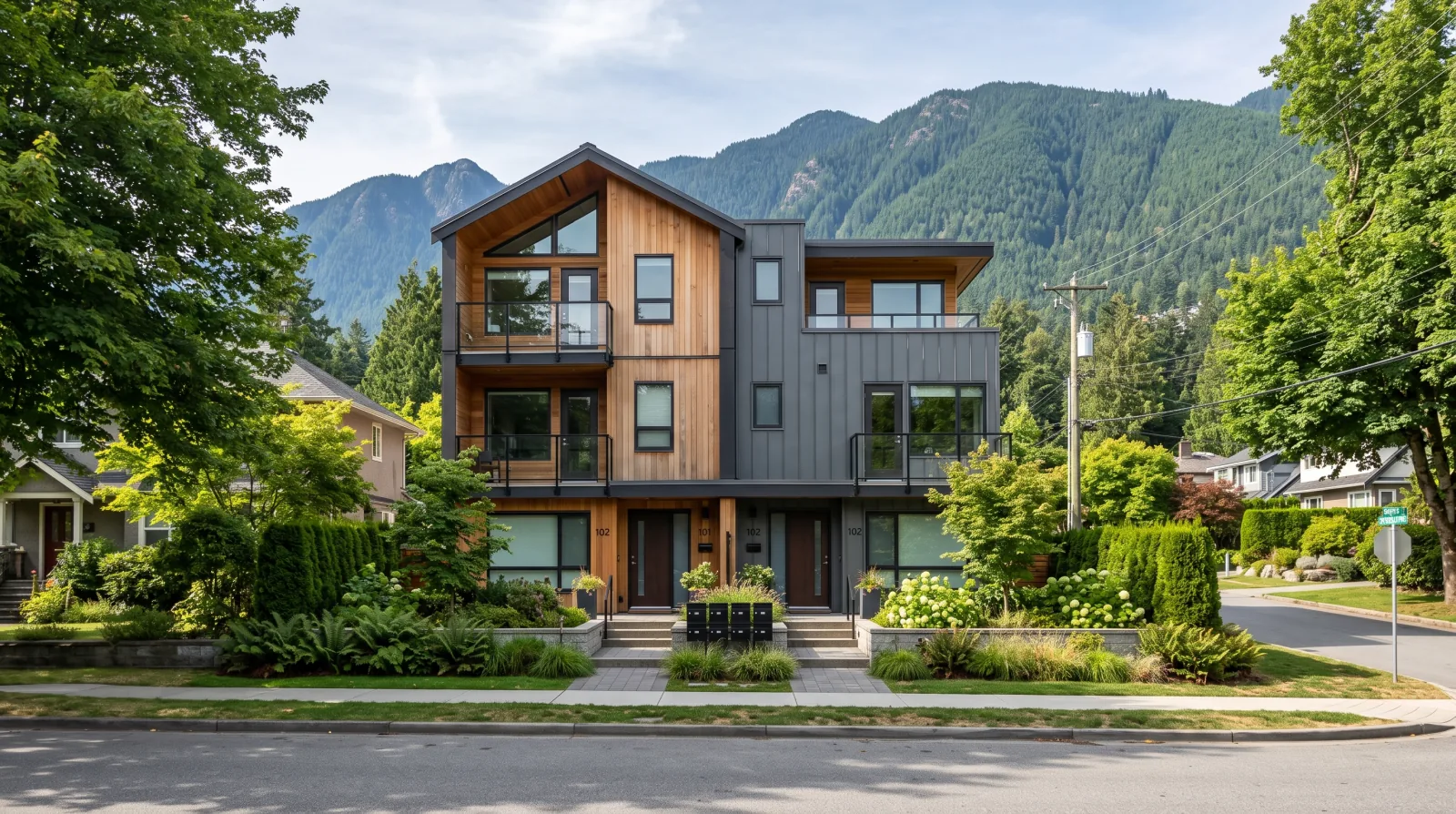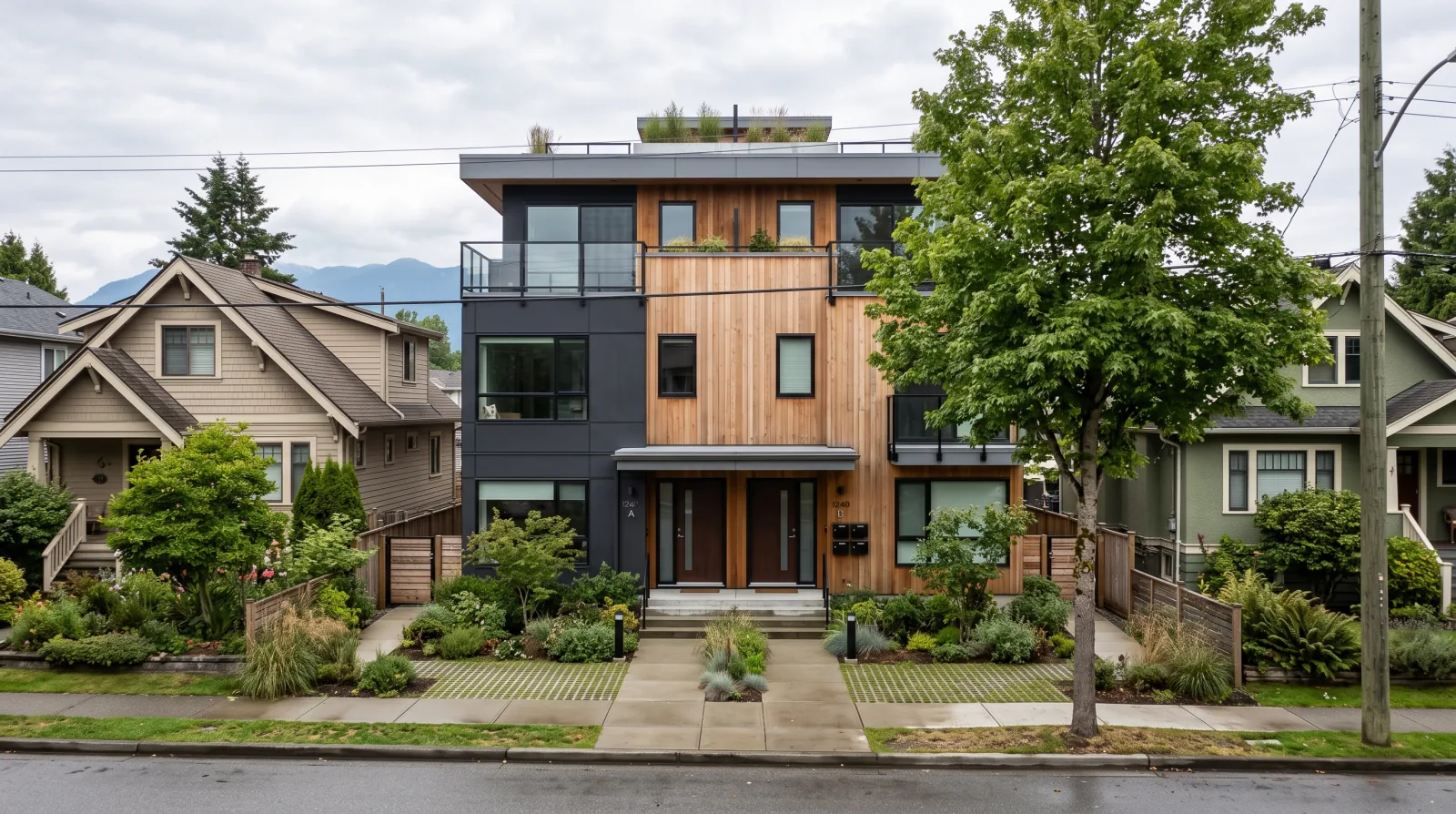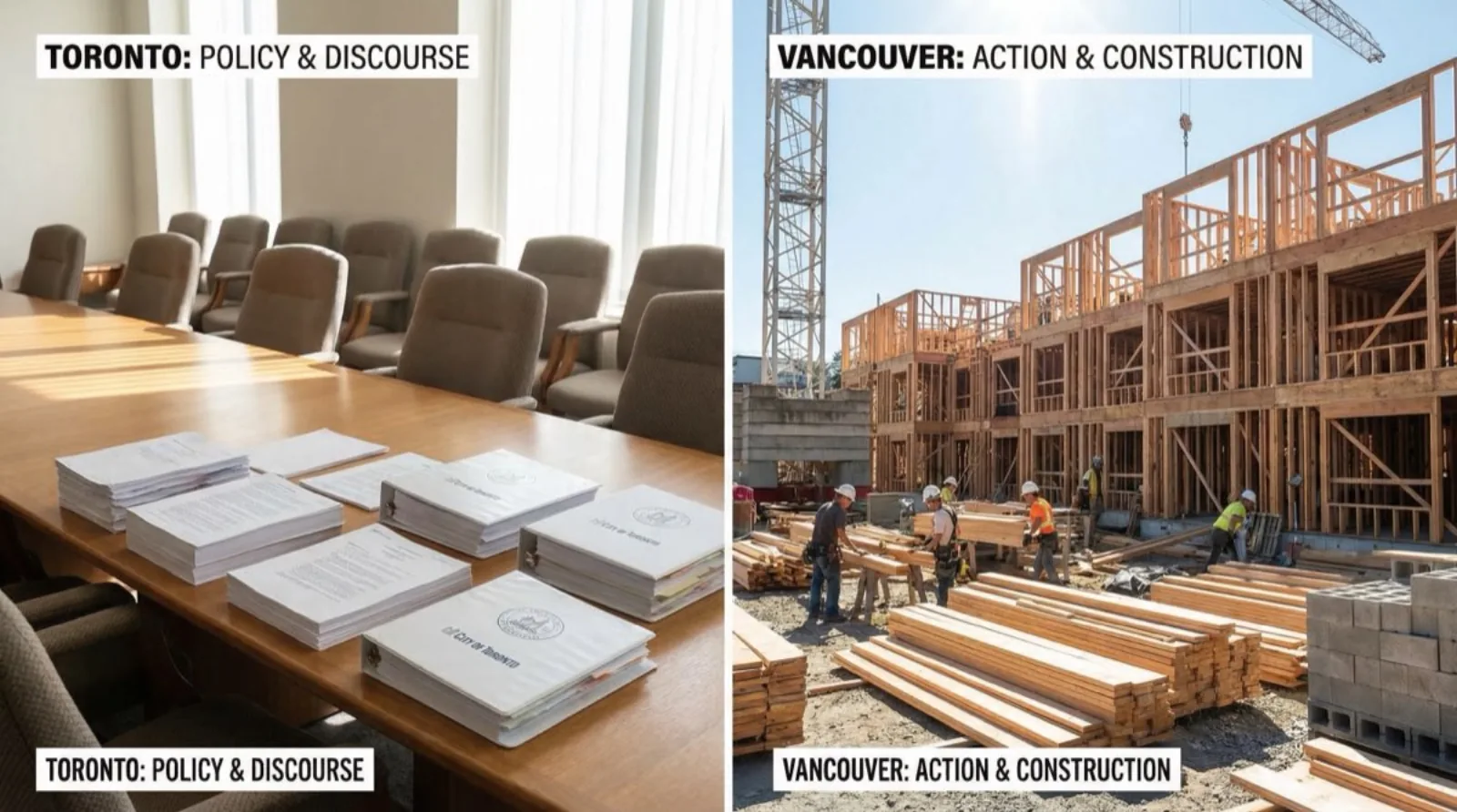

Split view comparing Toronto skyline with Vancouver multiplex construction, illustrating the gap between policy discussion and actual multigenerational housing development
Policy & Regulation Featured

Toronto Talks Multi-Gen Housing. Vancouver Builds It.

7 min read

Sky Property Group calls for multigenerational design in Toronto. Vancouver already has Bill 44 zoning, 441,750 multi-gen households growing 21.2%, and tools analyzing 86,000+ lots.

Key takeaway

Response to Sky Property Group's March 2026 press release on multigenerational housing, positioning Vancouver as already building what Toronto is just discussing, backed by 441,750 Census-counted multi-gen households, Bill 44 as-of-right zoning, and VanPlex's 86,000+ lot analysis.

What this covers

  • multigenerational housing Canada
  • Bill 44 vs Toronto zoning
  • 441,750 multi-gen households
  • Surrey 9.6% rate
  • Sky Property Group advocacy
  • MHRTC tax credit
multigenerational Bill-44 Toronto Vancouver SSMUH zoning

On March 13, 2026, Sky Property Group President & CEO Ladan Hosseinzadeh Sadeghi published a press release through ACCESS Newswire declaring that multigenerational housing is “reshaping Canada’s Housing Market.” She called on developers to “design with multigenerational living in mind.” In Vancouver, we read that and thought: we already are. BC has had the zoning framework since 2024, the permits are flowing, and VanPlex has analyzed 86,000+ properties for multigenerational multiplex feasibility. Toronto is writing press releases. Vancouver is pulling permits.

The press release that proved Vancouver is years ahead

Sky Property Group’s March 2026 press release reads like a manifesto for something BC figured out two years ago. “Canadian families are increasingly choosing to live together across generations,” the release states. “Developers need to design with multigenerational living in mind.”

Fair point. But in BC, the provincial government didn’t wait for developers to catch up. Bill 44, passed in late 2023 and effective across municipalities by mid-2024, mandated that every city in the province allow small-scale multiplex development on traditional single-family lots. Four units on standard lots. Six units near transit. No rezoning required.

Toronto is still asking developers to consider multigenerational design. Vancouver homeowners are already building it — and the multigenerational living guide shows what those projects look like in practice.

The numbers behind the movement

Statistics Canada’s 2021 Census counted 441,750 multigenerational households across the country—a 21.2% increase from 2011. That figure represents 2.4 million Canadians living under arrangements where grandparents, parents, and adult children share a home or property. When you include intergenerational arrangements (parents co-residing with adult children 20+), the figure reaches 9.5 million people (Statistics Canada, 2021 Census data released August 2025). The shift is structural, not cyclical.

BC is among the leaders. At 3.7% multigenerational household rate (Statistics Canada, 2021 Census), the province sits just behind Ontario (4.0%) and well above the national average of 2.9%. Within BC, Surrey stands out at 9.6%—more than triple the national rate and the highest in BC (nationally, Brampton leads at 14.3%). The critical difference: BC has the zoning framework AND the ecosystem to actually house these families in purpose-built multiplexes at scale.

Who lives multigenerationally—and why it matters for housing policy

The demographics tell a clear story. Among multigenerational households nationally (Statistics Canada, 2021 Census):

  • 52.7% include at least one person who identifies as racialized
  • 40.5% include at least one person born outside Canada
  • Only 4.3% of people in multigenerational households fall below the low-income threshold, compared to 30.2% of solo dwellers

This isn’t a niche lifestyle. It’s a proven economic strategy that reduces poverty, preserves family cohesion, and creates housing stability. The question is whether the built environment supports it—or fights it.

Why Toronto is talking and Vancouver is building

Credit where it’s due: Toronto adopted as-of-right multiplex zoning in May 2023, allowing up to 4 units citywide without rezoning. Standard multiplex permits now take 10-21 days for approval. On paper, Toronto’s zoning is comparable to BC’s Bill 44.

So why is Sky Property Group still calling for action? Because zoning is only step one. The gap between Toronto and Vancouver isn’t about permits anymore—it’s about ecosystem maturity.

FactorTorontoVancouver (Bill 44)
As-of-right multiplex zoningYes, since May 2023Yes, since mid-2024
Maximum units (standard lot)4 units4 units (6 near transit)
Standardized design catalogueNo provincial equivalentBC free design catalogue (Sept 2024)
Purpose-built multigenerational focusDeveloper-led advocacy stageEstablished builder ecosystem
Property analysis toolsLimitedVanPlex: 86,000+ lots analyzed
Provincial policy alignmentMunicipal-level onlyProvincial mandate (Bill 44) + federal MHRTC
Active multiplex construction pipelineEarly stagePermits flowing, builds underway

Vancouver’s advantage isn’t just about zoning anymore—it’s about execution. BC has a provincial mandate, a standardized design catalogue, established builder networks, and tools like VanPlex that have analyzed 86,000+ properties for feasibility. Toronto has the zoning, but the ecosystem to support multigenerational multiplex development at scale is still forming. If you own a Toronto lot, our Toronto multiplex guide walks through what the rules allow on it.

The builder ecosystem that Toronto lacks

Bill 44 didn’t just change zoning. It created an ecosystem. Architects now have standardized multiplex designs (BC’s free multiplex design catalogue launched in September 2024). Builders have developed repeatable construction processes for 4-6 unit projects. Lenders have created financing products specifically for multiplex development.

In Toronto, Sky Property Group is calling for this ecosystem to be built. In Vancouver, it already exists.

The financial case for multigenerational multiplexes

The economics of multigenerational multiplex development are compelling. Consider a typical Vancouver scenario:

ComponentSingle-Family HomeMultigenerational Fourplex
Current property value$2.2M$2.2M (same lot)
Development costN/A$1.6-2.1M
Post-development value$2.2M$4.4-5.6M
Monthly rental income$0$6,000-10,000 (from 2 market units)
Family housing costMarket rent elsewhere$0 (2 family units)
Annual family savings$0$48,000-72,000 in avoided rent
MHRTC tax creditN/AUp to $7,000 (2026 rate)

The MHRTC (Multigenerational Home Renovation Tax Credit) provides a refundable credit at the lowest federal tax rate (14% for 2026) on up to $50,000 of eligible renovation costs when creating a secondary dwelling unit for a senior aged 65+ or an adult with a disability. That’s up to $7,000 back at tax time—a federal program that directly rewards the multigenerational approach.

Beyond the spreadsheet

But the real value isn’t captured in a proforma. It’s the grandmother who can age in place in a ground-floor unit with wide doorways and grab bars instead of a $5,000/month care facility. It’s the adult child who can save for their own future instead of paying $2,500/month in rent to a stranger. It’s the family that stays together because the built environment finally allows it.

What this means for BC homeowners right now

The convergence is rare: demographic demand (441,750 households and growing), provincial policy (Bill 44), federal incentives (MHRTC), and an established builder ecosystem.

Toronto has the zoning in place. Sky Property Group’s advocacy is a positive signal that awareness is growing. But building the full ecosystem—standardized designs, experienced builders, property analysis tools, financing products—takes time.

BC homeowners don’t need to wait. The SSMUH framework is live across all major Metro Vancouver municipalities.

If you own a single-family lot in Vancouver, Burnaby, or Surrey, the zoning already permits a multigenerational multiplex. The question isn’t whether you can build—it’s whether your specific lot maximizes the opportunity.

Toronto owners now have a lot-level tool too: PlexCheck Toronto stamps the City zoning at a Toronto address, applies the ward’s unit ceiling, and prices the build against CMHC survey rents.

Visit VanPlex.ca to enter your address and see exactly what your property qualifies for under Bill 44. In under two minutes, you’ll know your lot’s PlexRank score, estimated development value, and multigenerational configuration options. Both cities have the zoning. BC has the ecosystem. You can start building today.


VanPlex Team

PlexRank(TM) | Profit with Multiplex
Frequently asked questions

How many multigenerational households does Canada have?

Statistics Canada's 2021 Census counted 441,750 multigenerational households across the country, a 21.2 percent increase from 2011, representing 2.4 million Canadians living under arrangements where grandparents, parents, and adult children share a home or property. Including broader intergenerational arrangements, such as parents co-residing with adult children aged 20 and older, the figure reaches 9.5 million people, based on 2021 Census data released in August 2025.

How does BC's multigenerational household rate compare to the rest of Canada?

BC's multigenerational household rate is 3.7 percent according to the 2021 Census, placing it just behind Ontario at 4.0 percent and well above the national average of 2.9 percent. Within BC, Surrey stands out at 9.6 percent, more than triple the national rate and the highest in the province, though nationally Brampton leads at 14.3 percent.

What is the difference between Toronto's and Vancouver's approach to multigenerational zoning?

Toronto adopted as-of-right multiplex zoning in May 2023, allowing up to 4 units citywide without rezoning, with standard permits now taking 10 to 21 days for approval. BC's Bill 44, passed in late 2023 and effective across municipalities by mid-2024, mandates similar zoning province-wide (4 units on standard lots, 6 near transit), but BC also built the supporting ecosystem: a free provincial multiplex design catalogue launched in September 2024, established builder networks, and property analysis tools like VanPlex that have analyzed more than 86,000 lots for feasibility.

What sparked the comparison between Toronto and Vancouver on multigenerational housing?

On March 13, 2026, Sky Property Group President and CEO Ladan Hosseinzadeh Sadeghi published a press release through ACCESS Newswire declaring that multigenerational housing is reshaping Canada's housing market and calling on developers to design with multigenerational living in mind. The post argues that BC had already built the zoning framework, permitting pipeline, and design catalogue that the Toronto press release was calling for developers to create.

What tax credit exists for building a multigenerational unit in Canada?

The Multigenerational Home Renovation Tax Credit (MHRTC) provides a refundable credit at the lowest federal tax rate, 14 percent for 2026, on up to $50,000 of eligible renovation costs when creating a secondary dwelling unit for a senior aged 65 or older or an adult with a disability. That works out to up to $7,000 back at tax time under the 2026 rate.

What are the demographics of multigenerational households in Canada?

Among multigenerational households nationally, according to the 2021 Census, 52.7 percent include at least one person who identifies as racialized and 40.5 percent include at least one person born outside Canada. Only 4.3 percent of people in multigenerational households fall below the low-income threshold, compared to 30.2 percent of people living alone, which the post frames as evidence that multigenerational living functions as an economic strategy rather than a niche lifestyle.

What would the financial picture look like for a Vancouver homeowner converting to a multigenerational fourplex?

In the post's typical Vancouver scenario, a $2.2 million single-family property becomes a fourplex valued at $4.4 million to $5.6 million after $1.6 million to $2.1 million in development cost. Two market-rate units can generate $6,000 to $10,000 per month in rental income, while the family units eliminate market rent elsewhere, producing $48,000 to $72,000 per year in avoided rent, on top of qualifying for up to $7,000 through the MHRTC.

Do BC homeowners need to wait for a builder ecosystem like Toronto's to develop?

No. The post states that the SSMUH (small-scale multi-unit housing) framework created by Bill 44 is already live across all major Metro Vancouver municipalities, meaning a single-family lot in Vancouver, Burnaby, or Surrey already permits a multigenerational multiplex today. The remaining question for a BC homeowner is not whether they can build, but whether their specific lot maximizes the opportunity, which is what property analysis tools like VanPlex are built to check.

PlexCheck Toronto

Stop reading about the rules and check one lot

PlexCheck Toronto reads the City zoning stamped at an address, applies the multiplex unit ceiling for that zone and ward, and prices the build against CMHC survey rents for the area.

Free. City-stamped zoning and CMHC survey rents. Takes about 30 seconds.

Check a Toronto address
David Babakaiff

David Babakaiff

Co-Founder, VanPlex | 25+ Years BC Construction

David Babakaiff is Co-Founder of VanPlex with 25+ years scaling BC construction. He led Alair Homes Vancouver to the 2024 HAVAN Award for Best Multiplex Unit in the GVRD. VanPlex’s PlexRank™ algorithm scores residential parcels across BC for multiplex conversion potential under Bill 44.

Want insights like this delivered weekly?

Join 2,500+ property owners getting ROI case studies, market data, and exclusive opportunities.

No spam. Unsubscribe anytime.

BC Legislature building in Victoria with residential neighbourhood showing multiplex housing representing Bill 44 SSMUH zoning reform
8 min read

How Bill 44 and Rental Tenure Rules Interact in BC

Bill 44 made multiplexes legal. It did not make them profitable. Vancouver added rental incentives worth $180K-$228K per project. Most cities did the bare minimum. Bill 25 closed the loopholes. The gap between 'allowed' and 'supported' is where the money hides.

Policy & Regulation
build-to-rentpolicy+8
By David Babakaiff • Co-Founder, VanPlex | 25+ Years BC Construction
A ground-oriented multiplex on a District of North Vancouver residential street with the North Shore mountains behind, representing the six-unit SSMUH zoning still coming to transit-proximate DNV lots after the missed June 30 2026 deadline
8 min read

DNV Missed the SSMUH Deadline: 4 Options Left

The June 30, 2026 SSMUH deadline passed with no compliant District of North Vancouver bylaw. The April 13 refusal (a 4 to 3 vote) still stands. Here are the four options DNV has now, the West Vancouver precedent for what the province does next, and why six-unit zoning is still coming to transit-proximate lots either way.

Policy & Regulation
multiplexdistrict-of-north-vancouver+8
By David Babakaiff • Co-Founder, VanPlex | 25+ Years BC Construction
A newly built three-storey ground-oriented multiplex with two front doors on a Vancouver residential street between older single-family houses, the incremental owner-built density that survives after Council rejected the Villages Plan
8 min read

Villages Plan Dead: Your Vancouver Multiplex Lives

Vancouver City Council killed the Villages Plan on July 28, 2026 in a 10 to 1 vote, ending a plan for up to eight storeys across 17 areas and about 13,000 lots. Here is why the rejection leaves every multiplex right untouched, protects the ~700 owners who feared losing their laneway and multiplex options, and confirms the incremental, owner-built multiplex as Vancouver's real density model.

Policy & Regulation
multiplexvancouver+8
By David Babakaiff • Co-Founder, VanPlex | 25+ Years BC Construction