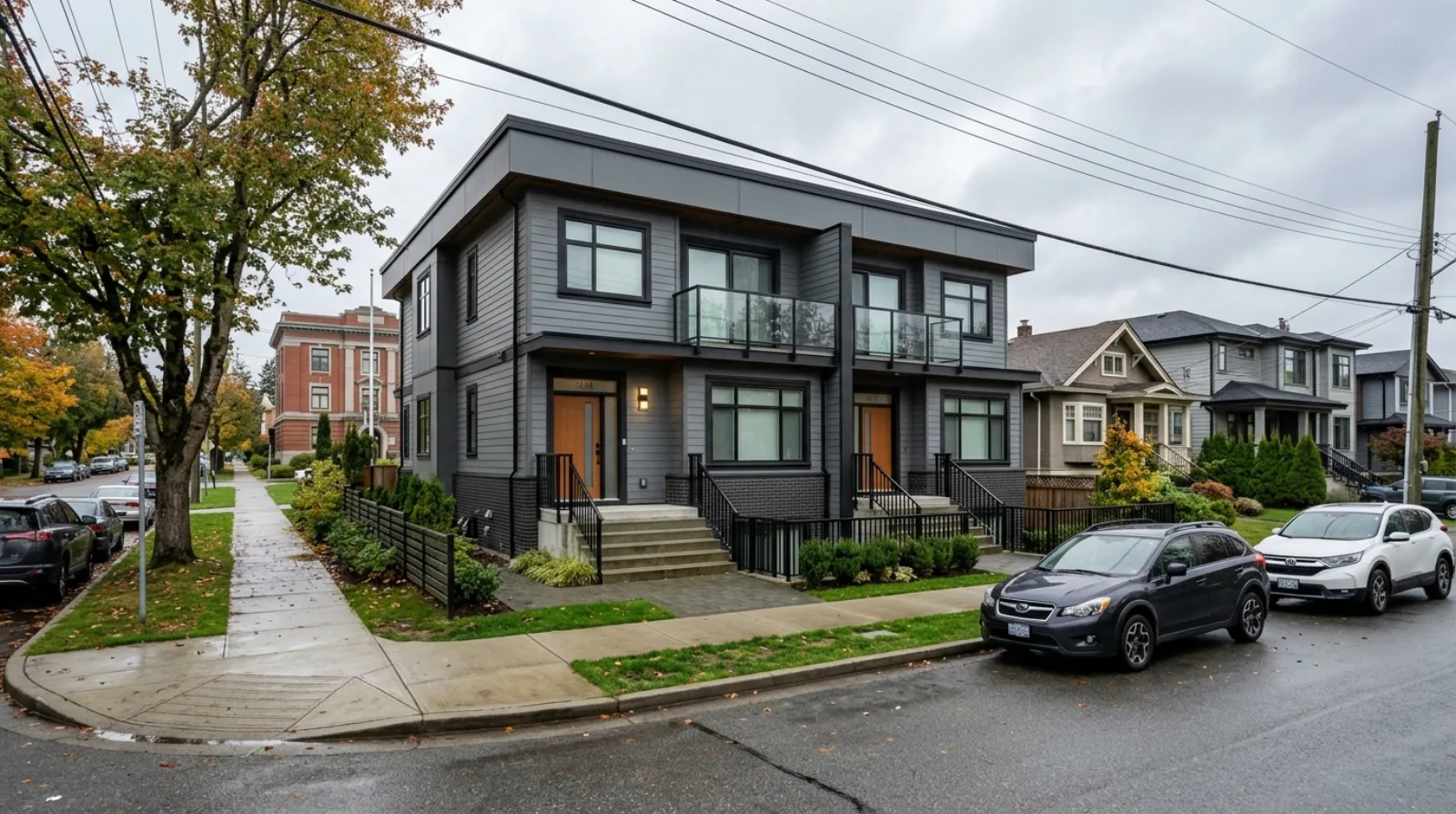

Bill 44 made multiplexes legal across BC. It did not make them profitable.
That distinction matters more than any headline you’ve read about the province “ending single-family zoning.” The Housing Statutes (Residential Development) Amendment Act — Bill 44, passed November 2023 — forced every municipality in BC to allow 3-6 units on lots that previously permitted only one house. But the legislation is deliberately silent on one critical question: should cities incentivize rental?
Vancouver answered yes. Most cities answered with silence. The gap between “allowed” and “supported” is where hundreds of thousands of dollars hide.
TL;DR (Key Takeaways)
- Bill 44 mandates multiplex zoning but does NOT require rental incentives — cities choose whether to go further
- Vancouver went further: 8-unit rental path, DCL waivers, density bonus fee exemptions — saving $180K-$228K per project
- Most BC cities did the bare minimum — 4-6 units allowed, zero rental-specific benefits
- Bill 25 (November 2025) closed loopholes — municipalities can no longer dodge SSMUH through creative zone definitions
- The “allowed vs. supported” gap is often the difference between a project that pencils and one that doesn’t
- Rental tenure lock is permanent — not 10 years, not 20, forever registered on title
What Bill 44 Actually Requires
The legislation sets a floor, not a ceiling. Every municipality in BC must now allow:
- 3 units on lots 280 m2 or smaller
- 4 units on lots larger than 280 m2
- 6 units on lots within 400 metres of a frequent transit stop
That’s it. No mention of rental incentives. No density bonuses for choosing rental over strata. No fee waivers. No expedited permitting for purpose-built rental.
The province told cities: you must allow the doors. It said nothing about helping people open them.
The Compliance Deadline Saga
Bill 44 gave municipalities until June 30, 2024 to update their bylaws. Some moved fast. Vancouver had already approved multiplex zoning in September 2023 — two months before Bill 44 even passed. Burnaby adopted compliant bylaws on schedule. Surrey updated its NCP areas.
Others stalled. Some cities exploited a loophole: if a zone already permitted three units (principal dwelling + secondary suite + coach house), the municipality argued it was already “compliant.” No need to allow fourplexes or sixplexes.
That loophole died on November 27, 2025.
Bill 25: The Enforcement Hammer
Bill 25 — the Housing and Municipal Affairs Statutes Amendment Act, 2025 — exists because municipalities found creative ways to comply with the letter of Bill 44 while violating its spirit.
The key fix: redefining “restricted zone.” Under Bill 44, zones that already permitted three units could claim exemption. Bill 25 closed that door. Areas with principal dwelling + suite + coach house must now permit the full SSMUH densities — 4 or 6 units depending on lot size and transit proximity.
New hard deadline: June 30, 2026. No extensions without provincial approval.
The message from Victoria to municipal halls was blunt: stop gaming the definitions. Allow the housing.
Vancouver: The City That Went Further
Vancouver didn’t just comply with Bill 44. It built an entire incentive architecture around rental tenure.
The 8-unit rental path. On R1-1 lots of 557 m2 or larger with 15.1m frontage, choosing secured rental unlocks 8 units instead of 6. FSR jumps from 0.70 to 1.00 — a 43% increase in buildable area. No other BC city offers this trade.
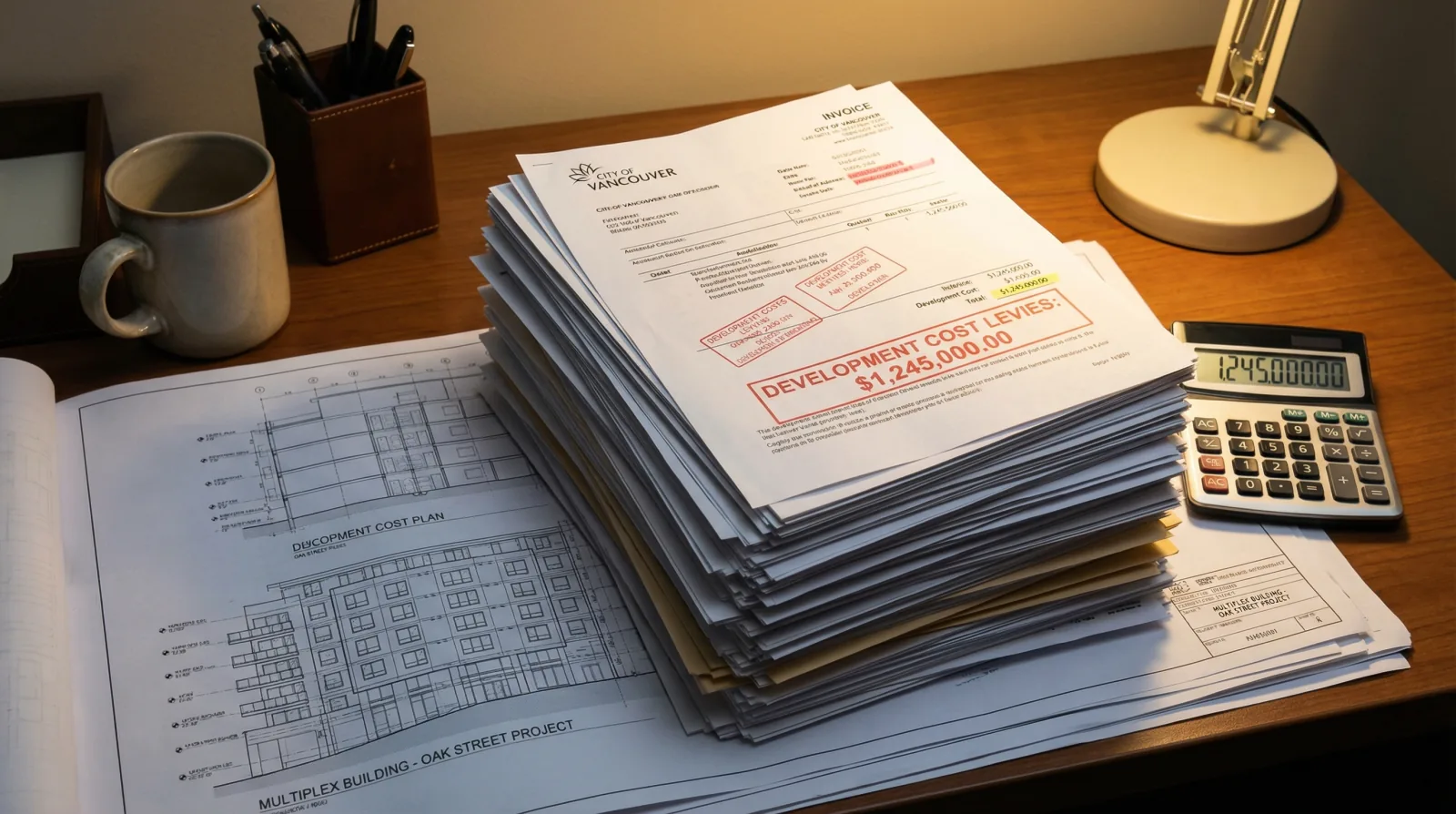
DCL waivers. Vancouver’s 20% DCL reduction (effective December 2025) saves $13,200-$16,000 on a typical multiplex. The separate Rental Development Relief Program offers full DCL waivers for projects meeting affordability criteria.
Density bonus fee exemption. Units 7 and 8 would normally trigger a density bonus contribution of approximately $82,000 per unit. Secured rental projects are exempt. That’s $164,000 saved on an 8-unit build.
Combined savings: $180,000-$228,000 on a single project. On a $5M total cost, that’s 3.6%-4.6%. Enough to flip a DSCR from failing to passing.
Cities That Did the Minimum
| City | Max Units | Rental Density Bonus | DCL Relief for Rental | Density Bonus Fee Waiver |
|---|---|---|---|---|
| Vancouver | 8 (rental) | Yes — 33% more units | 20% reduction + full waiver program | Full exemption |
| Burnaby | 6 | No | No | No |
| Surrey | 6 | No | DCC freeze (all tenure) | No |
| Kelowna | 6 | No | No | No |
| Victoria | 6 | No | No | No |
| Coquitlam | 6 | No | No | No |
| Richmond | 6 | No | No | No |
The table tells the story. Vancouver stands alone in offering rental-specific incentives at the multiplex scale. Every other major BC city treats rental and strata identically under their SSMUH bylaws.
Surrey’s DCC freeze through May 2027 applies to all development — rental gets no special treatment. Kelowna’s Infill Fast-Track gives you a 10-day permit, but the fee structure is the same regardless of tenure. Victoria allows 6 units near transit. No bonus for rental.
Why the Gap Matters for BTR
Build-to-rent proformas live and die on margins measured in tenths of a DSCR point. A project at 1.08 DSCR passes CMHC underwriting. The same project at 1.04 fails.
In Vancouver, the rental incentive stack — extra units, fee waivers, DCL reduction — can move a project 0.10-0.15 DSCR points. That’s the difference between fundable and dead.
In Burnaby, the same lot with the same construction costs and the same rents gets zero rental-specific help. The proforma has to work on pure economics: land basis, rent levels, and construction efficiency. For most purchased lots, it doesn’t.
This creates a paradox. Vancouver has the highest land costs in BC. It should be the hardest market for BTR. But its incentive architecture makes it the most viable — on qualifying lots with the right basis.
The Permanent Tenure Lock
Here’s what “secured rental” actually means in practice. A housing agreement is registered on title. The units cannot be stratified. Cannot be sold individually. The lock is permanent — not 10 years, not 20 years, forever.
You can sell the entire building as an income-producing asset. Buyers will value it on cap rate and NOI. But you cannot break it into condos and sell unit-by-unit. Ever.
For existing homeowners building a retirement income stream, this is the point. For speculative developers expecting a condo exit, this is the wall.
Know which one you are before you choose the rental path.
What Comes Next
Bill 25’s June 2026 deadline will force the remaining holdout municipalities into compliance. But compliance with unit counts is the easy part. The harder question — whether cities will add rental-specific incentives — remains unanswered.
Burnaby’s council has discussed rental incentives but hasn’t enacted them. Surrey’s housing strategy mentions purpose-built rental but offers no fee structure advantages. Victoria has shown zero interest in a rental density bonus.
The province could mandate rental incentives. It hasn’t. Bill 44 and Bill 25 focus on supply — more doors, any tenure. The province’s position: rental incentives are a municipal choice.
That leaves Vancouver as the only city where policy actively rewards choosing rental. If you’re evaluating BTR across BC municipalities, the regulatory framework matters less than the incentive framework. And right now, Vancouver is the only place where choosing rental literally gets you more building.
Explore the full regulatory landscape for build-to-rent multiplex in BC at VanPlex’s regulatory analysis.
David Babakaiff is the Co-Founder and CEO of VanPlex, a Vancouver-based company specializing in multiplex development and Missing Middle housing. VanPlex uses its AI-powered PlexRank system to identify and underwrite multiplex conversion opportunities under BC’s Bill 44 zoning reforms.