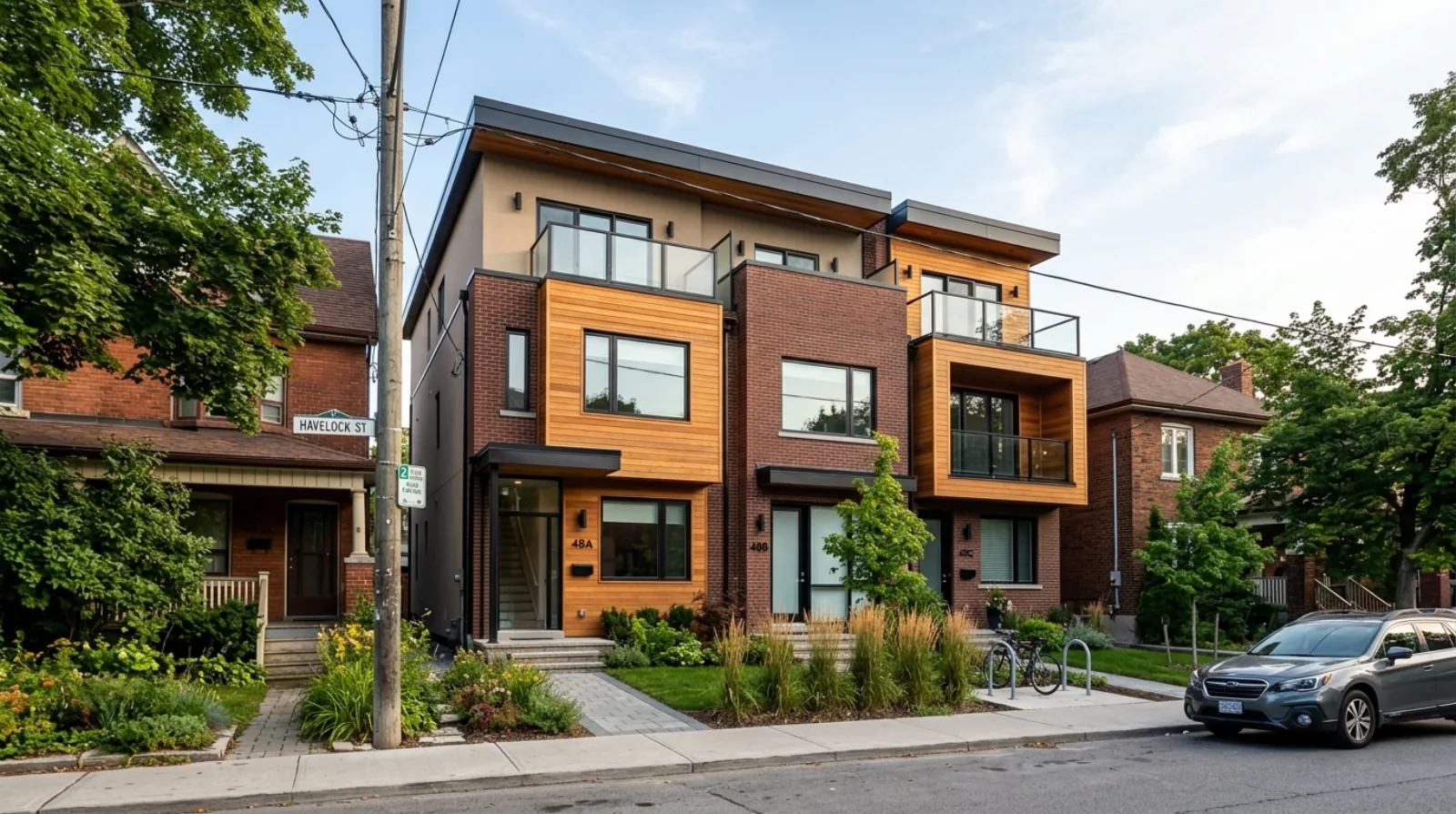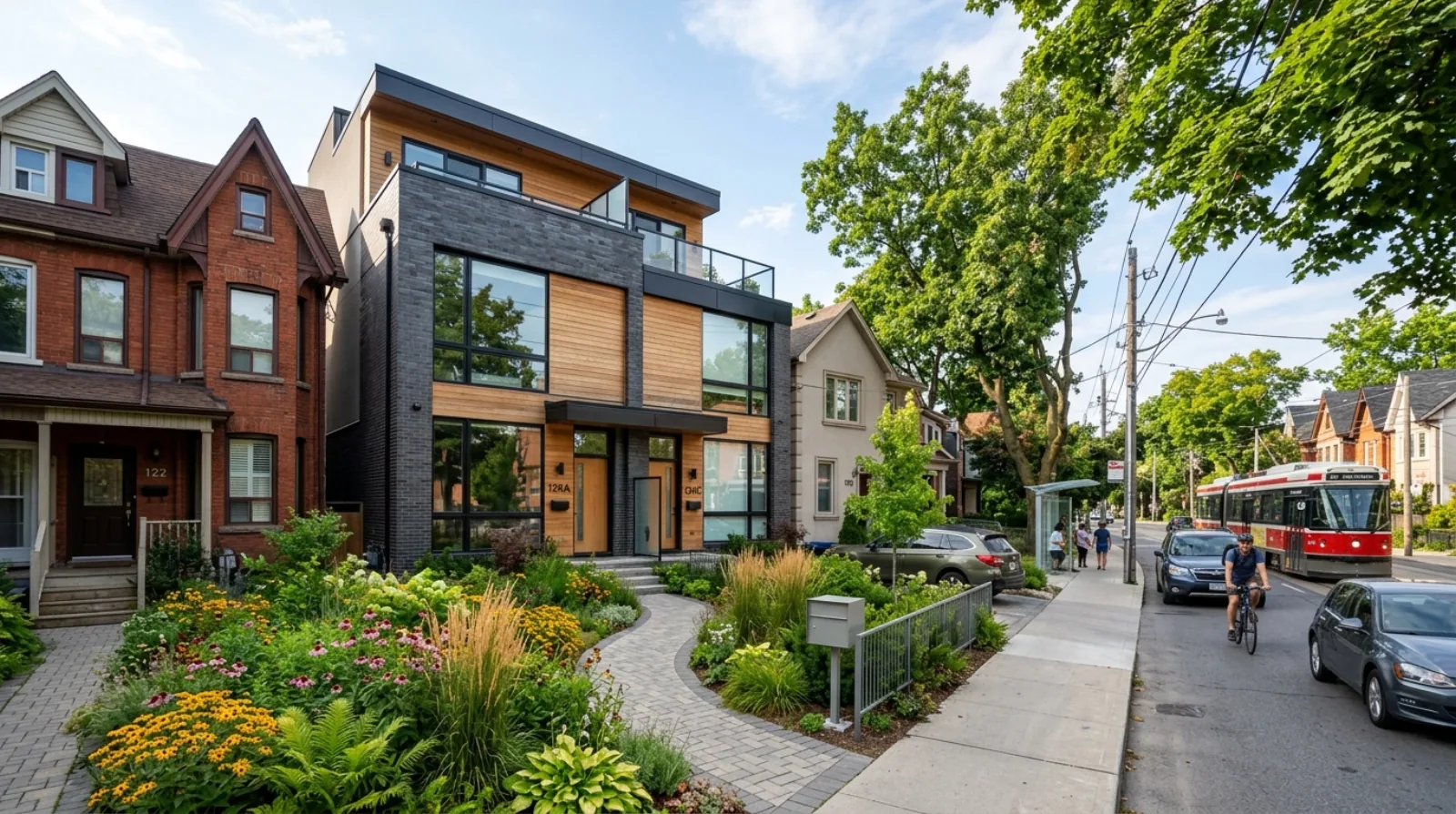

A Toronto fourplex with a landscaped front yard and walkway instead of a parking pad, on a transit-served street
Missing Middle

No Parking Required: How Toronto's 2022 Reform Changed the Multiplex Math

6 min read

Since February 2022, a Toronto duplex, triplex, or fourplex needs no parking spaces at all. That one change quietly reshaped what fits on a lot and what it costs to build. Here's the math.

Key takeaway

On December 15, 2021 (item PH29.3), Toronto City Council removed most minimum parking requirements; the change came into force February 3, 2022.

Duplexes, triplexes, and fourplexes now require no parking spaces. Removing the minimum frees land and floor area on a typical lot, cuts construction cost, and matches how transit-served residents actually travel. Accessible-parking requirements were retained.

What this covers

  • Toronto parking minimum removal 2022
  • no parking fourplex
  • PH29.3 parking reform
  • multiplex floor area savings
  • transit-oriented parking
  • accessible parking exception
toronto parking multiplex fourplex missing-middle zoning

For most of the last century, the single biggest thing forcing the shape of a small Toronto building was the parking minimum. Every unit needed a space, and every space ate land, floor area, and money. On February 3, 2022, that requirement went away for most new development. If you are building a duplex, triplex, or fourplex in Toronto today, the by-law no longer makes you put in a single parking space. That one change quietly rewrote the multiplex math.

TL;DR

  • Toronto City Council removed most minimum parking requirements on December 15, 2021 (item PH29.3); the change took effect February 3, 2022. Source: toronto.ca.
  • Since then, a duplex, triplex, or fourplex requires zero parking spaces as-of-right.
  • Removing the minimum frees the land and floor area a ramp, drive aisle, or pad would have consumed — so more of the lot goes to living space.
  • This is a city-wide rule, not a downtown-only one. It applies in transit-rich Old Toronto and in lower-density wards alike.
  • Accessible and bicycle parking rules still apply and were updated February 5, 2025 (effective March 31, 2025).
  • This sits on top of Toronto’s city-wide fourplex by-law (up to 4 units, adopted May 2023).

What actually changed in 2022

Before the reform, Toronto’s zoning by-law set a minimum number of parking spaces per dwelling unit. A four-unit building could be forced to provide several spaces, each one a slab of land you could not use for anything else. The Council decision on December 15, 2021 removed most of those minimums across the city. It did not cap parking — you can still build it if you want it — it just stopped requiring it. The full record is on the City’s parking requirements review page.

The City’s own considerations for building multiplexes states it plainly: as of February 3, 2022, duplex, triplex, and fourplex forms require no parking.

Why a parking space costs more than a parking space

A required space is never just the footprint of a car. To make it usable you need a driveway or drive aisle to reach it, turning room, and often a curb cut. On a narrow Old Toronto lot — the deep, skinny lots that back onto laneways — a drive aisle can swallow a quarter of the buildable width. That width is exactly where you would otherwise put a unit, a stair, or a wider main floor.

Toronto’s multiplex envelope already gives builders room. The City’s multiplex considerations page notes that the maximum FSI (“d” value) does not apply to multiplexes, though lot-coverage limits and setbacks still do. Drop the parking requirement on top of that, and the constraint that used to decide your unit count — can I fit the cars? — disappears. Now the question is the one that should have mattered all along: how many good units fit the envelope?

The transit context

Toronto did not remove parking minimums in a vacuum. The lots best suited to fourplex conversions — Leslieville, Riverdale, the Junction, Danforth–Pape, the Annex — sit on the subway and streetcar network. A household near Line 2 or a streetcar route may not own a car at all. Forcing a developer to build a space that the eventual tenant will not use was a pure waste: it raised the cost of the unit and lowered the number of units, with no benefit to the renter.

The province later reinforced the direction. Bill 23, which received Royal Assent on November 28, 2022, barred municipalities from requiring more than one parking space per unit on as-of-right three-unit projects. Source: ero.ontario.ca. Toronto had already gone further by removing the minimum entirely.

The one exception: accessible parking

“No required parking” is not quite “no parking rules.” Accessible-parking and visitor-parking provisions were retained, and the City updated its accessible and bicycle parking rules on February 5, 2025, in force March 31, 2025. If your project type triggers an accessible-space requirement, you still provide it. For a typical small as-of-right multiplex on a building permit, the practical takeaway holds: you are not forced to build general parking. Confirm your specific case against the current zoning by-law before you finalize a layout.

What this means for the pro forma

The arithmetic is simple. Land you do not pave is land you can build on. Floor area you do not give to a drive aisle is floor area you can rent. For a builder running the numbers on a Toronto fourplex, removing the parking minimum does two things at once: it lowers hard cost (no slab, no ramp, no curb cut) and it raises the rentable area on the same lot. That is the rare reform that improves both sides of the ledger.

If you are weighing Toronto against another Ontario market, the parking treatment is one of the lines worth comparing directly — see Toronto vs Ottawa.

For the full picture on Toronto’s multiplex rules, start with the Toronto Multiplex hub. To run this arithmetic on a real lot instead of a worked example, put your address into PlexCheck, which models the units with no parking requirement.
Frequently asked questions

Do I need parking for a duplex, triplex, or fourplex in Toronto?

No. Since February 3, 2022, a duplex, triplex, or fourplex in Toronto requires zero parking spaces as-of-right. Toronto City Council removed most minimum parking requirements through a decision made on December 15, 2021, item PH29.3, and the change took effect on February 3, 2022.

When did Toronto remove its parking minimums for small residential buildings?

Toronto City Council made the decision on December 15, 2021, under item PH29.3, and the change took effect on February 3, 2022. The reform did not cap parking, meaning a builder can still choose to build it, but it stopped requiring it for most new development.

Does Toronto's no-parking rule only apply downtown?

No. The rule is a city-wide policy, not a downtown-only one. It applies equally in transit-rich areas of Old Toronto and in lower-density wards elsewhere in the city, which distinguishes it from many multiplex rules that vary by ward or zone.

Why does removing a parking requirement matter for a Toronto fourplex budget?

A required parking space is never just the footprint of a car. Making a space usable requires a driveway or drive aisle to reach it, turning room, and often a curb cut, and on a narrow Old Toronto lot a drive aisle can take up a quarter of the buildable width, space that would otherwise hold a unit, a stair, or a wider main floor. Removing the parking minimum lowers hard construction cost, since there is no slab, ramp, or curb cut to build, and raises the rentable floor area on the same lot at the same time.

Are there any parking rules that still apply to a Toronto multiplex?

Yes. Accessible-parking and visitor-parking provisions were retained even after the 2022 reform, and the City updated its accessible and bicycle parking rules on February 5, 2025, effective March 31, 2025. If a specific project type triggers an accessible-space requirement, that space still has to be provided, so a builder should confirm their specific case against the current zoning by-law before finalizing a layout.

How does Bill 23 relate to Toronto's parking minimum removal?

Bill 23, which received Royal Assent on November 28, 2022, barred Ontario municipalities from requiring more than one parking space per unit on as-of-right three-unit projects. Toronto had already gone further than that provincial floor by removing the parking minimum entirely for duplexes, triplexes, and fourplexes as of February 3, 2022.

Why were Toronto's old parking minimums considered wasteful near transit?

The lots best suited to fourplex conversions, including Leslieville, Riverdale, the Junction, Danforth-Pape, and the Annex, sit on the subway and streetcar network, where a household near a rapid transit line may not own a car at all. Forcing a developer to build a parking space that the eventual tenant would not use raised the cost of the unit and lowered the number of units that could fit, without any benefit to the renter.

How does the parking reform affect the financial numbers on a Toronto multiplex project?

Removing the parking minimum improves both sides of a builder's pro forma at once: land that does not need to be paved for parking becomes land that can be built on, and floor area that does not go to a drive aisle becomes floor area that can be rented. This applies on top of Toronto's multiplex rule that the maximum floor space index does not apply to multiplexes, though lot-coverage limits and setbacks still do.

PlexCheck Toronto

Stop reading about the rules and check one lot

PlexCheck Toronto reads the City zoning stamped at an address, applies the multiplex unit ceiling for that zone and ward, and prices the build against CMHC survey rents for the area.

Free. City-stamped zoning and CMHC survey rents. Takes about 30 seconds.

Check a Toronto address
David Babakaiff

David Babakaiff

Co-Founder, VanPlex | 25+ Years BC Construction

David Babakaiff is Co-Founder of VanPlex with 25+ years scaling BC construction. He led Alair Homes Vancouver to the 2024 HAVAN Award for Best Multiplex Unit in the GVRD. VanPlex’s PlexRank™ algorithm scores residential parcels across BC for multiplex conversion potential under Bill 44.

Want insights like this delivered weekly?

Join 2,500+ property owners getting ROI case studies, market data, and exclusive opportunities.

No spam. Unsubscribe anytime.