
Surrey announced fresh cuts yesterday. Vancouver moved in December. Metro Vancouver reversed course in April. Kelowna is exploring. Victoria is halfway through a one-year permit holiday. Port Moody has been at this quietly for years. Stack every program a Vancouver builder can claim, and total relief lands at roughly 2% of project cost. Most GVRD cities haven’t moved at all.
TL;DR
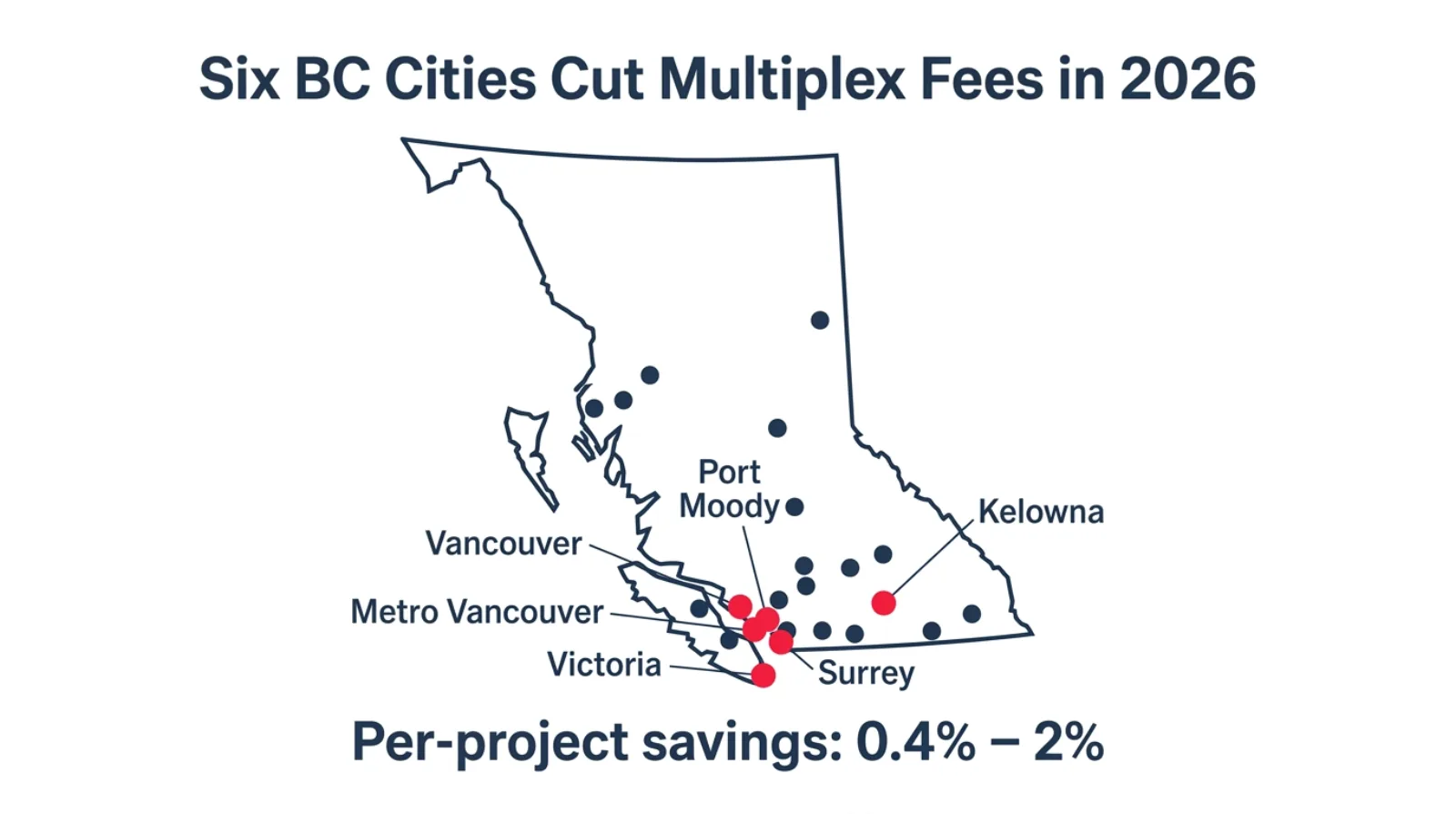
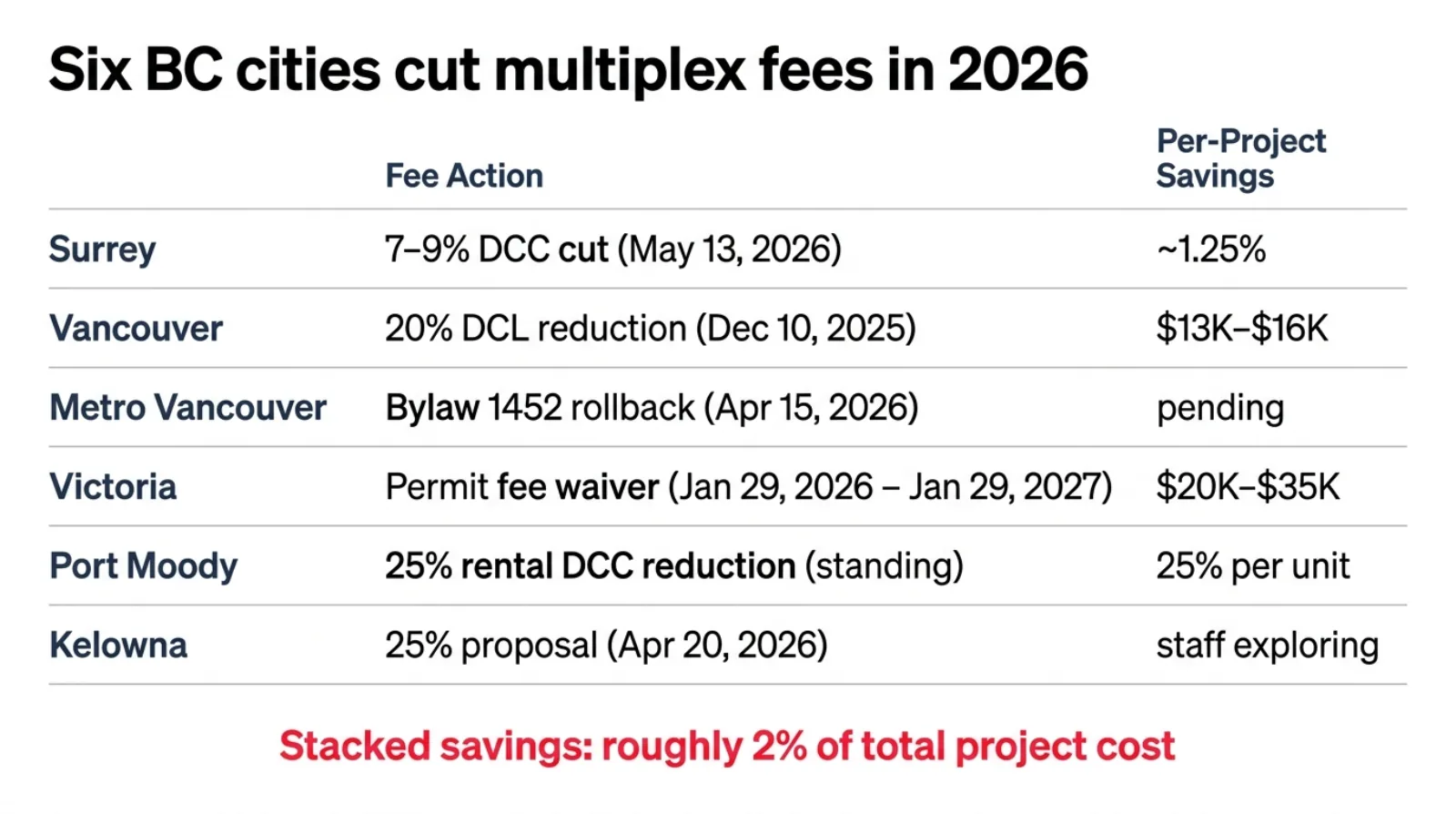
- Six BC jurisdictions have cut development fees in 2026: Surrey, Vancouver, Metro Vancouver (rollback), Victoria, Port Moody, and Kelowna (proposed).
- Stack every available program on a Vancouver multiplex and the per-project savings land between 0.4% and 2% of total project cost.
- Vancouver’s December 20% DCL cut was briefly cancelled by Metro Van’s January DCC hike — until Metro Van reversed that hike in April.
- Victoria’s one-year permit fee waiver is the largest percentage cut. A 4–6 unit multiplex saves $20K–$35K.
- Thirteen GVRD cities have not moved at all. That’s where most lots actually sit.
- The fee cuts don’t elevate marginal lots into viability. The three numbers that decide whether a multiplex pencils are units per lot, land basis, and exit price per square foot.
Surrey: the newest and most aggressive move (May 13, 2026)
Surrey already rolled back residential DCCs to 2023 rates in March 2025, with a freeze running through May 2027. Yesterday, Council approved a proposal to cut 2026 DCC rates an additional 7–9% below 2024 levels. The bylaw goes to the province for approval, then back to Council for final adoption.
Per Surrey’s own published comparison, single and small-scale housing DCCs in Surrey currently run $51,633 per unit, versus $87,615 in the Township of Langley. Surrey is now arguably the most aggressive fee-cutter in the GVRD.
Mayor Brenda Locke’s framing: “If we want people to be able to live and buy a home in Surrey, we need to make housing more affordable to build.”
Vancouver: 20% off, then Metro Van stepped in, then reversed
On December 10, 2025, Vancouver City Council approved a temporary 20% reduction across all Development Cost Levies. The City-wide DCL dropped from $62.35/m² to $49.88/m². The Utilities DCL dropped from $48.83/m² to $39.06/m². Combined rate moved from $111.18/m² to $88.94/m².
Run it on a typical 6-unit multiplex at 560 m² of buildable area:
| Metric | Pre-cut | Post-cut | Delta |
|---|---|---|---|
| City-wide DCL | $34,916 | $27,933 | -$6,983 |
| Utilities DCL | $27,345 | $21,874 | -$5,471 |
| Combined DCLs | $62,261 | $49,806 | -$12,455 |
Across the typical multiplex range, headline savings come in at $13K to $16K per project.
Then Metro Vancouver moved in the opposite direction. Effective January 1, 2026, regional Development Cost Charges — collected on top of city DCLs — jumped from $21,941 per unit to $29,197 per unit. The 2027 rate was already legislated at $34,133.
On that same 6-unit multiplex:
| Year | Metro Van DCCs (6 units) |
|---|---|
| 2025 rate | $131,646 |
| 2026 rate | $175,182 |
| Increase | +$43,536 |
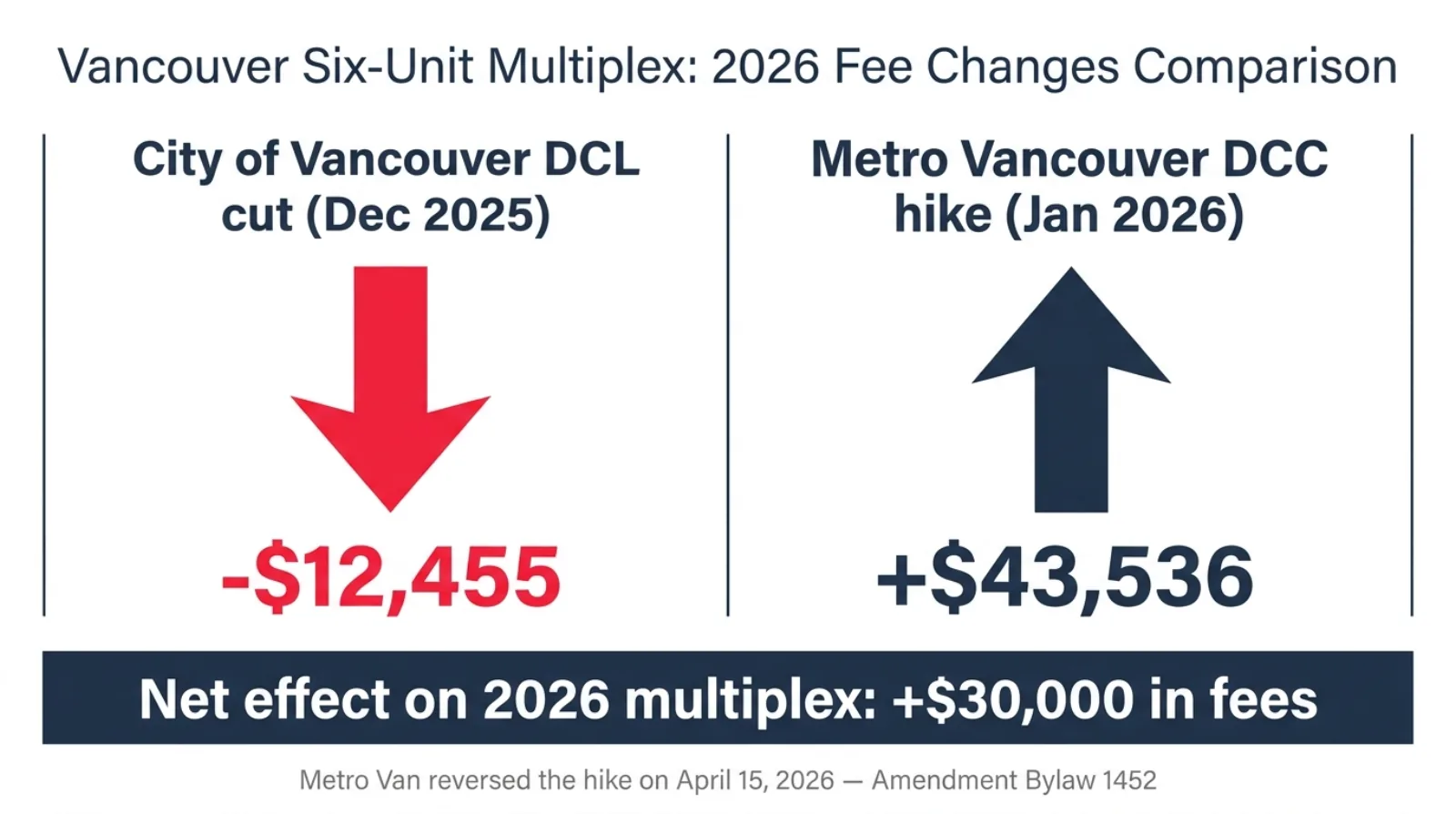
The City of Vancouver cut $13K. Metro Vancouver added $43K. Net effect on a 2026 multiplex starter: roughly $30,000 more in total fees than the same project paid in 2025.
Then this April, Metro Vancouver reversed itself.
Metro Vancouver regional rollback (April 15, 2026)
The Metro Vancouver Board voted to roll back the January 1, 2026 DCC increase to 2025 rates, reduce the planned 2027 increase, and extend the move to a 1% assist factor from 2027 to 2029. Amendment Bylaw 1452 is now pending provincial Inspector of Municipalities approval. Implementation expected June or July 2026 once approved. Total revenue impact between $246M and $389M depending on the final option.
Two timing notes that matter for any project in the queue right now. There will be no retroactive refunds for fees already paid in Q1 and Q2 of 2026. Rate certainty doesn’t return until the bylaw is finalized.
If the rollback lands as expected, the Vancouver math flips back. The 20% DCL cut becomes net positive again at roughly $13K–$16K per project, with no offsetting Metro Van increase. That’s still a single-digit percentage of a $2.4M–$3.5M Vancouver multiplex build cost.
Victoria: largest percentage, tight window
From January 29, 2026 through January 29, 2027, the City of Victoria is waiving municipal permit fees for planning and development activities. Mayor Marianne Alto pushed the Development Fee Waiver Bylaw through ahead of the 2026 budget.
For a 4–6 unit missing middle multiplex, savings land at $20,000–$35,000. Smaller infills on already-zoned lots save $8K–$12K. Larger projects requiring rezoning, a public hearing, and a floor area assessment save closer to $35K.
The most generous of the six programs as a percentage of fees waived. Also the smallest market and the tightest window. A project starting rezoning today is cutting the application deadline close.
On a $2.5M Victoria multiplex, $30K in fee savings is 1.2% of total project cost.
Port Moody: the standing multiplex incentive
Port Moody has a standing DCC Reduction Bylaw offering a 25% per-unit reduction for “for-profit affordable” development — broadly, multiplex projects secured as rental tenure. The non-profit version goes to 50%.
This one rewards a tenure decision rather than a timing decision. It’s not a market response to slowing starts. It just sits there waiting for builders willing to register rental on title.
Port Moody is a smaller market than Vancouver, Surrey, or Burnaby. But for a builder evaluating where to commit a build-to-rent multiplex, it’s the most generous standing per-unit reduction in the GVRD.
Kelowna: 25% proposed, still in exploration
April 20, 2026, Mayor Tom Dyas brought a motion directing staff to explore a 25% DCC reduction over a two-year period. Council passed it 5–2. Staff are still working through the policy. It has not yet been approved into bylaw.
Per city staff’s own analysis, DCCs make up only 3–6% of a Kelowna project’s total cost. A 25% reduction on a 5% line item is a 1.25% reduction on the project. On a $1.5M Kelowna multiplex, that’s roughly $19K in fee savings.
Councillor Stack stated publicly that a 20–25% reduction “may not be enough to spur stalled projects.” He’s right about the math. New multiplex sells at roughly $570/sf in Kelowna versus $1,100/sf in the City of North Vancouver. A 50% revenue gap doesn’t close on a 25% cut to 5% of project costs.
The thirteen GVRD cities that aren’t moving
Burnaby. Coquitlam. Richmond. City of North Vancouver. District of North Vancouver. New Westminster. West Vancouver. Delta. Port Coquitlam. Maple Ridge. Pitt Meadows. Langley City. Langley Township. White Rock.
None of them have a fee reduction program aimed at multiplex or general housing supply right now. New Westminster did adopt an updated DCC bylaw on January 12, 2026 — but that change added fire protection and police facility categories. Rates went up, not down.
That’s where most GVRD lots actually sit.
The common number: still one percent
Stack every program a Vancouver builder can claim — the 20% DCL cut, the Metro Van rollback once approved, the BC-wide DCC deferral that took effect January 1, 2026, and a multiplex targeting 2027 completion is looking at roughly 2% off total project cost. Surrey and Kelowna builders see 1.25%. Victoria builders see 1.2%. Port Moody builders who commit to rental tenure see the best of the group, but the underlying DCC base in Port Moody is moderate to begin with.
That’s real money saved. It’s not the lever that turns a non-viable project into a viable one.
The macro story: BC’s own projection is already behind pace
When the BC Ministry of Housing modelled Bills 44 and 47 in late 2023, it projected the combined legislation would deliver between 216,000 and 293,000 net-new housing units over ten years — roughly 22,000 to 29,000 units per year at the high end of the range.
Two years in, the early data is well below that pace.
CMHC’s Spring 2026 Housing Market Outlook projects BC housing starts will drop sharply in 2026–2027 to historically weak levels. Total urban starts in 2025 came in at 41,532, down 5% from 2024. The Q1 2026 CHBA Housing Market Index — measuring builder confidence in homeownership construction — landed at 20.9 for single-family (1.3 points above the all-time record low) and 13.4 for multi-family (a third consecutive record low). Ontario and BC are leading the national pessimism.
The multiplex piece, specifically, is moving on paper but not yet through to completion. Vancouver has 518 multiplex applications representing roughly 2,200 dwelling units in its R1-1 pipeline. The first wave of completed multiplexes only appeared in Fall 2025 — two years after Bill 44 passed. A larger wave is expected this spring. CBRE projects an ongoing pace of 40–50 multiplex land transactions per year in Vancouver as the functioning baseline.
Bill 44 made multiplexes legal. It didn’t make them profitable. The fee cuts coming out of six BC jurisdictions are an implicit admission that supply targets aren’t being hit on the original schedule. Whether those cuts move the needle enough to recover the ten-year trajectory depends on factors that have nothing to do with municipal fees.
Where the math actually moves
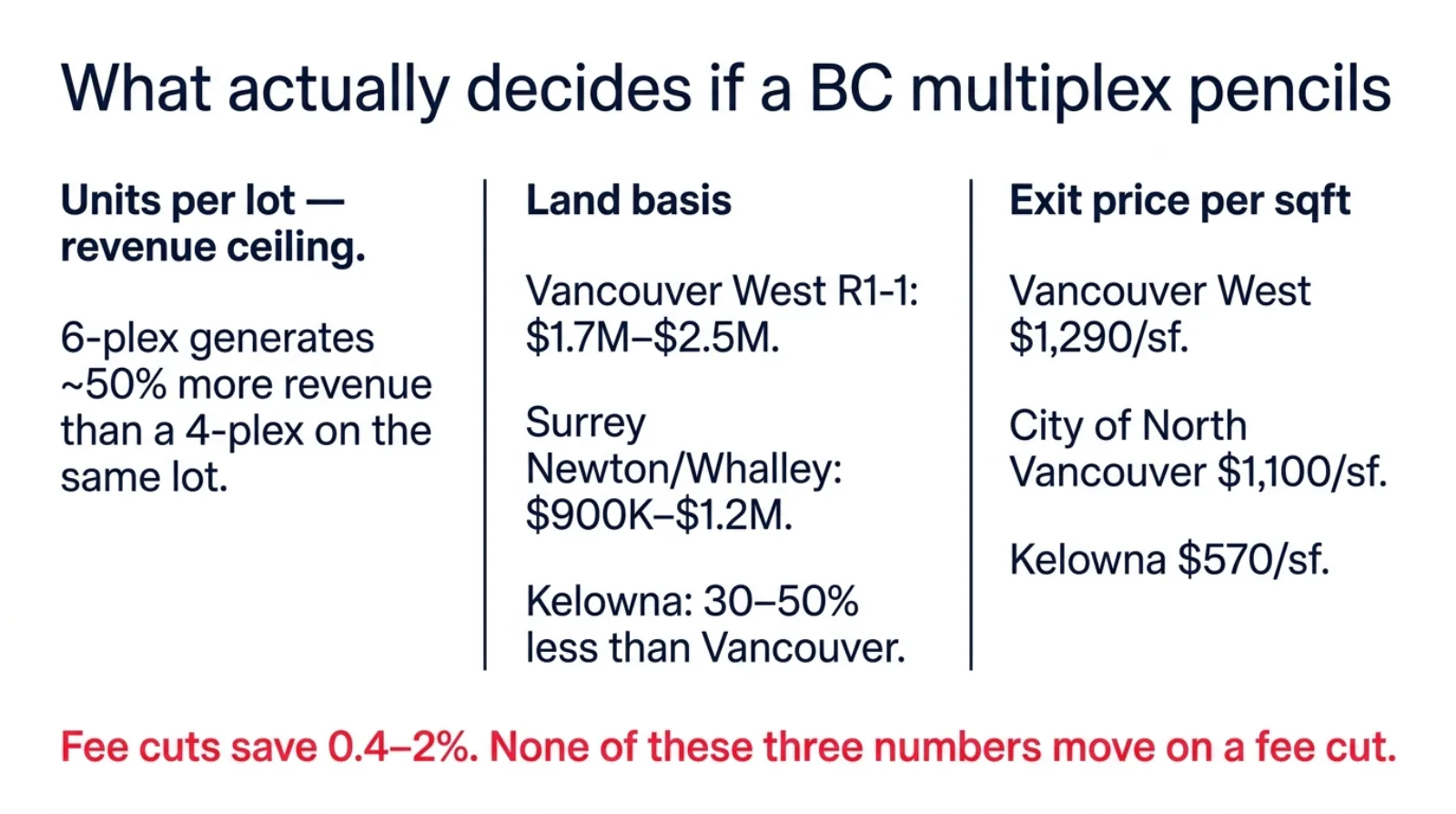
A multiplex pencils or doesn’t based on three structural inputs, in this order.
Number of units and square footage per lot. This is the revenue ceiling. A lot that fits a 6-plex generates roughly 50% more revenue than the same lot constrained to a 4-plex. Frontage, lot depth, setback rules, FSR limits, transit proximity — all of these collapse into how much sellable square footage the parcel produces.
Cost of the lot to purchase. Land basis is the largest single input cost in most BC multiplex builds, and the spread across the province is enormous. A West Side Vancouver R1-1 lot runs $1.7M–$2.5M. The same SSMUH-eligible lot in Surrey’s Newton or Whalley runs $900K–$1.2M. Kelowna lots cost roughly 30–50% less than Vancouver lots for comparable footprints. The cheaper land doesn’t always win, because revenue moves too.
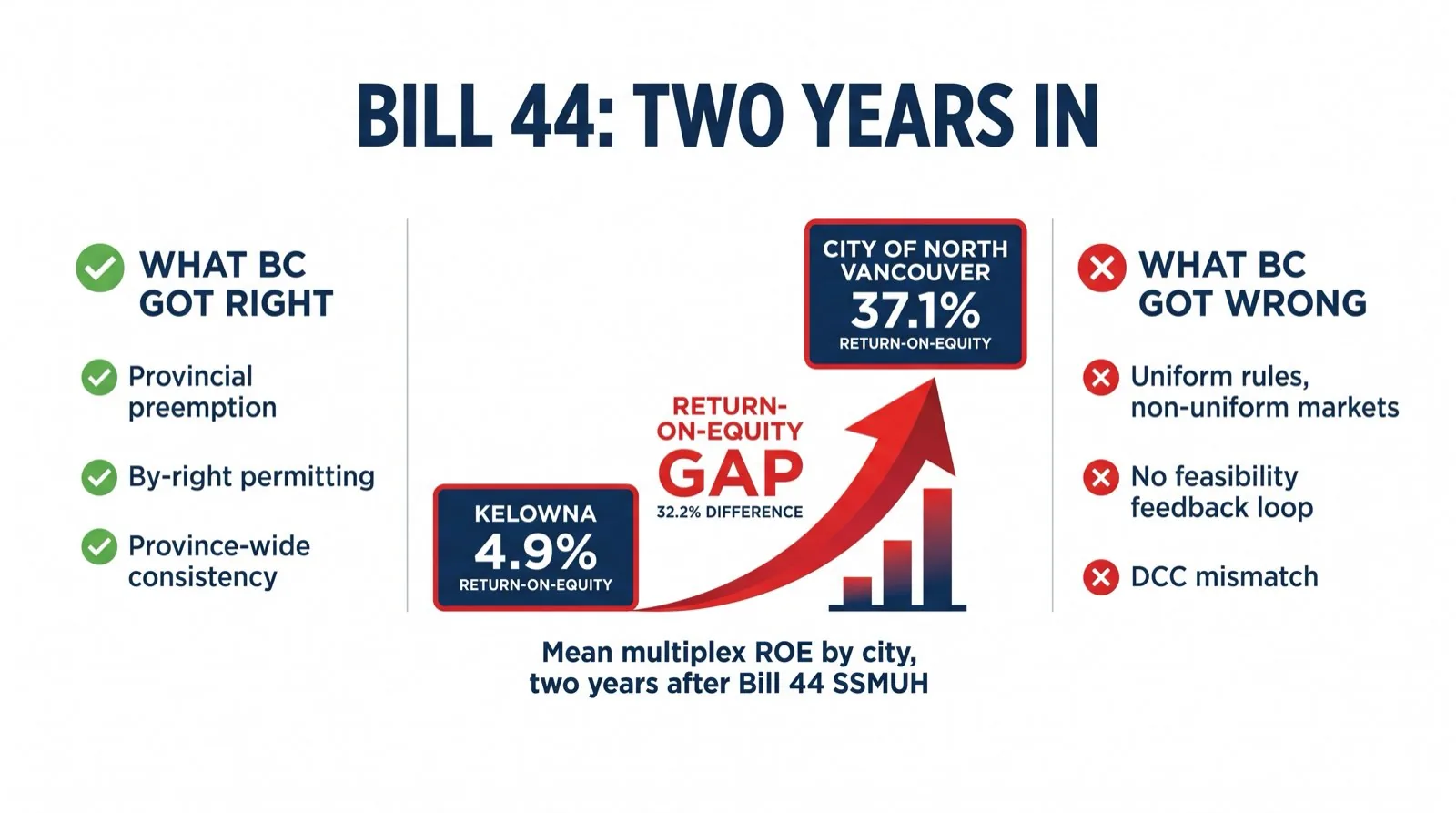
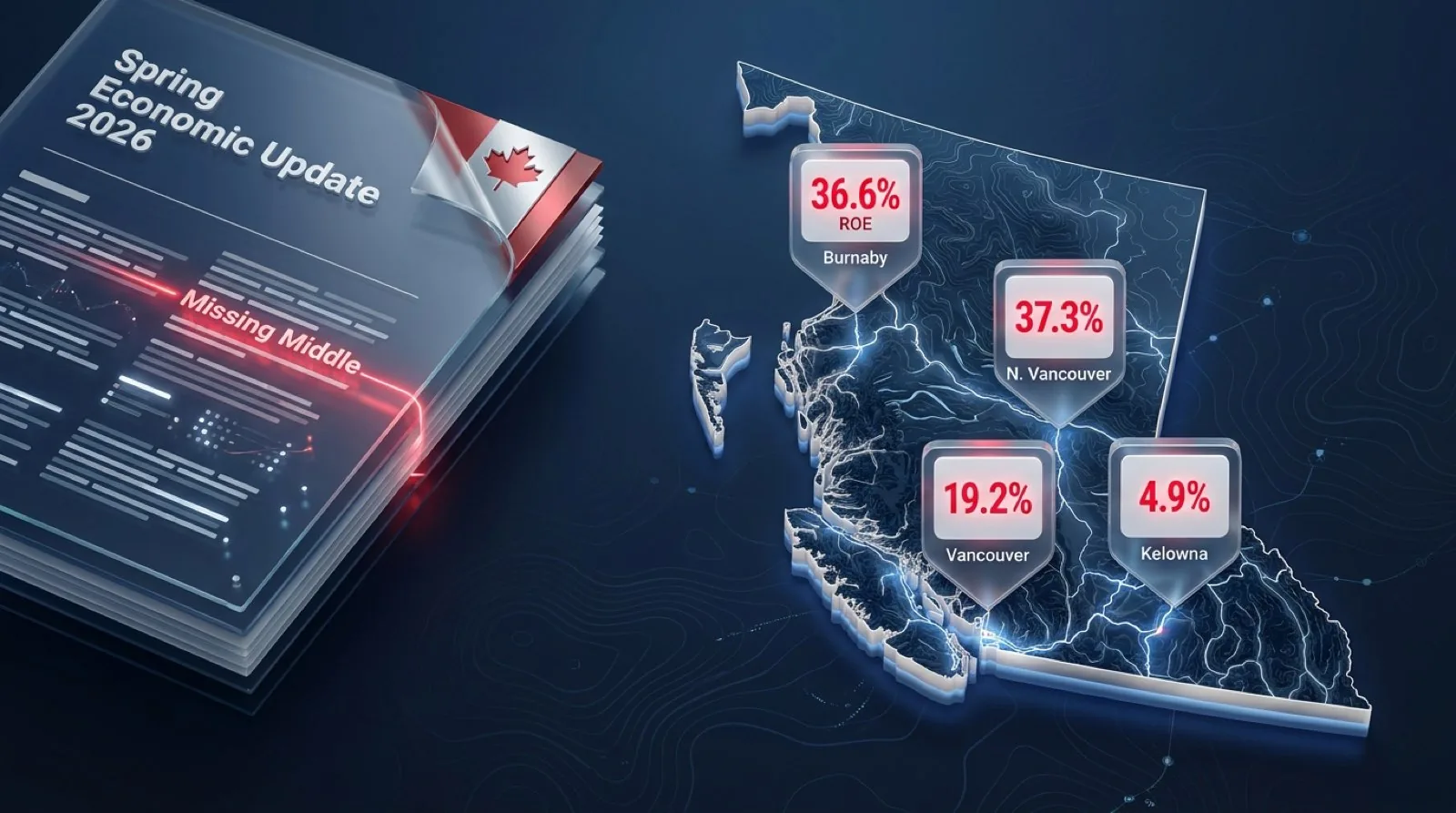
Sales price for new multiplex units in that location. This is what the project exits at, and it varies more by location than almost any other input. New multiplex sells at roughly $1,290/sf in Vancouver West, $1,100/sf in the City of North Vancouver, and $570/sf in Kelowna. A 50% revenue gap against a 25% cost gap is what produces a 32-point ROE spread on identical zoning across BC.
Get those three numbers right and the project pencils. Get one of them wrong and no fee cut anywhere in BC closes the gap.
PlexRank™, VanPlex’s internal screening system, sorts BC parcels by projected return on equity precisely because the spread between viable and non-viable lots is so wide that fee-level optimization doesn’t matter if the underlying three numbers are wrong. The fee cuts help confirmed Alpha lots clear viability thresholds faster. They don’t elevate marginal lots into the viable tier.
What this means for investors
The fee cut headlines are real. They’re not the signal worth tracking. Three signals that actually matter right now.
Which of the six fee programs survive provincial approval and final adoption. Metro Vancouver’s rollback is the biggest pending mover. Surrey’s May 13 proposal is the next one in queue.
Which lots in the thirteen non-participating cities — Burnaby, Coquitlam, Richmond, both North Vans, and the rest — still pencil at current rents despite zero municipal incentive.
Which credit unions and CMHC programs are actually writing multiplex construction debt at scale today.
VanPlex is actively running co-investment scenarios on BC parcels where the underlying lot math works regardless of what cities do with fees. If you’re an accredited investor evaluating multiplex exposure in 2026, the conversation worth having is about specific PlexRank-screened lots, capital structure, and timeline — not about chasing the next municipal fee announcement.
Reach out to david at vanplex.ca to discuss current co-investment opportunities. Or DM on LinkedIn.
— David Babakaiff, Co-Founder & CEO, VanPlex — PlexRank™ | Profit with Multiplex
In the news this week
Vancity passes $60M in multiplex construction debt. April 8, 2026: Vancity’s multiplex construction mortgage program, launched Fall 2025, has now financed 45 projects worth $60.4M in approvals. Up to 80% loan-to-cost, 18 months interest-only during construction, rental offset to help qualify. The Big Six remain largely absent from sub-$5M deals.
CBRE pegs Vancouver multiplex sales floor at 40–50 deals per year. 46 multiplex land sales totalling $114M in 2025, down from 124 sales and $303M in 2024. CBRE reads this as maturation, not retreat. The 2024 zoning surge was a one-time event. 40–50 deals per year is the functioning baseline going forward.
BC’s province-wide DCC deferral takes effect. January 1, 2026: BC developers can pay 25% of DCCs at permit issuance and defer the remaining 75% to occupancy or four years out. Doesn’t reduce gross fees, but shifts construction-phase cash flow where carrying cost is the binding constraint.
Province moves to expand DCC waiver categories. April 1, 2026: Minister Boyle introduced legislation amending the Local Government Act, the Vancouver Charter, the GVS&DD Act, and the South Coast British Columbia Transportation Authority Act to allow new project categories to qualify for DCC waivers. Currently only not-for-profit rental and student housing qualify. New regulations to follow, and municipalities and TransLink choose whether to opt in.