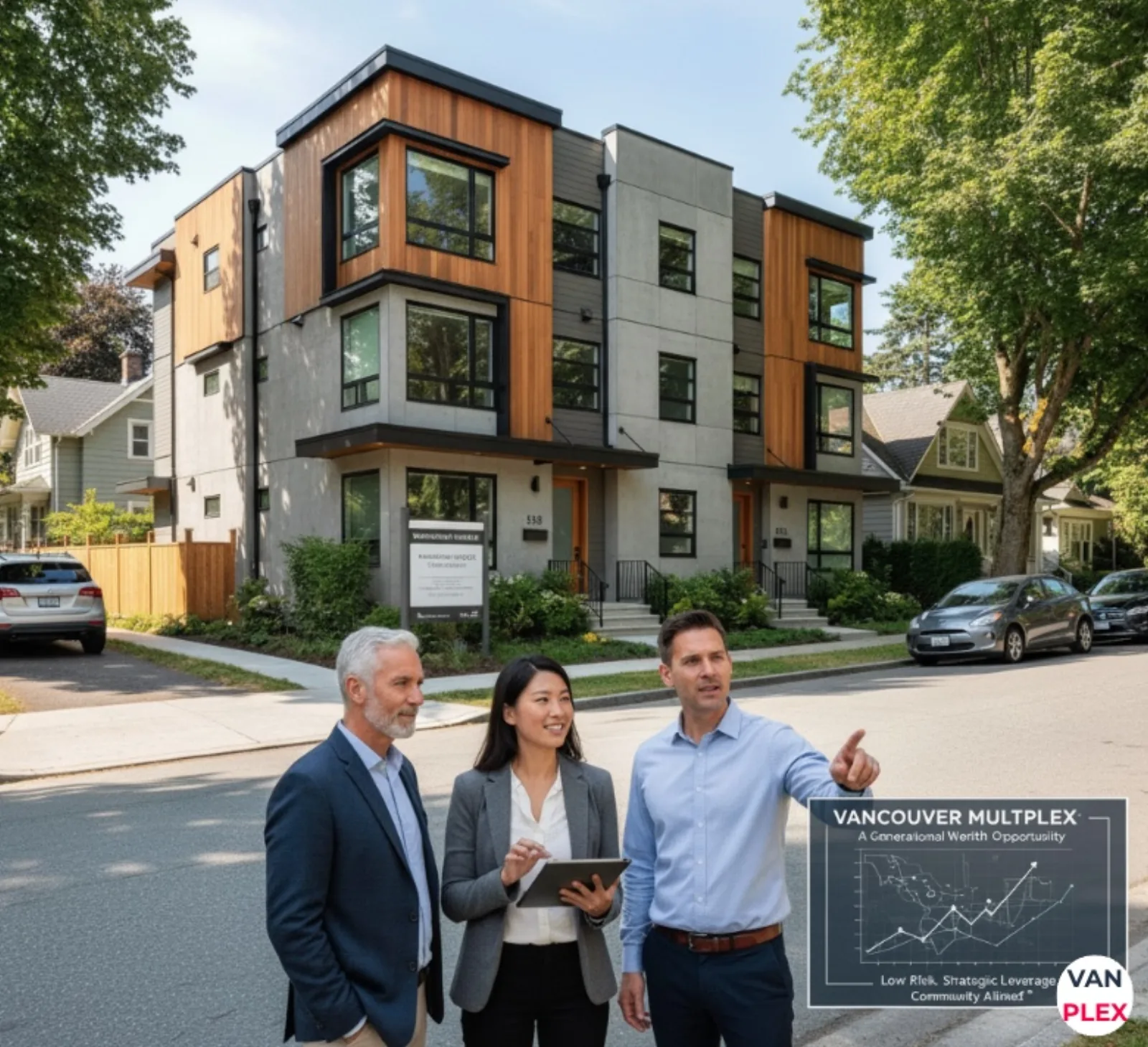

Data-driven institutional investors analyzing Vancouver multiplex arbitrage opportunities
Institutional Investment Featured

The Multiplex Arbitrage: A New Alpha Opportunity for Data-Driven Investors

8 min read

Institutional investors face compressed returns in traditional multifamily markets. Vancouver's Bill 44 has created a measurable pricing inefficiency—a temporary arbitrage opportunity where land values lag buildable capacity. Learn how data-driven analysis can capture alpha before pricing equilibrium is reached.

Key takeaway

Analysis of the temporary pricing arbitrage created by Bill 44 in Vancouver's multiplex market, explaining how institutional investors can use data-driven screening tools to identify and capture alpha before market pricing reaches equilibrium.

What this covers

  • pricing arbitrage
  • land value vs buildable value
  • AI-enabled screening
  • portfolio efficiency
  • speed-to-market advantage
  • structured evaluation
institutional-investment arbitrage bill-44 vancouver multiplex alpha

Across global real estate markets, institutional investors are navigating a familiar tension: capital commitments remain high, but scalable opportunities to generate differentiated performance have become increasingly limited.

Rising interest rates, inflationary construction costs, and extended project timelines have compressed returns across traditional multifamily and commercial segments. In many portfolios, new deployment has slowed, not for lack of capital, but for lack of clarity on where sustainable alpha can still be found.

In Vancouver and Burnaby, however, a structural shift is underway that warrants closer examination. Zoning reform, technology adoption, and early-stage pricing inefficiencies have combined to open a new category of investable real estate: the multiplex market. The investment overview at VanPlex is a good starting point for institutional and accredited investors evaluating entry.

For institutions that rely on data-driven analysis and disciplined underwriting, this market represents a short window of measurable inefficiency—one that can be evaluated, modeled, and scaled within existing real-asset frameworks.

The Pricing Gap: Land Value vs. Buildable Value

In December 2023, British Columbia enacted Bill 44, a major zoning reform allowing three- to six-unit multiplex developments by right on more than 70,000 single-family parcels across Vancouver and Burnaby.

This change removed much of the entitlement risk that previously limited medium-density infill. Yet, in many cases, land values have not fully adjusted to reflect this expanded development potential.

For institutional investors accustomed to underwriting stabilized multifamily assets, this creates a measurable period of price discovery. Parcels once valued primarily on single-family use now carry multiplex entitlements, but market pricing often lags behind their new buildable value.

That disconnect, between current pricing and latent density, is creating a temporary data-driven arbitrage. The opportunity lies not in speculation, but in identifying where market valuation and zoning capacity are misaligned.

Technology Is the New Edge

Historically, fragmented data and inconsistent zoning interpretation made small-lot infill nearly impossible to scale at institutional levels. Today, that barrier has been significantly reduced.

Modern AI-enabled zoning and feasibility platforms—such as VanPlex.ca’s Vancouver Multiplex Index™—aggregate permit data, comparable sales, and zoning information across thousands of parcels.

These tools allow investors and their analysts to:

  • Rapidly screen multiplex-eligible parcels by neighborhood and zoning type in Vancouver and surrounding cities
  • Quantify buildable square footage, development capacity, and potential yield ranges
  • Track permitting velocity and emerging market trends in near real-time

By standardizing data and reducing underwriting friction, technology is transforming what was once a boutique infill niche into a systematic, analyzable, and potentially scalable investment category.

In a market where speed, information, and precision increasingly determine outcomes, data—not location alone—has become the primary source of advantage.

Speed-to-Market and Portfolio Efficiency

Multiplex projects operate at a smaller scale but with inherently faster development cycles and broader diversification potential than conventional multifamily towers.

Typical timelines, from acquisition through completion, are meaningfully shorter, reducing exposure to macroeconomic volatility and interest-rate shifts. The format allows investors to deploy capital in smaller, repeatable increments, which can enhance liquidity and portfolio flexibility.

From a risk-management perspective, multiplex development enables exposure to high-demand urban housing while limiting concentration in any single asset or submarket. For many allocators, it functions as a complementary strategy within an overall multifamily portfolio.

Closing the Gap

As awareness of the multiplex opportunity grows, the current pricing inefficiency will narrow. Appraisers, lenders, and large-scale investors are already beginning to recalibrate models to incorporate multiplex entitlements.

That normalization will likely compress the spread between land value and buildable value over time. The analytical advantage currently available to data-driven investors is, therefore, finite—but actionable.

The decision point for institutions is not whether multiplex arbitrage exists, but when and how to engage in structured evaluation before pricing equilibrium is reached. Use our pro forma calculator to stress-test specific sites before committing capital.


Next Steps for Institutional Investors

  1. Assess Portfolio Exposure

    Evaluate whether existing multifamily allocations sufficiently capture Vancouver’s emerging medium-density segment. Identify potential gaps in exposure to rezoned infill assets.

  2. Adopt Data-Driven Screening Tools

    Incorporate advanced zoning and feasibility analytics—such as the Vancouver Multiplex Index™—into internal market-screening workflows to surface qualified sites and monitor value trends.

  3. Engage Local Expertise

    Partner with on-the-ground data and development teams who understand regional dynamics and execution frameworks.

    Learn more at vanplex.ca/invest.

Conclusion

Multiplex development is not a speculative surge; it represents a structural evolution in how density is delivered in supply-constrained urban markets. For institutional investors seeking analytical clarity, diversification, and exposure to policy-driven growth, it is a segment worth evaluating now while the inefficiency remains visible.


David Babakaiff

Co-Founder, VanPlex.ca

Vancouver Multiplex Index™ | Profit with Multiplex

To explore data, insights, and partnership opportunities, visit vanplex.ca/invest.

Frequently asked questions

What is the multiplex arbitrage opportunity in Vancouver's real estate market?

The arbitrage is a disconnect between current land pricing and the new buildable value that Bill 44 created. Parcels once valued mainly for single-family use now carry multiplex entitlements allowing three to six units by right, but market pricing has often lagged behind that expanded development potential. The opportunity lies in identifying parcels where market valuation and zoning capacity are misaligned, not in speculation.

How many properties did Bill 44 make eligible for multiplex development in Vancouver and Burnaby?

British Columbia enacted Bill 44 in December 2023, a zoning reform allowing three to six unit multiplex developments by right on more than 70,000 single-family parcels across Vancouver and Burnaby. This removed much of the entitlement risk, meaning the uncertainty and delay of getting a rezoning approved, that previously limited medium-density infill development on those lots.

Why do institutional investors find Vancouver's multiplex market appealing right now?

Rising interest rates, inflationary construction costs, and extended project timelines have compressed returns across traditional multifamily and commercial real estate, slowing new capital deployment industry-wide. Vancouver and Burnaby's multiplex market, created by zoning reform, technology adoption, and early-stage pricing inefficiencies, is presented as a measurable, data-driven inefficiency that institutions can evaluate and scale within their existing real-asset frameworks.

What is the Vancouver Multiplex Index and how does it help investors?

The Vancouver Multiplex Index is an AI-enabled zoning and feasibility platform built by VanPlex.ca that aggregates permit data, comparable sales, and zoning information across thousands of parcels. It lets investors and their analysts screen multiplex-eligible parcels by neighborhood and zoning type, quantify buildable square footage and potential yield ranges, and track permitting velocity and market trends close to real time.

How does technology change the ability to invest in small-lot multiplex infill at scale?

Fragmented data and inconsistent zoning interpretation historically made small-lot infill nearly impossible to scale at an institutional level. Modern AI-enabled feasibility platforms standardize that data and reduce underwriting friction, turning what was once a boutique infill niche into a more systematic, analyzable, and potentially scalable investment category.

How do multiplex project timelines compare to conventional multifamily towers for institutional portfolios?

Multiplex projects operate at a smaller scale but with faster development cycles than conventional multifamily towers, with typical timelines from acquisition through completion described as meaningfully shorter. This shorter cycle reduces exposure to macroeconomic volatility and interest-rate shifts, and lets investors deploy capital in smaller, repeatable increments that can improve liquidity and portfolio flexibility.

Is the multiplex pricing gap in Vancouver a permanent opportunity for investors?

No. As awareness of the multiplex opportunity grows, appraisers, lenders, and large-scale investors are already beginning to recalibrate their models to account for multiplex entitlements. That normalization is expected to compress the spread between land value and buildable value over time, which is why the analysis frames the current pricing inefficiency as finite, though still actionable for investors who evaluate it now.

What steps should an institutional investor take to evaluate Vancouver's multiplex opportunity?

The recommended next steps are to assess whether existing multifamily portfolio allocations already capture Vancouver's medium-density segment, adopt data-driven screening tools such as the Vancouver Multiplex Index into internal market-screening workflows, and engage local development and data teams who understand regional execution. A pro forma calculator can then be used to stress-test specific sites before committing capital.

Free 12-page guide for Vancouver-area homeowners. Build, sell, hold, or partner — side-by-side comparison of the numbers, timeline, and risk on each path.

Verified phone required. We'll text you the link in 60 seconds.

David Babakaiff

David Babakaiff

Co-Founder, VanPlex | 25+ Years BC Construction

David Babakaiff is Co-Founder of VanPlex with 25+ years scaling BC construction. He led Alair Homes Vancouver to the 2024 HAVAN Award for Best Multiplex Unit in the GVRD. VanPlex’s PlexRank™ algorithm scores residential parcels across BC for multiplex conversion potential under Bill 44.

Want insights like this delivered weekly?

Join 2,500+ property owners getting ROI case studies, market data, and exclusive opportunities.

No spam. Unsubscribe anytime.

Professional capital investors analyzing Vancouver multiplex development as a higher-return alternative to traditional multifamily
Featured
7 min read

A Higher-Return, Lower-Risk Alternative Emerging in the Multifamily Landscape

Why capital investors are reassessing small-format multifamily in Vancouver and Burnaby. Discover how multiplex projects combine operational simplicity with economic profiles that can surpass conventional multifamily assets—offering shorter development cycles, lower regulatory risk, and projected returns that merit serious institutional attention.

Institutional Investment
institutional-investmentmultifamily+8
By David Babakaiff • Co-Founder, VanPlex | 25+ Years BC Construction
Family office generational wealth opportunity through Vancouver multiplex development
Featured
9 min read

A Generational Wealth Opportunity with Low Risk and Strategic Leverage for Family Offices in Vancouver's Multiplex Market

Around the world, family offices are re-evaluating where to deploy capital. Vancouver and Burnaby's new multiplex market offers the same strategic depth as traditional multifamily with lower complexity, shorter cycles, and greater control—a rare policy-driven opportunity in a mature market.

Institutional Investment
family-officeinstitutional-investment+7
By David Babakaiff • Co-Founder, VanPlex | 25+ Years BC Construction
Vancouver institutional multifamily investment opportunities with multiplex development
Featured
9 min read

Multiplex Development Is Vancouver and Burnaby's Next Institutional Multifamily Investment Opportunity

A sweeping zoning reform and shifting economics are creating a multiplex development opportunity that mirrors early-stage multifamily cycles: fragmented, data-sensitive, and potentially lucrative for first movers with disciplined capital.

Institutional Investment
institutional-investmentmultiplex+6
By David Babakaiff • Co-Founder, VanPlex | 25+ Years BC Construction