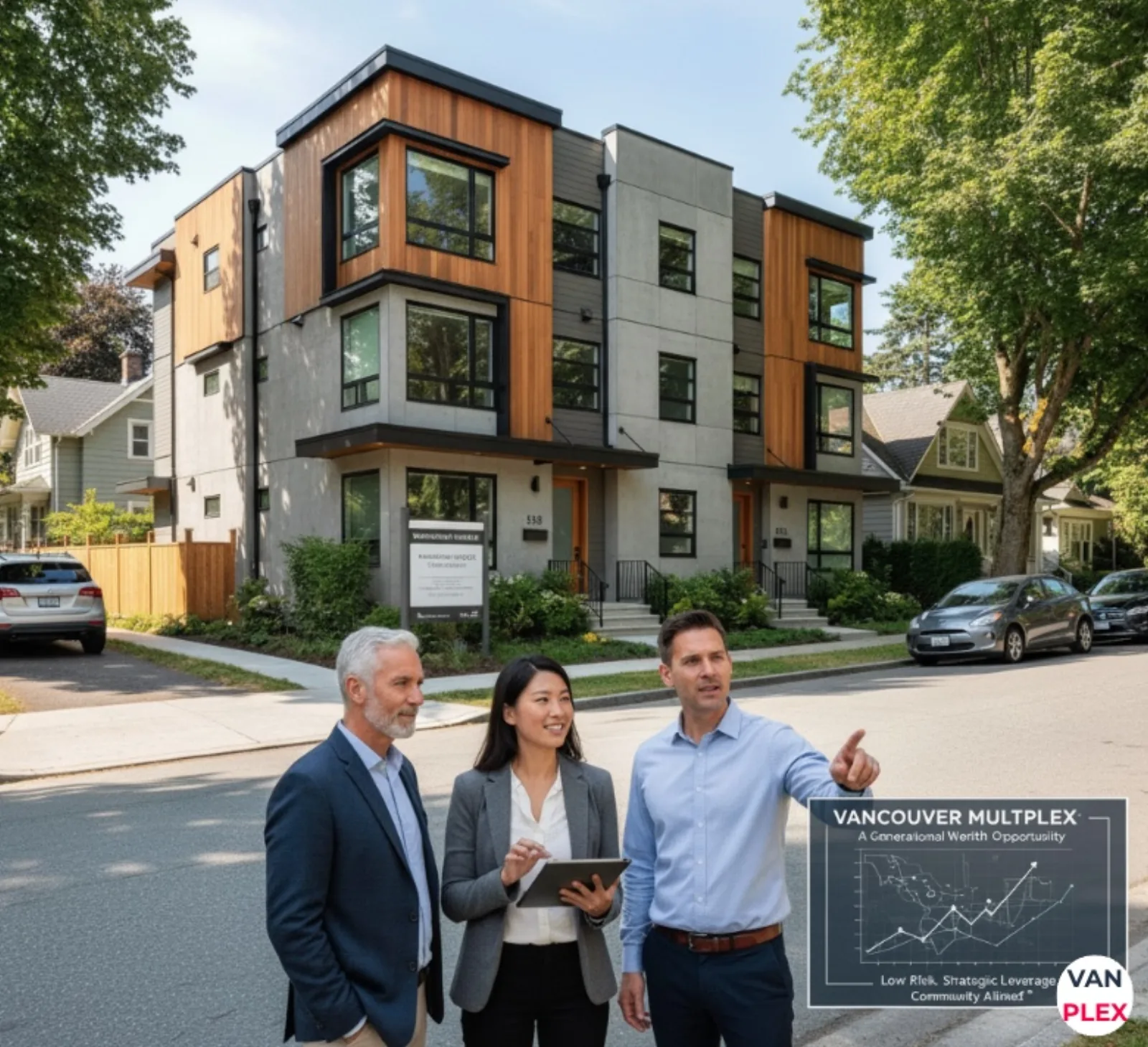

Family office generational wealth opportunity through Vancouver multiplex development
Institutional Investment Featured

A Generational Wealth Opportunity with Low Risk and Strategic Leverage for Family Offices in Vancouver's Multiplex Market

9 min read

Around the world, family offices are re-evaluating where to deploy capital. Vancouver and Burnaby's new multiplex market offers the same strategic depth as traditional multifamily with lower complexity, shorter cycles, and greater control—a rare policy-driven opportunity in a mature market.

Key takeaway

Comprehensive guide for family offices exploring Vancouver's multiplex market as a generational wealth strategy.

Explains how Bill 44 created low-risk, high-control investment opportunities through build-to-sell projects with 18-24 month cycles, technology-enabled scale, and strategic timing advantages.

What this covers

  • Bill 44 policy shift
  • family office strategy
  • build-to-sell model
  • AI-driven feasibility tools
  • risk mitigation structure
  • Vancouver market stability
  • systematic scaling approach
family-office institutional-investment generational-wealth multiplex vancouver burnaby

In Vancouver and Canada, family offices are re-evaluating where to deploy capital. Traditional multifamily projects, once favored for their scale, are now constrained by high interest rates, elongated timelines, and compressed yields. Yet in Vancouver and Burnaby, a new path has opened that offers the same strategic depth with lower complexity and greater control: small-scale multiplex development for sale.

This emerging model offers family offices the chance to participate early in a structural shift that is reshaping one of North America’s most stable urban markets.


Bill 44: The Policy Shift Behind the Opportunity

In December 2023, British Columbia’s Bill 44 transformed over 70,000 single-family parcels across Vancouver and Burnaby.

The new zoning framework allows three- to six-unit multiplexes by right, eliminating the need for individual rezoning applications.

For the first time, established residential neighborhoods can support moderate-density housing with predictable approvals. The result is a window where development potential has increased dramatically—but land pricing has not yet fully adjusted.

For investors with long-term perspective, this represents a rare timing advantage—a policy-driven opening in a mature market.

Why Multiplex Appeals to Family Offices

Unlike large multifamily towers, multiplex projects:

  • Operate on smaller, fully owned lots, reducing financing exposure.
  • Follow shorter entitlement and construction cycles (typically 18–24 months).
  • Deliver multiple units for sale on a single parcel, improving capital turnover.
  • Are located in high-demand, supply-constrained neighborhoods.

Family offices value this structure because it combines tangible real estate ownership with the agility to scale over multiple sites, balancing risk and liquidity while building assets aligned with community needs.

A Build-to-Sell Model, Not Buy-and-Hold

The Vancouver multiplex model differs from traditional income-property investing.

Projects are typically developed to sell individual units rather than held for rent, allowing investors to realize value and recycle capital efficiently.

This approach fits investors seeking:

  • Defined project horizons instead of indefinite holding periods.
  • Capital appreciation through development, not long-term tenancy.
  • Reduced operational complexity, no ongoing property management.

The focus is on executing repeatable, well-located developments that meet end-user demand for attainable ownership housing.

Technology Enables Scale and Precision

Historically, scattered-lot development was too fragmented for professional investors.

Now, AI-driven zoning and feasibility platforms—such as VanPlex.ca—enable:

  • Rapid identification of eligible parcels.
  • Instant buildable-area and financial feasibility modeling.
  • Neighborhood-level screening for price-to-potential discrepancies.
  • Benchmarking through the Vancouver Multiplex Index™, which tracks policy, pricing, and activity trends.

Technology brings transparency, consistency, and scalability, allowing family offices to approach this market with institutional rigor.

A Strategic Path for Patient Capital

Family offices are uniquely positioned to capitalize on this transition because they can move deliberately, form local partnerships, and maintain direct control over outcomes.

Key strategic principles:

  1. Asymmetric returns through AI-powered targeting
  2. Risk Hedging through Vanplex’s vertical structure
  3. Performance alignment through shared upside exposure
  4. Deal flow platform future proofing returns
  5. High Alpha conversions to legacy assets

This disciplined approach emphasizes execution quality and timing, not speculation.

Conclusion

Vancouver’s multiplex market represents a practical, mission-aligned opportunity for family capital:

  • It contributes to urban housing solutions.
  • It leverages real assets rather than financial engineering.
  • It allows wealth to compound through reinvestment and expertise.

Policy has unlocked the potential.

Technology has made it accessible.

Patient, values-aligned investors can make it durable.

For family offices seeking low-risk, high-control pathways to generational wealth, Vancouver’s multiplex market stands out as a strategic frontier designed to build and sell intelligently, not speculate. Our investment overview and development services are designed for exactly this kind of patient, structured capital deployment.

David Babakaiff

Co-Founder, VanPlex.ca

Vancouver Multiplex Index™ | Profit with Multiplex

To explore data, insights, and partnership opportunities, visit vanplex.ca/invest.

Frequently asked questions

How many properties did Bill 44 open up for multiplex development in Vancouver and Burnaby?

British Columbia's Bill 44, passed in December 2023, transformed over 70,000 single-family parcels across Vancouver and Burnaby. The new zoning framework allows three to six unit multiplexes by right on those parcels, removing the need for an individual rezoning application before construction can proceed on a qualifying lot.

Why are family offices interested in Vancouver's multiplex market instead of traditional multifamily towers?

Traditional multifamily projects are constrained by high interest rates, elongated timelines, and compressed yields, while multiplex projects operate on smaller, fully owned lots that reduce financing exposure. Multiplex projects also follow shorter entitlement and construction cycles, typically 18 to 24 months, and deliver multiple units for sale on a single parcel, which improves how quickly capital turns over.

Is the Vancouver multiplex model a buy-and-hold strategy or a build-to-sell strategy?

The Vancouver multiplex model is build-to-sell, not buy-and-hold. Projects are typically developed to sell individual units rather than held for rent, which lets investors realize value and recycle capital rather than manage tenants over an indefinite holding period. This fits investors who want a defined project horizon and capital appreciation from development rather than long-term tenancy.

What is the Vancouver Multiplex Index and what does it track?

The Vancouver Multiplex Index is a benchmarking tool referenced alongside VanPlex.ca's AI-driven zoning and feasibility platform. It tracks policy, pricing, and activity trends in the multiplex market, giving family offices a way to screen neighborhoods for price-to-potential discrepancies alongside instant buildable-area and financial feasibility modeling.

Why is there a timing advantage for investors in Vancouver's multiplex market right now?

Bill 44 increased development potential on eligible parcels, but land pricing has not yet fully adjusted to reflect that increase. For investors with a long-term perspective, this creates a policy-driven opening in a mature market where the buildable value of a lot has grown faster than its price, before the broader market catches up.

What role does technology play in scaling multiplex investment for family offices?

AI-driven zoning and feasibility platforms such as VanPlex.ca enable rapid identification of eligible parcels, instant buildable-area and financial feasibility modeling, and neighborhood-level screening for price-to-potential discrepancies. This kind of technology lets family offices bring institutional rigor to a market that was historically too fragmented across scattered individual lots for professional investors to approach at scale.

How long does a typical multiplex development cycle take for a family office investor?

Multiplex projects typically follow entitlement and construction cycles of 18 to 24 months, shorter than the timelines associated with large multifamily towers. This shorter cycle supports faster capital recycling, since an investor can complete one project and redeploy capital into the next site sooner than with a longer-hold multifamily development.

What makes family offices well suited to Vancouver's multiplex opportunity compared to other capital sources?

Family offices are positioned to move deliberately, form local partnerships, and maintain direct control over outcomes, which suits a market built on smaller, individually owned lots rather than one large asset. This patient, values-aligned approach favors execution quality and timing over speculation, treating each multiplex project as a step toward compounding wealth through reinvestment and expertise rather than a single large bet.

Free 12-page guide for Vancouver-area homeowners. Build, sell, hold, or partner — side-by-side comparison of the numbers, timeline, and risk on each path.

Verified phone required. We'll text you the link in 60 seconds.

David Babakaiff

David Babakaiff

Co-Founder, VanPlex | 25+ Years BC Construction

David Babakaiff is Co-Founder of VanPlex with 25+ years scaling BC construction. He led Alair Homes Vancouver to the 2024 HAVAN Award for Best Multiplex Unit in the GVRD. VanPlex’s PlexRank™ algorithm scores residential parcels across BC for multiplex conversion potential under Bill 44.

Want insights like this delivered weekly?

Join 2,500+ property owners getting ROI case studies, market data, and exclusive opportunities.

No spam. Unsubscribe anytime.

Professional capital investors analyzing Vancouver multiplex development as a higher-return alternative to traditional multifamily
Featured
7 min read

A Higher-Return, Lower-Risk Alternative Emerging in the Multifamily Landscape

Why capital investors are reassessing small-format multifamily in Vancouver and Burnaby. Discover how multiplex projects combine operational simplicity with economic profiles that can surpass conventional multifamily assets—offering shorter development cycles, lower regulatory risk, and projected returns that merit serious institutional attention.

Institutional Investment
institutional-investmentmultifamily+8
By David Babakaiff • Co-Founder, VanPlex | 25+ Years BC Construction
Vancouver institutional multifamily investment opportunities with multiplex development
Featured
9 min read

Multiplex Development Is Vancouver and Burnaby's Next Institutional Multifamily Investment Opportunity

A sweeping zoning reform and shifting economics are creating a multiplex development opportunity that mirrors early-stage multifamily cycles: fragmented, data-sensitive, and potentially lucrative for first movers with disciplined capital.

Institutional Investment
institutional-investmentmultiplex+6
By David Babakaiff • Co-Founder, VanPlex | 25+ Years BC Construction
Vancouver skyline representing institutional multiplex investment opportunities
Featured
10 min read

The New Frontier for Multifamily Investors: Vancouver's Multiplex Market Is Poised for Institutional Strategy

Discover how zoning reform and AI technology are creating a new institutional investment opportunity in Vancouver's multiplex market, with 100%+ ROE potential for early movers.

Institutional Investment
institutional-investmentmultiplex+5
By David Babakaiff • Co-Founder, VanPlex | 25+ Years BC Construction