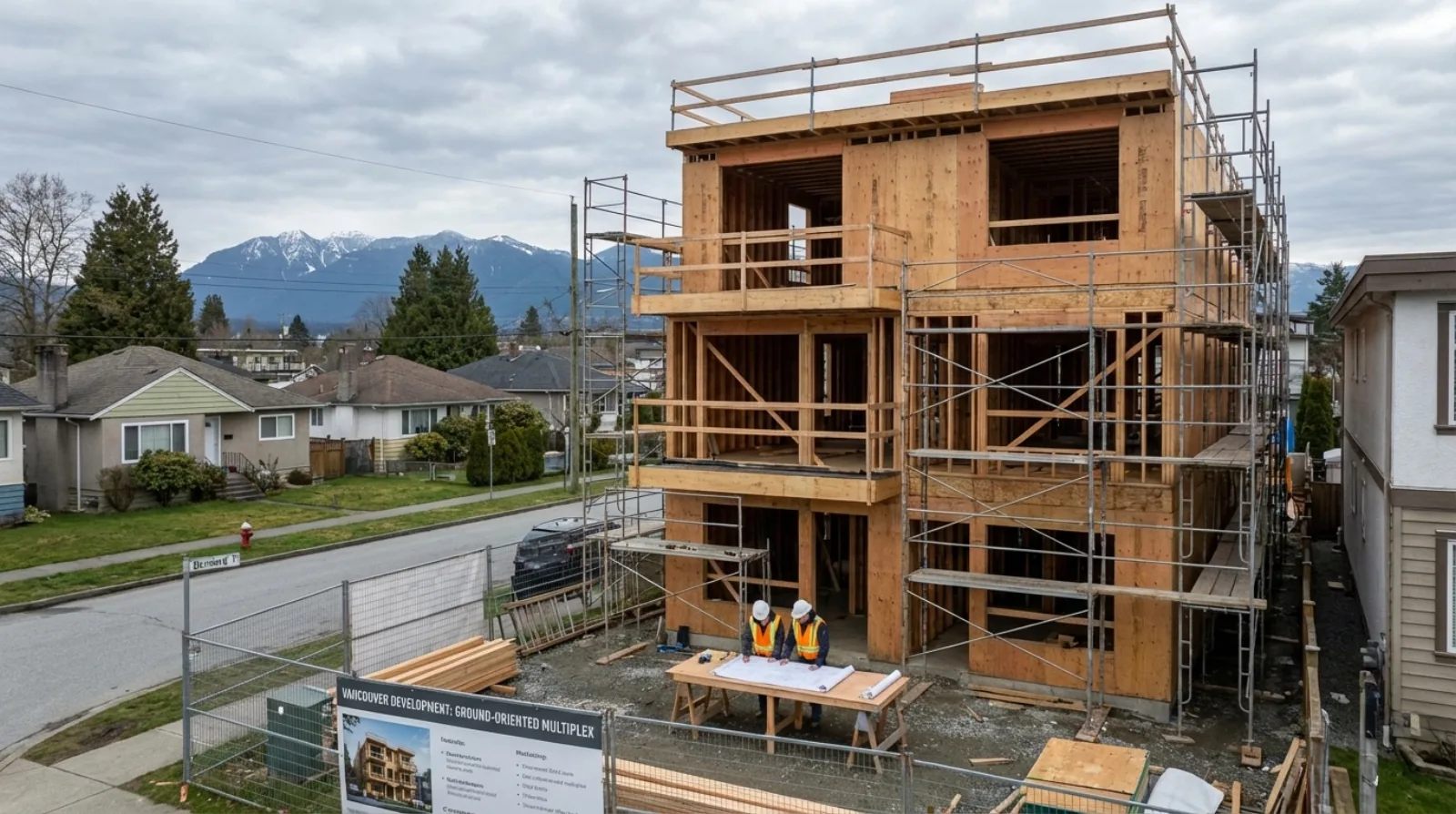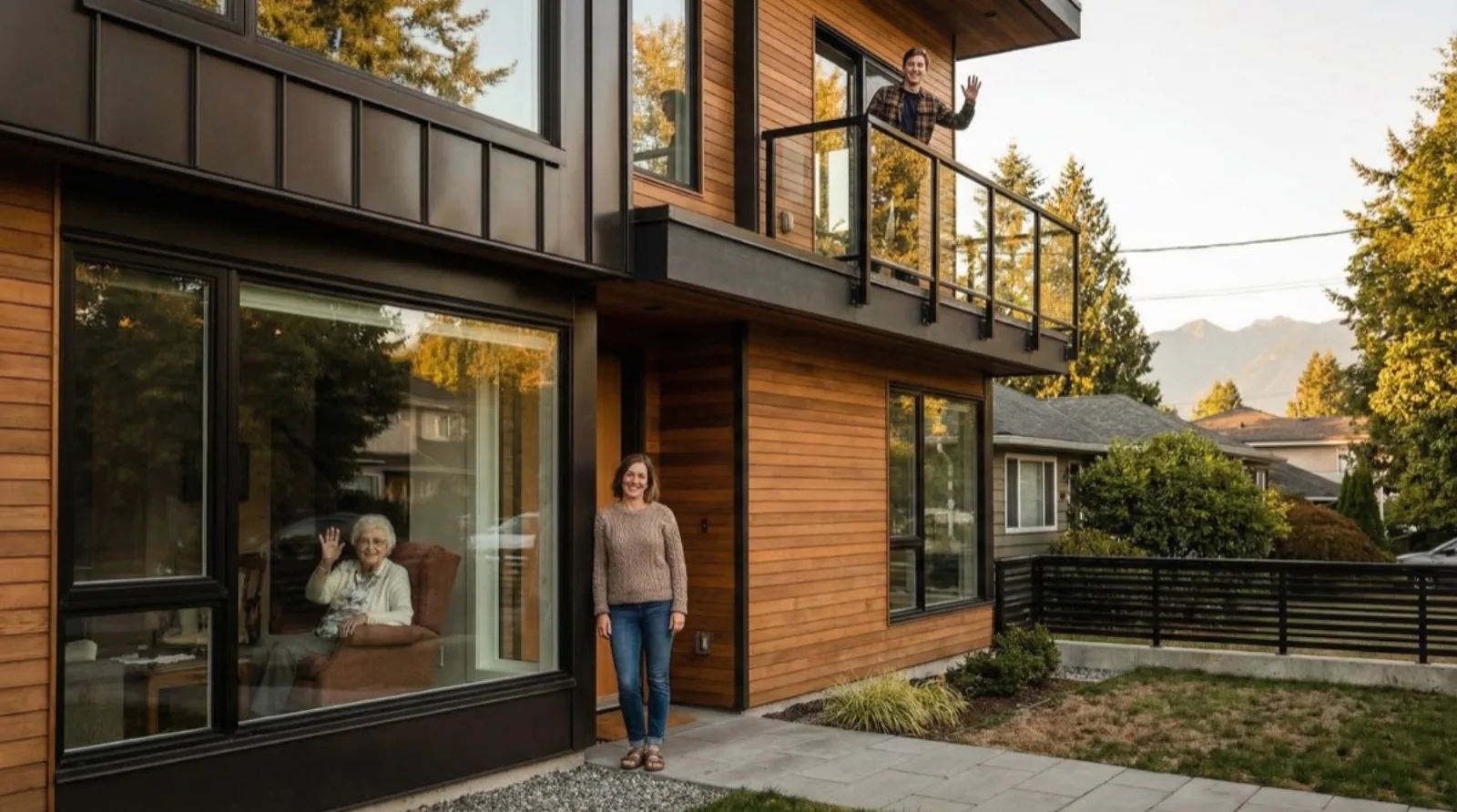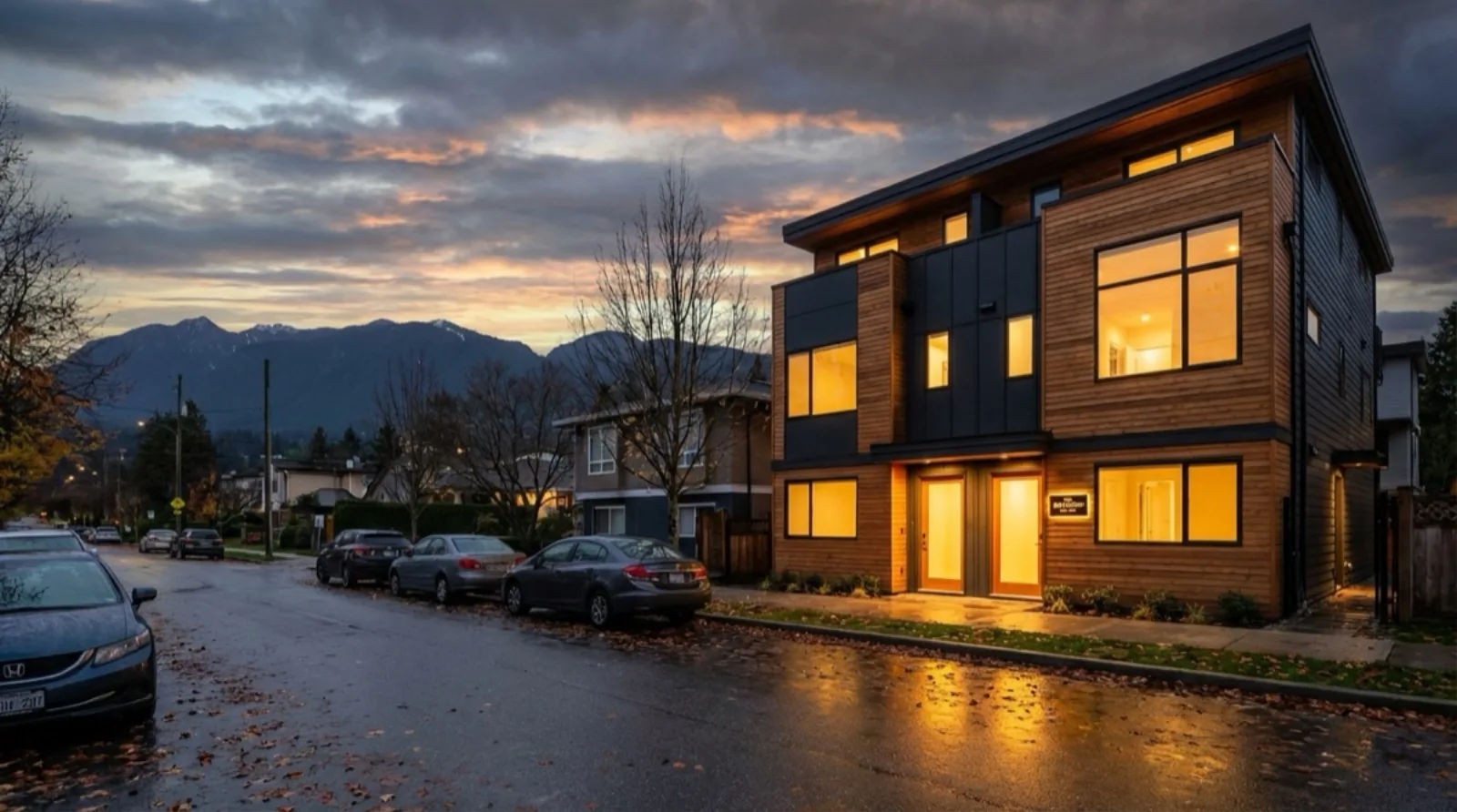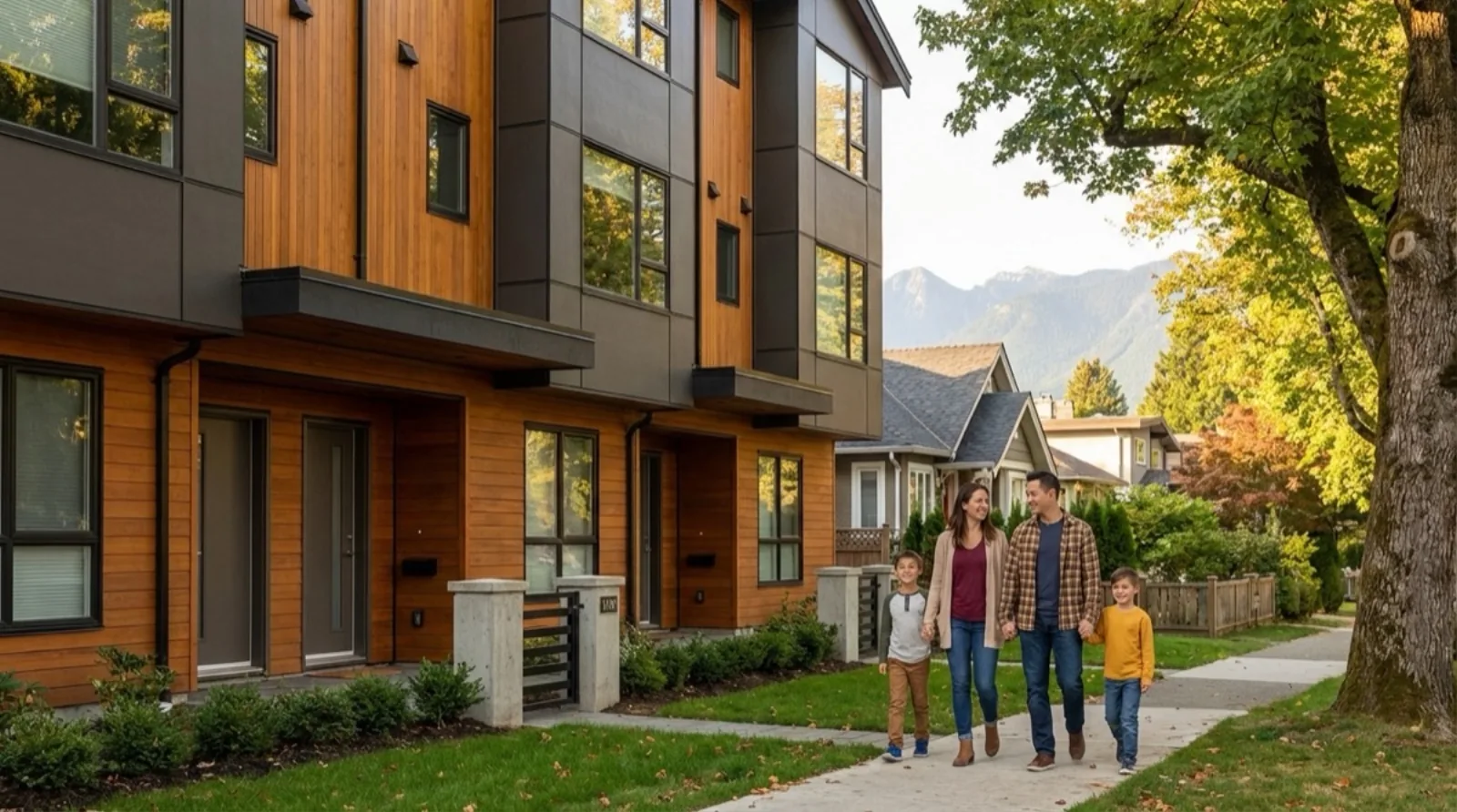

Homeownership among Canadians aged 30-34 dropped from 60% to 52% over the past decade. That’s not a rounding error—it’s an entire generation losing access to the single most reliable wealth-building tool in Canadian history. And 86% of young Canadians still say they want to own a home. They just can’t.
The gap between aspiration and access is the “missing middle” problem. Not missing middle housing (though that’s part of it). The missing middle of the wealth ladder—the rung between renting forever and owning a detached home that costs $2.5 million.
Multiplex development is the only policy tool that addresses both sides of this equation at once. Build new ownership-sized units. Create them on land that already exists. Price them below detached homes but above condos. That’s the missing middle.
The treadmill that keeps renters renting
Here’s the math that traps an entire generation. A couple in Vancouver pays $3,200/month in rent for a two-bedroom apartment. A mortgage payment on a $1.2M multiplex unit (20% down, 5% rate) runs about $5,100/month.
The gap between those numbers is real. But it’s not the actual barrier.
The barrier is the down payment. Twenty percent of $1.2M is $240,000. At $3,200/month in rent, even saving aggressively ($2,000/month after rent and expenses), it takes 10 years to accumulate that down payment. By then, prices have moved.
This is the treadmill effect. Renters pay monthly amounts equal to or exceeding what a mortgage would cost, yet they can’t accumulate the capital to make the transition. Every month of renting is a month of not building equity. The gap widens.
The Missing Middle Initiative report put it plainly: “Ownership supply is failing to keep up with population growth… rapid population growth, lackluster construction of family-sized ownership homes, and investors buying up family-sized homes has created a shortage.”
Why condos don’t solve this
The standard response to affordability pressure has been: build more condos. Vancouver has done that. And it hasn’t solved the problem.
A 600-square-foot condo in a tower doesn’t replace a family home. It’s not where a couple with two kids wants to spend a decade. It doesn’t have a yard, a second bathroom, or enough space for a home office and a playroom.
The families priced out of detached homes aren’t looking for smaller—they’re looking for different. A 1,200-square-foot ground-oriented unit with its own entrance, some outdoor space, and a neighbourhood feel. That’s what multiplex units provide.
The price point matters too. Condos in new Vancouver towers are selling at $1,100-1,400/sqft. A 600-sqft unit costs $660K-840K—and you’re getting 600 square feet. Multiplex units in east Vancouver price at $800-1,000/sqft but deliver 1,200+ square feet. The total price is higher ($960K-1.2M), but the value per dollar is dramatically better.
What multiplex does that nothing else can
Multiplex development fills a specific gap in the housing ladder. The SSMUH program is the policy framework that made this possible at scale in BC. It creates units that are:
- Larger than condos: 1,000-1,400 sqft vs. 500-700 sqft typical condo
- Cheaper than detached: $1.0-1.7M vs. $2.5M+ for a single-family home
- Ground-oriented: Individual entrances, some outdoor space, neighbourhood feel
- Ownership-ready: Can be stratified and sold as individual titles
| Housing Type | Typical Size | Vancouver Price Range | Monthly Payment (20% down, 5%) |
|---|---|---|---|
| Condo (tower) | 500-700 sqft | $660K-980K | $2,800-4,200 |
| Multiplex unit | 1,000-1,400 sqft | $1.0-1.7M | $4,300-7,200 |
| Detached home | 2,000-3,000 sqft | $2.0-3.5M | $8,500-14,900 |
The multiplex unit sits right in the middle. Accessible to dual-income households earning $150K+ (which describes a lot of Vancouver’s young professional couples). Not cheap—but possible. And unlike a condo, it’s a place where a family can actually live long-term.
The senior downsizer piece nobody talks about
There’s a second side to the missing middle equation that gets almost no attention: senior homeowners who want to downsize but have nowhere to go.
A 70-year-old couple in a 3,000-square-foot home in Sunset doesn’t want to move to a condo tower in Metrotown. They want to stay in their neighbourhood, in a smaller space, close to their community.
A multiplex unit in the same neighbourhood solves this. Sell the family home (or contribute it to a JV development), move into one of the completed units. Same community, right-sized space, and a significant chunk of liberated equity.
When seniors downsize this way, they free up larger homes for the next generation. The family home becomes a development site. Four to six new units replace one aging house. The housing stock turns over and expands simultaneously.
This is the virtuous cycle that multiplex development creates. But it only works if there are units for seniors to move into—and those units need to be in their neighbourhoods, not across town.
Redirecting investor capital toward new supply
Here’s an uncomfortable truth about Vancouver’s housing market: a significant portion of investment capital goes into buying existing homes, not building new ones. Every investor who buys a single-family home to rent is adding zero units to the housing stock while removing one ownership opportunity.
Multiplex development redirects that capital. Instead of buying an existing home, investors fund the construction of four to six new ones. The land was already there. The zoning now permits it. The capital creates supply instead of competing for it.
This isn’t theoretical. In 2024, multiplex-focused purchases comprised approximately one-third of Vancouver’s residential land sales—roughly $300 million of a $1 billion total (City of Vancouver permit data, 2024). That capital is flowing toward construction, not speculation.
What has to change for this to work at scale
Multiplex alone doesn’t fix the housing crisis. But it’s the most immediately deployable tool available. Bill 44 removed the zoning barrier. Construction financing is available. The demand exists.
The bottlenecks are execution speed and volume:
- Permitting timelines need to compress. Six months for a permit application on a by-right development is too long.
- Construction costs need competition. More builders entering the multiplex space will bring pricing discipline.
- Financing products need to mature. Multiplex-specific mortgages are still new and inconsistent across lenders.
None of these are unsolvable. They’re just early-stage market frictions in a housing type that barely existed two years ago.
The Canadian dream, rebuilt one lot at a time
The version of homeownership that defined the last 50 years—a detached house on a big lot for every family—is over in Vancouver. Land costs made it impossible years ago.
But the underlying aspiration hasn’t changed. Families want space. They want ownership. They want to build equity in a community they care about.
Multiplex development offers a path. Not the same path as 1975, but a realistic one for 2026. A 1,200-square-foot unit with its own entrance in a neighbourhood with good schools and transit. Ownership equity that grows over time. A place that works for 10+ years.
VanPlex has analyzed 86,000+ properties across Metro Vancouver to identify which lots can deliver this product at prices the missing middle can actually afford.
Visit VanPlex.ca to:
- Check your property’s eligibility for multiplex development
- See what completed units in your neighbourhood are worth
- Understand whether your lot can produce units in the $1.0-1.7M range
- Connect with builders and financing partners active in the multiplex space
The missing middle doesn’t need a new policy. It needs the existing policy to produce units. That starts with one lot at a time. Our gentle density overview explains the design philosophy behind this approach.
David Babakaiff CEO & Co-Founder, VanPlex
PlexRank™ | Profit with Multiplex