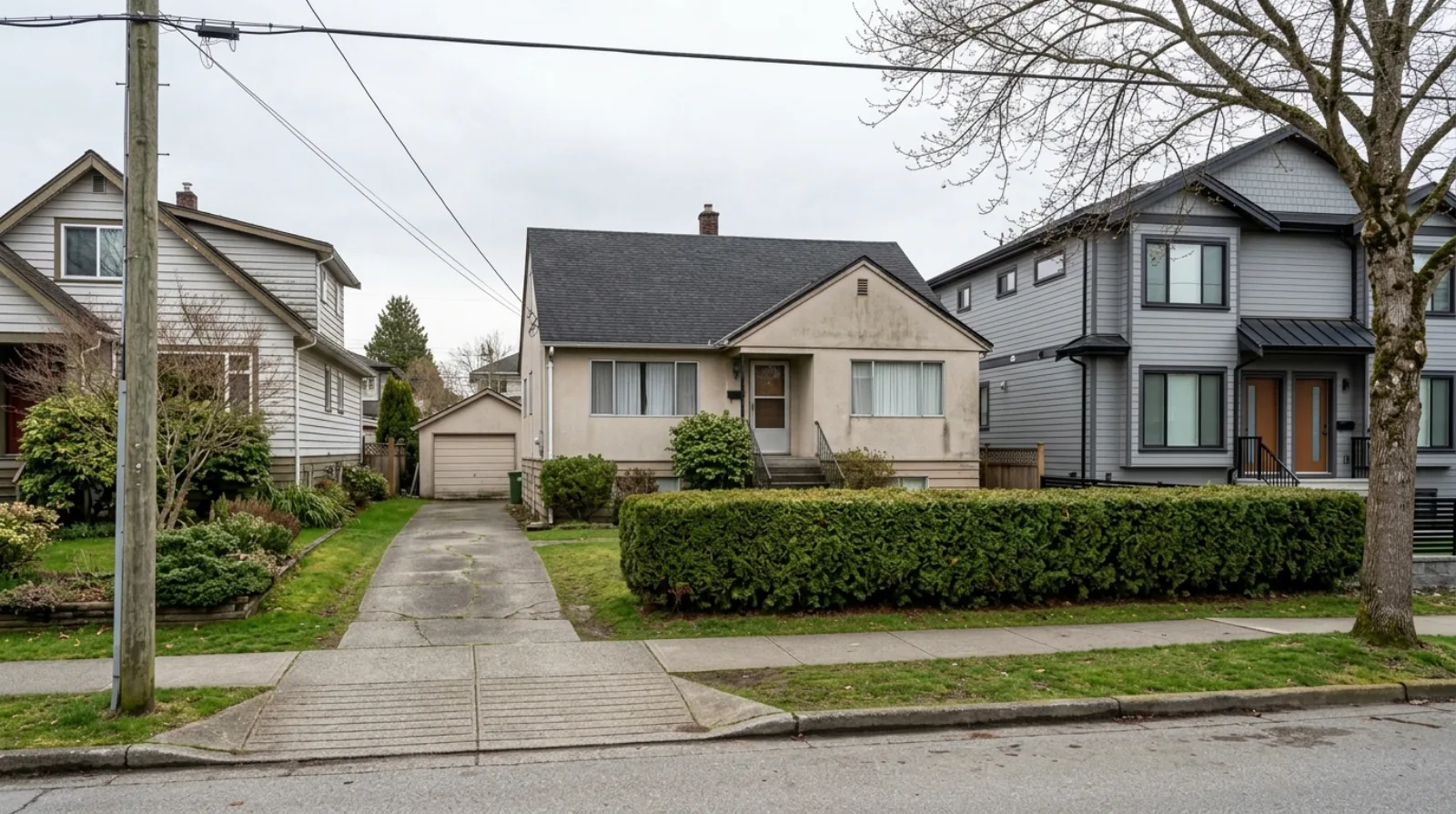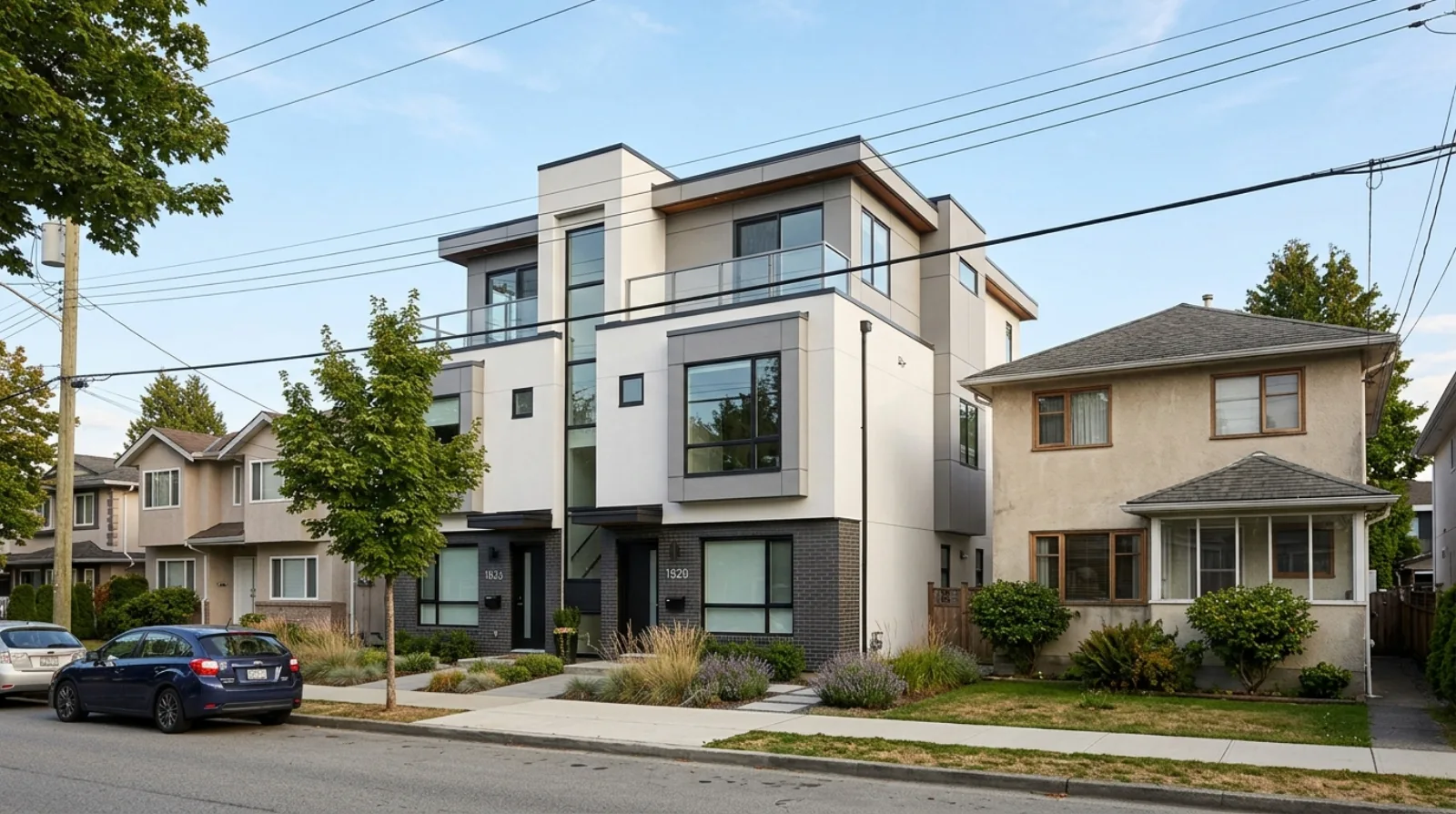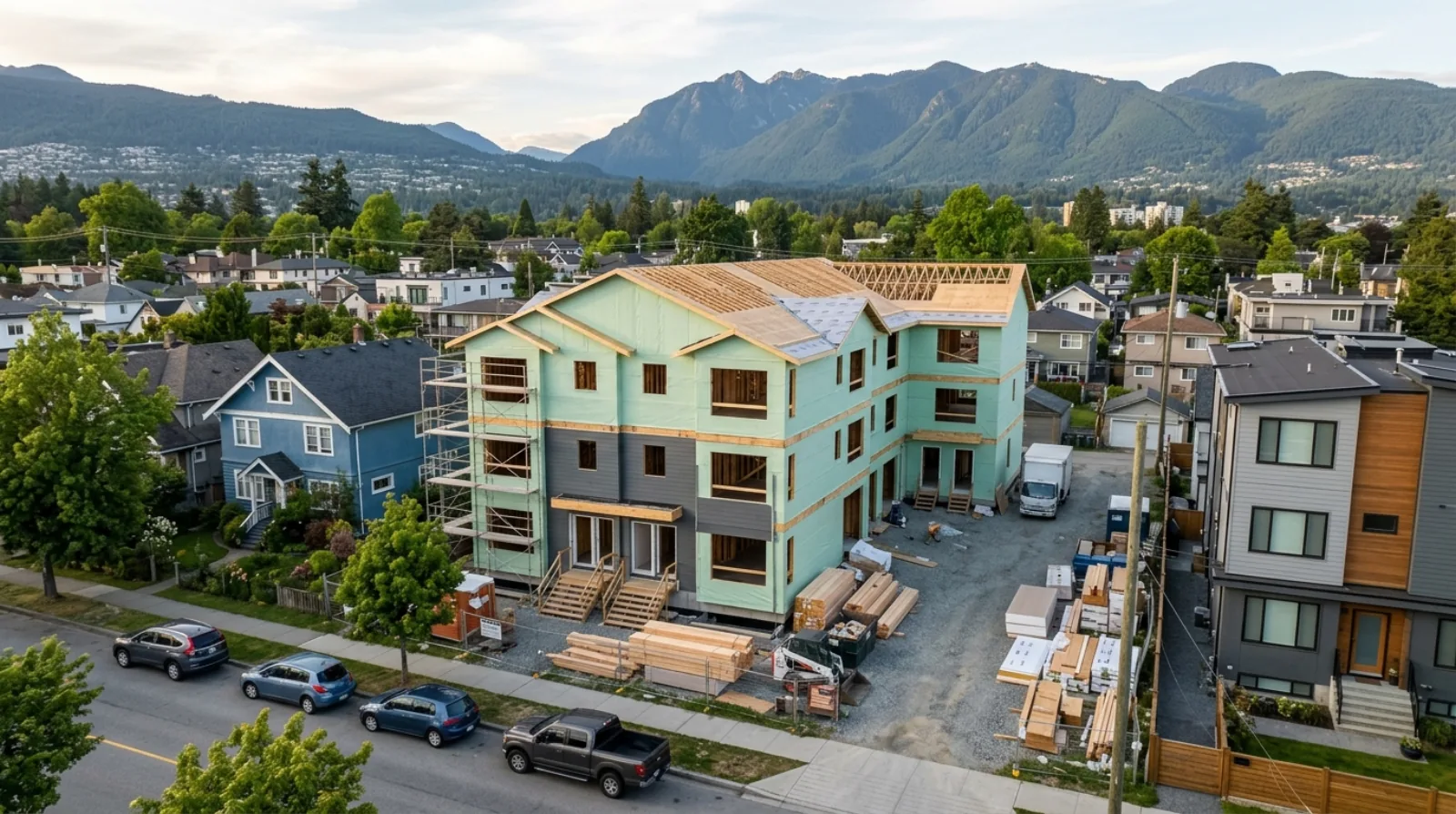

A six-plex multiplex under construction on a Vancouver residential lot, framing sheathed and roof trusses set, with two front entries at grade and the North Shore mountains behind, representing the 18 to 24 months of execution that decide multiplex returns
Investment Analysis

Execution, Not the Lot, Decides Multiplex Returns

9 min read

Construction filed 208 business insolvencies in Canada in Q1 2026, 17.0 percent of all business filings, while total business insolvencies fell 7.5 percent. Two Vancouver receiverships this spring failed on operations, not on zoning. Multiplex Intelligence Issue #5 looks at the 18 to 24 months of execution between an aligned deal and a profitable completion.

Key takeaway

Issue #5 of VanPlex's Multiplex Intelligence newsletter argues that a multiplex project earns its projected return through execution, not at acquisition or at the capital raise, and that investors should weigh an operator's people, controls and systems as carefully as they weigh the lot.

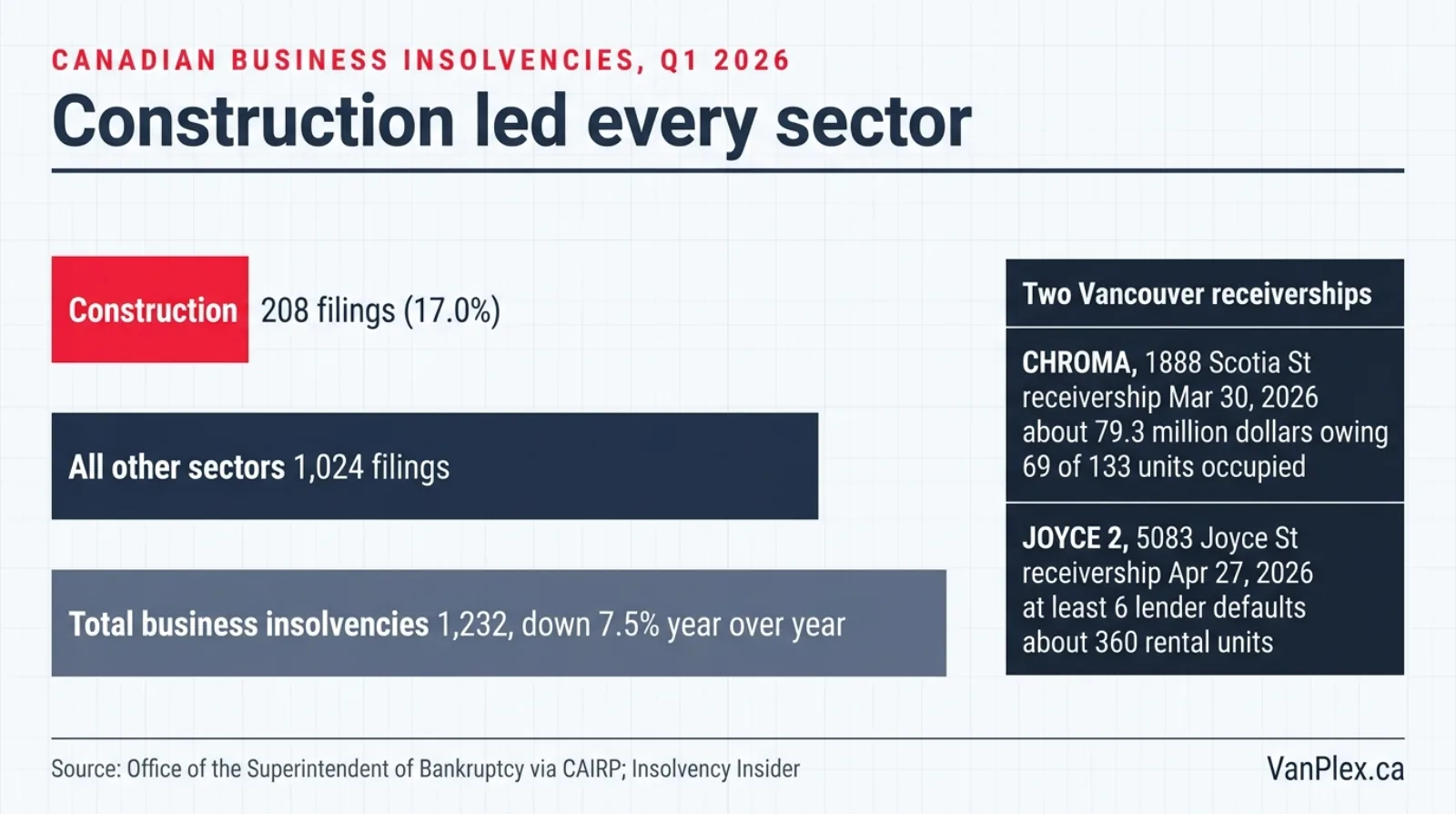
The evidence comes from insolvency courts. Construction firms filed 208 business insolvencies in Canada in Q1 2026, up 15 filings year over year and 17.0 percent of all business filings, the largest share of any industry, even as total business insolvencies fell 7.5 percent to 1,232 (Office of the Superintendent of Bankruptcy data via CAIRP, June 4, 2026). Two Vancouver receiverships illustrate the failure mode. Chroma, a completed 10-storey building at 1888 Scotia Street with 133 residential strata units and 8 commercial units, was placed in receivership by Institutional Mortgage Capital Canada on March 30, 2026 with about $79.3 million owing as at January 19, 2026; only 69 of 133 residential units were occupied and 2 of 8 commercial units leased, leasing performance had 'lagged materially', and roughly $1.4 million in payment deficiencies accumulated between August 2025 and February 2026. Joyce 2, a near-complete 360-unit rental development at 5083 Joyce Street, went into receivership on April 27, 2026 after senior secured lender National Bank issued a notice of default in early January 2026 listing at least six defaults: missed interest payments, unfulfilled equity infusion obligations, unreported cost overruns, failure to deliver financial reporting, construction lien registrations, and material adverse change.
None of those items concern zoning, land value, or the housing market; all are operating failures that fit inside a six-unit project on a 50-foot lot. The cost environment leaves little tolerance for error: residential construction prices in the 15-CMA composite rose 3.0 percent year over year and 0.4 percent quarter over quarter in Q4 2025 (Vancouver residential was down 0.3 percent for the quarter), with Statistics Canada citing labour shortages and elevated wages in the skilled trades, and residential building prices across urban Canada are up almost 70 percent from Q3 2019 to Q3 2025 against overall inflation of 17.2 percent, with labour now the primary driver (ICBA Economics citing Desjardins, January 22, 2026). Absorption is also slower: Vancouver's Empty Homes Tax vacant new inventory declarations rose from 261 in 2024 to 597 in 2025, about 130 percent. The article defines operating capability in three parts: people (a builder with completed multiplex projects, an architect who knows the form and local approvals, someone accountable for schedule and budget weekly, a REALTOR® who knows how the units sell locally), controls (monthly budget-to-actual tracking, draws released against verified milestones, change orders priced and approved in writing before work, contingency treated as a governed reserve with a written draw rule, regular investor reporting), and systems (maintained cost and schedule tracking, a communication rhythm, and the capital-account and compliance administration pooled-capital structures legally require). It gives investors four diligence questions and previews Issue #6 on the land market, where Vancouver multiplex land sales fell from 124 in 2024 to 46 in 2025 and total land value from $303 million to $114 million while average value per deal held roughly flat near $2.4 to $2.5 million (CBRE, February 2026).

What this covers

  • construction led all Canadian business insolvencies in Q1 2026 with 208 filings and a 17.0 percent share
  • total business insolvencies fell 7.5 percent while construction rose by 15 filings
  • Chroma 1888 Scotia Street receivership March 30 2026, about $79.3 million owing, 69 of 133 units occupied
  • Joyce 2 receivership April 27 2026 and the six defaults in National Bank's notice of default
  • residential construction prices up 3.0 percent year over year in Q4 2025 and almost 70 percent since Q3 2019
  • operating capability defined as people, controls and systems
  • four diligence questions to ask a multiplex operator before committing capital
  • Investor Intelligence Principle #5: a multiplex earns its return through execution
multiplex vancouver investors execution construction-insolvency operating-capability

Construction firms filed 208 business insolvencies in Canada in the first quarter of 2026, 17.0 percent of all business filings and more than any other sector. Total business insolvencies fell 7.5 percent that quarter. Construction rose. Between an aligned multiplex deal and a profitable completion sits 18 to 24 months of execution, and that stretch is where these projects are actually won or lost.

Last week I ended on alignment. A financeable multiplex needs enough capital, contingency and time to complete the business plan, and the investor’s position should fit their wealth, liquidity and experience. This week I want to look at what happens after that alignment is in place, because on its own it is still only a plan on paper.

What the court filings actually say

The clearest evidence for that view is coming out of the insolvency courts, and it is worth reading carefully because the direction is counterintuitive.

Total business insolvencies in Canada fell 7.5 percent year over year in the first quarter of 2026, to 1,232 filings. Construction went the other way. It filed 208, up 15 from the same quarter last year, and took 17.0 percent of all business filings, the largest share of any industry. When the overall trend improves and one sector still deteriorates, that sector has a problem of its own.

Two Vancouver receiverships this spring show what that looks like up close.

Chroma, at 1888 Scotia Street, is a completed 10-storey building with 133 residential strata units and 8 commercial units. Institutional Mortgage Capital Canada put it into receivership on March 30, 2026. Total indebtedness was about $79.3 million as at January 19, 2026. Construction had finished in April 2025. By the receivership application, 69 of 133 residential units were occupied and 2 of 8 commercial units were leased. The lender’s material described leasing performance that “lagged materially” and payment defaults that emerged shortly after funding, with roughly $1.4 million in payment deficiencies accumulating between August 2025 and February 2026. Rental income was not enough to service the debt.

Joyce 2 followed. On April 27, 2026 the BC Supreme Court granted a receivership order over the entities behind a near-complete rental development at 5083 Joyce Street: about 360 rental units, 4,500 square feet of retail and 87 underground parking stalls. The senior secured lender, National Bank, had issued a notice of default in early January 2026 listing at least six defaults: missed interest payments, unfulfilled equity infusion obligations, unreported cost overruns, failure to deliver financial reporting, construction lien registrations, and material adverse change.

Data graphic showing construction led Canadian business insolvencies in Q1 2026 with 208 filings and 17.0 percent share while total business insolvencies fell 7.5 percent, alongside the Chroma and Joyce 2 Vancouver receiverships

These are large projects, much bigger than a multiplex, and I want to be fair about that. But read the Joyce 2 list again. Nothing on it is about zoning, land value or the housing market. Every item is an operating failure: costs not tracked, overruns not reported, equity not funded, reporting not delivered. Those failure modes do not require a 360-unit tower. They fit comfortably inside a six-unit project on a 50-foot lot, and in my experience they show up there for the same reasons, just without a court file to make them public.

The cost environment leaves no room for sloppiness

Execution matters more right now because costs are still moving against you.

Residential construction costs across the 15-census-metropolitan-area composite rose 3.0 percent year over year in the fourth quarter of 2025, and 0.4 percent quarter over quarter. Statistics Canada attributed part of that to materials, and part to something harder to budget around: “Labour shortages and elevated wages continued to place further upward pressure on construction costs, particularly in the skilled trades.” Vancouver residential was actually down 0.3 percent for the quarter, so the local read is flatter than the national one. That is a pause, not a reversal.

The longer view is the sobering one. Residential building construction prices across urban Canada are up almost 70 percent from the third quarter of 2019 to the third quarter of 2025. Overall Canadian inflation over the same period was 17.2 percent. ICBA Economics, citing Desjardins, notes that labour costs are now the primary driver rather than materials.

MeasureFigurePeriodSource
Residential construction prices, 15-CMA composite+3.0% year over yearQ4 2025Statistics Canada, released Jan 27, 2026
Same index, quarter over quarter+0.4%Q4 2025Statistics Canada
Vancouver residential, quarter over quarter-0.3%Q4 2025Statistics Canada
Residential building prices, urban Canada+70% (approx.)Q3 2019 to Q3 2025ICBA Economics, Jan 22, 2026
Overall Canadian inflation+17.2%same periodICBA Economics, citing Desjardins

A budget set at acquisition meets a different market at completion. That is why contingency exists, and it is also why contingency has to be governed rather than quietly spent in the first year.

Now add the exit. Vancouver’s vacant new inventory declarations under the Empty Homes Tax rose from 261 in 2024 to 597 in 2025, about a 130 percent increase, according to a City of Vancouver staff report. Finished homes are sitting longer before they sell or lease. That is the same absorption problem I wrote about when CMHC’s forecast came out. Slower absorption stretches the period during which every operating mistake keeps costing you money.

In this market, the projects that finish profitably will be the ones that were run well, not just the ones that were bought well.

People, controls, systems

So what does operating capability actually consist of? I group it in three parts.

People. A multiplex is a small project that needs the same professional bench as a large one: a builder with completed multiplex projects behind them, an architect who knows the form and the local approval process, someone accountable for managing the schedule and the budget week to week, and a REALTOR® who understands how these units actually sell in that neighbourhood. The builders retreating from this market right now had capital and land. What many of them lacked was depth on this bench.

Controls. This is the discipline that keeps a project honest while it is underway. Budgets tracked against actuals monthly, not reconstructed at the end. Construction draws released against verified milestones. Change orders priced and approved in writing before the work happens. Contingency treated as a governed reserve with a clear rule for when it can be drawn. And regular reporting to the people whose capital is in the deal. The Joyce 2 default list is a useful reminder of what happens when reporting stops: lenders assume the worst, and they are usually right to.

Systems. The least glamorous part, and the part most often skipped at this scale. Cost and schedule tracking that someone actually maintains. A communication rhythm so investors hear about problems from the operator, not from a lien search. And the administrative machinery I wrote about in Issue #2, the capital accounts, records and compliance that pooled-capital structures legally require. Systems are what let a small project be run with large-project discipline without hiring a large-project head office.
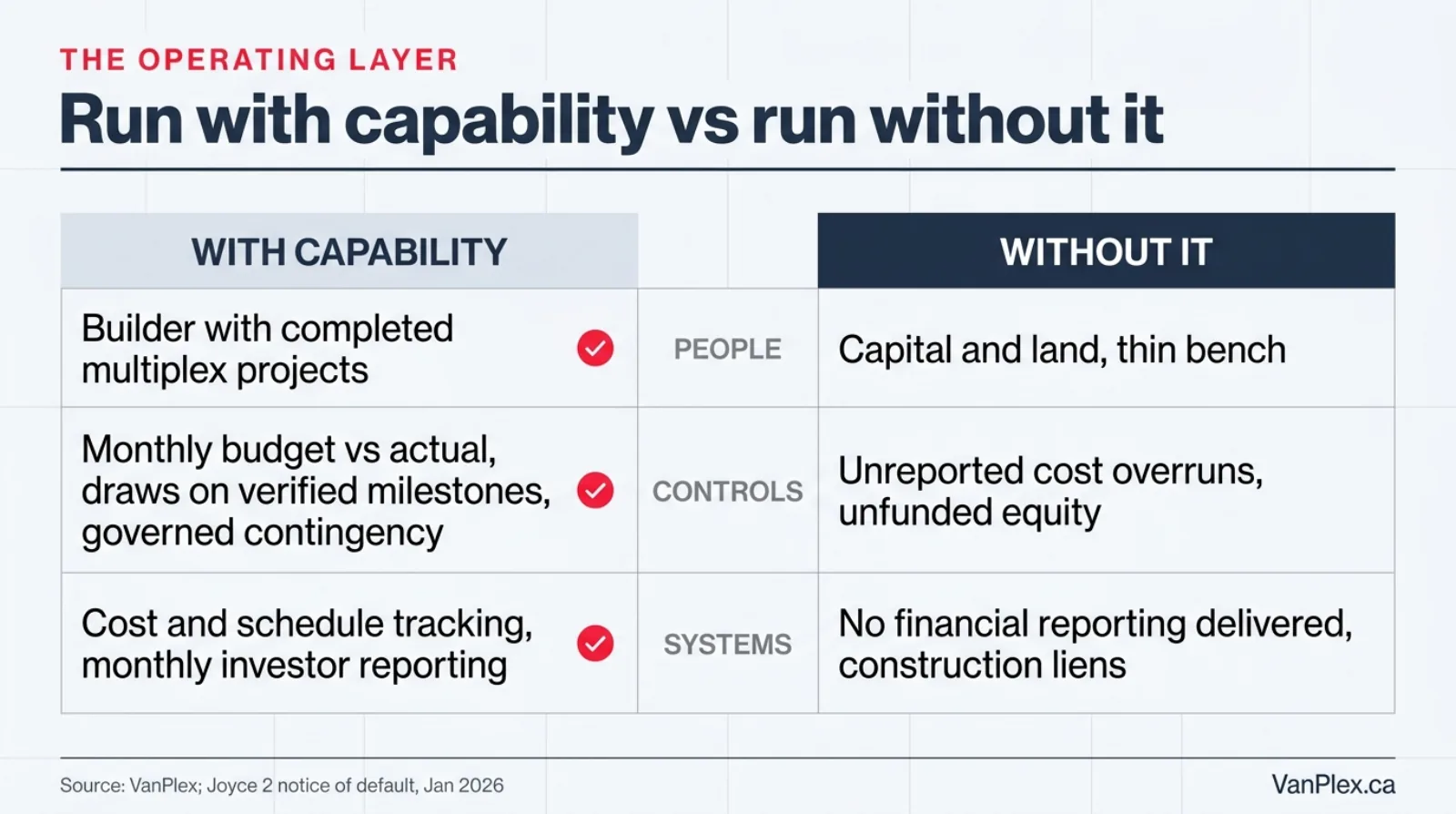
Comparison graphic contrasting a project run with people, controls and systems against one missing them, mapped to the six defaults listed in the Joyce 2 notice of default

Where this sits for VanPlex

This operating layer is the substance of the general partner role in our co-development structures. Selecting the lot is the beginning of the work, not the end of it, and the 18 to 24 months between acquisition and stabilization is where we spend most of our effort. That is why we treat operating capability as part of the underwriting, alongside the land and the capital. PlexRank™ narrows 205,047 lots down to the small number worth underwriting. The operating layer is what decides whether the one you pick actually performs.

Four questions to ask before you commit capital

When you evaluate a multiplex opportunity, the questions about the operator deserve the same weight as the questions about the lot.

  1. Who has completed this kind of project before, and can you see those projects?
  2. How are costs tracked against budget, and how often will you see them?
  3. What has to happen before contingency is touched, and who approves it?
  4. What do you receive in writing, and when?

An operator who answers those questions easily has probably already built the capability. An operator who bristles at them is telling you something too.

Next week I plan to turn to the land market itself. Multiplex land sales in Vancouver fell from 124 in 2024 to 46 in 2025, and total land value from $303 million to $114 million, while the average value per deal held roughly flat near $2.4 to $2.5 million (CBRE, February 2026). Volume collapsed. Pricing did not. That raises an interesting question about whether multiplex land has actually repriced, and what entry looks like for patient capital in a standoff between disciplined buyers and unhurried sellers.

Investor Intelligence Principle #5

A multiplex project does not earn its projected return on the day the lot is bought or the capital is raised. It earns it through execution. Investors should weigh the operator’s people, controls and systems as carefully as they weigh the lot itself.
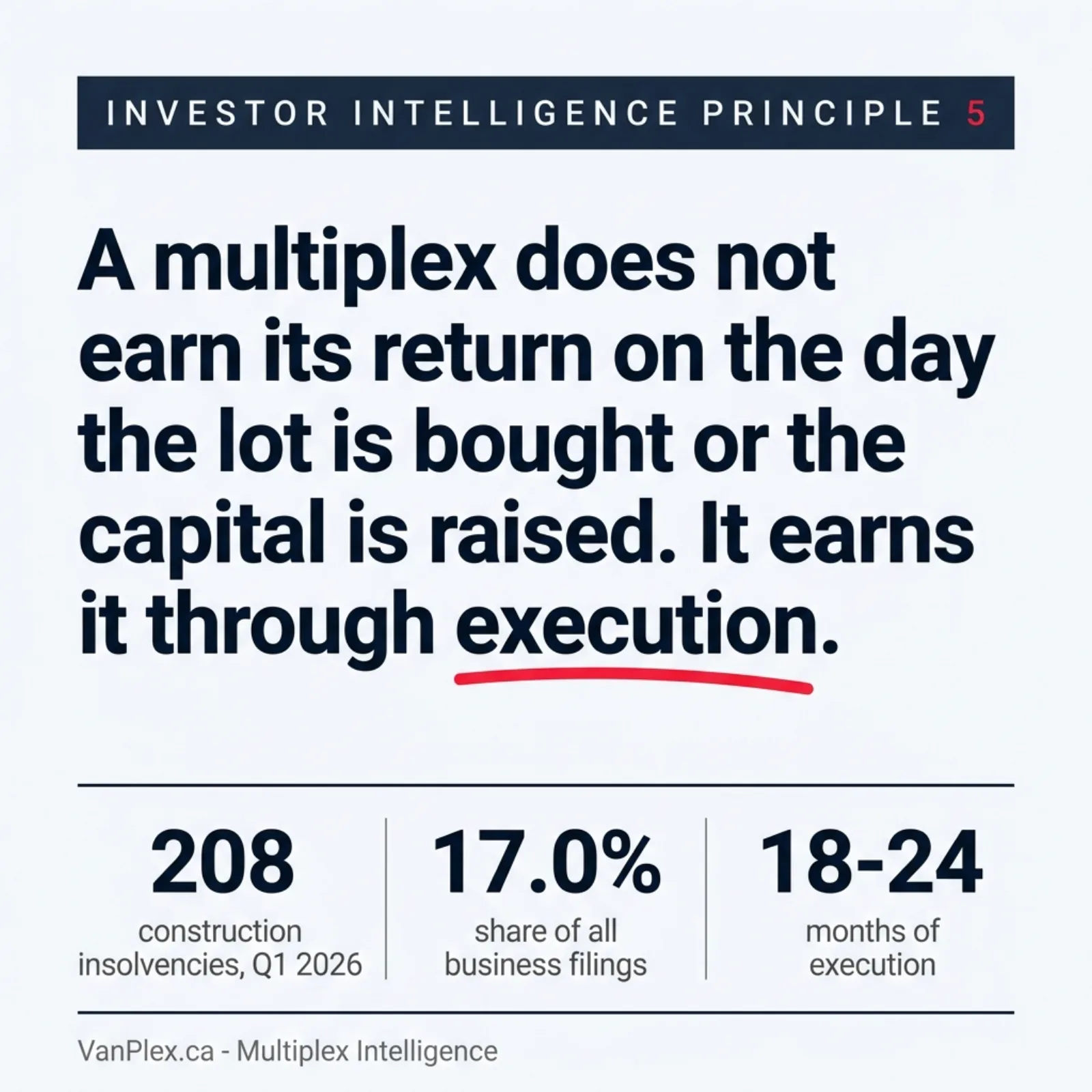

Square social graphic stating Investor Intelligence Principle #5, that a multiplex project earns its return through execution rather than at acquisition

Frequently asked questions

Why does construction lead Canadian business insolvencies if the overall number is falling?

Because the pressure on construction is specific to construction. In Q1 2026 total business insolvencies fell 7.5 percent to 1,232 filings, while construction rose by 15 filings to 208 and took 17.0 percent of the total, the largest share of any sector. Input costs, labour availability and slower absorption are hitting builders harder than the wider economy.

Chroma and Joyce 2 are large projects. Why should a six-unit multiplex investor care?

Because the defaults were operational, not structural. Missed interest payments, unfunded equity, unreported cost overruns, missing financial reporting and construction liens are all things that can happen on a six-unit project on a 50-foot lot. Scale changes the dollar amounts and whether there is a court file. It does not change the failure mode.

What does governed contingency actually mean?

It means there is a written rule for when contingency can be drawn, who approves the draw, and what it can be used for, and that the balance is reported to investors every month. The opposite is contingency being absorbed into ordinary cost overruns during the first year, so it is gone by the time you actually need it.

Isn't slower absorption a reason to wait rather than to focus on operations?

Slower absorption makes operations matter more, not less. Vancouver's vacant new inventory declarations went from 261 in 2024 to 597 in 2025. Every extra month a finished unit sits, you keep paying interest, taxes, insurance and marketing. Tight cost and schedule control is what buys you the room to sit through it.

How do I check whether an operator actually has controls, rather than just saying so?

Ask to see a real monthly budget-to-actual report from a project they completed, with the contingency line visible. Ask what their draw process looked like and who verified milestones. Ask for the investor reporting package they sent, not a description of it. Documents exist or they do not.

How much did residential construction costs rise in Canada in late 2025?

Residential construction costs across the 15-census-metropolitan-area composite rose 3.0 percent year over year and 0.4 percent quarter over quarter in the fourth quarter of 2025, according to Statistics Canada. Vancouver residential was actually down 0.3 percent for the quarter, which the article describes as a pause rather than a reversal, since labour shortages and elevated wages in the skilled trades continue pushing costs upward nationally.

How much have residential building construction prices risen since 2019?

Residential building construction prices across urban Canada rose almost 70 percent from the third quarter of 2019 to the third quarter of 2025, compared to overall Canadian inflation of 17.2 percent over the same period, according to ICBA Economics citing Desjardins. Labour costs are now the primary driver of that increase rather than materials.

What three categories make up an operator's execution capability on a multiplex project?

The article groups execution capability into people, meaning a builder with completed multiplex projects, an experienced architect, a dedicated schedule and budget manager, and a REALTOR® who understands the local market; controls, meaning budgets tracked monthly against actuals, draws released against verified milestones, and governed contingency; and systems, meaning maintained cost and schedule tracking plus the administrative machinery pooled-capital structures legally require.

Free 12-page guide for Vancouver-area homeowners. Build, sell, hold, or partner — side-by-side comparison of the numbers, timeline, and risk on each path.

Verified phone required. We'll text you the link in 60 seconds.

David Babakaiff

David Babakaiff

Co-Founder, VanPlex | 25+ Years BC Construction

David Babakaiff is Co-Founder of VanPlex with 25+ years scaling BC construction. He led Alair Homes Vancouver to the 2024 HAVAN Award for Best Multiplex Unit in the GVRD. VanPlex’s PlexRank™ algorithm scores residential parcels across BC for multiplex conversion potential under Bill 44.

Want insights like this delivered weekly?

Join 2,500+ property owners getting ROI case studies, market data, and exclusive opportunities.

No spam. Unsubscribe anytime.