
Last week we argued that multiplex housing should be treated as an asset class, not a set of one-off projects. This week the wider market handed us another useful signal. On July 14, 2026, Royal LePage raised its 2026 national home price forecast: it now expects the aggregate price of a Canadian home to rise 2% year over year in the fourth quarter, up from its earlier call of 1%.
That is a small number with a large message. Demand and capital have not left the housing market. What is missing is the structure that lets money move carefully into the part of the market Canada says it wants most — attainable, ground-oriented homes in neighbourhoods that already exist. We talk a lot about the missing middle in housing. Investors should also be thinking about the missing middle in capital.
The market is not leaving — it is getting selective
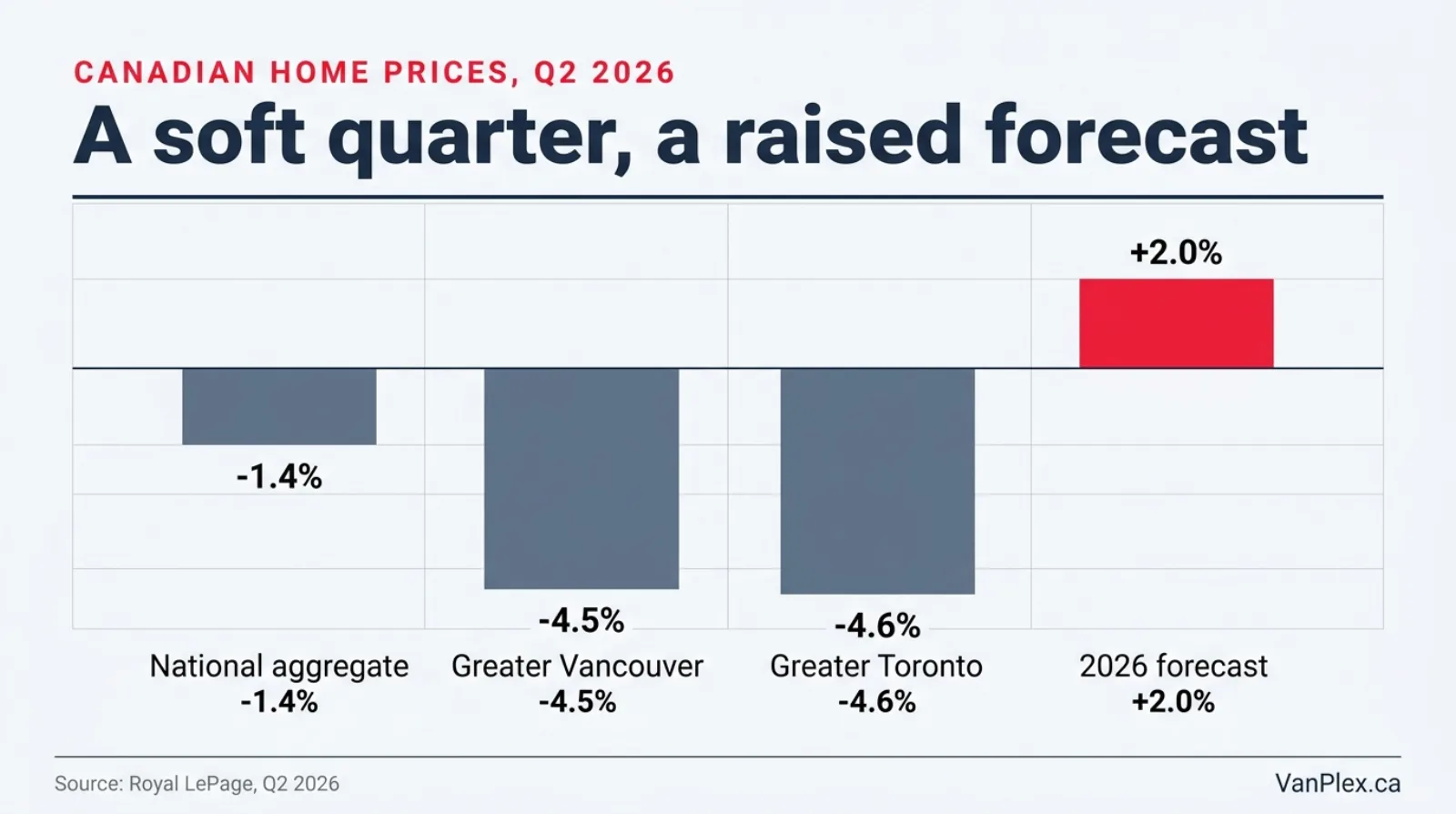
Start with the numbers, because they set the mood. Royal LePage’s Q2 2026 report put the national aggregate price at $814,900, down 1.4% from a year earlier but up 0.2% from the prior quarter. On the back of that, the company lifted its full-year call to a 2% year-over-year gain by Q4, to $823,344.
The two most expensive markets are still soft. Greater Vancouver and Greater Toronto took the steepest annual declines in Q2, falling 4.5% and 4.6%. Royal LePage’s forecast has both ending 2026 below late-2025 levels — Vancouver about 3.5% lower, Toronto about 2% lower.
Read those two signals together and they point the same way. A rising national forecast and a still-soft Vancouver both say the same thing: value is becoming more selective. Buyers are careful. Capital is demanding. Neither is walking away. Projects that lean only on a broad “housing is in demand” story will struggle to earn attention. Projects that can show careful selection, clear underwriting, and credible delivery have a better chance of standing apart.
Two missing middles: housing and capital
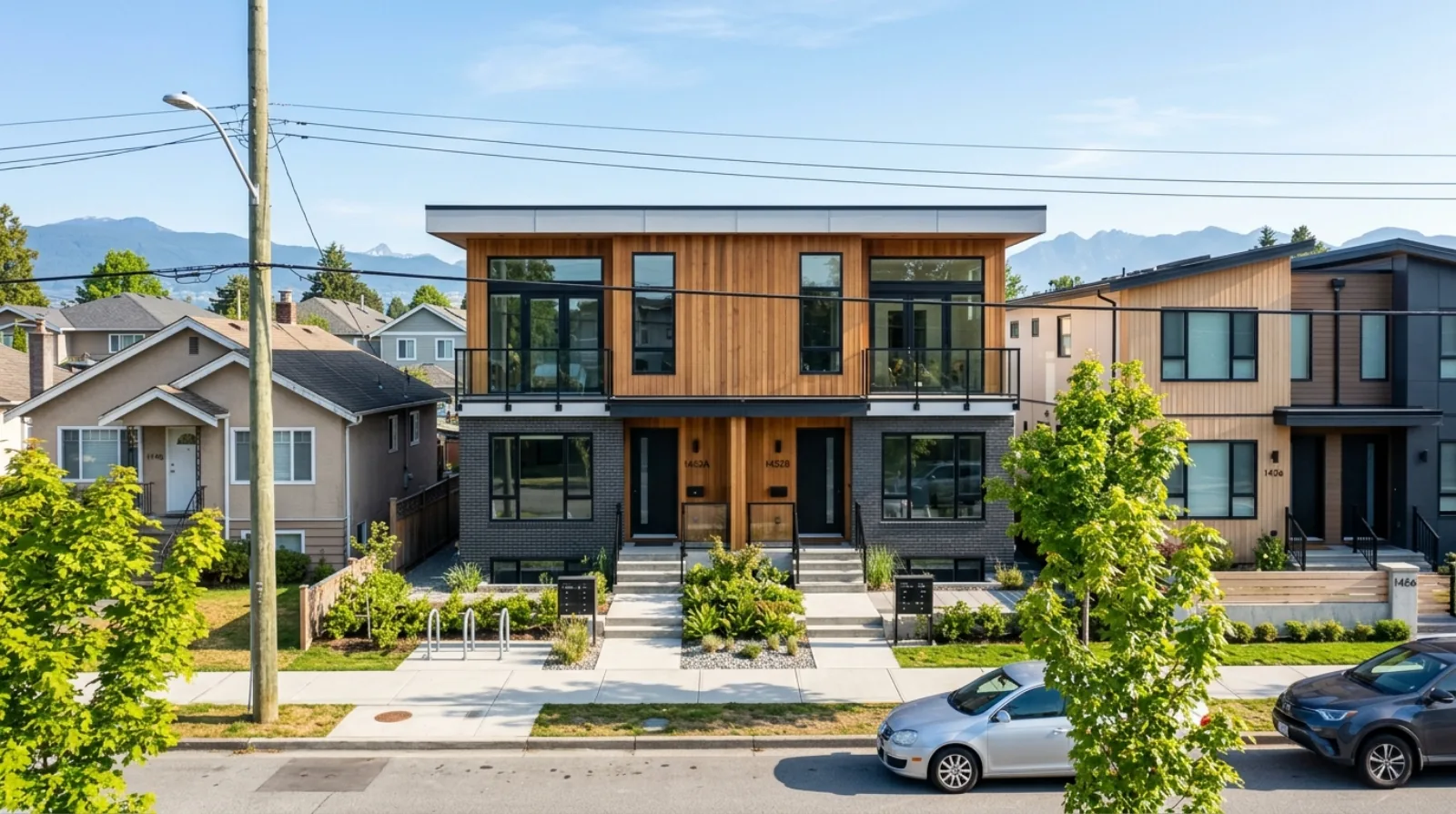
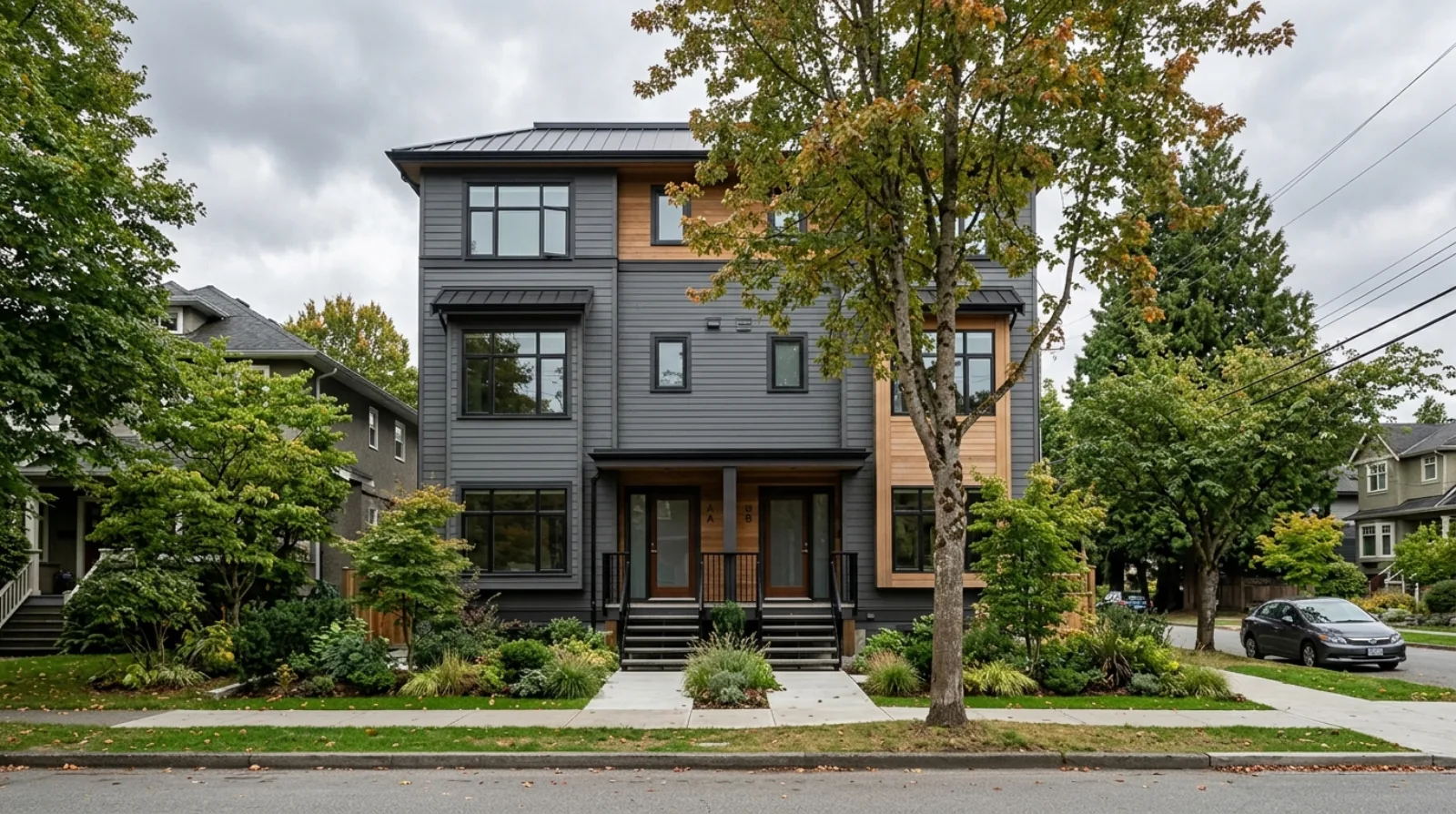
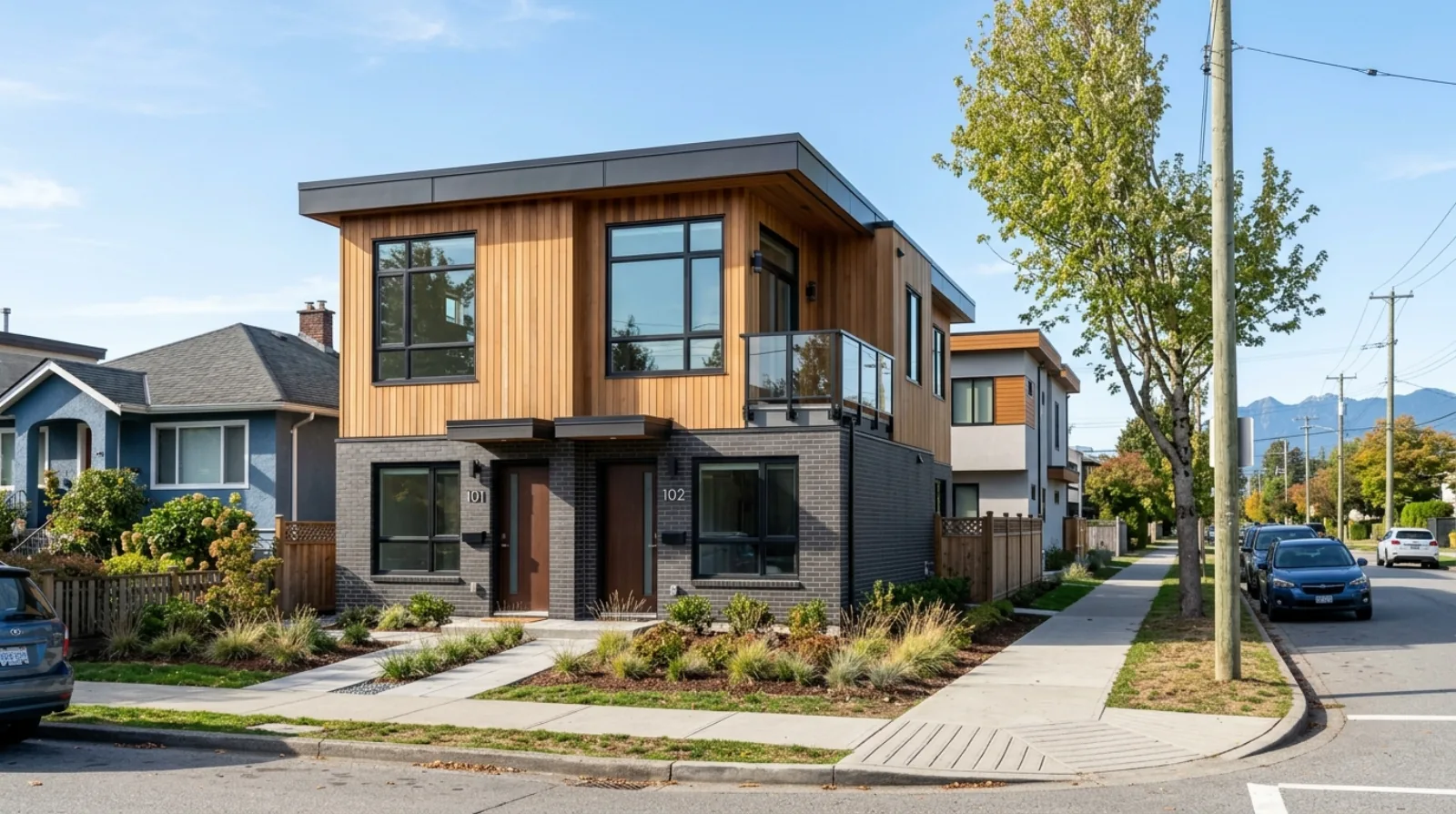
The phrase “missing middle” usually points at the homes: duplexes, triplexes, fourplexes, sixplexes, townhomes — the forms that sit between a detached house and a large apartment building. Bill 44 answered part of that question. Most single-family lots in BC now allow three to six homes.
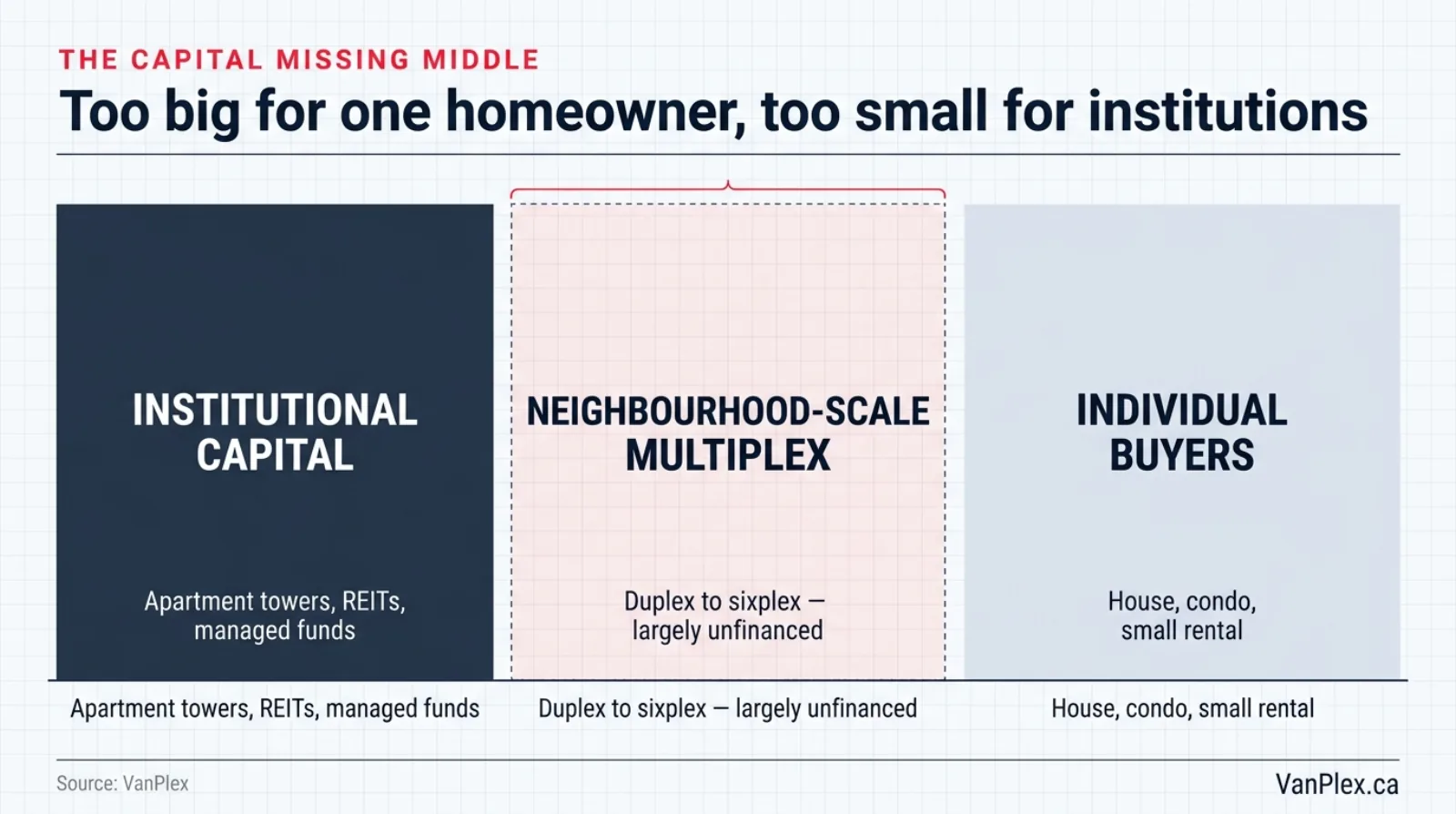
But there is a second gap, and it is about money. At one end, large institutional capital can buy apartment towers, industrial portfolios, public REITs, and professionally managed funds. At the other end, an individual can buy a house, a condo, or a small rental. Between those two worlds sits small-scale, neighbourhood-level housing development. That is where multiplex lives, and it is hard to finance properly.
The problem is not whether a fourplex or sixplex can be built. In many cities, zoning already settled that. The harder question is whether a specific property can carry the full investment case. Can the land basis work? Can enough value be created? Can the design support the exit price? Can construction risk be controlled? Can the timeline protect the return? Most multiplex opportunities are too large and risky for one homeowner to run alone, and too small and scattered for institutional money to bother with. That gap is where a new investment category can form.
The gap is structure and governance, not just money
Here is the part most people skip. When money is pooled at this scale, it usually takes the form of a limited partnership or a joint venture. Those structures exist for good reason. They set out who contributes what, who makes decisions, how risk is shared, how profits are split, and what happens when a project runs long or over budget.
But those structures carry real obligations. Investors need reporting they can trust. Capital accounts have to be kept properly. Distributions have to follow the agreement. Conflicts of interest have to be spotted and managed. And raising money from outside investors brings securities rules into play, with real consequences for getting them wrong.
That level of governance is normal in institutional real estate. It is rare in small-scale development. Most builders are set up to build, not to administer other people’s capital. Ask a one-off builder to also run a properly governed partnership and you are asking them to run two businesses at once — and the second one is usually the one that suffers. So the missing middle is a gap in structure and governance as much as a gap in dollars.
Why the parcel is where the truth shows up
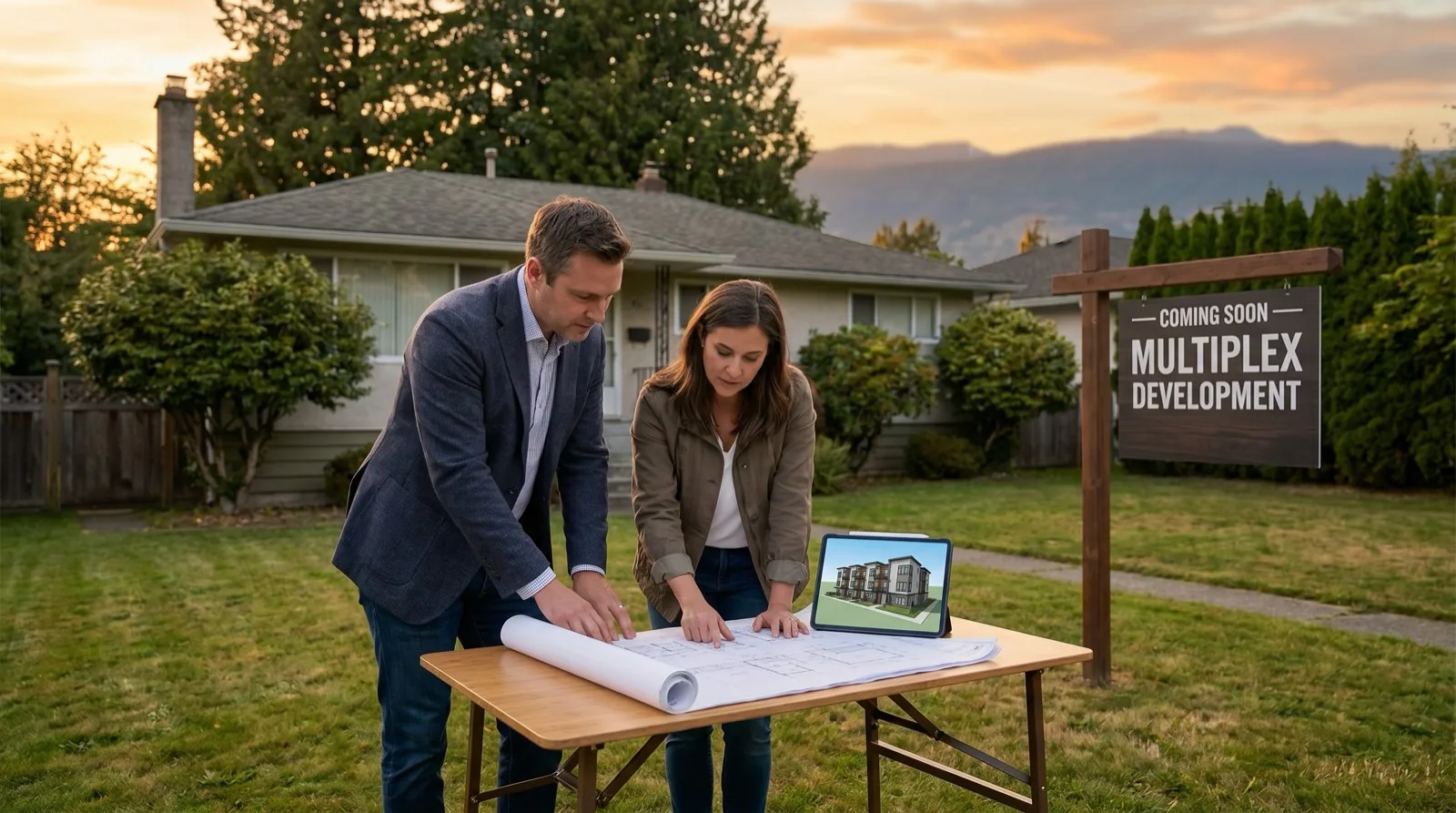
We begin at the parcel because the parcel is where the truth shows up first. Two properties can sit on the same street, under the same zoning, in the same city, and produce very different outcomes. One supports a strong multiplex project. The next fails once site constraints, construction costs, unit mix, resale values, and financing assumptions get tested.
A rising national forecast does not remove that discipline. A softer Vancouver market does not either. For multiplex to attract serious capital, it needs more than permissive zoning and nice renderings. It needs a repeatable way to identify strong properties, throw out weak ones, underwrite the economics, manage execution risk, govern pooled capital properly, and compare opportunities across a large field of eligible lots. That is the work VanPlex is focused on, and it is why our analysis starts at the lot rather than the pitch deck.
From permission to performance
Canada has created new development rights across thousands of established neighbourhood lots. Those rights can produce more homes, new options for families, a way for older owners to unlock land value, and investment opportunities that are smaller than institutional real estate but more sophisticated than buying one property and hoping.
But the category has to be built carefully — with selection, standards, underwriting, and capital structures that fit the scale of the opportunity. Over the coming weeks we will keep looking at how multiplex moves from permission to performance. The next phase needs more than zoning reform. It needs a capital model built for the scale, risk, and potential of neighbourhood-level housing. That is the missing middle investors should be watching.
Investor Intelligence Principle #2
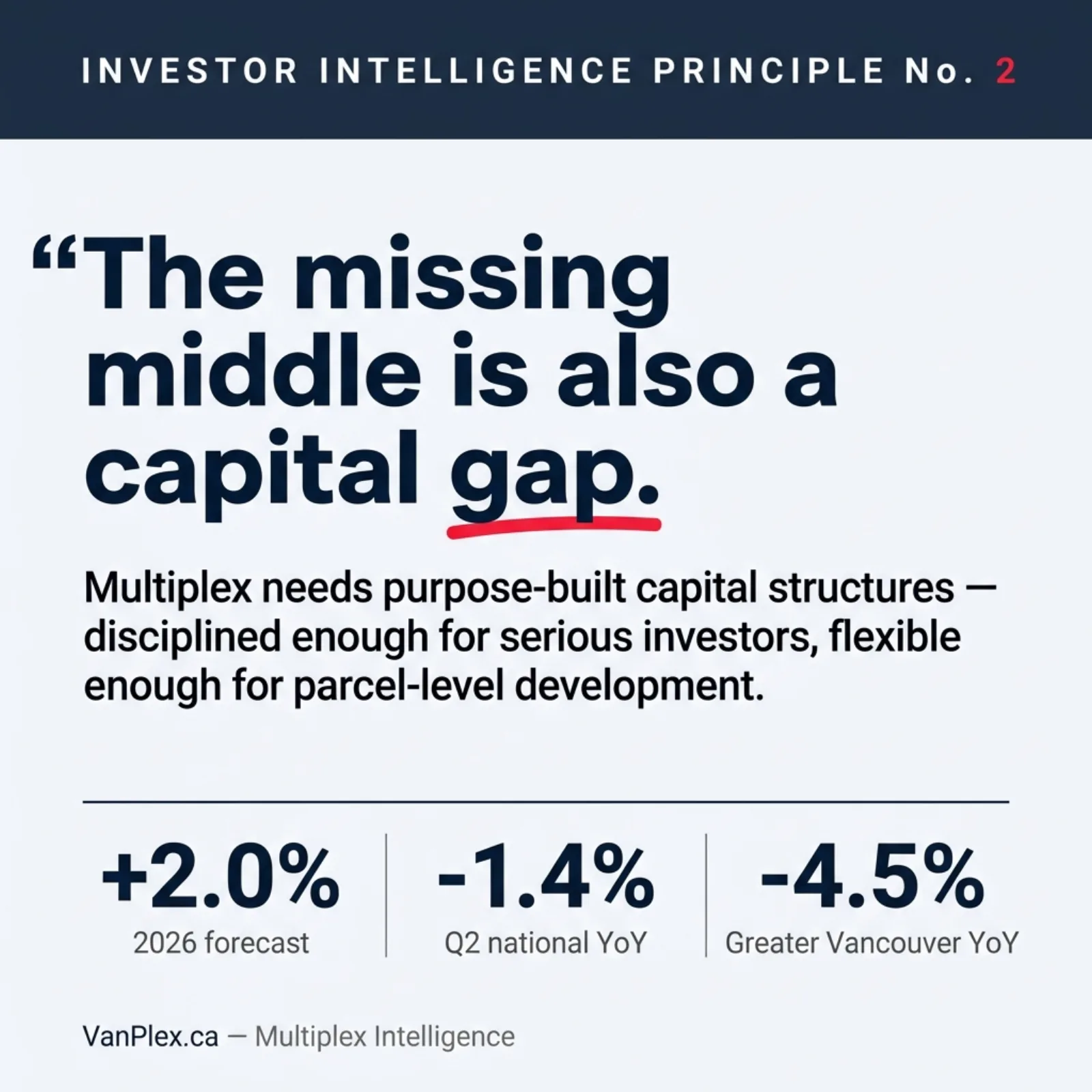
The missing middle is not only a housing form. It is also a capital gap. Multiplex housing will need purpose-built capital structures that are disciplined enough for serious investors and flexible enough for parcel-level development.
Common questions from investors
If demand is coming back, why be selective? Because the recovery is uneven. Royal LePage raised the national forecast to 2% for 2026, but Q2 prices were still down 1.4% year over year, and Vancouver and Toronto are forecast to end the year below late-2025 levels. A rising average hides a market that rewards careful selection and punishes weak deals.
Why can’t a normal builder just raise money from investors? They can, but pooling outside money means a limited partnership or joint venture, with reporting, capital accounts, distributions, conflict management, and securities rules. That is a second business on top of building. Most one-off builders aren’t set up to run it, and that gap is a real reason good projects stall.
Isn’t the missing middle just about the type of home? That is half of it. The homes — duplex to sixplex — are the housing missing middle. The capital missing middle is the money gap: too big for one homeowner, too small for institutions. Both have to be solved for the category to scale.
What does starting at the parcel actually change? It means we test cost, design, unit mix, resale, and financing on each specific lot before anyone raises a dollar. Two lots on the same block, same zoning, can land very differently once you run the real numbers. Selection at the parcel is what protects the capital later.
Multiplex won’t earn serious money because it is new. It will earn it when the weak lots get filtered out early, the strong ones get underwritten the same way every time, and the capital behind them is structured properly. Check whether your lot clears the first screen — it takes about two minutes.
— David Babakaiff, Co-Founder, VanPlex | PlexRank™ | Profit with Multiplex