Ontario’s Bill 23 and BC’s Bill 44 are usually mentioned together as the two big provincial moves to legalize multiplex housing in Canada. They are not the same law. The differences shape why Vancouver’s R1-1 multiplex pipeline now sits at 518 applications and why Toronto’s small-plex starts only this year surpassed 100-plus-unit project starts for the first time on record.
If you build, finance, or own land in either province, the gaps between these two bills tell you more about where the market is going than the bills themselves.
TL;DR (Key Takeaways)
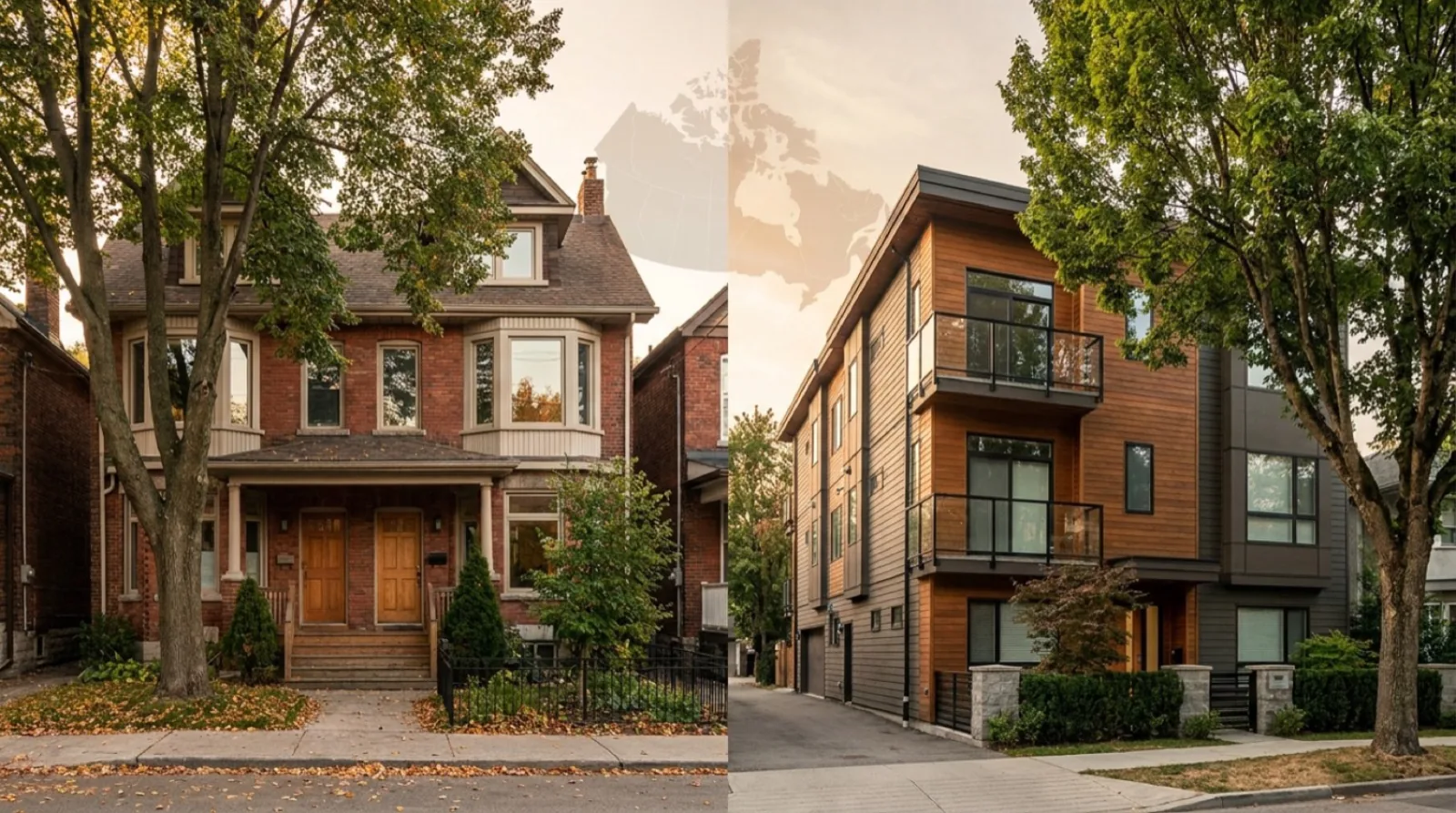
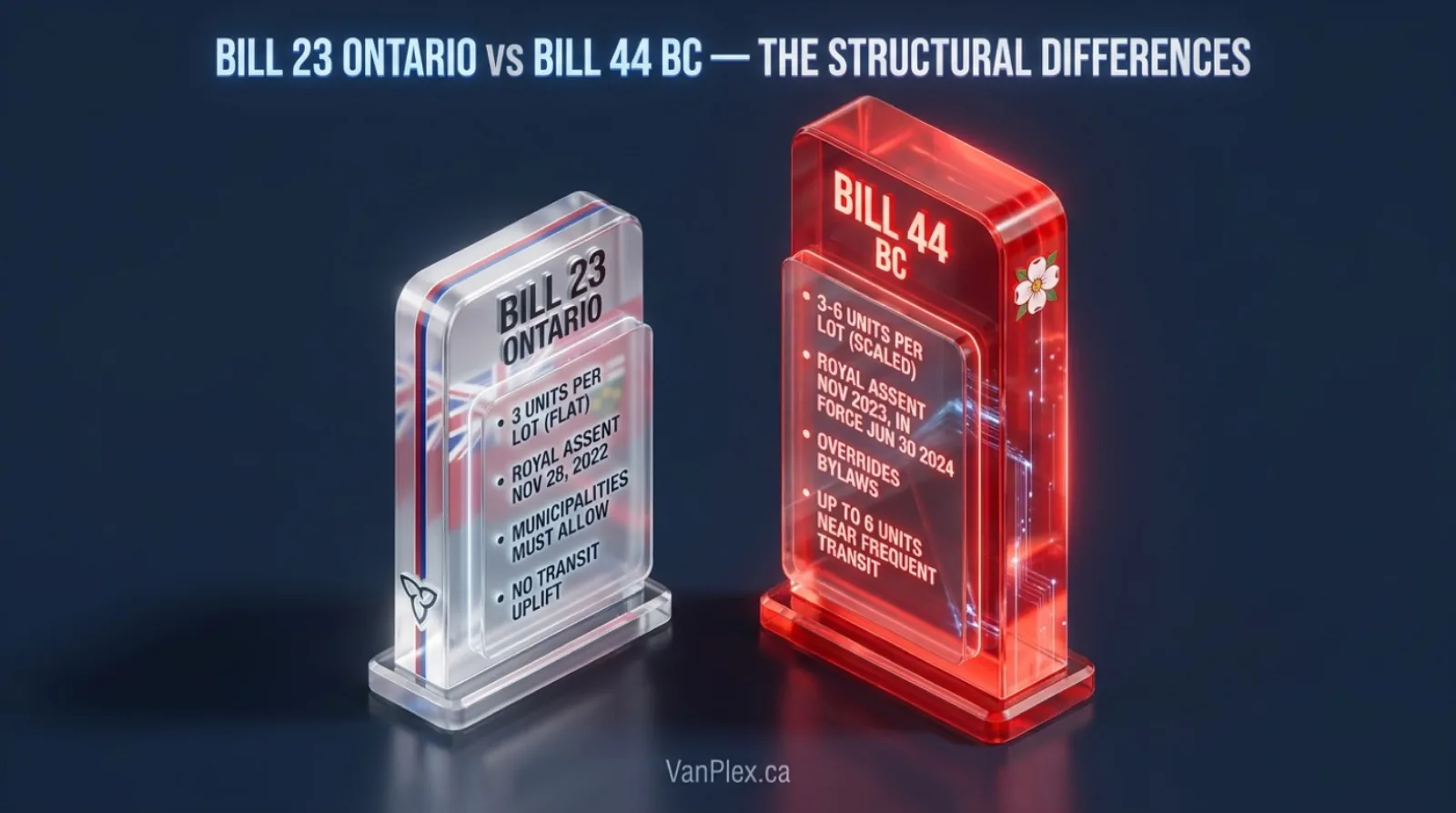
- Bill 23 (Ontario) legalized 3 units per lot as-of-right province-wide; royal assent November 28, 2022
- Bill 44 (BC) requires 3 to 6 units per lot depending on lot size and transit proximity; royal assent November 2023, in force June 30, 2024
- Bill 44’s transit uplift to 6 units near frequent-transit stops has no Ontario equivalent
- Bill 44 overrides local zoning bylaws; Bill 23 sets a province-wide floor municipalities must allow
- BC’s pipeline integrates with CMHC MLI Select, Vancouver R1-1 fee structure, and credit union construction debt in a way Ontario’s hasn’t matched yet
- Despite Bill 23 being a year older, Toronto’s 3–5 unit small-plex starts only just surpassed 100-plus-unit starts in 2026 — Bill 44 unlocked a faster-moving market
- Ontario is broader but shallower; BC is more prescriptive and deeper
Bill 23 in one paragraph
Bill 23 — the More Homes Built Faster Act, 2022 — received royal assent on November 28, 2022. The headline change for residential property owners: every Ontario municipality must allow up to three residential units on a residential lot without rezoning. The three units can be three within the primary building, or two within the primary building plus one in an ancillary structure such as a converted garage or a laneway suite. Bill 23 also touched development charges, conservation authorities, and the Greenbelt — but the as-of-right tri-plex provision is the part that affects homeowners directly.
There’s no scaling clause. A standard Toronto residential lot and a 50-foot Etobicoke double-fronted parcel get the same maximum: three units.
Bill 44 in one paragraph
Bill 44 — BC’s Housing Statutes (Residential Development) Amendment Act — received royal assent in November 2023 and came into full force on June 30, 2024. It overrides local zoning bylaws and requires every municipality with population over 5,000 to permit small-scale multi-unit housing on any lot previously zoned for one or two units. The minimum density depends on lot size and location:
- 1 secondary suite or detached ADU on the smallest lots
- 3–4 units on most standard lots
- Up to 6 units on lots near frequent-transit stops
By June 2024, BC reported nearly 90% of communities had adopted Bill 44-compliant bylaws. As of early 2026, Vancouver alone has 518 multiplex applications in the pipeline.
The four real differences
| Dimension | Bill 23 (Ontario) | Bill 44 (BC) |
|---|---|---|
| Maximum density | 3 units per lot, flat | 3–6 units per lot, scaled by lot + transit |
| Mechanism | Municipalities must allow | Province overrides bylaws |
| Effective date | November 28, 2022 | June 30, 2024 |
| Transit-proximity uplift | None | Up to 6 units near frequent-transit |
| Companion legislation | Limited | Bill 16 (financing tools), Bill 25 (further compliance) |
These aren’t cosmetic differences. Each one shapes which projects get built and where.
Density ceiling — 3 vs 6
The single biggest practical gap. In BC, a homeowner on a standard 33-foot Vancouver lot near a frequent-transit corridor can build a six-unit purpose-built rental multiplex as-of-right. In Ontario, the same lot tops out at three units regardless of transit access. For a build-to-rent operator, the per-lot pencil math at six units is materially better than at three — more revenue, better economies of scale on land cost, easier to hit CMHC financing thresholds.
That ceiling difference is why the BC build-to-rent multiplex thesis works on a small lot. The Ontario thesis at three units is closer to a multigenerational owner-occupied product.
Mechanism — override vs floor
Bill 44 overrode municipal bylaws. Cities had until June 30, 2024 to comply, and the province has since used Orders in Council (West Vancouver Ambleside, April 2026) to enforce against non-compliant municipalities. The framing: this is provincial law; municipalities have to align.
Bill 23 set a floor. Municipalities had to amend their bylaws to permit up to three units, but the political dynamic was less confrontational. Toronto, Mississauga, and Ottawa moved relatively quickly. Smaller Ontario municipalities have moved more slowly, with less direct provincial follow-up than BC has done.
Companion legislation — BC’s stack vs Ontario’s standalone
BC didn’t stop at Bill 44. The province paired it with:
- Bill 16 — restrictions on how municipalities can charge density bonuses and inclusionary zoning (June 30, 2026 compliance deadline; see our Vancouver Density Bonus Removal post)
- Bill 25 — additional zoning and small-scale housing compliance with a June 30, 2026 deadline
- Transit-Oriented Development legislation — minimum densities near major transit
- Active provincial enforcement — Orders in Council to override holdouts
Ontario’s Bill 23 came with development charge changes, but the financing-and-fees ecosystem has not been built out the way BC’s has. The result: a BC homeowner has a more developed playbook of fee waivers, financing programs, and CMHC product alignment than an Ontario homeowner working on the same as-of-right zoning right.
Transit uplift
Bill 44 explicitly ties higher density (4 to 6 units) to proximity to frequent-transit stops. The policy logic: deliver density where the existing transit infrastructure can absorb it. The practical effect: a lot two blocks from the Skytrain or a frequent-bus corridor in BC can build twice as many units as the same lot in suburban Toronto, even with both being “as-of-right” multiplex zones.
Why Toronto small-plex starts only just outpaced high-rises
Bill 23 has been law for nearly four years. Bill 44 has been in force for under two. The number that gets quoted — Toronto’s 3–5 unit small-plex starts surpassing 100-plus-unit project starts for the first time on record — is the inflection of a market that took those four years to mature.
Three reasons it took longer:
- Three-unit density limit. A tri-plex pencils for some sponsors, especially multigenerational families and small landlords. It rarely pencils for a build-to-rent professional operator the way a six-plex does in BC.
- Higher Toronto land cost. A 25-foot Toronto lot cleared for redevelopment trades at numbers that demand more than three units of revenue to make sense.
- Slower lender maturation. Ontario credit unions have multiplex programs but haven’t built the visible track record BC institutions like Vancity have. Vancity announced in April 2026 that it had financed 45 multiplex projects worth $60.4M in six months.
The Toronto small-plex pipeline that’s now overtaking high-rises is largely catalyzed by condo high-rise stalling, not by Bill 23 itself. Bill 23 made the units legal. The condo market collapsing made the small-plex deals attractive.
What this means if you own land in either province
BC homeowner
You have the deepest provincial multiplex stack in Canada. Six units near transit, financing ecosystem maturing, fee waivers in motion, CMHC MLI Select alignment, and credit union construction lending. The play is to evaluate your specific lot’s density entitlement, run the proforma against current and post-June-30 fee structures, and decide build-to-rent vs strata exit. (See our build-to-rent vs sell proforma post.)
Ontario homeowner
You have province-wide three-unit as-of-right zoning, the start of municipal alignment, and a small-plex market that’s just hitting inflection. The math at three units is more often a multigenerational or small-landlord story than a professional build-to-rent thesis. Watch for any provincial move that increases the as-of-right ceiling — Ontario hasn’t yet matched BC’s six-unit transit uplift, but the political pressure is real.
Investor with capital across both provinces
The deeper financing infrastructure, higher density ceiling, and lower-friction permitting in BC make it the more developed multiplex market today. Ontario small-plex is the asymmetric bet — earlier in its maturation, less crowded with sophisticated capital, and with major upside if Ontario eventually closes the policy gap with BC.
What to watch next
For BC: the June 30, 2026 Bill 16 compliance deadline removes density bonusing on 90%+ of multiplex lots. Council vote at Vancouver was May 5, 2026; public hearing June 2; effective June 30. (See our density bonus removal post.)
For Ontario: any move toward four-or-more-unit as-of-right zoning at the provincial level. Toronto already permits four units in residential zones; provincial alignment would change the small-plex math materially.
For both: the CMHC MLI Select September 30, 2026 energy code transition affects multiplex financing in both provinces equally. (See our MLI Select deadline post.)
What to do this month
If your lot is in BC and you’re considering a multiplex:
- Check whether your lot qualifies for the 6-unit transit uplift
- Get pre-quotes from Vancity, Prospera, or your local credit union for construction debt
- Run a proforma against the post-June-30 fee structure (density bonusing removed)
If your lot is in Ontario:
- Confirm what your municipality permits beyond Bill 23’s three-unit floor — Toronto goes to four
- Talk to local Ontario credit unions and alt-A lenders about small-plex construction debt
- Watch for provincial moves on as-of-right ceilings
For a lot-specific check on whether your BC property is suitable for a Bill 44 multiplex, drop the address into the VanPlex proforma. It models the BC zoning entitlement, fee load, and financing stack in one place.
Author: David Babakaiff, Co-Founder of VanPlex PlexRank™ | Profit with Multiplex
Sources:
- Legislative Assembly of Ontario — Bill 23, More Homes Built Faster Act, 2022
- BLG — Bill 23 in Ontario: the More Homes Built Faster Act receives Royal Assent
- Province of BC — Small-scale, multi-unit housing
- BC Gov News — Nearly 90% of B.C. communities have adopted small-scale multi-unit housing legislation
- Canadian Centre for Housing Rights — What you need to know about Ontario’s Bill 23
- Canadian Mortgage Trends — As condo projects stall, multiplexes emerge as Toronto’s next supply engine