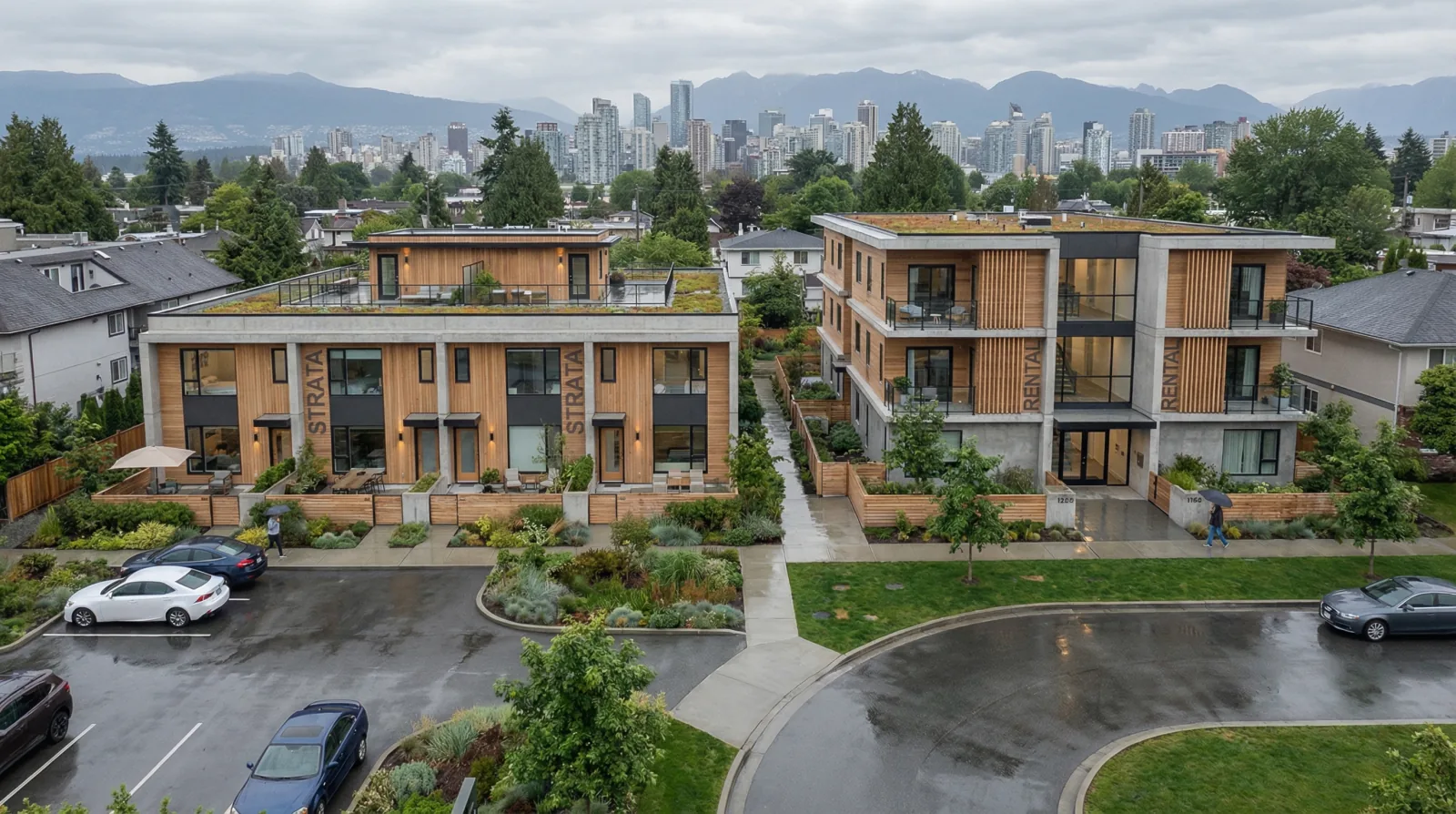

Modern wood-frame multiplex building in Vancouver showing a secured rental development under R1-1 zoning with 8 units
Build-to-Rent

What Is Build-to-Rent Multiplex and Why BC Is Leading

7 min read

BTR is not a building type. It's a tenure decision — you build a multiplex and hold it as rental instead of stratifying and selling. BC is the only province where Bill 44 zoning, CMHC MLI Select financing, and R1-1 density bonuses all converge.

Key takeaway

Foundational explainer on build-to-rent (BTR) multiplex in British Columbia.

BTR is a tenure decision: same building, different ownership model where one owner holds all units as rental instead of stratifying. BC uniquely combines three enablers: Bill 44 (provincial multiplex zoning mandate, 518+ applications in Vancouver), Vancouver's R1-1 zoning (8 units at 1.00 FSR for secured rental vs 6 units at 0.70 FSR for strata, density bonus contribution exemption), and CMHC MLI Select (5+ unit minimum, 95% LTV, 50-year amortization). Honest assessment of where BTR works (lots with 5+ units, rents clearing 1.10 DSCR, reasonable land cost) and where it doesn't (high land cost areas, sub-5-unit zoning, low-rent neighbourhoods).

What this covers

  • BTR as tenure decision not building type
  • Bill 44 SSMUH zoning mandate
  • R1-1 secured rental density bonus
  • CMHC MLI Select 5-unit threshold
  • where BTR works and doesn't
  • BC as only province with all three enablers
build-to-rent BTR Bill-44 SSMUH R1-1 CMHC

Build-to-rent is not a building type. It’s a tenure decision. You build a multiplex and hold it as rental instead of stratifying and selling individual units. The building itself can look identical either way. The difference is ownership structure, financing, and how you make money.

The Tenure Decision

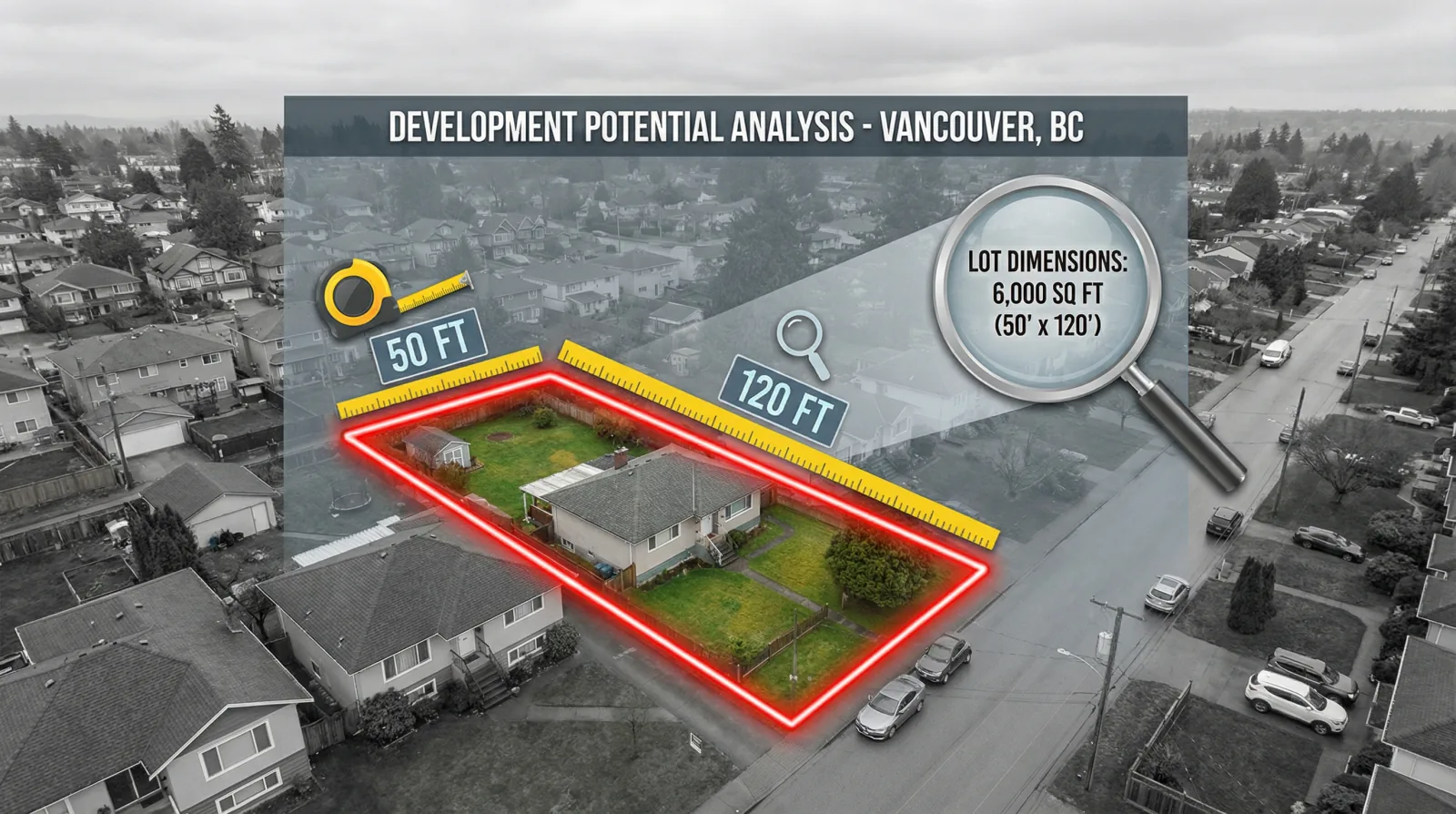
You own a 6,000 sq ft lot in Vancouver. Under R1-1 zoning, you can build a 6-unit multiplex and sell each unit individually as strata. Or you can build an 8-unit secured rental multiplex and hold all of them.

Same lot. Same neighbourhood. Different financial structure. Different regulatory pathway. Different outcome over 10, 20, 30 years.

Strata gives you a one-time profit event. You build, you sell, you move on. The return is immediate and taxable as income (or capital gains if structured carefully).

BTR gives you a compounding asset. You build, you hold, you collect rent. The return is slow at first — but the asset appreciates, the mortgage amortizes, and rents rise. Over 25 years, you own a debt-free building throwing off six figures in annual net operating income.

Neither model is universally better. The right choice depends on your lot, your cost structure, your financing access, and your timeline.

Why BC Specifically

Three things converged in BC between 2023 and 2026 that made small-scale BTR viable for the first time.

Bill 44 (November 2023) — BC mandated that every municipality over 5,000 residents allow multiplex housing on single-family lots. This was not optional. The Province set compliance deadlines: June 30, 2024, for initial bylaw amendments, and June 30, 2026, for full OCP alignment under Bill 25. As of early 2026, over 498 multiplex applications have been filed in Vancouver alone.

Vancouver’s R1-1 District Schedule — Vancouver went further than the provincial minimum. Under R1-1, secured rental projects on lots 557 m2+ with 15.1m frontage get a density bonus: 1.00 FSR instead of 0.70, and up to 8 units instead of 6. Secured rental projects are also exempt from density bonus contributions — a fee that can run $82,000+ per unit on market strata projects.

CMHC MLI Select — The federal government’s multi-unit mortgage insurance program requires a minimum of 5 rental units. It offers up to 95% loan-to-value, amortizations up to 50 years, and premium discounts of 10-30% based on a points system (affordability, energy efficiency, accessibility). This is the financing that makes the hold model pencil.

No other province has all three. Ontario doesn’t have a Bill 44 equivalent. Alberta doesn’t have the rent levels. Quebec’s rent controls make the math harder. BC is the testbed.

How R1-1 Changes the Math

The density bonus for secured rental in Vancouver’s R1-1 zone isn’t just 2 extra units. It changes the entire financial model.

At 0.70 FSR on a 6,000 sq ft lot, you get 4,200 sq ft of buildable space. Divide that into 6 strata units and you’re looking at roughly 700 sq ft per unit.

At 1.00 FSR, you get 6,000 sq ft. Divide into 8 rental units and each unit is 750 sq ft — larger units with more total building area.

The additional 1,800 sq ft of buildable space at approximately $425/sq ft in hard costs represents about $765,000 in additional construction cost. But those 2 extra units generate rental income that feeds directly into DSCR calculations for CMHC qualification.

More units = more rental income = stronger CMHC qualification = better financing terms = lower equity requirement.

Where BTR Works — And Where It Doesn’t

BTR works on lots where:

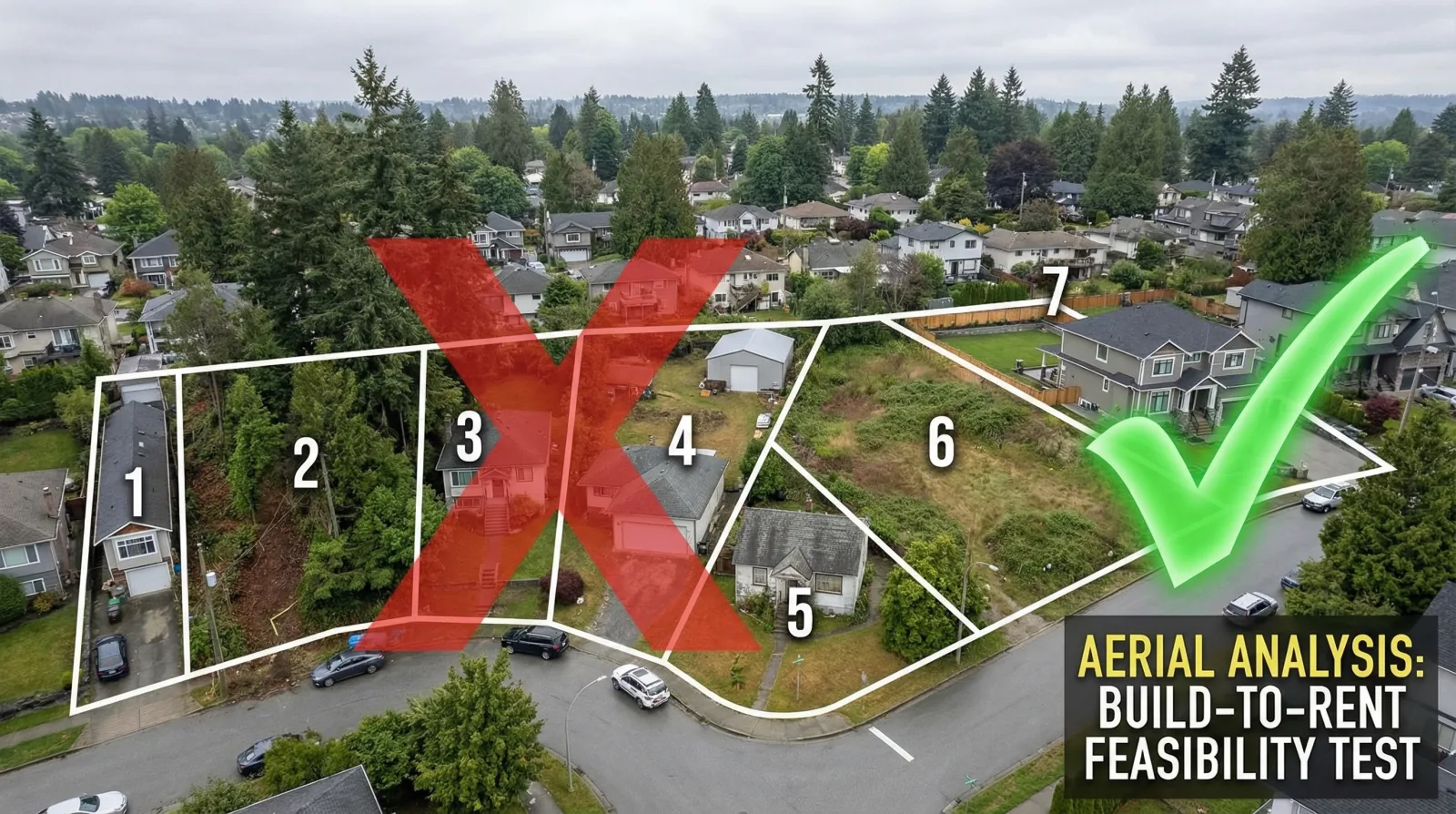
  1. The lot qualifies for 5+ units — This is the CMHC threshold. Four units means conventional financing at 20% down with 25-year amortization. Five units means CMHC MLI Select at potentially 5% down with 50-year amortization. This single threshold changes everything. (Read more about the 5-unit threshold)

  2. Rents cover debt service — CMHC requires a minimum 1.10 debt service coverage ratio. Your net operating income must exceed annual mortgage payments by at least 10%. In lower-rent areas of Metro Vancouver, this doesn’t clear. In higher-rent neighbourhoods with transit access, it does.

  3. Land cost is reasonable relative to revenue — A $3.5M lot in Kitsilano produces the same rent as a $2.1M lot in East Vancouver, but the financing math is dramatically different.

BTR does not work on lots where:

  • Land cost eats the model — West Side Vancouver lots at $3M+ make the DSCR nearly impossible to clear without below-market land acquisition
  • Zoning caps at 4 units — Some municipalities haven’t implemented Bill 44’s 6-unit near-transit provisions yet
  • The neighbourhood doesn’t support rental premiums — New-build rental commands $2,400-3,200/month in Vancouver depending on unit size and location. If market rents in your area are $1,800 for a 2-bedroom, the math doesn’t pencil.

The Honest Picture

BTR is not passive income from day one. Year one through five, you’re likely cash-flow neutral or slightly negative after accounting for vacancy, maintenance reserves, and property management. The wealth creation comes from mortgage paydown and asset appreciation compounding over a decade or more.

It’s also not simple. You need to qualify for CMHC MLI Select, which means navigating a points system, commissioning energy modelling, and potentially committing to affordability or accessibility standards. You need a property management strategy from day one. You need to understand the Residential Tenancy Act because once those units are occupied, your obligations are real and ongoing.

But for the right lot, with the right financing, held by an owner with a long-term horizon — BTR multiplex in BC is a structurally advantaged investment that didn’t exist before 2024.

The zoning is by-right. The financing is government-backed. The demand for rental housing in Metro Vancouver isn’t going anywhere. CMHC’s Spring 2026 report showed rental completions running at 2x the ten-year average nationally, and purpose-built rental starts exceeded condo starts in Toronto for the first time on record.

The question is whether your specific lot and your specific financial situation make the hold model better than the sell model. That’s the analysis that matters. (Compare the two proformas side by side)


David Babakaiff is the Co-Founder and CEO of VanPlex, a Vancouver-based company specializing in multiplex development and Missing Middle housing. VanPlex uses its AI-powered PlexRank system to identify and underwrite multiplex conversion opportunities under BC’s Bill 44 zoning reforms.

Want to see whether your lot pencils for build-to-rent? Visit VanPlex.ca and run a proforma.
Frequently asked questions

What is build-to-rent multiplex?

Build-to-rent is a tenure decision, not a building type: the owner builds a multiplex and holds all units as rental instead of stratifying and selling each one individually. The building can look identical to a strata project either way. The difference is ownership structure, financing, and how the owner makes money, either through a one-time sale profit or through compounding rental income, mortgage paydown, and appreciation over 10 to 30 years.

Why is BC uniquely suited for build-to-rent multiplex development?

Three things converged in BC between 2023 and 2026: Bill 44, passed in November 2023, mandates that every municipality with more than 5,000 residents allow multiplex housing on single-family lots, with over 498 applications filed in Vancouver alone by early 2026. Vancouver's R1-1 District Schedule adds a density bonus for secured rental (1.00 FSR and up to 8 units versus 0.70 FSR and 6 units for strata). CMHC MLI Select offers up to 95 percent loan-to-value and 50-year amortization for buildings with 5 or more rental units. No other Canadian province combines all three: Ontario has no Bill 44 equivalent, Alberta lacks comparable rent levels, and Quebec's rent controls make the math harder.

How does Vancouver's R1-1 zoning change the math for build-to-rent versus strata?

On a 6,000 square foot lot, strata at 0.70 FSR yields 4,200 square feet divided into 6 units of roughly 700 square feet each. Secured rental at 1.00 FSR yields the full 6,000 square feet divided into 8 units of about 750 square feet each. That extra 1,800 square feet costs approximately $765,000 more in hard costs at $425 per square foot, but the 2 extra rental units generate income that feeds directly into the debt service coverage ratio CMHC uses to qualify the mortgage.

Why is 5 units the key threshold for build-to-rent financing?

Four units qualifies only for conventional financing at 20 percent down with 25-year amortization, while 5 units unlocks CMHC MLI Select, which can offer as little as 5 percent down with 50-year amortization. This single threshold changes the entire financing structure available to a build-to-rent project, which is why lot size and unit count eligibility matter as much as location when evaluating a site.

What debt service coverage ratio does CMHC require for build-to-rent financing?

CMHC requires a minimum 1.10 debt service coverage ratio, meaning net operating income must exceed annual mortgage payments by at least 10 percent. New-build rental in Vancouver commands $2,400 to $3,200 per month depending on unit size and location, and the post notes that in lower-rent areas of Metro Vancouver where a comparable 2-bedroom rents for closer to $1,800, this ratio does not clear.

On which lots does build-to-rent not work in Vancouver?

Build-to-rent struggles on West Side Vancouver lots priced at $3M or more, where land cost makes the debt service coverage ratio nearly impossible to clear without below-market land acquisition. It also fails where zoning still caps density at 4 units because a municipality has not yet implemented Bill 44's 6-unit near-transit provisions, or where local market rents are too low to generate the rental premium a new-build project needs to cover its financing.

Is build-to-rent multiplex passive income from day one?

No. The post describes years one through five as likely cash-flow neutral or slightly negative after accounting for vacancy, maintenance reserves, and property management costs. Wealth creation comes later, from mortgage paydown and asset appreciation compounding over a decade or more, and the owner also needs to navigate CMHC's points system, energy modelling, and BC's Residential Tenancy Act once units are occupied.

How does the Vancouver rental market compare nationally in 2026?

CMHC's Spring 2026 report showed rental completions running at twice the ten-year national average, and purpose-built rental starts exceeded condo starts in Toronto for the first time on record, according to the post. Combined with by-right zoning under Bill 44 and government-backed CMHC financing, the post frames this as evidence that demand for rental housing in Metro Vancouver supports the build-to-rent model for owners with a long-term horizon.

Free 12-page guide for Vancouver-area homeowners. Build, sell, hold, or partner — side-by-side comparison of the numbers, timeline, and risk on each path.

Verified phone required. We'll text you the link in 60 seconds.

David Babakaiff

David Babakaiff

Co-Founder, VanPlex | 25+ Years BC Construction

David Babakaiff is Co-Founder of VanPlex with 25+ years scaling BC construction. He led Alair Homes Vancouver to the 2024 HAVAN Award for Best Multiplex Unit in the GVRD. VanPlex’s PlexRank™ algorithm scores residential parcels across BC for multiplex conversion potential under Bill 44.

Want insights like this delivered weekly?

Join 2,500+ property owners getting ROI case studies, market data, and exclusive opportunities.

No spam. Unsubscribe anytime.