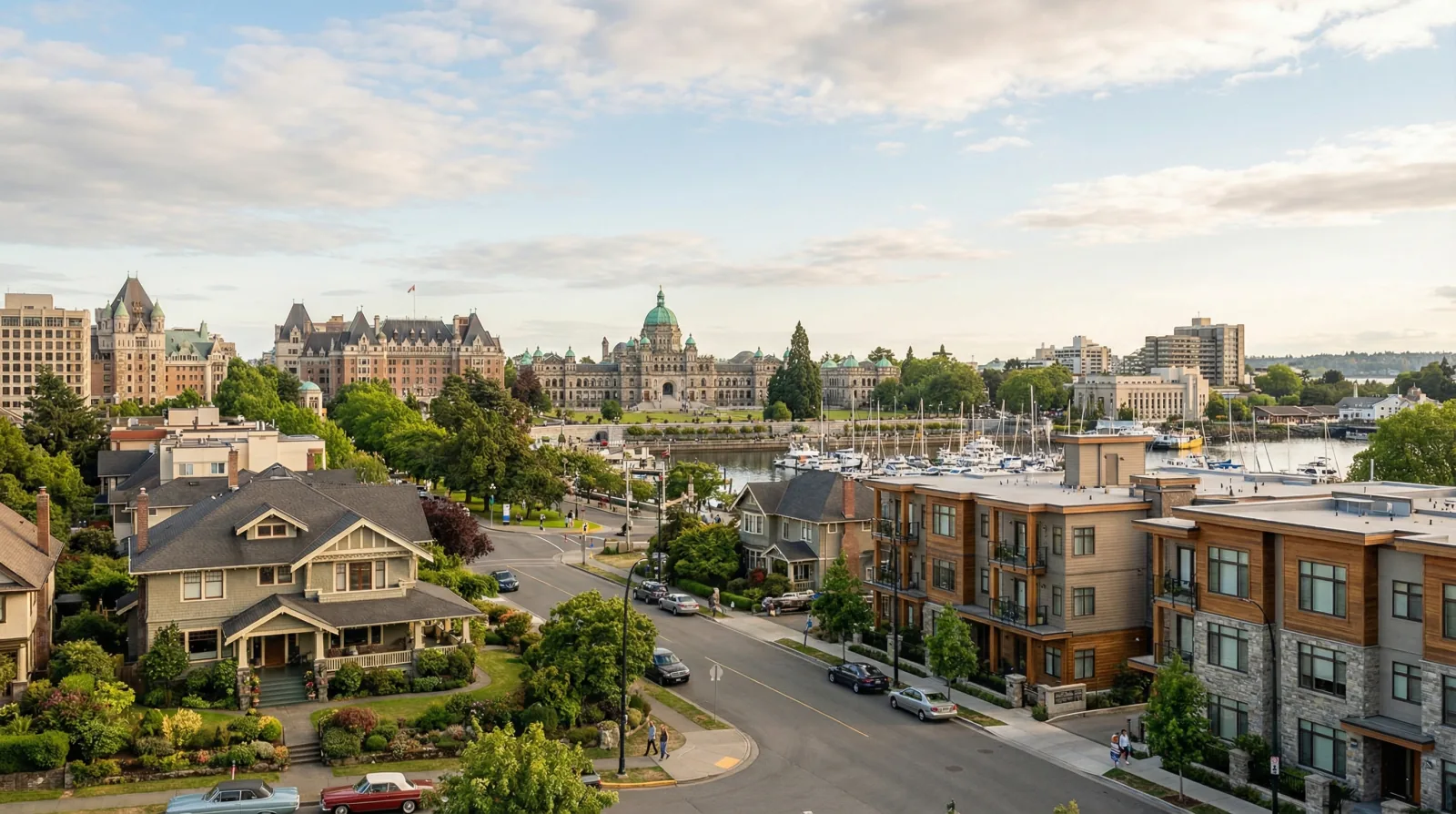

Victoria’s rental market doesn’t crash. It doesn’t boom either. It just grinds.
Vacancy rose to 3.3% in 2025 — the highest since 1999. Average 2-bedroom rent: $2,120, up 5.1% year-over-year. Those two facts shouldn’t coexist. More vacancies should mean softer rents. But Victoria operates on island economics, and island economics follow different rules.
Island Economics: Why Victoria Is Different
Every building material that isn’t milled on Vancouver Island arrives by ferry or barge. Lumber, concrete, steel, drywall, fixtures — all of it crosses water. BC Ferries’ commercial rates add $800-$1,200 per truckload. A typical 6-unit multiplex needs 40-60 truck deliveries during construction. That’s $32,000-$72,000 in ferry surcharges alone.
Then there’s labour. Victoria has fewer general contractors, fewer framing crews, fewer plumbers, fewer electricians than Metro Vancouver. The trades that exist are busy. Wait times for electrical rough-in: 3-4 weeks in Vancouver, 5-7 weeks in Victoria. Framing crews: booked 2-3 months out. Every subcontractor knows they’re one of fewer options.
The result: construction costs in Victoria run 10-15% above Vancouver. If Vancouver hard costs are $425/sq ft, Victoria is $470-$490/sq ft. On a 4,000 sq ft 6-unit building, that’s $180,000-$260,000 in additional cost. Not a dealbreaker, but it moves the DSCR needle.
Victoria’s Missing Middle Head Start
Victoria adopted its Missing Middle Housing Initiative in March 2023 — eight months before Bill 44 passed provincially. The city was ahead of the curve.
What Victoria’s zoning allows: up to 6 units on most average residential lots in the Traditional Residential designation, across four common low-density zones. SSMUH guidelines scale by lot size and transit proximity. Small lots under 280 m2 get 3 units. Medium lots 280-1,000 m2 get 4 units. Lots near frequent transit can reach 6.
The Official Community Plan goes further, enabling ground-oriented and low-rise buildings up to four storeys in all residential areas — not just low-density zones. Houseplexes, townhouses, low-rise apartments. Victoria’s planning framework is arguably more permissive than Vancouver’s for mid-density infill.
But permissive zoning doesn’t mean fast permitting. Victoria’s development permit process still runs 8-12 months for multiplex projects. No Fast-Track equivalent like Kelowna’s 10-day program. No streamlined R1-1 path like Vancouver’s. You file, you wait, you revise, you wait again.
The Demand Anchors
UVic: 22,000 Students
The University of Victoria enrolls 22,000 students — undergraduate and graduate combined. That’s 5.3% of the entire Greater Victoria population of 415,000.
UVic’s on-campus housing doesn’t come close to meeting demand. Student residence rates run $9,694-$12,105/year for apartments — roughly $1,200-$1,500/month. These are competitive with off-campus rents for shared accommodations, but single students looking for studios or 1-bedrooms are priced into the private rental market.
The campus is in Saanich, not downtown Victoria. Student rental demand concentrates along the Shelbourne corridor, in Gordon Head, and in Hillside-Quadra — all areas with single-family lots potentially eligible for Missing Middle redevelopment.
Unlike UBC Okanagan (which has seen international enrollment declines due to federal visa changes), UVic’s international student body of 3,400 represents a smaller share of total enrollment. The university is less exposed to immigration policy shifts.
Government Workers
Victoria is BC’s capital. The provincial government employs approximately 33,000 people in the Greater Victoria area. These are stable, well-paid jobs with pensions. Government workers don’t lose their housing during recessions (at least not at the same rate as private sector). They provide a bedrock of rental demand that cycles don’t easily erode.
This is why Victoria’s vacancy rate hit 3.3% — the highest in 25 years — and rents still went up 5.1%. The demand floor is high. The tenants are stable. Turnover is low. When a government worker rents an apartment, they tend to stay for years. Low turnover means fewer units hitting the market even when new supply arrives.
Tech Sector Concentration
Victoria developed a meaningful tech sector over the past decade. Companies like Vivid Solutions, LlamaZOO, Certn, and the VENUS cybersecurity cluster employ thousands. Tech workers earn $80,000-$140,000 and many prefer renting over buying in a $1.3M single-family market.
The tech sector is more volatile than government — layoffs happen, startups fail. But the concentration of tech talent in a city this size creates rental demand in the $2,200-$2,800/month range for quality units. New-build multiplex units with modern finishes command premium rents from this demographic.
Running the Numbers: Saanich 6-Plex
A lot in Saanich near the Shelbourne transit corridor. 6,500 sq ft. Qualifies for 6 units under SSMUH (near frequent transit). Land value: $1,150,000.
| Line Item | Amount |
|---|---|
| Land acquisition | $1,150,000 |
| Buildable area (~3,900 sq ft) | 3,900 sq ft |
| Hard costs ($475/sq ft) | $1,852,500 |
| Soft costs, permits, GST | $560,000 |
| Total project cost | $3,562,500 |
| CMHC mortgage (95% LTV) | $3,384,375 |
| Equity required (5%) | $178,125 |
| Annual gross rent (6 units avg $2,200/mo) | $158,400 |
| Vacancy (4%) + OpEx ($58,000) | -$64,336 |
| NOI | $94,064 |
| Annual debt service (4.2%, 45-yr am) | $157,400 |
| DSCR | 0.60 |
Fails. The island construction premium ($475/sq ft vs. $425 on the mainland) and the land cost ($1.15M) push the total project cost too high for Victoria rents to service.
At zero land basis (existing homeowner):
| Line Item | Amount |
|---|---|
| Total project cost | $2,412,500 |
| CMHC mortgage (95% LTV) | $2,291,875 |
| Annual debt service | $106,600 |
| NOI | $94,064 |
| DSCR | 0.88 |
Closer. But still short. The construction premium is the killer. A mainland builder hitting $425/sq ft would have a project cost of $2,217,500 and debt service of $97,300. DSCR: 0.97. Getting closer, but Vancouver’s 8-unit path on the same lot — if it were in Vancouver — would clear 1.10 because you’d have 33% more revenue from the two additional units.
Victoria doesn’t offer that extra density. Six units is the ceiling.
When Victoria BTR Works
The math works in three specific scenarios:
1. Owner-occupied unit reduces financing requirements. Live in one unit, rent five. Use conventional financing (not CMHC MLI Select). 20% down, 25-year amortization. Higher equity requirement ($482,500 on the $2.4M build) but you’re also eliminating your own housing cost. If your alternative is paying $2,500/month in rent or mortgage elsewhere, the effective cash flow improves by $30,000/year.
2. Higher-rent locations command $2,500+/month. Downtown Victoria, James Bay, Fairfield — areas where new-build rental units command $2,400-$2,800/month for 2-bedrooms. At $2,500 average across 6 units, annual gross jumps to $180,000. NOI hits $109,664. On the zero-land-basis build, DSCR reaches 1.03. Still not 1.10, but within range if you can push one or two units to $2,700+.
3. Smaller lot, lower land cost, 4-unit build outside CMHC. Skip MLI Select entirely. Build 4 units on a $700K lot using conventional construction financing. Total project cost: $2.0M. Put $400K down. Rent at $2,200/month average. Gross rent: $105,600. Mortgage payment on $1.6M at 5.0%, 25-year: $112,000. Negative cash flow in year one, but the building appreciates and rents increase. This is a 15-year wealth-building strategy, not an income strategy.
The Stability Argument
Victoria BTR doesn’t offer Vancouver’s density bonus. It doesn’t offer Surrey’s cheap land. It doesn’t offer Kelowna’s fast permits.
What Victoria offers is stability.
Government worker demand doesn’t disappear in recessions. UVic enrollment doesn’t swing with commodity prices. Island land supply is physically constrained — you can’t sprawl when you’re surrounded by water on three sides and agricultural land reserves on the fourth.
Victoria’s single-family benchmark has been remarkably stable: $1,319,100 in February 2025, $1,307,400 in February 2026. Down 0.9%. In a year when Vancouver dropped 3-5% in many neighbourhoods and Kelowna’s market softened significantly. Victoria held.
For a BTR investor, stability means your exit value is predictable. A 6-unit building valued on a 4.5% cap rate with $94,000 NOI is worth $2.09M. If NOI grows at 3% annually (BC rent increase cap + turnover repricing), the building is worth $2.81M in year 10 and $3.77M in year 20. Add mortgage paydown and you’ve built significant equity with minimal downside risk.
The internal rate of return won’t match a Vancouver 8-plex on the right lot. But the variance is lower. Victoria BTR is the index fund of BC multiplex investing — moderate returns, low volatility, long time horizon.
The Secondary Suite Requirement
One detail that often gets missed: Victoria requires a secondary suite in new single-family construction. If you’re building a multiplex on a lot that currently has a single-family home, the city’s existing policy already pushed toward density. The transition from “house with suite” to “6-unit multiplex” is culturally less jarring in Victoria than in suburban Surrey or lifestyle-oriented Kelowna.
Neighbours are already accustomed to multi-tenant properties. The NIMBY resistance is lower. Community consultation periods tend to be smoother. This doesn’t show up in a proforma, but it reduces project risk in ways that matter during the permit process.
Who This Market Is For
Victoria BTR suits investors with three characteristics:
-
Long time horizon. Twenty years minimum. You’re not flipping. You’re building a pension on an island where land supply is permanently constrained.
-
Tolerance for lower initial returns. Cash-on-cash in year one might be 1-3%, or slightly negative. The returns compound through rent growth and mortgage paydown over decades.
-
Existing land position or willingness to owner-occupy. Purchasing a lot at $1.1M+ and building BTR for pure rental income doesn’t clear DSCR at current rents. You need either zero land basis or an owner-occupied unit to make the numbers work.
Victoria is not the best BTR market in BC. It might be the most boring. And for the right investor, boring is exactly what you want.
Explore the Victoria multiplex rental analysis for neighbourhood-level data and lot screening results.
David Babakaiff is the Co-Founder and CEO of VanPlex, a Vancouver-based company specializing in multiplex development and Missing Middle housing. VanPlex uses its AI-powered PlexRank system to identify and underwrite multiplex conversion opportunities under BC’s Bill 44 zoning reforms.