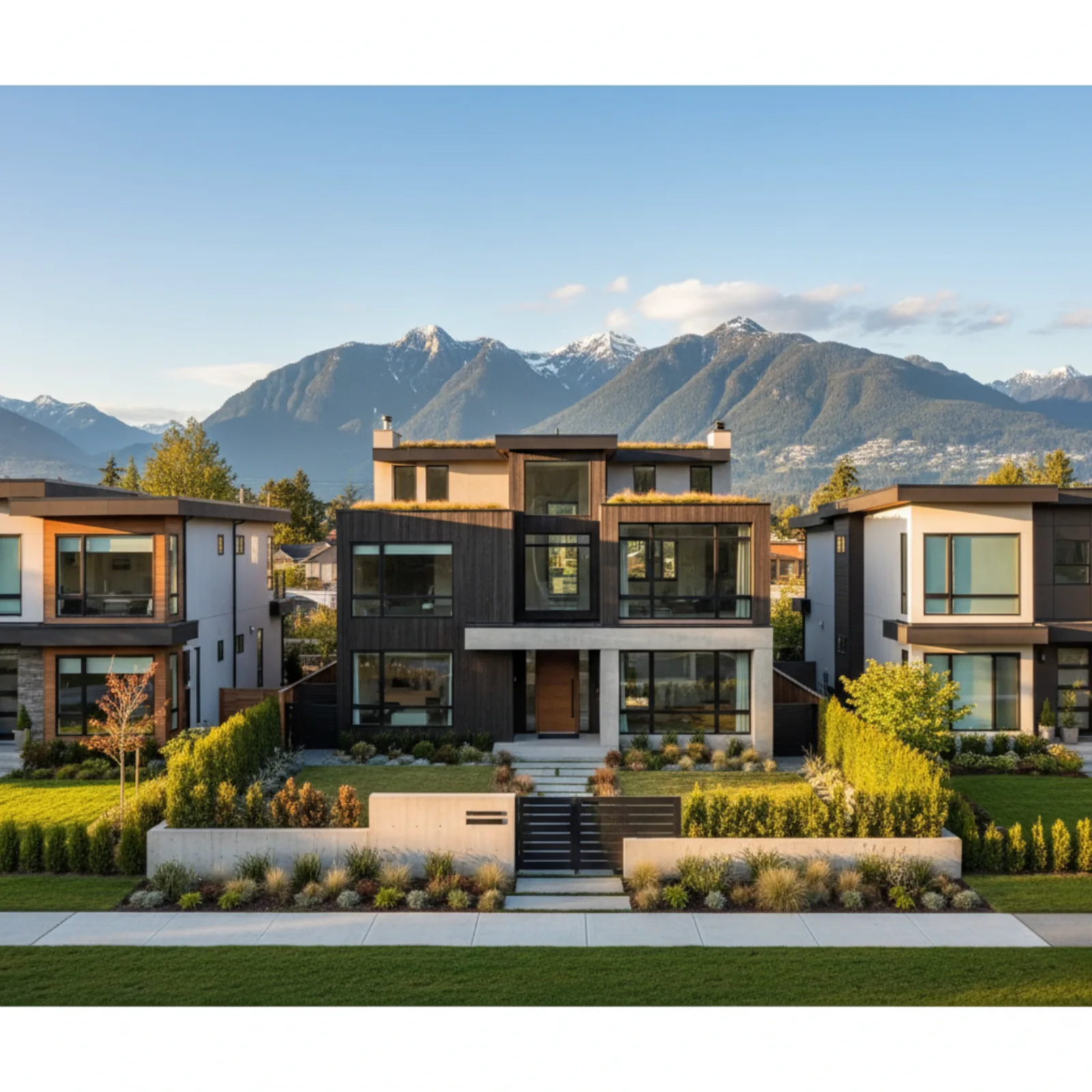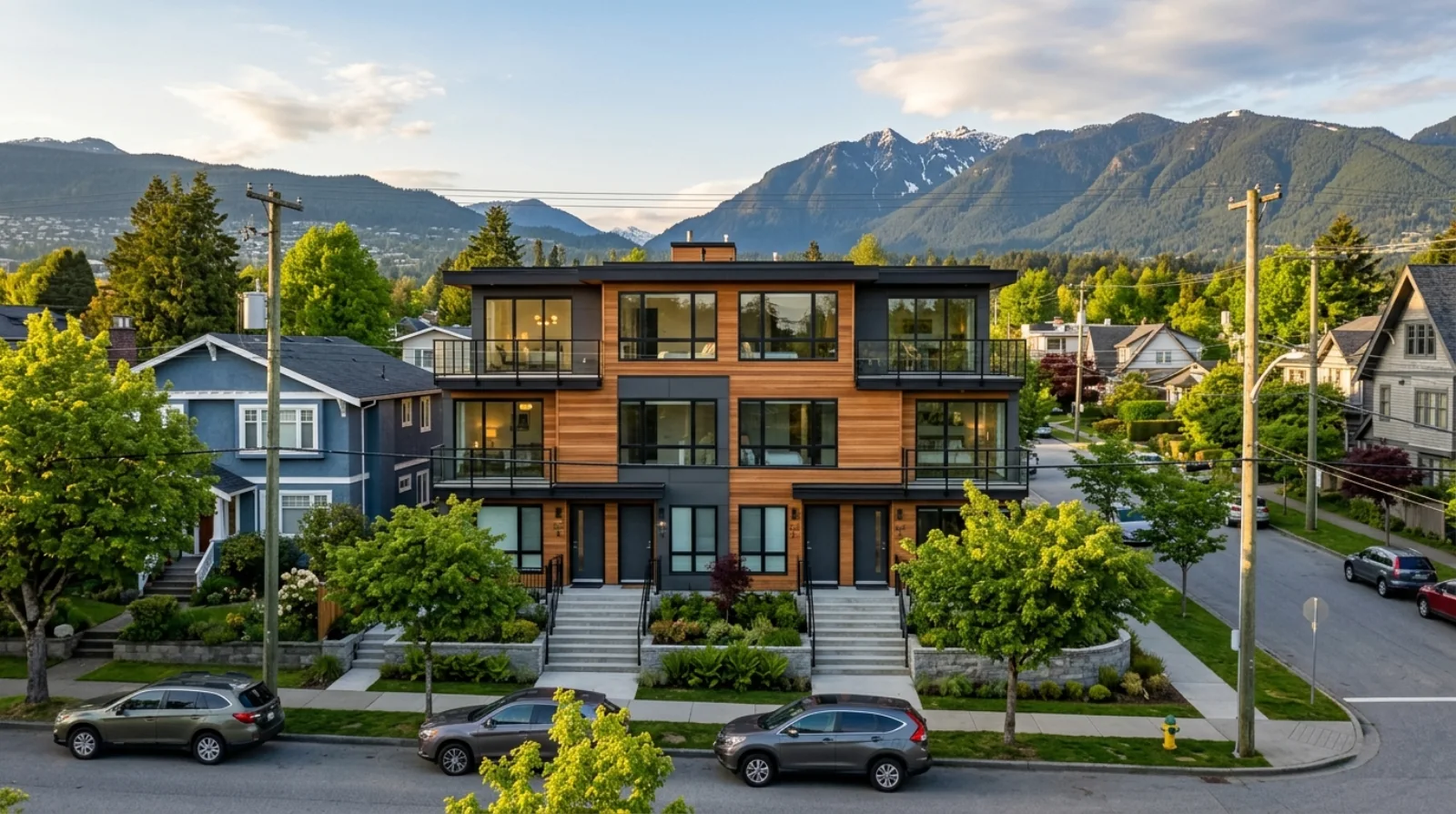

The Complete Guide to Vancouver Multiplex Development in 2026
Updated July 2026 — Bill 25’s June 30 compliance deadline has passed, Bill 44 is fully in force, and Metro Vancouver’s multiplex permit pipeline has grown year-over-year. The numbers and process below reflect current 2026 conditions.
Vancouver’s 2023 R1-1 zoning changes — reinforced by Bill 44 and Bill 25 — allow up to 6 units on standard single-family lots. That’s still the biggest housing policy shift in decades. A typical fourplex (5,200 sq ft) costs $5.6M to build and sells for $6.5M, yielding $910K profit with ROI ranging from 15–100% depending on location.
TL;DR (Key Takeaways)
- Bill 44 allows 3-6 units on Vancouver single-family lots (R1-1 zoning)
- FSR increased to 1.0-1.25 for multiplexes; up to 3 stories permitted
- Typical cost: $5.6M for a 5,200 sq ft fourplex ($2.8M land + $2.25M construction)
- Typical profit: $910K pre-tax on $6.5M sale value
- ROI range: 15–100%+ depending on location (median ~15–18% as of mid-2026)
- Timeline: ~20 months from planning to unit sales
- Parking: Reduced to 0.5 spaces per unit near transit; zero required for 6-unit strata buildings under Bill 44
- Bill 25 (2026): Compliance deadline passed June 30, 2026 — all major Vancouver-area municipalities now fully open
Vancouver’s housing landscape is rapidly evolving, and multiplex developments are at the forefront of this transformation. With recent zoning changes and growing demand for diverse housing options, now is an excellent time to explore multiplex development opportunities.
Understanding Vancouver’s Multiplex Zoning
Recent Zoning Changes
In 2023, Vancouver City Council approved sweeping changes to single-family neighborhoods, allowing up to six units on standard lots previously zoned for single-family homes. This represents one of the most significant shifts in Vancouver’s housing policy in decades.
Key changes include:
- R1-1 Zones: Now allow up to 6 units that can be sold (previously 1)
- Increased FSR: Floor Space Ratio increased to 1.25 for multiplexes if Net Zero and designed for other FSR bonuses (otherwise max is 1.0 FSR)
- Height Allowances: Up to 3 stories permitted
- Parking Requirements: Reduced to 0.5 spaces per unit near transit
Types of Multiplex Developments
- Duplex: 2 units on a single lot
- Triplex: 3 units on a single lot
- Fourplex: 4 units on a single lot
- Fiveplex: 5 units on a single lot
- Sixplex: 6 units on a single lot
- Eightplex: 8 rental only units on a single lot
Financial Analysis: The Numbers That Matter
Development Costs Breakdown
Here’s a typical cost structure for a 5,200 sq foot fourplex development in Vancouver:
Assuming market sales rates (highly location specific, using median sale value of $1,252 per sq ft):
- Total Sales Value: 5,200 sq ft × $1,252 = $6,510,400
Typical cost to buy land (or homeowner’s equity already earned) plus design, permit, build, finance and sell the fourplex:
| Cost Category | Amount (CAD) | Percentage |
|---|---|---|
| Land Acquisition / Ownership | $2,800,000 | 50% |
| Construction | $2,250,000 | 40% |
| Soft Costs | $350,000 | 7% |
| Contingency | $200,000 | 3% |
| Total Cost | $5,600,000 | 100% |
Profit Pre-Tax: $6,510,400 - $5,600,000 = $910,400
Return on Investment
We are seeing a broad range of returns. It is important to run your own property analysis (at vanplex.ca):
- Return on Equity (ROE): Ranges from NIL to over 100%. Median return is 15% (fall 2025)
- Internal Rate of Return (IRR): Ranges from NIL to 45% for properties with ROE of 80% or higher
- Development Timeline: Approximately 20 months from planning to selling units
The Development Process: Step by Step
1. Site Selection and Due Diligence
Critical factors to consider:
- Lot size and dimensions
- Current zoning designation
- Proximity to transit and amenities
- Neighborhood character and market demand
- Environmental considerations
2. Design and Planning
Work with experienced professionals:
- Architect specializing in multiplex design
- Civil engineer for site servicing
- Landscape architect for outdoor spaces
- Energy consultant for sustainability features
3. Permit Applications
Navigate the municipal approval process:
- Development Permit (4-6 months)
- Building Permit (2-3 months)
- Various trade permits
- Final occupancy permit
4. Construction Management
Key considerations:
- Good track record in multiplex development
- Contractor selection and management
- Construction scheduling and phasing
- Quality control and inspections
- Budget monitoring and control
Learn more about our comprehensive Vancouver multiplex development services including construction management and turn-key solutions.
5. Marketing and Sales
Strategies for success:
- Professional photography and virtual tours
- Targeted online marketing campaigns
- Competitive pricing analysis
- Strategic timing of unit releases
Maximizing Your Investment
Energy Efficiency and Sustainability
Incorporating green features can:
- Reduce operating costs by 20-30%
- Attract higher sales value and sell faster
- Qualify for government incentives
- Increase property value
Design for Flexibility
Consider:
- Adaptable floor plans
- Universal design principles
- Future conversion possibilities
- Personal spaces and office in home
Common Pitfalls to Avoid
- Starting with a low ROE profile: Risk increases as profit potential lessens (what can you sell it for in the future?)
- Ignoring neighborhood context: Design should complement existing character
- Cutting corners on quality: Invest in durable materials and systems
- Poor contractor selection: Vet thoroughly and check references
- Inadequate contingency planning: Keep 10% buffer for unexpected costs
Future Outlook
The multiplex market in Vancouver shows strong fundamentals:
- Growing population and housing demand
- Limited land supply driving densification
- Government support for missing middle housing
- Shifting preferences toward densified neighborhoods
Take Action Today
The opportunity to develop multiplex properties in Vancouver has never been better. With the right approach, knowledge, and team, you can create profitable developments that contribute to solving the housing crisis while building long-term wealth.
Next Steps
- Enter your address at www.vanplex.ca to find out your feasibility and profit potential
- Learn how to convert your single-family home to a Vancouver multiplex with our comprehensive homeowner guide
- Explore our glossary of Vancouver multiplex terms to understand key concepts like FSR, R1-1 zoning, and Bill 44
- Review our full-service multiplex development services including feasibility analysis, permitting, and construction
- Schedule a call with VanPlex for an architectural preliminary design, and we will confirm access to construction financing
Remember, successful multiplex development requires patience, planning, and professional expertise. But with Vancouver’s strong market fundamentals and supportive policy environment, the rewards can be substantial.