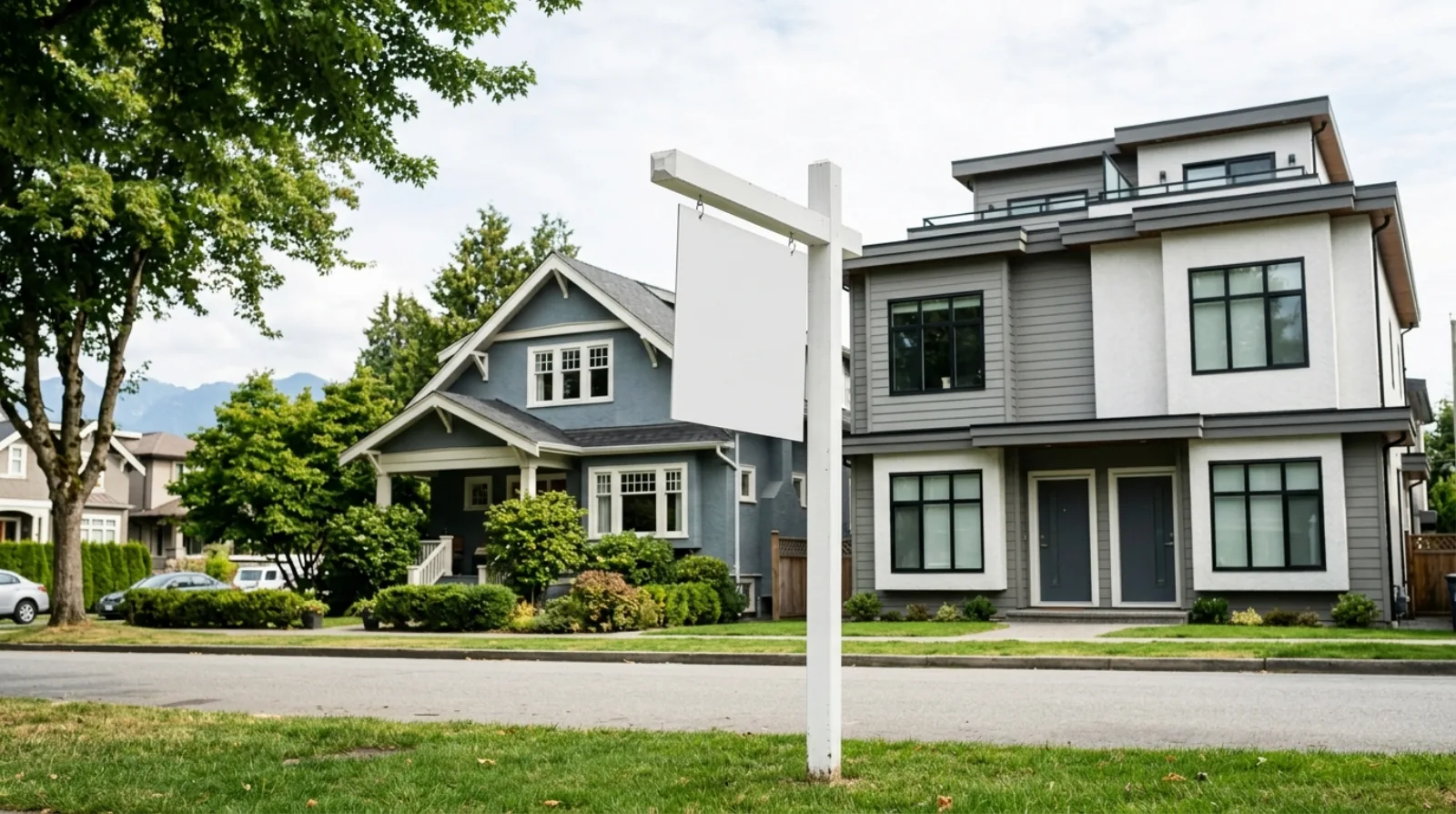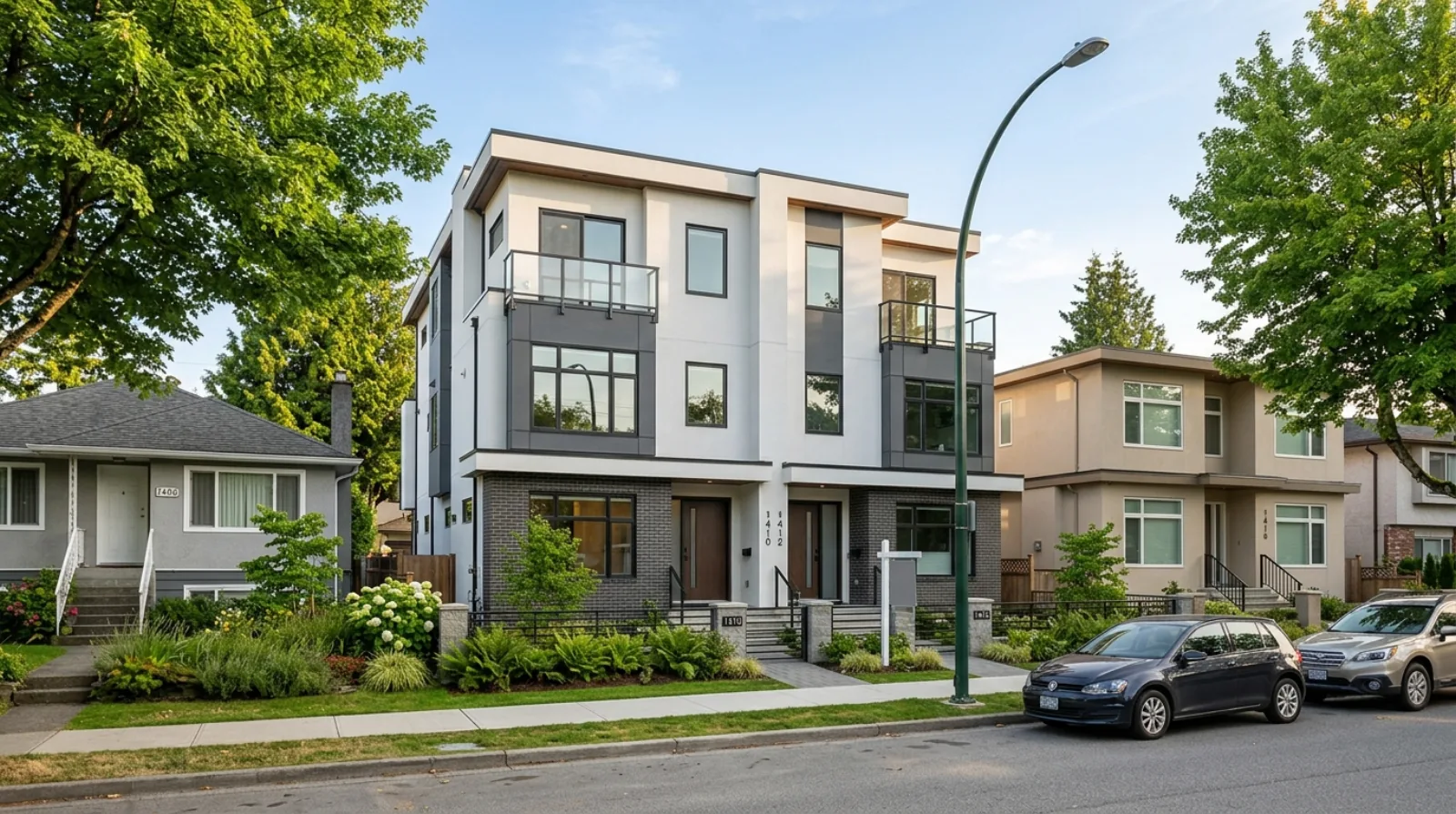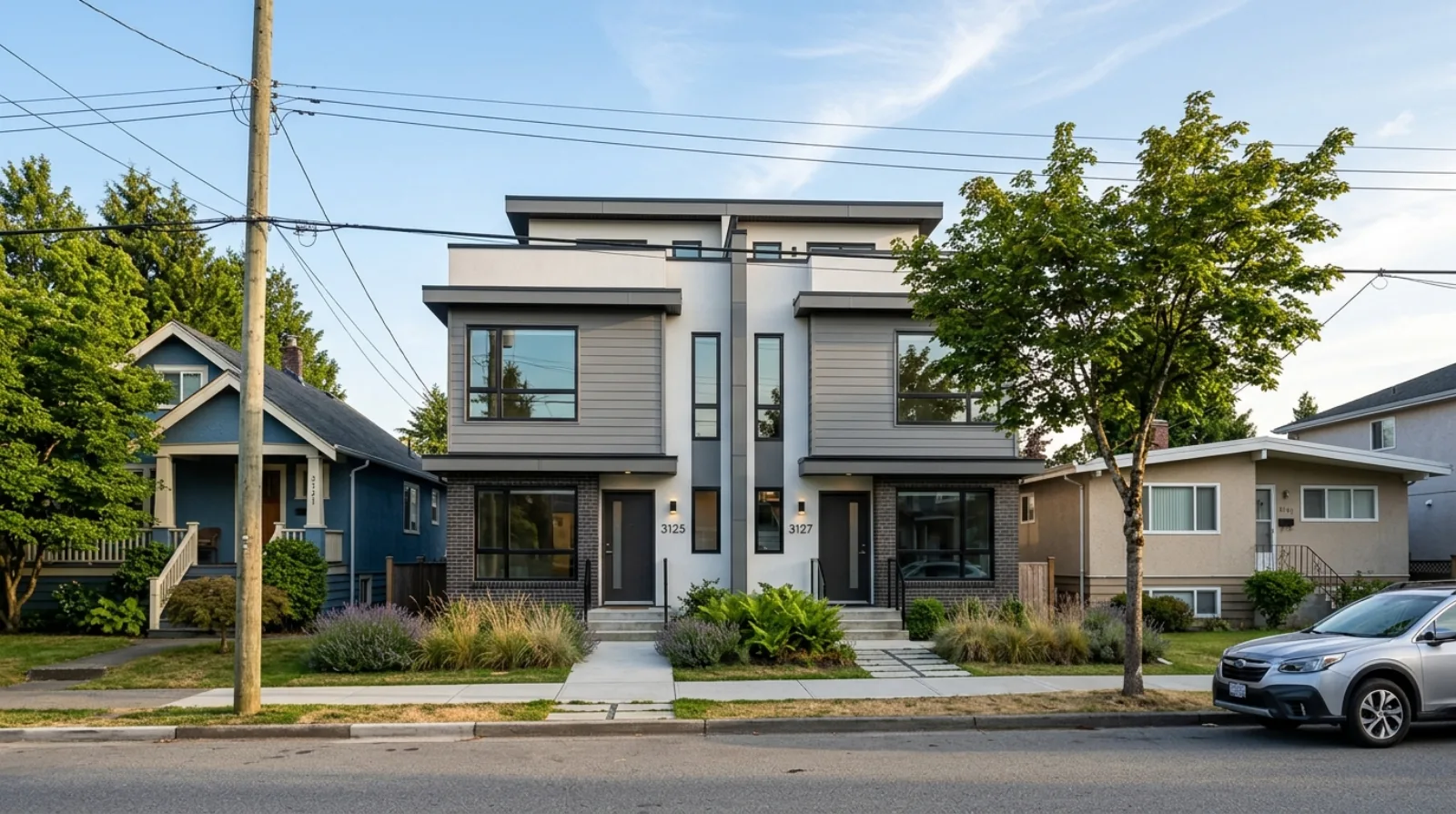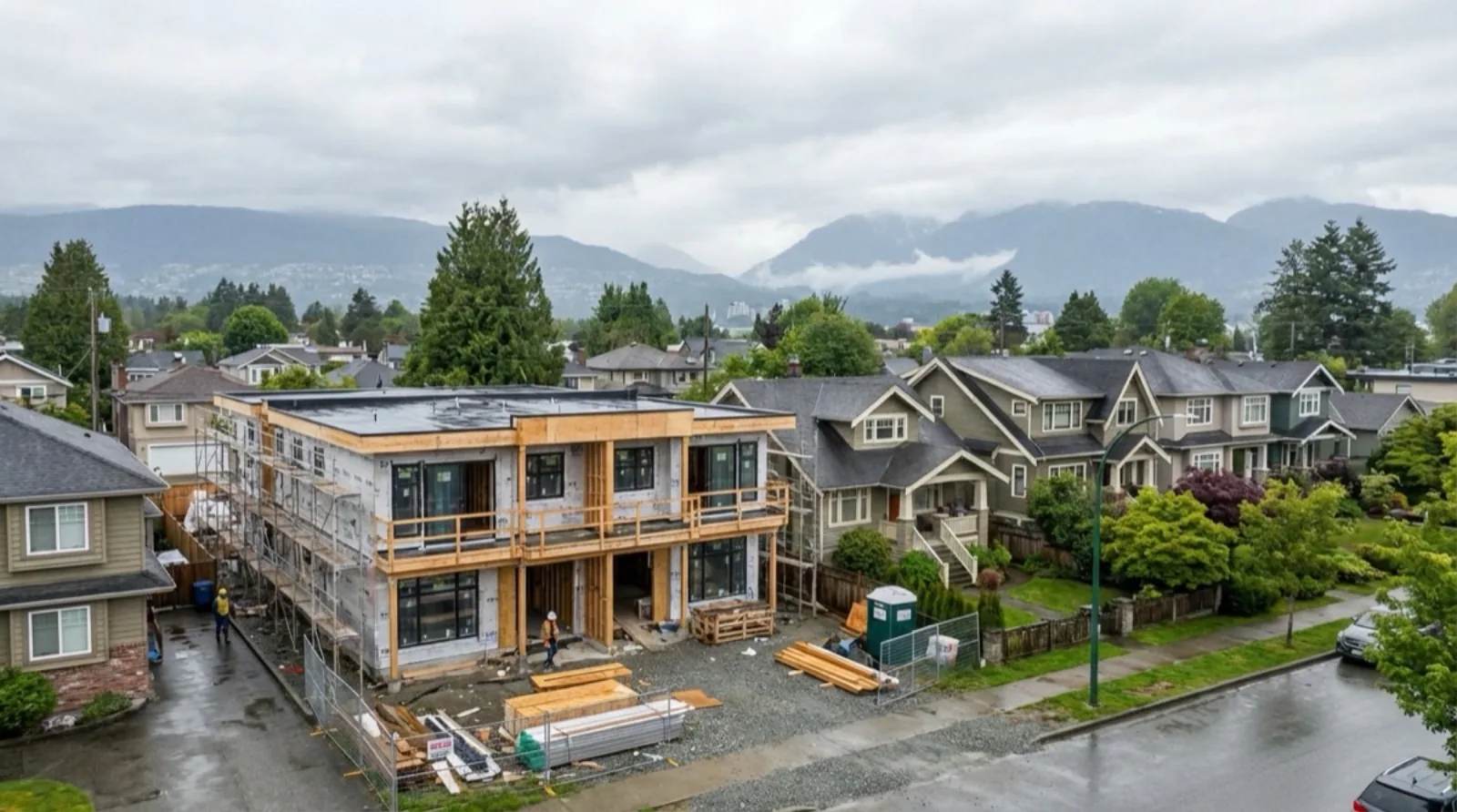

518 multiplex applications filed in Vancouver by end of 2025. Only 10-15% are under construction. The gap between permits and shovels in the ground tells the real story of Vancouver’s multiplex market right now—and it’s not the one you’ve been reading in headlines.
The 518 Number Everyone Gets Wrong
Let’s be direct about what Vancouver’s 518 multiplex applications actually mean. City staff will tell you it’s a success story. Developers know the reality: roughly 40% are approved, but most remain paper projects.
The math on “build-and-hold” broke in 2025. Interest rates murdered rental economics. The homeowners who thought they’d build a fourplex and retire on rental income? Most discovered their proformas didn’t survive contact with actual financing terms.
| Application Status | Percentage | Count (Approx) |
|---|---|---|
| Under Construction | 10-15% | ~50-70 |
| Approved (not started) | 25-30% | ~120-140 |
| In Review | 40-50% | ~190-230 |
| Withdrawn/Denied | ~15% | ~70 |
Why 98% of Lots Don’t Pencil
VanPlex has analyzed over 86,000 R1-1 lots in Vancouver. The uncomfortable truth: 98% don’t make financial sense for the average homeowner attempting a DIY build-and-hold strategy.
Here’s what kills most projects:
Lot frontage under 33 feet. The fixed costs of stairwells, setbacks, and building code compliance eat the same square footage whether you’re building on a 33-foot lot or a 50-foot lot. On narrow lots, you’re left with units too small to command premium prices.
BC Hydro PMT requirements. This one blindsided dozens of 2025 projects. Many multiplexes now require on-site transformers (pad-mounted transformers). These eat up a parking spot or garden space and add $40,000-$80,000 to your budget. Check your electrical requirements early—it’s a project killer.
Construction costs at $400-500/sqft. Hard costs haven’t budged despite rate cuts. A 3,500 sqft fourplex runs $1.4-1.75M in construction alone before soft costs.
The Concurrent Processing Breakthrough
Vancouver announced one genuinely useful change for 2026: concurrent Development Permit and Building Permit processing for projects up to 4 units.
Previously, you’d wait 6-12 months for DP approval, then start the BP process. Now eligible projects can run both reviews simultaneously. Real-world impact: potentially 4-6 months saved on the critical path.
Who qualifies:
- Maximum 4 units (2 units per building)
- Standard lot sizes (under 1,000 m²)
- Projects following the small-site rainwater management pathway
If you’re considering a 5-6 unit project, you’re still looking at 12-18 month processing delays. The concurrent stream is specifically for simpler builds.
Bill 25: The Enforcement Hammer Drops
Some municipalities thought they’d comply with Bill 44 on paper while making projects unbuildable through creative bylaw obstruction. Impossible parking requirements. Extreme setbacks. The province noticed.
Bill 25 (passed late 2025) gives BC Housing authority to override these local restrictions. Municipalities that technically complied but practically obstructed now face provincial intervention.
What this means for homeowners: if your city has been slow-walking multiplex approvals, expect the process to speed up. The political cover for obstruction is gone.
The 2026 Market Reality: Build-and-Sell Dominates
Here’s the strategic shift every Vancouver homeowner needs to understand: “build-and-hold” is largely dead for 2026. The viable model is “build-and-sell” (strata).
| Strategy | 2025 Viability | 2026 Viability | Why |
|---|---|---|---|
| Build & Hold (rental) | Poor | Poor | Interest rates kill cash flow math |
| Build & Sell (strata) | Moderate | Strong | Buyer demand + lower carrying costs |
| Partner Development | Strong | Strong | Risk sharing + expertise access |
| Sell to Developer | Moderate | Strong | Premium for permitted lots |
The sweet spots for 2026:
- 4-plex and 5-plex projects on lots with 49.5ft+ frontage
- 3-bedroom units targeting families priced out of detached homes
- Transit-adjacent locations within 400m of frequent service
What’s Actually Getting Built
Walk through Renfrew-Collingwood or Kensington-Cedar Cottage and you’ll see the pattern. The multiplexes moving forward share common DNA:
Lot characteristics:
- 49.5-50+ foot frontage
- At least 5,000 sqft lot area
- R1-1 zoning (or equivalent SSMUH eligible)
- No heritage designation complications
Unit mix:
- 3-bedroom units at 1,000-1,200 sqft predominate
- Targeting $900K-$1.2M price points
- Families, not investors, as primary buyers
Developer profile:
- Experienced builders with capital access
- Pre-sale capacity to satisfy lender requirements
- Relationships with efficient trades
The Rainwater Management Curveball
Vancouver’s new rainwater management requirements (effective July 2025) added another compliance layer. Every multiplex now needs detention systems.
The good news: the “Small Site Pathway” exempts standard lots from full engineering requirements. If you’re under 1,000 m² and following prescriptive standards, you avoid weeks of drainage engineering work.
The bad news: if you’re on a larger lot or have unusual conditions, budget $15,000-$30,000 and 4-8 weeks for the drainage engineering and review process.
Three Moves for 2026
Based on current market data, here’s what makes sense for Vancouver homeowners considering multiplex development:
1. Check your frontage first. If you’re under 33 feet, the economics are brutal. Above 49.5 feet is the sweet spot. Between those numbers—it depends on the specific lot geometry.
2. Verify BC Hydro requirements early. Before you spend $50K on design, find out if you need a PMT. This single factor has killed more 2025 projects than any zoning issue.
3. Design for the concurrent stream. If you can make a 4-unit project work, you avoid months of permit delay. Only go to 5-6 units if the math demands it.
Prefab and Modular: The 2026 Experiment
Watch for modular multiplex projects in 2026. Several BC manufacturers are targeting the market with factory-built units promising:
- 30-40% reduction in on-site construction time
- Better cost predictability
- Quality control advantages
Early projects are still proving the model. If modular delivers on promises, it could shift the economics meaningfully by late 2026.
How to Know If Your Property Works
The gap between “eligible under Bill 44” and “profitable to develop” is massive. Eligibility is easy—profitability requires analysis.
VanPlex’s PlexRank™ system evaluates the factors that actually determine development success:
- Lot geometry and buildable area
- Current and projected land values
- Construction cost estimates for your specific site
- Rental income potential vs. strata sale values
- Timeline and carrying cost projections
Visit VanPlex.ca to check your property’s development potential. We’ve analyzed 86,000+ Vancouver lots—chances are yours is already in our database.
David Babakaiff, CEO & Co-Founder of VanPlex
PlexRank™ | Profit with Multiplex