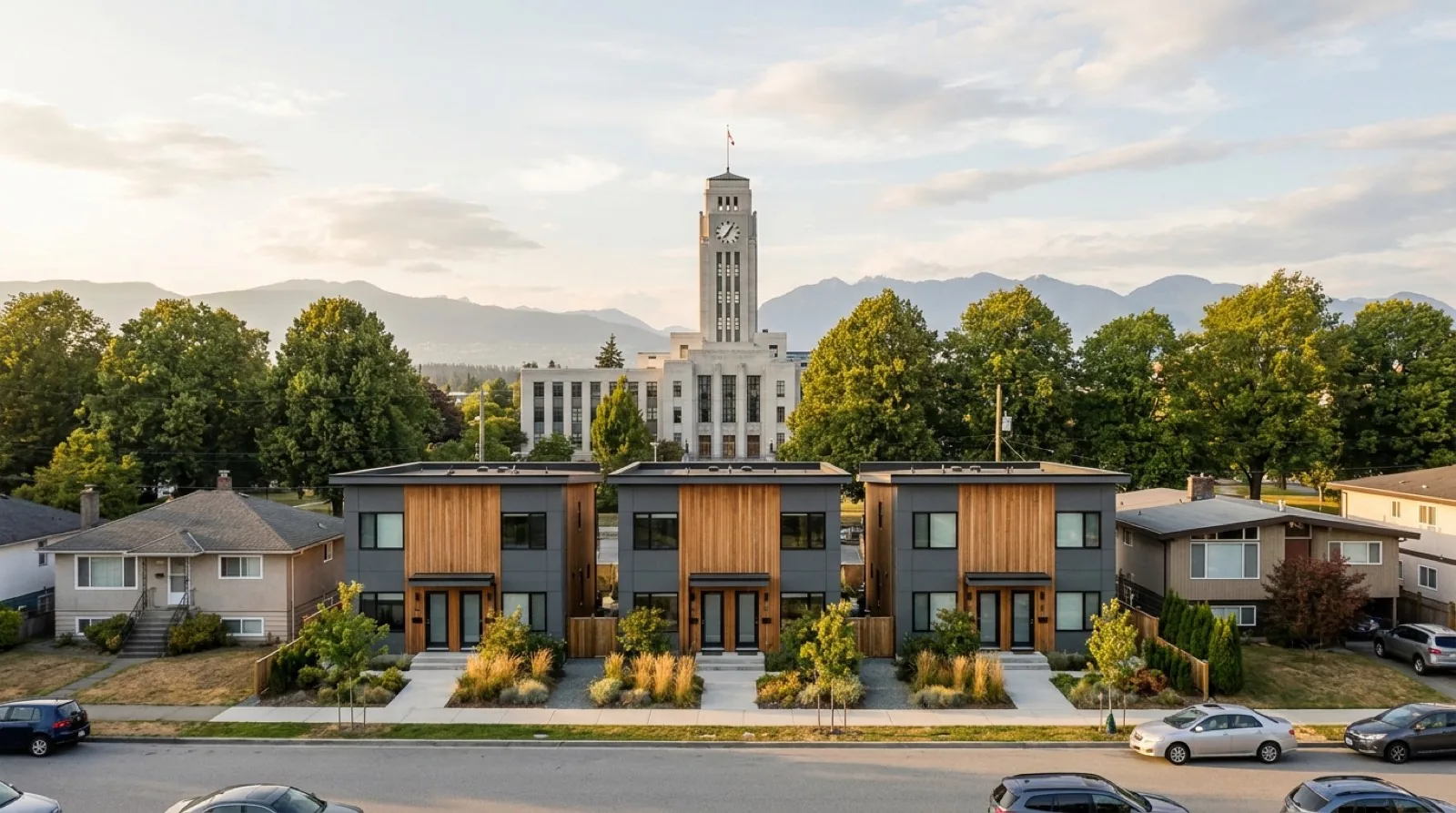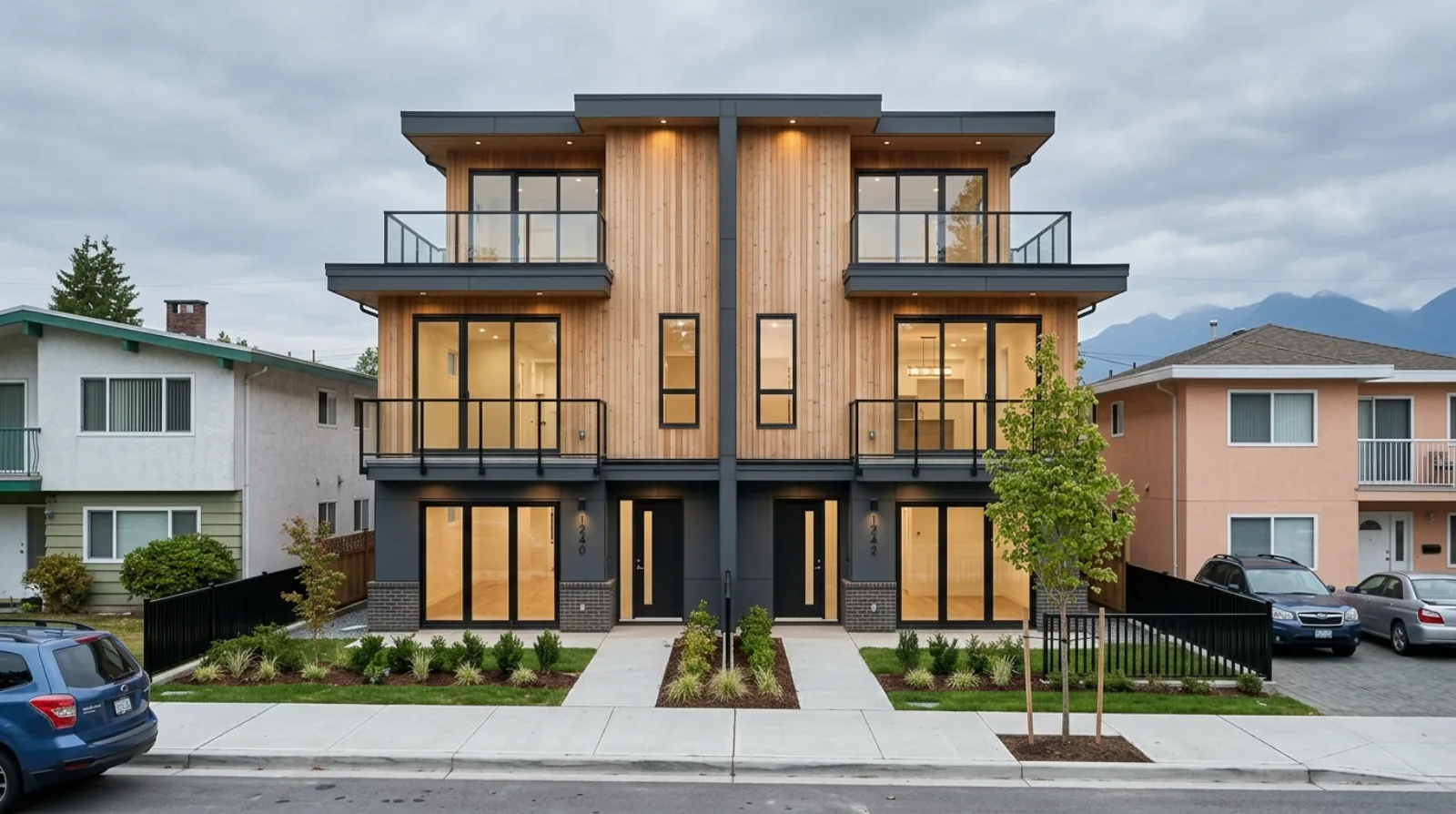

Vancouver just greenlit an $8.5 million social housing project at 3122 SE Marine Drive that will use the federal Housing Design Catalogue’s “BC Fourplex 01” concept — three mirrored fourplexes delivering 12 units. The project is fully funded by $4 million from CMHC’s Affordable Housing Innovation Fund (AHIF) and $4.5 million from the Housing Accelerator Fund (HAF). Construction target: under 12 months to start, completion by Q4 2027. It’s the first real-world test of the standardized designs we’ve been cataloguing in our Design Guidelines section — and the economics tell a story worth unpacking.
TL;DR (Key Takeaways)
- $8.5M total cost for 12 units at 3122 SE Marine Drive (February 2026 Council approval)
- $708,333 per unit — roughly 2x the per-unit cost of private multiplex development
- BC Fourplex 01 design from the Housing Design Catalogue (CMHC, March 2025)
- $4M from AHIF + $4.5M from HAF = 100% government-funded
- 11,601 sqft gross floor area, 0.88 FSR on a challenging sloped lot
- Six 1-bed + six 3-bed units — 30% must rent below 80% of median market rent for 25 years
- Land was free — transferred to City as rezoning obligation from 3125 Pierview Crescent
- Private fourplex comparison: $1.6-$2.1M total ($400K-$525K/unit) at $400-$500/sqft
The Project: What’s Actually Being Built
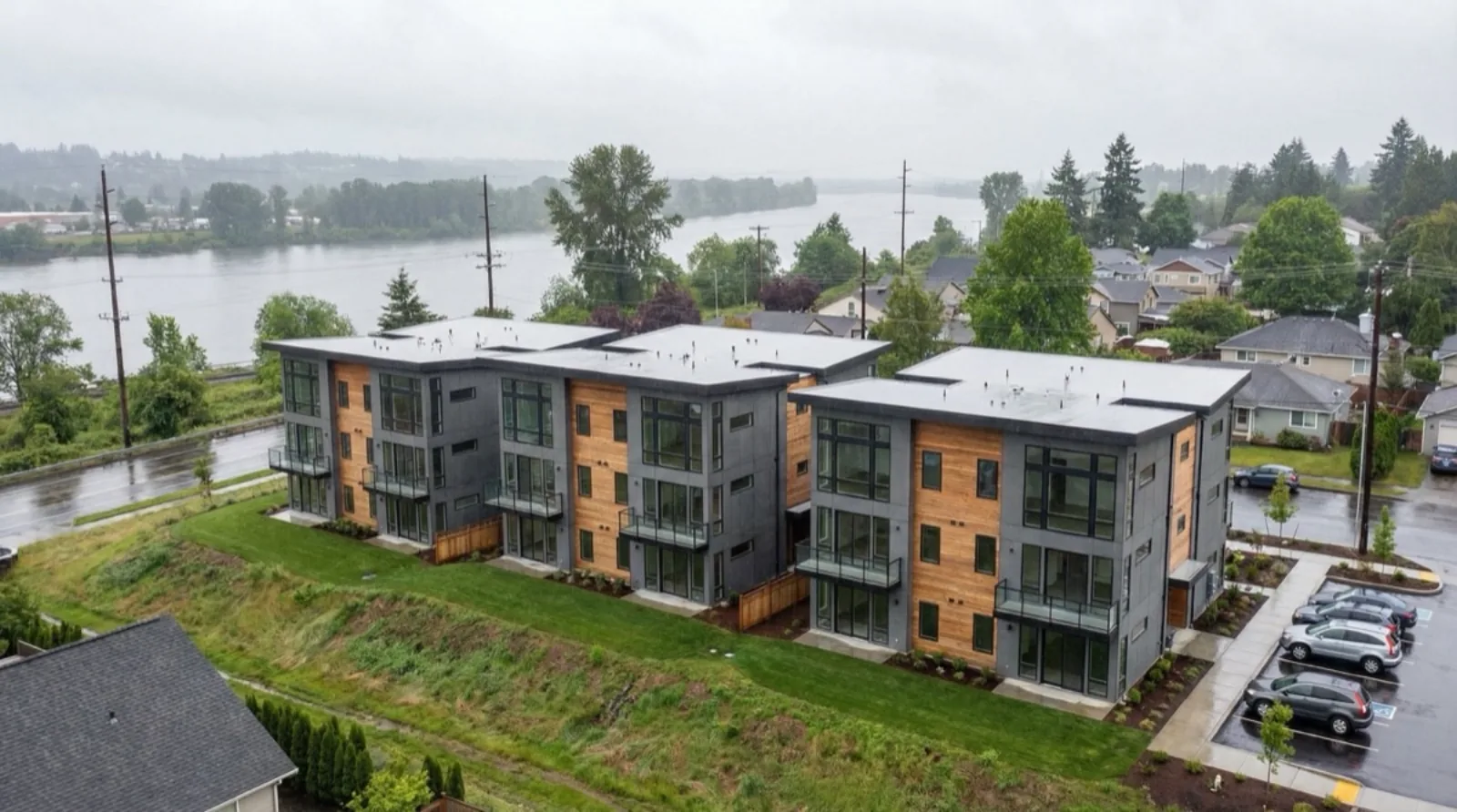
The site at 3122 SE Marine Drive sits near the Fraser River and River District, at the intersection with Kerr Street. BC Assessment values the land at $1,392,000, though it was transferred to the City of Vancouver in July 2025 for $1,930,000 as a social housing obligation tied to the adjacent 3125 Pierview Crescent rezoning (enacted July 5, 2022).
The plan calls for three separate, mirrored “BC Fourplex 01” buildings — the standardized design concept from the Housing Design Catalogue published by CMHC in March 2025. Together they’ll deliver:
- 12 total units: six one-bedroom and six three-bedroom
- 11,601 sqft gross floor area
- 0.88 FSR — permissible under existing zoning
- Surface parking at the southern end of the site
The City describes the site as an “undeveloped dirt site” that “faces a number of challenges” — namely a downward slope toward the Fraser River. An architectural feasibility study (co-funded by the City and CMHC) concluded the standardized fourplex design was viable despite the terrain.
This is a genuine pilot project. The City’s Non-Market Housing Development department will directly deliver it, with CMHC providing oversight and documenting the entire process as a case study for other municipalities.
The Funding: $8.5 Million From Two Federal Programs
The full $8.5 million comes from two Government of Canada programs:
| Source | Amount | Program Details |
|---|---|---|
| Affordable Housing Innovation Fund (AHIF) | $4,000,000 | $580M federal program for innovative building techniques; conditional approval December 2025 |
| Housing Accelerator Fund (HAF) | $4,500,000 | Vancouver secured $115M in December 2023, plus $4.375M performance bonus in March 2025 |
| Total | $8,500,000 | 100% government-funded |
AHIF requires 30% of units at rents below 80% of median market rent for a minimum of 25 years, plus at least 10% reduction in energy intensity and greenhouse gas emissions versus local building codes.
The land itself was essentially free to the City — a social housing obligation from the adjacent development’s rezoning. So the $8.5 million covers design, construction, and project management on land that cost taxpayers nothing directly.
The Per-Unit Math: $708K Government vs. $400-$525K Private
Here’s where this gets interesting for anyone tracking multiplex economics.
This project: $708,333 per unit
- $8,500,000 / 12 units = $708,333
- 11,601 sqft / 12 units = 967 sqft average
- Effective cost: $733/sqft ($8.5M / 11,601 sqft)
Private fourplex development (VanPlex data):
- Typical cost: $1.6M-$2.1M for a fourplex
- Per unit: $400,000-$525,000
- Construction cost: $400-$500/sqft
- Timeline: 18-24 months
| Metric | Marine Drive Project | Private Fourplex | Difference |
|---|---|---|---|
| Cost per unit | $708,333 | $400K-$525K | +35-77% |
| Cost per sqft | ~$733 | $400-$500 | +47-83% |
| Land cost | $0 (transferred) | $1.5M-$3M+ | N/A |
| Funding source | 100% government | Private/construction loans | — |
| Timeline to start | Under 12 months | 2-4 months (after permit) | — |
| Affordable units | 30% below market | 0% (market rate) | — |
The per-unit premium is substantial — even without accounting for the free land. Some of that premium is explained by the challenging sloped site, the affordability requirements, the pilot-project overhead (case study documentation, CMHC oversight), and the additional energy performance requirements. Government delivery also carries overhead that private builders don’t face.
But the gap raises a question worth asking: could the same $8.5 million have produced more affordable units through a different mechanism?
What This Means for the Housing Design Catalogue
The real significance isn’t the economics — it’s the precedent.
This is the first publicly announced project using the Housing Design Catalogue in a real construction context. The catalogue was published in March 2025 with 10 standardized designs created by Leckie Studio Architecture and four partner firms, with the promise of faster approvals, lower architectural costs, and repeatable quality.
If the Marine Drive pilot proves the standard designs work in the field — on a difficult site, no less — it validates the entire catalogue concept. The CMHC case study documentation will provide the first real data on:
- Actual construction costs versus catalogue estimates
- Permit timeline with standardized designs
- Site adaptation requirements for non-ideal lots
- Constructability of the specific “BC Fourplex 01” design
That data will be far more valuable to private developers than the project itself. Right now, every builder considering a standard design is working from renderings and assumptions. After Marine Drive, they’ll have a real-world benchmark.
We’ll be tracking this project and updating our BC Standard Designs and Fourplex Designs pages as construction data emerges.
The Bigger Picture: Government Capital Allocation
The user commentary on this story is worth acknowledging directly: $8.5 million in public funds for 12 units, in a country where household debt sits at $1.51 for every dollar earned (Statistics Canada, 2025) and federal debt-to-GDP has climbed to 42.1% (Parliamentary Budget Office, Q4 2025).
A private developer building three fourplexes on a comparable lot would spend $4.8M-$6.3M — and would do it without taxpayer funding. The units would rent at market rates, but they’d also get built faster and create taxable economic activity.
The counterargument: market-rate housing doesn’t solve for the lowest-income renters. The AHIF’s 25-year affordability requirement ensures below-market rents that private development can’t match without subsidy. That’s a legitimate social housing function.
The tension isn’t new. It’s the same question cities across Canada are grappling with: is government the right entity to build housing, or should public money flow to mechanisms that leverage private efficiency?
What we know for certain: the standardized designs themselves are a net positive. Whether this specific delivery model scales efficiently is the question the CMHC case study should answer honestly.
What This Means for Homeowners and Investors
If you own property in Vancouver, the Marine Drive pilot has practical implications:
For the Housing Design Catalogue: This project will either validate or expose gaps in the standardized designs. Either outcome benefits you. Validation means you can confidently use the same “BC Fourplex 01” design for your own project, knowing it’s been built and documented. Gaps mean you’ll know what to watch for before you commit.
For permit timelines: The City is positioning standardized designs as a fast-track pathway. If the pilot demonstrates faster approvals, expect municipalities across Metro Vancouver to adopt similar streamlining for projects using catalogue designs.
For construction costs: The $733/sqft number on this project includes government overhead that private builds won’t face. But the underlying construction data — materials, labour, site prep on a sloped lot — will help calibrate your own estimates.
For your own property analysis: VanPlex has analyzed 86,000+ properties across Metro Vancouver for multiplex feasibility. You can check your specific lot’s potential — including which standard designs fit your site — using our proforma calculator. Visit VanPlex.ca to enter your address and see a personalized ROI projection in under two minutes.
David Babakaiff, CEO & Co-Founder of VanPlex PlexRank™ | Profit with Multiplex