
Vancouver homeowner standing in front of their house with blueprints, considering co-development versus selling their lot
Co-Development Featured

I Own a Vancouver Lot. Should I Co-Develop Instead of Selling?

9 min read

The honest decision framework for Vancouver homeowners weighing a clean sale against a 18-24 month co-development partnership. Net proceeds, timeline, tax drag, and execution risk compared.

Key takeaway

Decision framework for Vancouver homeowners comparing a clean lot sale against an 18-24 month co-development partnership.

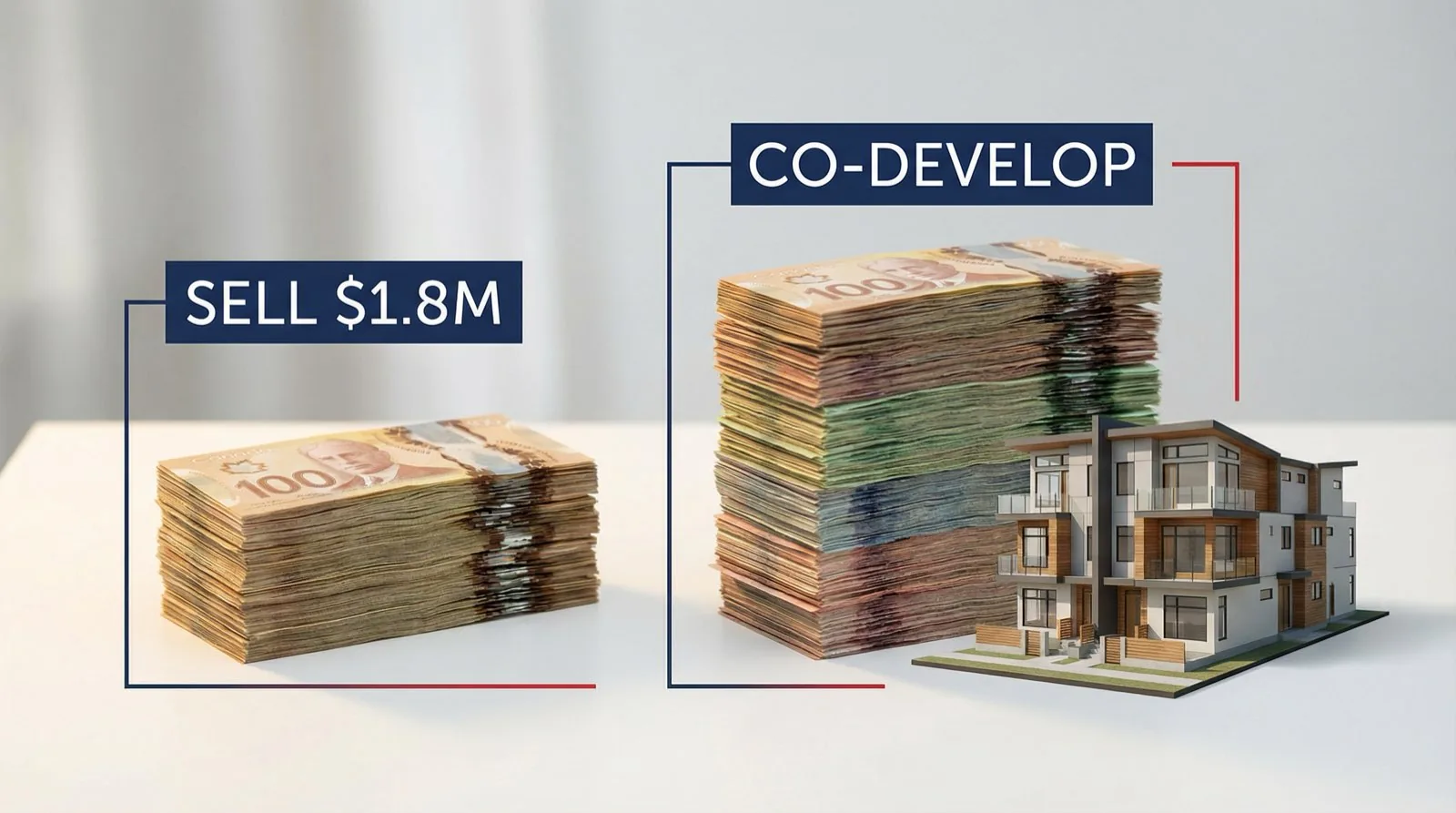
Sale path: $1.6-1.8M net, 60-90 day close, principal residence exemption preserved. Co-dev path: potentially $2.2-2.8M total value but 18-24 month timeline, capital gains exposure on new units, execution risk. Key factors: financial runway, risk tolerance, tax position, and whether you need to relocate.

What this covers

  • clean sale $1.6-1.8M net 60-90 days
  • co-development $2.2-2.8M potential 18-24 months
  • principal residence exemption sale vs co-dev
  • capital gains exposure new units co-development
  • financial runway risk tolerance assessment
  • relocation requirement decision factor
co-development Vancouver homeowner multiplex selling decision-framework

You own a Vancouver lot. Probably for 15, 20, maybe 40 years. A developer sends you a letter. A neighbour mentions they “co-developed” and kept two units in a new building. You Google it. Now you’re here.

The question underneath the question is not “should I co-develop?” It is: what do I actually want from this lot, and which path gets me there with the least regret?

Let me make the framework simple.

The Two Paths on the Same Lot

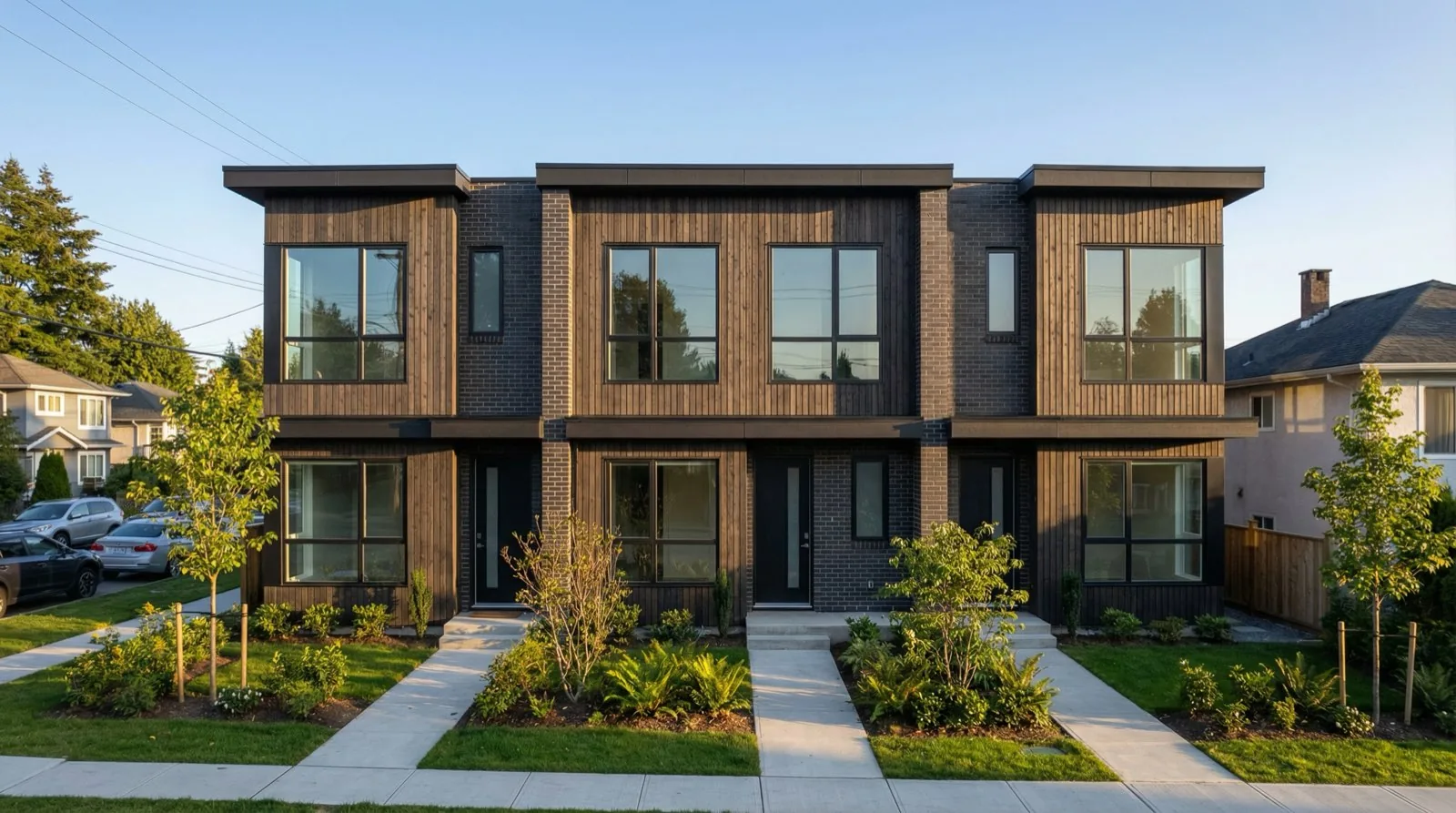
Take a standard 33 by 122 foot east Vancouver lot. Current assessed value: $1.8M. Under R1-1 co-development rules, it can support a 4-unit multiplex.

Path A: Clean sale to a builder. You list the lot, receive offers, pick one, close in 60 to 90 days. Cheque clears. You move on.

Typical 2026 Vancouver east side outcome: $1.75M to $1.95M gross. After real estate commission (~3.5%), legal, and minor adjustments, net proceeds around $1.65M to $1.85M.

Path B: Co-development with a land-for-units swap. You contribute the lot at an agreed value of $1.8M. Builder funds the $2.4M build. At completion (22 months), you receive two finished strata units worth roughly $1.4M each, or $2.8M total.

Net delta: roughly $950,000 to $1,150,000 in extra value for the same lot. That is the headline number. It is also a completely misleading number unless you understand what you’re trading for it.

What You’re Actually Trading

You are not trading “selling” for “more money”. You are trading:

  1. Certainty (cheque in hand) for contingency (units that exist in 22 months, if everything works).
  2. Speed (60 to 90 days) for a two-year process with multiple decision points.
  3. Zero post-sale involvement for an active partnership with a builder you just met.
  4. One simple tax event for a complex matrix of GST rebates, Principal Residence Exemption change-of-use, and Property Transfer Tax on new units.
  5. No upside for upside and downside, because markets move.

If you sell and the market goes up 20% in two years, you missed it. If you co-develop and the market drops 20% in two years, your retained units are worth less than the land you contributed.

The Honest Framework

Here is the framework I give every homeowner who asks me this.

1. Timeline tolerance. How long can you wait for real money? If the answer is less than 6 months, stop reading. Sell. The paperwork is simpler and the regret is smaller when you don’t have the patience to see a multi-year project through.

2. Risk tolerance. Can you absorb a scenario where the builder hits trouble, permits delay by 8 months, and you end up living in a rental for 30 months instead of 22? If the answer is “that would break me financially or emotionally”, sell.

3. Unit mindset. Do you actually want to own new strata units at the end of this? Or do you want cash? If the honest answer is cash, sell. Co-development is worth it primarily when you want the units — to live in, to rent, to give to family.

4. Counterparty discipline. Are you willing to spend $10K on your own lawyer reviewing every page of the term sheet and definitive agreement? If you’re going to sign whatever the builder’s lawyer puts in front of you, sell. The bad deals happen to owners who trust.

5. Tax and estate clarity. Do you understand (or are you willing to pay a CPA to model) the Principal Residence Exemption change-of-use, GST rebate eligibility, and capital gains on retained units? If not, sell or hire help before signing anything.

Four out of five “yes” answers means co-development is worth serious evaluation. Three or fewer means sell.

The Middle Path Most People Miss

There is a third option that gets ignored: sell to a builder at a premium with a retained unit clause. You sell the lot for market value plus a right to purchase one finished unit at cost. You get the clean sale and the upside on one unit.

This is harder to negotiate — builders prefer clean title — but on the right lot in the right market, it is the best of both worlds. See our deal structures guide for the mechanics.

What Actually Kills Co-Development Deals

Not market crashes. Not construction cost overruns. Not permit delays.

The single biggest killer is paperwork fatigue. Homeowners enter the deal excited, get worn down by 6 months of term sheets and lawyer letters, and sign something they don’t fully understand just to get it over with. Six months later, they realize the unit selection is “to be determined at builder’s discretion”, or the performance bond is actually a personal guarantee from a numbered company, or the waterfall pays the builder first.

If you can’t commit to reading every page of every draft with your own lawyer, don’t start. A bad co-development is worse than a clean sale at a lower price.

The Question I Ask Every Homeowner

“In 24 months, which regret would you rather live with — the regret of taking the cheque and watching units get built on your old lot, or the regret of spending two years in a paperwork fight to get units you’re not sure you really wanted?”

Your honest gut answer is the decision.

Further Reading

Frequently asked questions

What are the two paths for a Vancouver homeowner on a multiplex-eligible lot?

Path A is a clean sale to a builder: list the lot, receive offers, pick one, and close in 60 to 90 days. On a standard 33 by 122 foot east Vancouver lot assessed at $1.8 million, the typical 2026 outcome is $1.75 million to $1.95 million gross, netting roughly $1.65 million to $1.85 million after commission, legal, and minor adjustments. Path B is co-development, a land-for-units swap where the homeowner contributes the lot at an agreed value while the builder funds construction, receiving finished strata units at completion around 22 months later.

How much extra value can co-development create versus a clean sale?

On the example lot, contributing land at an agreed value of $1.8 million while the builder funds a $2.4 million build can result in the homeowner receiving two finished strata units worth roughly $1.4 million each, or $2.8 million total, after 22 months. That is a net delta of roughly $950,000 to $1,150,000 in extra value for the same lot, though the post describes this headline number as misleading unless the trade-offs behind it are understood.

What is a homeowner actually trading for the higher co-development value?

A homeowner is trading certainty, a cheque in hand, for contingency, units that exist in 22 months if everything works. They trade a 60 to 90 day sale for a two-year process with multiple decision points, zero post-sale involvement for an active partnership with a builder they just met, one simple tax event for a complex matrix of GST rebates, Principal Residence Exemption change-of-use, and Property Transfer Tax on new units, and no market exposure for both upside and downside if prices move during the build.

How should a homeowner decide between selling and co-developing?

The decision framework asks five questions: can you wait longer than 6 months for real money, can you absorb permits delaying by 8 months and living in a rental for 30 months instead of 22, do you actually want to own new strata units rather than cash, are you willing to spend $10,000 on your own lawyer to review the term sheet and definitive agreement, and do you understand or are willing to pay a CPA to model the Principal Residence Exemption change-of-use, GST rebate eligibility, and capital gains on retained units. Four or five yes answers means co-development is worth serious evaluation, three or fewer means sell.

Is there a middle option between selling outright and full co-development?

Yes. A homeowner can sell to a builder at a premium with a retained unit clause: sell the lot for market value plus a right to purchase one finished unit at cost. This gets the clean sale plus upside on one unit, though it is harder to negotiate because builders generally prefer clean title. On the right lot in the right market it can combine benefits of both paths.

What actually causes co-development deals to fail?

The single biggest killer of co-development deals is not market crashes, construction cost overruns, or permit delays. It is paperwork fatigue: homeowners enter the deal excited, get worn down after 6 months of term sheets and lawyer letters, and sign something they do not fully understand just to finish the process, only to later discover unit selection left to the builder's discretion, a performance bond that is actually a personal guarantee, or a profit waterfall that pays the builder first.

Who should choose a clean sale instead of co-development?

A homeowner should sell if they need real money within 6 months, if losing 30 months in a rental during permit or construction delays would break them financially or emotionally, if they honestly want cash rather than new strata units, if they are not willing to pay for independent legal review of every draft, or if they cannot commit to understanding the tax and estate implications before signing.

What tax and estate complexities does co-development add compared to a sale?

A clean sale is one simple tax event. Co-development introduces the Principal Residence Exemption change-of-use rules, GST rebate eligibility on new construction, and Property Transfer Tax on the new units received, all of which require a CPA or professional advisor to model correctly. A homeowner unwilling or unable to work through that complexity is advised to sell or hire help before signing anything.

Free 12-page guide for Vancouver-area homeowners. Build, sell, hold, or partner — side-by-side comparison of the numbers, timeline, and risk on each path.

Verified phone required. We'll text you the link in 60 seconds.

David Babakaiff

David Babakaiff

Co-Founder, VanPlex | 25+ Years BC Construction

David Babakaiff is Co-Founder of VanPlex with 25+ years scaling BC construction. He led Alair Homes Vancouver to the 2024 HAVAN Award for Best Multiplex Unit in the GVRD. VanPlex’s PlexRank™ algorithm scores residential parcels across BC for multiplex conversion potential under Bill 44.

Want insights like this delivered weekly?

Join 2,500+ property owners getting ROI case studies, market data, and exclusive opportunities.

No spam. Unsubscribe anytime.