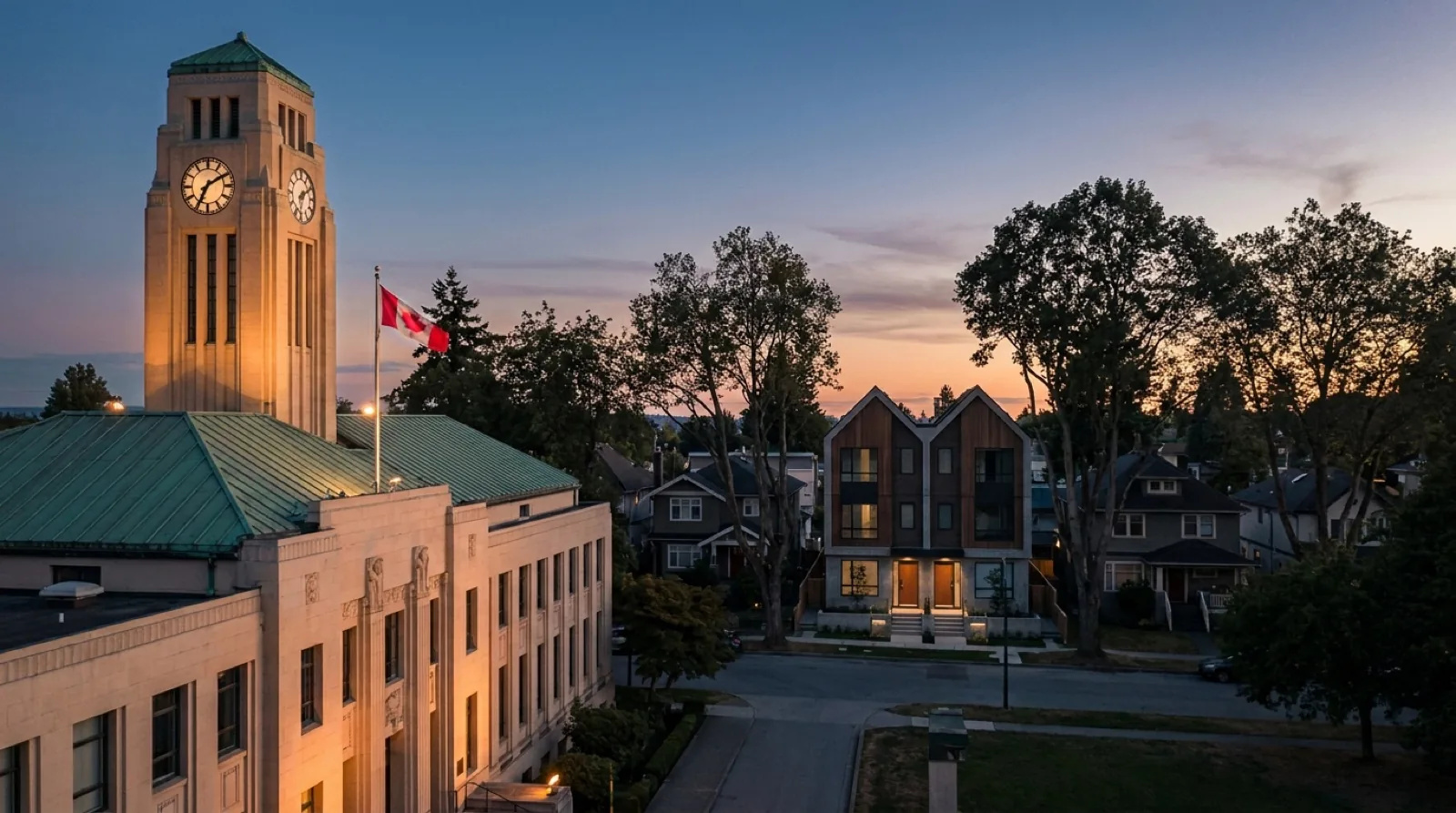

Vancouver City Hall with overlay text showing June 30 2026 density bonus removal deadline affecting more than 90 percent of R1-1 multiplex lots in compliance with provincial Bill 16
BC Housing Policy Featured

Vancouver Drops Density Bonus on 90% of Multiplex Lots

7 min read

On May 5, 2026, Vancouver Council moved to strip density bonus contributions from over 90% of multiplex lots. Bill 16 forces the change June 30. What it means for the 518 applications already in the pipeline.

Key takeaway

On May 5, 2026, Vancouver City Council considered a March 23, 2026 referral report (rr1) that brings the city's density bonus and inclusionary zoning bylaws into compliance with provincial Bill 16.

If approved at the June 2, 2026 public hearing, density bonus contributions are eliminated from more than 90% of multiplex lots and more than 75% of RM-8A townhouse lots, taking effect June 30, 2026. Inclusionary zoning replaces density bonuses on three zones: R1-1 multiplex (large west-side lots) with cash contributions reduced approximately 35%, RM-8A in the Cambie Corridor (single lots) with assemblies and smaller single-lot projects fully exempt, and FC-2E in False Creek Flats with contributions reduced approximately 57%. A full Amenity Cost Charge (ACC) bylaw returns to Council on July 28, 2026 along with associated Development Cost Levy and Community Amenity Contribution amendments.

With 518 multiplex applications already filed in Vancouver's R1-1 pipeline, the change directly affects in-stream applicants, projects receiving permits on or after June 30 fall under the new fee structure. Authored by David Babakaiff, Co-Founder of VanPlex.

What this covers

  • Vancouver Council May 5 2026 density bonus removal vote
  • Bill 16 Housing Statutes Development Financing Amendment Act compliance
  • June 30 2026 effective date density bonus elimination
  • More than 90 percent of multiplex lots affected
  • More than 75 percent of RM-8A townhouse lots affected
  • R1-1 multiplex inclusionary zoning 35 percent cash reduction
  • RM-8A Cambie Corridor inclusionary zoning exemptions
  • FC-2E False Creek Flats 57 percent cash reduction
  • Amenity Cost Charge ACC bylaw July 28 2026
  • March 23 2026 Chris Robertson referral report rr1
  • June 2 2026 public hearing density bonus
  • 518 Vancouver multiplex applications pipeline
  • Outright density vs base plus bonus structure
  • DCL CAC amendments July 2026
  • In-stream multiplex permit timing Vancouver
density-bonus bill-16 vancouver multiplex r1-1 rm-8a

On May 5, 2026, Vancouver City Council referred a staff report to public hearing that strips density bonus contributions from over 90% of multiplex lots in the city. The public hearing is June 2. If Council approves at that hearing, the change takes effect June 30, 2026 — the same day BC’s Bill 16 compliance deadline lands on every municipality in the province.

For homeowners with an in-stream R1-1 multiplex application, this is the most consequential fee change since Bill 44 came into force.

What density bonusing actually was

For most of the last decade, Vancouver let you build more floor area than your base zoning allowed if you paid a per-square-foot contribution into the city’s amenity fund. On a multiplex, this typically showed up as a per-unit charge for the “bonus” units the zoning permitted above outright density.

In practical terms: on a six-unit project where the base zoning allowed four units outright, units five and six each carried a density bonus contribution that ran into five figures per unit. Different lots, different numbers — but for an R1-1 multiplex on a standard 33 ft lot, density bonus contributions plus the related fee stack often added more to the project than landscaping and the entire interior finishing budget combined.

That fee structure ran into a wall in 2024 when the province passed Bill 16.

Why Bill 16 forced the change

Bill 16 — the Housing Statutes Amendment Act, 2024 — was passed alongside Bill 44 but got far less attention. It tightened the rules on how municipalities can collect cash and in-kind contributions from new housing. The province’s read was straightforward: if cities are now required to allow multiplex housing under Bill 44, they shouldn’t be using density bonusing to make those same projects unaffordable.

Bill 16 set a June 30, 2026 deadline for municipalities to bring their density bonus and inclusionary zoning bylaws into compliance, or to replace them with the new Amenity Cost Charge tool the legislation introduced.

Vancouver’s response, drafted in a March 23, 2026 referral report from Chris Robertson and considered at the May 5 Council meeting, takes a two-step approach:

  1. June 30, 2026 — Strip density bonus contributions from the bylaws where the province requires outright density (most of R1-1, RM-8A, FC-2E)
  2. July 28, 2026 — Bring back a full Amenity Cost Charge bylaw that replaces the revenue density bonusing used to provide

The first move is what affects you in the next eight weeks. The second is what shapes pro formas from August onward.

What changes on June 30, 2026

If Council approves at the June 2 public hearing, the May 5 report eliminates density bonus contributions on:

  • More than 90% of multiplex lots citywide
  • More than 75% of RM-8A townhouse lots in the Cambie Corridor

That’s done by shifting these zones from a “base + bonus” structure to outright density at the level Bill 44 already requires. If you can build it under the province’s minimum, you don’t pay a bonus to do it.

Where the bonus structure isn’t fully removed, it’s replaced with inclusionary zoning — a requirement to either deliver on-site below-market units or pay a cash-in-lieu contribution. Three areas carry inclusionary zoning forward:

ZoneWhat it coversWhat changes
R1-1 multiplexLarge west-side lotsCash contribution down ~35%
RM-8ACambie Corridor single lotsReduced contribution; assemblies and smaller single-lot projects fully exempt
FC-2EFalse Creek FlatsCash contribution down ~57%

For a typical R1-1 project on a standard 33 ft east-side lot, neither density bonus nor inclusionary zoning will apply after June 30. The fee load drops, the proforma improves, and the marginal lot that didn’t pencil at $4.8M in May might pencil at $4.6M in July.
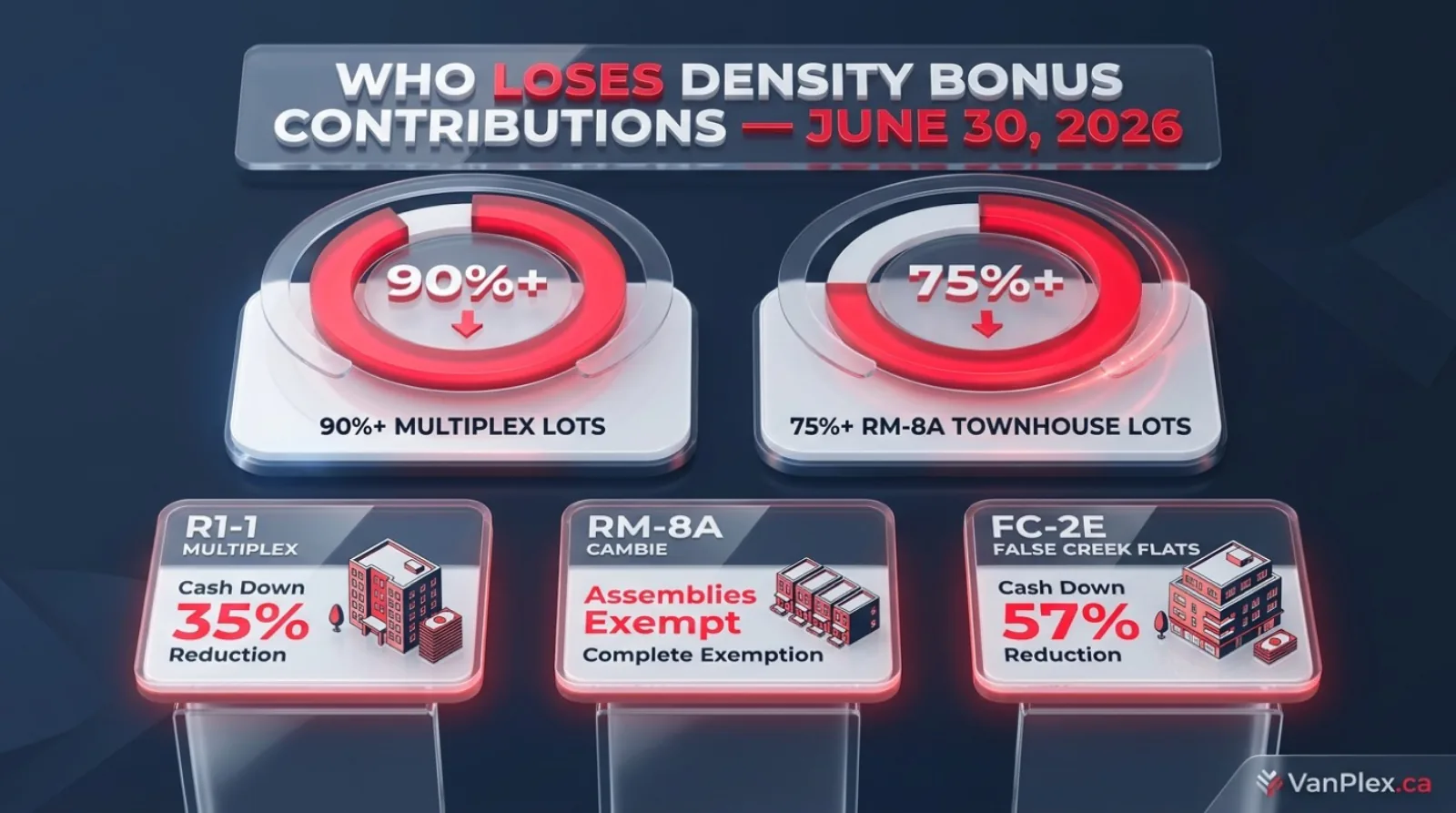
Vancouver inclusionary zoning impact comparison showing 90 percent of multiplex lots and 75 percent of RM-8A townhouse lots losing density bonus contributions, with R1-1 multiplex cash contribution down 35 percent and FC-2E down 57 percent

What this means if your application is in-stream

Vancouver’s permit pipeline currently shows 518 multiplex applications filed and only a small fraction completed. Most of them are sitting somewhere between intake and issuance. The question every owner is asking: do the new rules apply to my file, or am I locked into the old fee schedule?

The May 5 staff report frames it around the date of permit issuance. Applications that receive their building permit on or after June 30, 2026 fall under the new rules. Applications already issued under the old bylaws stay on the old schedule.

A few things follow from that:

  • If your permit is close to issuance and you’re still subject to a density bonus contribution, delaying issuance past June 30 may save you tens of thousands of dollars. Talk to your permit coordinator about the timing.
  • If your project is in pre-application or design review, you’re almost certainly under the new rules by default — your proforma should already reflect the lower fee load.
  • If you’re at the schematic stage on a lot that could fall inside one of the inclusionary zoning zones (R1-1 multiplex on a large west-side lot is the most common case for VanPlex audiences), the cash-in-lieu math is now ~35% lower, but it still exists. Don’t model your project as if all fees disappeared.

The June 2 public hearing is the last formal opportunity to weigh in. After that, expect Council to vote, expect the change to pass — the staff report has Mayor and Council political alignment — and expect July 28’s ACC bylaw to be the next number to track.

What the July 28 ACC bylaw will likely do

Amenity Cost Charges are the replacement vehicle Bill 16 hands municipalities. Unlike density bonuses, which were tied to a specific FSR uplift, ACCs are charged across a project at a published rate — closer in mechanics to a Development Cost Levy than to a negotiated bonus.

Three things to watch in the July 28 bylaw:

  1. The rate. If Vancouver sets the ACC at a number that recovers most of the density bonus revenue, the multiplex savings from June 30 evaporate. If it’s set lower, the win sticks.
  2. The exemptions. The current DCL waiver for secured rental multiplex is one of the largest fee advantages in BC. If the ACC carries forward an equivalent exemption for rental tenure, the build-to-rent thesis stays intact. If it doesn’t, the math shifts.
  3. The phase-in. Whether the ACC kicks in immediately on July 28 or phases in over months will determine the size of the August-to-October application surge.

We’ll publish the ACC analysis the day the bylaw drops. For now, the move that matters is June 30.
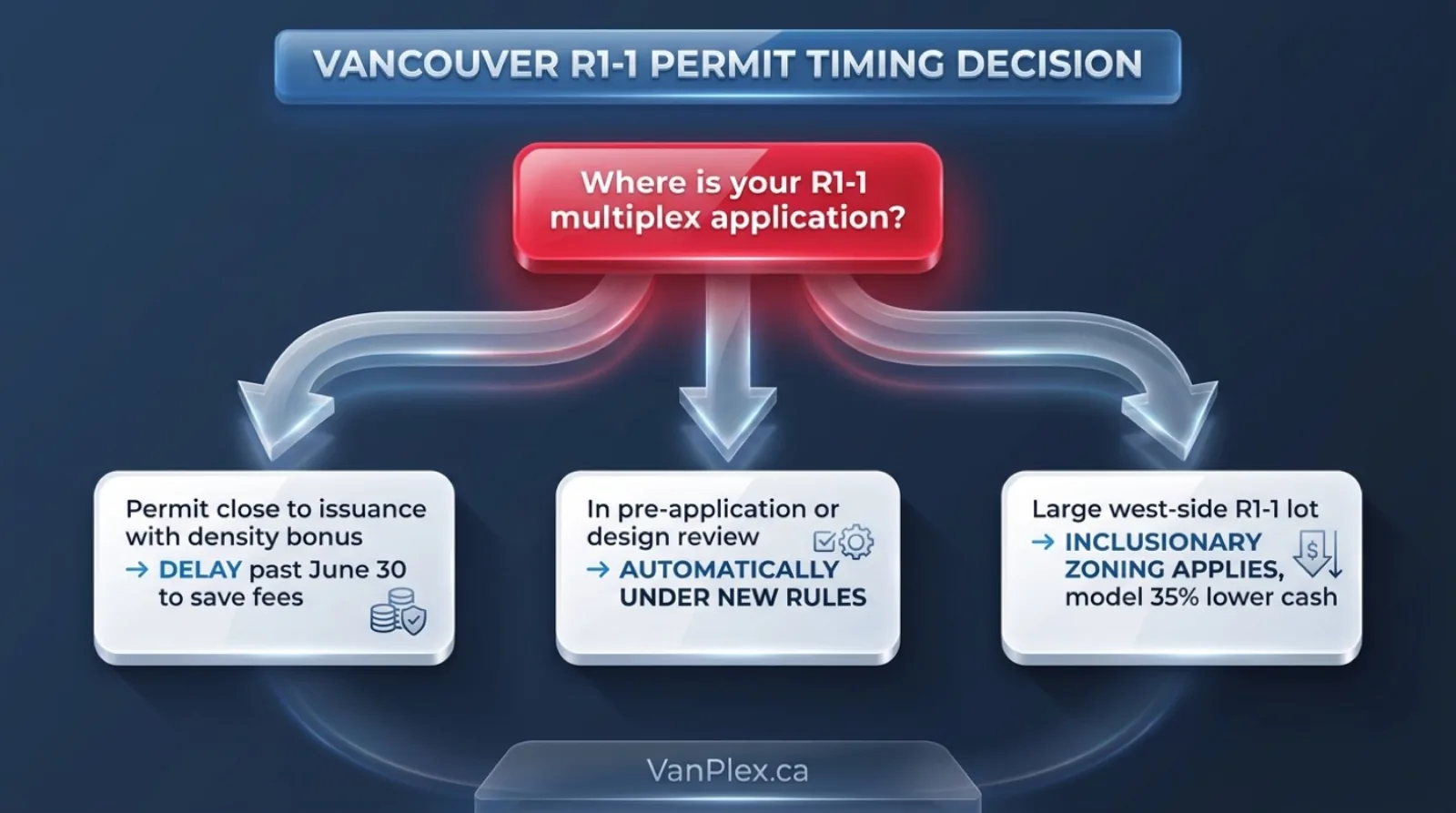
Decision tree for Vancouver multiplex applicants showing whether to push permit issuance before or after June 30 2026 based on project stage and density bonus exposure

What to do this week if you own a Vancouver R1-1 lot

If you’re early in evaluating your lot, the proforma you build today should already use post-June 30 fees. The conservative move is to model both — old fee schedule and new — so you can see how much of the project’s return is structural vs. a function of which side of June 30 your permit lands on.

If you’re already in permitting, ask your designer or permit coordinator three questions this week:

  • What density bonus contribution is currently calculated against my project?
  • Is my permit on track to be issued before or after June 30, 2026?
  • If issuance is borderline, what does delaying by two weeks cost me in carrying costs vs. what it saves in fees?

Run the math. The answers usually surprise.

For a quick read on whether your specific Vancouver lot is in the affected zones — and what the post-June 30 economics look like — drop your address into the VanPlex proforma. The fee schedule gets updated as Council moves; the proforma keeps pace.


Author: David Babakaiff, Co-Founder of VanPlex PlexRank™ | Profit with Multiplex

Sources:
Frequently asked questions

What happens to Vancouver's density bonus on June 30, 2026?

If Council approves at the June 2, 2026 public hearing, density bonus contributions are eliminated from more than 90% of multiplex lots citywide and more than 75% of RM-8A townhouse lots in the Cambie Corridor, effective June 30, 2026. These zones move from a base-plus-bonus fee structure to outright density at the level Bill 44 already requires, so no bonus payment is owed to build what the province already mandates.

Why is Vancouver removing density bonus contributions?

The province's Bill 16, the Housing Statutes Amendment Act, 2024, set a June 30, 2026 deadline for municipalities to bring density bonus and inclusionary zoning bylaws into compliance or replace them with a new Amenity Cost Charge tool. Vancouver's May 5, 2026 Council report responds by stripping bonus fees from zones where Bill 44 already requires outright density, since a city cannot charge a bonus fee for density it is legally obligated to allow.

Does the density bonus removal apply to my Vancouver R1-1 multiplex lot?

It applies to more than 90% of multiplex lots citywide, moved from density bonusing to outright density. Where inclusionary zoning still applies, R1-1 multiplex lots on large west-side parcels see cash contributions reduced by roughly 35% rather than eliminated. Confirm which category your specific lot falls into with the City of Vancouver referral report or your permit coordinator.

What replaces density bonusing where it isn't fully removed?

Inclusionary zoning, which requires either delivering on-site below-market units or paying a cash-in-lieu contribution. Three zones carry inclusionary zoning forward after June 30, 2026: R1-1 multiplex on large west-side lots (cash contribution down about 35%), RM-8A in the Cambie Corridor (reduced contribution, with assemblies and smaller single-lot projects fully exempt), and FC-2E in False Creek Flats (cash contribution down about 57%).

How many Vancouver multiplex applications are affected by the June 30 change?

518 multiplex applications were already filed in Vancouver's permit pipeline as of the May 5, 2026 Council report, with only a small fraction completed. The May 5 staff report frames eligibility around permit issuance date: applications receiving their building permit on or after June 30, 2026 fall under the new fee rules, while applications already issued under the old bylaws keep the old fee schedule.

Should I delay my Vancouver multiplex permit issuance until after June 30, 2026?

If your permit is close to issuance and still carries a density bonus contribution, delaying issuance past June 30, 2026 may save tens of thousands of dollars, since the fee is tied to the date the building permit is issued rather than when it was applied for. Weigh that saving against the carrying cost of the delay, and confirm the timing with your permit coordinator before deciding.

What is the Amenity Cost Charge (ACC) bylaw coming July 28, 2026?

The ACC is the replacement revenue tool Bill 16 hands municipalities in place of density bonusing. Unlike a bonus tied to a specific floor-area uplift, an ACC is charged across a project at a published rate, closer in mechanics to a Development Cost Levy than a negotiated bonus. Vancouver's full ACC bylaw returns to Council on July 28, 2026 along with related Development Cost Levy and Community Amenity Contribution amendments.

Will the Amenity Cost Charge cancel out the June 30 fee savings?

That depends on the rate Council sets on July 28, 2026. If the ACC is set high enough to recover most of the density bonus revenue it replaces, the multiplex savings from the June 30 change shrink or disappear. If it's set lower, the fee reduction sticks. Whether the ACC carries forward an exemption for secured rental multiplex, similar to the existing Development Cost Levy waiver, will also determine whether the build-to-rent case stays intact.

Free 12-page guide for Vancouver-area homeowners. Build, sell, hold, or partner — side-by-side comparison of the numbers, timeline, and risk on each path.

Verified phone required. We'll text you the link in 60 seconds.

David Babakaiff

David Babakaiff

Co-Founder, VanPlex | 25+ Years BC Construction

David Babakaiff is Co-Founder of VanPlex with 25+ years scaling BC construction. He led Alair Homes Vancouver to the 2024 HAVAN Award for Best Multiplex Unit in the GVRD. VanPlex’s PlexRank™ algorithm scores residential parcels across BC for multiplex conversion potential under Bill 44.

Want insights like this delivered weekly?

Join 2,500+ property owners getting ROI case studies, market data, and exclusive opportunities.

No spam. Unsubscribe anytime.