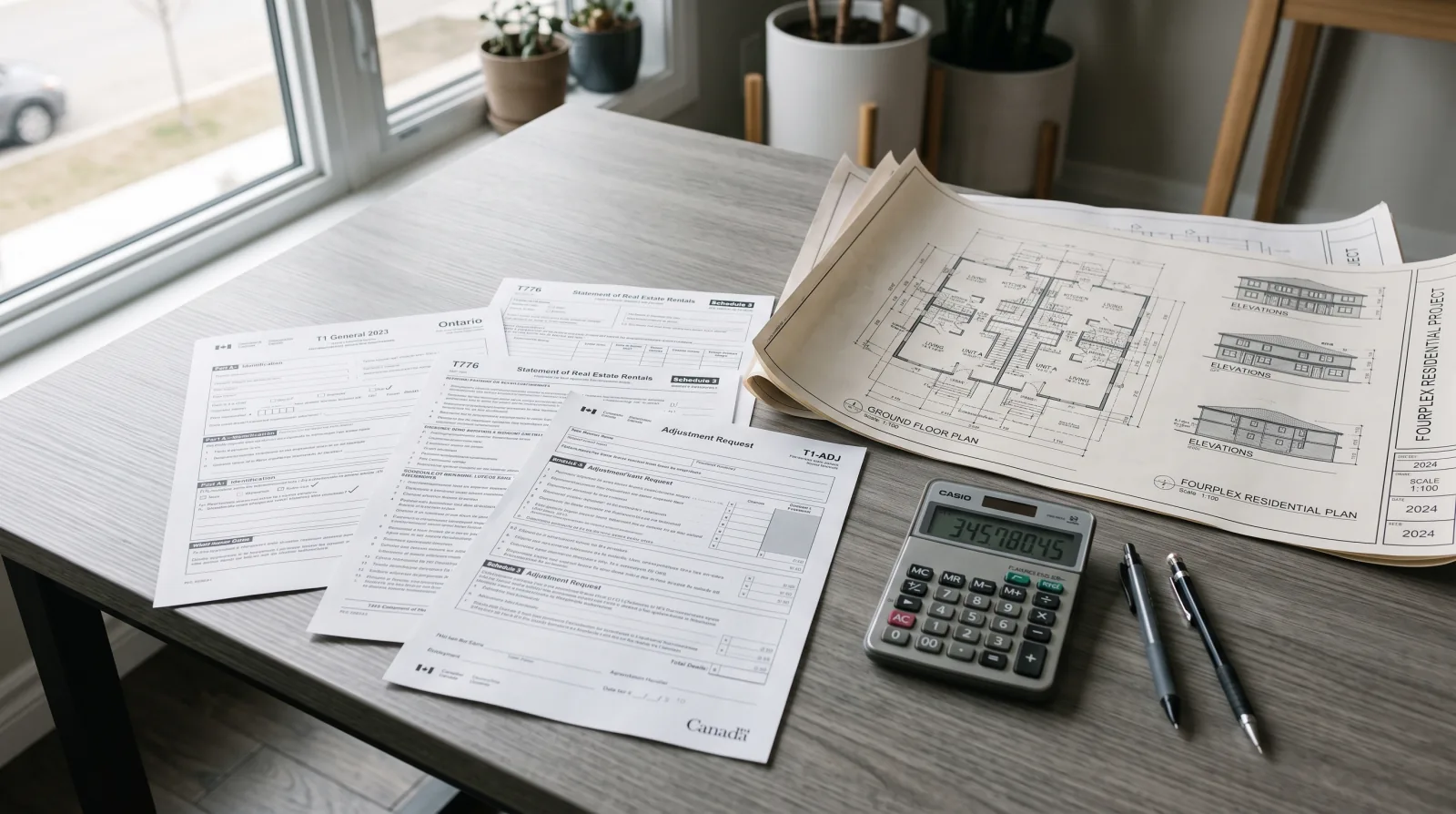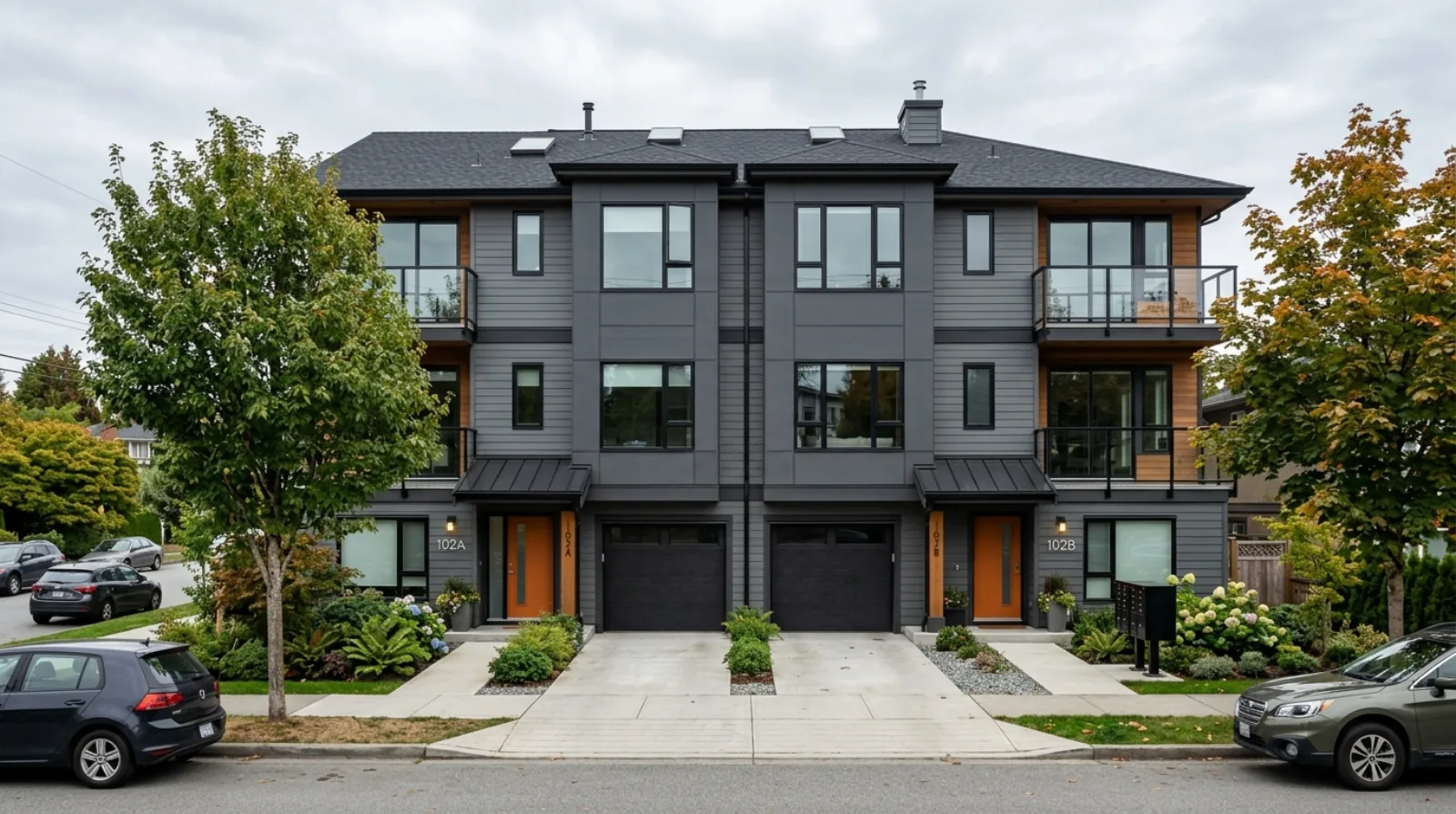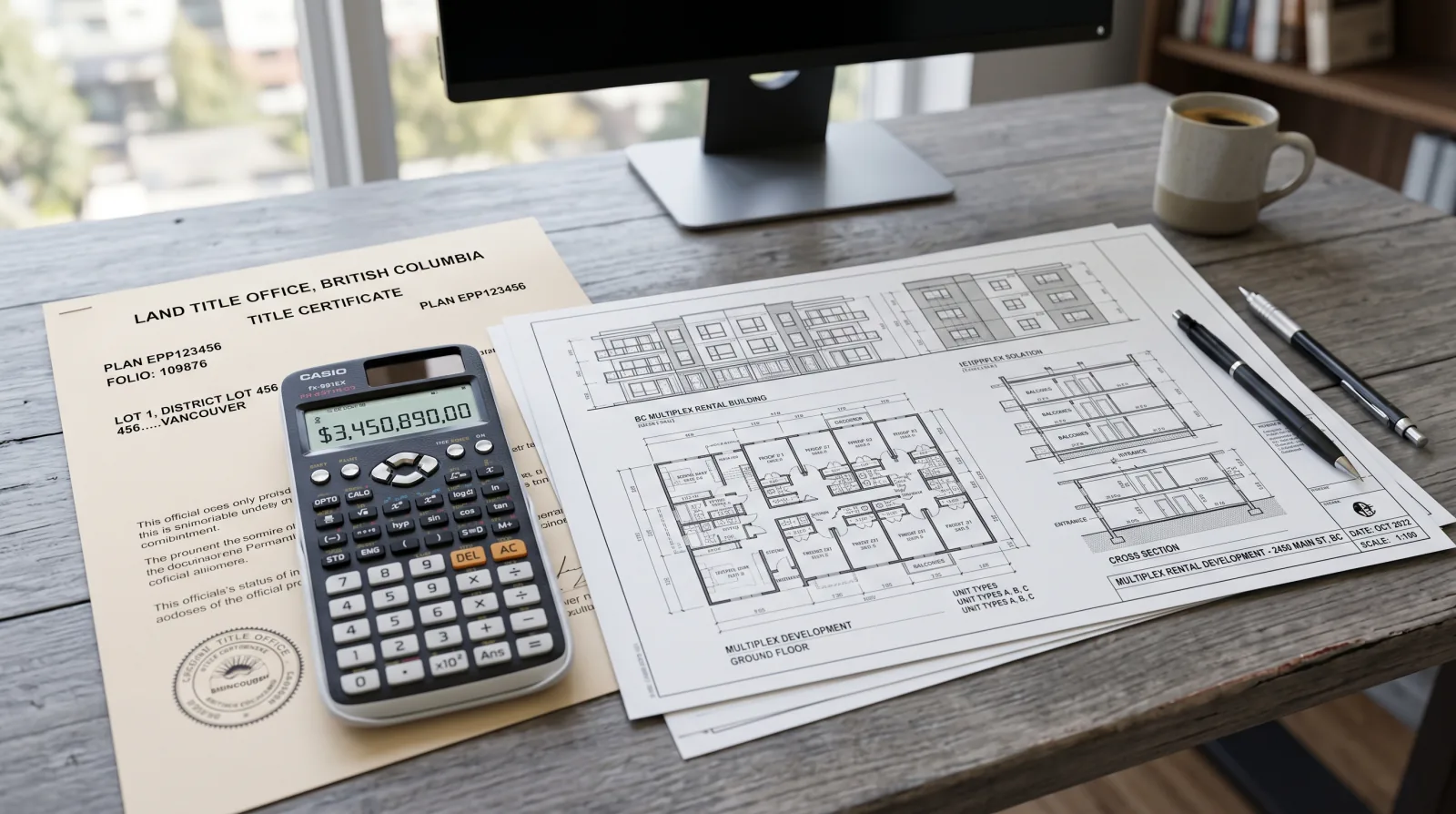

BC’s Property Transfer Tax (PTT) normally adds tens of thousands of dollars to the cost of buying property. On a $2.5M purchase, you’d owe $48,000 in PTT before you break ground. But if you’re building a non-stratified rental multiplex with four or more units, BC has a full exemption — and it’s been available since 2025.
This post covers exactly how the PTT works, which exemptions apply to multiplex development, what the savings actually look like in dollar terms, and where builders get tripped up.
How PTT Is Calculated
The BC Property Transfer Tax applies whenever property is registered at the Land Title Office. The rate is tiered:
| Purchase Price | Rate |
|---|---|
| First $200,000 | 1% |
| $200,001 – $3,000,000 | 2% |
| Above $3,000,000 | 3% |
A property bought for $2.5M generates a PTT bill of: $2,000 (1% × $200K) + $46,000 (2% × $2.3M) = $48,000.
A property bought for $3.5M generates: $2,000 + $56,000 + $15,000 (3% × $500K) = $73,000.
PTT is due at Land Title registration. It’s not due when you pull a building permit, sign a purchase agreement, or break ground — it’s due when title transfers.
The Purpose-Built Rental Exemption
This is the one that matters most for multiplex developers.
The province created a full PTT exemption for newly built, non-stratified residential rental buildings. Here are the qualifying conditions:
Building requirements:
- Four or more separate residential rental units
- Non-stratified (the building cannot be strata-titled)
- First registered at Land Title between January 1, 2025 and December 31, 2030
Ownership requirements:
- The owner must commit to using all residential units as rental housing for a minimum of 10 years
- The owner must register a covenant on title confirming the rental use obligation
The retroactive expansion: Effective retroactively to January 1, 2025, the exemption was expanded to include buildings that were leased for up to 24 months before first taxable registration at Land Title. This means a developer who pre-leased units before completing the strata-free registration still qualifies.
What you save: On a $2.5M non-stratified rental fourplex, the full PTT bill of $48,000 is eliminated. That’s $48,000 that stays in your project — not in the provincial treasury.
On a $3.5M sixplex: you save $73,000.
These aren’t small numbers. In a project where construction cost overruns are fought at $5,000 increments, a $48,000–$73,000 exemption is meaningful capital.
Why Non-Stratified Matters
BC’s Bill 44 (SSMUH legislation) lets you build 4–6 units on most lots in most municipalities. But Bill 44 doesn’t dictate tenure — you choose whether to strata-title the units for individual sale, or hold the building as a single non-stratified rental.
The PTT exemption only applies to the non-stratified path. If you strata and sell individual units, each buyer pays PTT at registration. The purpose-built rental exemption is gone.
This is one of the structural financial advantages of build-to-rent over build-to-sell. You don’t just keep the rental income — you also skip $48,000+ at registration.
The tradeoff: you’re committing to rental tenure for 10 years via a registered covenant. If you sell the building within 10 years, the covenant doesn’t disappear — a buyer who wants to change use would need to address it. For long-term investors, this isn’t a constraint. For developers who want a quick sale to an investor, it’s something to disclose upfront.
Newly Built Home Exemption
This exemption applies to buyers of newly built homes — not developers registering a rental building. It’s relevant if you’re selling stratified units.
Full exemption: Property purchased for under $835,000 by an eligible buyer (Canadian citizen or permanent resident, BC resident, principal residence intended).
Partial exemption: Phases out between $835,000 and $1,100,000. Above $1.1M, no exemption.
For new condos and townhomes in Metro Vancouver, these thresholds are tight. Most new units in Vancouver proper come in above $835K, and many above $1.1M. The exemption has more practical application in smaller markets or for lower-priced product.
If you’re building a sixplex and selling units as strata: the individual buyer may qualify for the newly built home exemption on their unit if it’s priced below the thresholds. This doesn’t help the developer directly, but it’s a selling point to buyers comparing your new strata product against resale.
First-Time Buyer Exemption and Stacking
A separate first-time buyer exemption runs alongside the new home exemption. The thresholds differ slightly:
First-time buyer:
- Full exemption: under $835,000
- Partial exemption: $835,000–$1,000,000
- No exemption: above $1,000,000
Stacking: A buyer who qualifies for both exemptions can apply both. Below $835K on a new home, that’s a full PTT exemption either way. Between $835K and $1M, the newly built home exemption offers a slightly more generous phase-out. Between $1M and $1.1M, only the newly built home exemption applies.
For a developer marketing new strata units: pointing out the stacked exemptions to first-time buyers under $835K is accurate and useful. It’s not a reason to build strata over rental — the purpose-built rental exemption for the developer is worth far more — but it’s a legitimate selling point for the buyer.
The Foreign Buyer Question
BC added a foreign buyer ban on residential property purchases in most municipalities, layered on top of the federal foreign buyer ban.
The exemption you need to know: Canadian citizens and permanent residents are fully exempt from the foreign buyer restriction, regardless of where they currently live. A Canadian PR who has spent the last five years abroad can buy residential property in BC without triggering the foreign buyer ban.
This matters for overseas Canadians looking at multiplex investments. The residency-based restriction does not apply to citizens and PRs. What does apply is the Speculation and Vacancy Tax satellite family classification — but that’s a separate tax with different rules.
If you’re a non-resident buying a rental multiplex: the PTT purpose-built rental exemption still applies. It’s not conditioned on residency. You owe no PTT on a qualifying rental building even as a non-resident citizen or PR.
Comparing the Tax Impact: Rental vs. Strata
PTT comparison for a fourplex developed under Bill 44, at three different valuations:
| Building Value | PTT at Registration (Rental — exempt) | PTT Per Unit (Strata — buyer pays) | Developer PTT Savings |
|---|---|---|---|
| $1.5M building | $0 (exemption) | ~$5,500/unit × 4 = $22,000 | $13,000 on developer’s own registration |
| $2.5M building | $0 (exemption) | ~$11,000/unit × 4 = $44,000 | $48,000 on developer’s own registration |
| $3.5M building | $0 (exemption) | ~$15,750/unit × 4 = $63,000 | $73,000 on developer’s own registration |
Under rental: the developer registers the building once and pays $0 PTT (purpose-built rental exemption).
Under strata: the developer’s own PTT position depends on the land acquisition. Each individual buyer also pays PTT at their unit registration. The developer saves nothing from the exemption — that benefit flows to buyers, not the developer.
The $48,000–$73,000 developer savings is real money on the rental path. It comes from a single non-stratified title registration that qualifies for the full exemption.
What Triggers the PTT — and What Doesn’t
PTT is a Land Title tax. It applies once, when title transfers at the Land Title Office.
PTT is triggered:
- When you purchase the land (buying the existing house and lot)
- When a new strata unit is sold to a buyer (first registration of a strata lot)
- When the building is sold as a whole to a new owner
PTT is NOT triggered:
- When you pull a building permit
- When you start or complete construction
- When you register a pre-sale contract
- When you lease units to tenants
The timing implication: your PTT liability on the land purchase is already determined when you buy. The exemption applies at that registration — provided the qualifying conditions are met at that point. If you buy the land, demolish the house, build a qualifying rental building, and never re-sell: you pay PTT once, on the original land purchase. If that purchase qualifies, you pay $0.
Common Mistakes
Stratifying to unlock individual sales, then assuming the rental exemption still applies. It doesn’t. Once you strata, the exemption is gone. The strata decision is irreversible for PTT purposes.
Buying the land in one corporate structure and building in another. PTT follows title. If title transfers between related entities during the project — even a name change on a holding company — it may trigger a PTT assessment. Get legal advice before restructuring corporate ownership mid-project.
Missing the 10-year covenant registration. The exemption is conditional on registering a covenant that binds the property to rental use for 10 years. If you don’t register the covenant, you don’t get the exemption. Your notary or lawyer handles this at closing — confirm it explicitly rather than assuming.
Assuming the exemption applies to renovations. The purpose-built rental PTT exemption applies to newly built buildings, not renovations or conversions of existing structures. Secondary suite additions and laneway homes follow different rules.
Does Your Property Qualify?
Whether the PTT exemption saves you $48,000 or $73,000 depends on what you’re building and how you’re holding it. The numbers shift based on land purchase price, building value at registration, tenure choice, and municipal location.
VanPlex’s proforma tool runs the PTT calculation as part of the full financial picture for any Metro Vancouver address — including the purpose-built rental exemption, CMHC MLI Select financing, DCL waivers, and projected rental income.
Enter your address at vanplex.ca to see the numbers for your specific lot.
David Babakaiff is the Co-Founder and CEO of VanPlex, a Vancouver-based company specializing in multiplex development and Missing Middle housing. VanPlex uses its AI-powered PlexRank system to identify and underwrite multiplex conversion opportunities under BC’s Bill 44 zoning reforms.