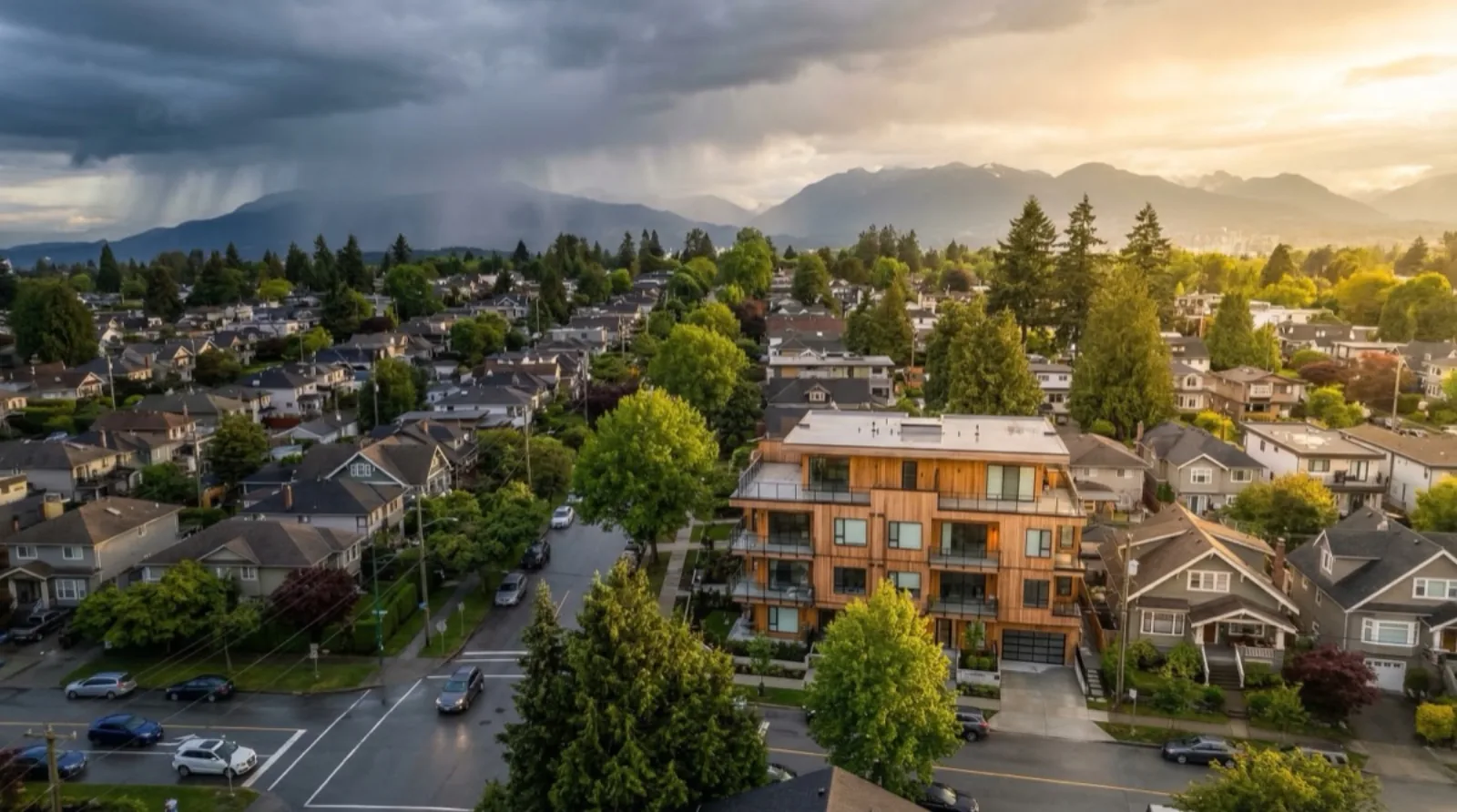

Data visualization showing the power law distribution of multiplex ROE across 100,000 Vancouver properties with a steep concentration curve
Market Analysis Featured

The Power Law Hiding in Multiplex Zoning

5 min read

PlexRank analyzed 100,000+ GVRD properties. Only 2,419 (about 2%) show 100%+ ROE. The rest don't pencil. That's a power law -- and it changes how you should think about multiplex investing.

Key takeaway

Analysis of PlexRank data across 100,000+ GVRD properties reveals a power law distribution in multiplex development returns: only 2,419 properties (roughly 2%) show 100%+ return on equity, while ~48% are marginal and ~50% don't pencil at all.

Most developers work outside-in (pick neighbourhood, find lot), landing in viable territory only 2% of the time. VanPlex works inside-out, identifying the top 2% first and reverse-engineering deals from there. Expansion into North Vancouver and Kelowna underway.

What this covers

  • power law in real estate returns
  • PlexRank 100K property analysis
  • 2% viable multiplex lots
  • outside-in vs inside-out development
  • asymmetric information advantage
  • North Vancouver and Kelowna expansion
PlexRank power-law ROE data-analysis Vancouver GVRD

Most games are designed to be fair. Ten players, ten roughly equal chances. Wins spread around the table over time. Poker with strangers on a first hand works roughly like that. Game theory calls this a normal distribution. Most real estate investors and developers assume this is the game they’re in.

It’s not.

What a power law actually is

When one player at the table can see cards the others can’t, the wins stop spreading. They concentrate. The informed player doesn’t win slightly more often — they win at a rate completely disproportionate to their numbers. That’s a power law. A small percentage of players capturing an outsized share of outcomes because they were playing a different game than everyone else thought was being played.

This isn’t abstract theory. It shows up in venture capital (a handful of deals return all the fund’s profits), in real estate (a few blocks drive most of a city’s appreciation), and now in Vancouver’s multiplex zoning data.

What the multiplex data actually shows

PlexRank has now analyzed over 100,000 GVRD properties across Vancouver and surrounding municipalities.

Of those, roughly 2,419 show a return on equity of 100% or better. That’s about 2% of the multiplex-eligible properties. The rest either don’t pencil, barely pencil, or the math only works on paper until you add real risk — what if the sales price when it’s finished in the future is less than today?

That’s the power law showing up in zoning data.

CategoryPropertiesShareWhat it means
100%+ ROE~2,419~2%Strong risk-adjusted returns
Marginal or break-even~48,000~48%Works on paper, fragile under stress
Doesn’t pencil~50,000~50%Negative or negligible returns

The distribution isn’t a bell curve. It’s a cliff. A tiny fraction of lots carry the vast majority of the viable opportunity.

Why the standard approach misses

Most developers I know work from the outside in. They start with a neighbourhood they like, find a lot, run the numbers, and go from there.

Our data says that approach lands in viable territory roughly 2% of the time. The other 98% don’t know they missed the lowest-risk, best-return properties before the first meeting with an architect.

Think about what that means practically. A developer who picks a neighbourhood first and then hunts for a lot is essentially playing a game where they have a 2% chance of finding the best deals. They might find something that pencils — barely — but they’re almost certainly not finding the lots where the risk-adjusted math is strongest.

Working the problem backwards

We work the opposite direction. PlexRank identifies the 2% first. The investment overview covers how professional capital is using this kind of data to build disciplined deal flow. Then we reverse-engineer the deal structure, the capital stack, and the timeline backward from the outcome.

What this means practically: the edge in multiplex development isn’t hustle or relationships or even construction efficiency. It’s asymmetrical knowledge of which lots to invest in.

That’s what we’ve been building.

How PlexRank finds the 2%

The algorithm scores every residential property across multiple variables: lot dimensions, zoning capacity, current assessed value vs. post-development value, construction cost estimates, neighbourhood sale comps, and risk-adjusted return projections. Properties that clear the threshold on all dimensions — not just one or two — make it into the top tier.

It’s the difference between “this lot is zoned for 4 units” (true for tens of thousands of lots) and “this lot is zoned for 4 units AND the math works AND the risk profile is strong AND the neighbourhood supports the end-product pricing.” That second filter is where the 100,000 becomes 2,419.

From the field this week

VanPlex is extending into North Vancouver and Kelowna over the next 90 days. Both markets show different versions of the same problem: homeowners sitting on rezoned land they don’t fully understand yet. We’re building the same PlexRank data layer for both cities that we built for Vancouver — discovering the power law in those markets.

We also have a federal grant application on the desk right now for a mass timber multiplex project in Vancouver. Deadline March 27. More on what we’re building there once it’s submitted.

What this means for you

If you own property in Metro Vancouver, one of two things is true:

  1. Your lot is in the 2%. The math works, the risk profile is manageable, and a multiplex development could meaningfully change your financial position.
  2. Your lot is in the 98%. That doesn’t mean it’s a bad property — it means multiplex development isn’t the right play for it right now.

Either way, you should know which side you’re on before you spend $20K on architectural drawings. The advanced proforma calculator lets you model the numbers yourself before engaging any professionals.

Visit VanPlex.ca and enter your address. You’ll see your property’s PlexRank score and where it falls in the distribution. Two minutes. No cost. No sales pitch — just the data.


David Babakaiff

CEO & Co-Founder, VanPlex

PlexRank(TM) | Profit with Multiplex
Frequently asked questions

What is a power law and why does it matter for multiplex investing?

A power law is a distribution where a small share of participants capture most of the outcomes, instead of results spreading evenly the way they do in a normal distribution. The article compares it to a poker game where one player can see cards the others cannot: that player wins at a rate completely disproportionate to their numbers. In Vancouver multiplex zoning data, a small fraction of lots carry most of the viable return, so an investor working from city-wide averages is not seeing the real shape of the opportunity.

How many GVRD properties has PlexRank analyzed?

PlexRank has analyzed over 100,000 properties across Vancouver and surrounding Metro Vancouver municipalities. Of those, roughly 2,419 properties, about 2%, show a return on equity of 100% or better, which the article treats as the threshold for a strong, risk-adjusted multiplex opportunity.

What share of Vancouver-area properties actually pencil for multiplex development?

According to the article's breakdown, about 2% of properties, roughly 2,419 lots, show 100%-plus return on equity. About 48%, roughly 48,000 properties, are marginal or break-even, meaning they work on paper but are fragile under stress. The remaining 50%, roughly 50,000 properties, do not pencil at all, showing negative or negligible returns.

Why does picking a neighbourhood first lead most developers to weaker deals?

Most developers work from the outside in: they pick a neighbourhood they like, find a lot, then run the numbers. The article states that this approach lands in viable territory only about 2% of the time, meaning the other 98% of developers working this way never discover the lowest-risk, best-return properties before they even meet with an architect.

How does PlexRank identify the top 2% of properties?

PlexRank scores every residential property on multiple variables at once: lot dimensions, zoning capacity, current assessed value versus post-development value, construction cost estimates, neighbourhood sale comparables, and risk-adjusted return projections. A property only reaches the top tier if it clears the threshold on all of these dimensions together, not just one or two, which is what narrows 100,000 properties down to 2,419.

Does VanPlex work forward from a neighbourhood or backward from the data?

VanPlex works backward from the outcome. Instead of starting with a neighbourhood and hunting for a lot, PlexRank identifies the top 2% of properties first, and the deal structure, capital stack, and timeline are reverse-engineered from that starting point. The article frames this as working with asymmetrical knowledge of which lots to invest in, rather than relying on hustle or relationships.

Where is VanPlex expanding its PlexRank data beyond Vancouver?

The article states that VanPlex is extending into North Vancouver and Kelowna over the 90 days following publication in March 2026. Both markets are described as having homeowners sitting on rezoned land they do not fully understand yet, and VanPlex is building the same PlexRank data layer for both cities that it built for Vancouver.

If my property is not in the top 2%, does that mean it has no value?

No. The article is explicit that being in the other 98% does not mean a property is a bad property. It means that ground-up multiplex development is not the right move for that specific lot right now, based on the combination of zoning capacity, construction cost, and projected return. The article recommends checking a property's PlexRank score before spending money on architectural drawings.

Free 12-page guide for Vancouver-area homeowners. Build, sell, hold, or partner — side-by-side comparison of the numbers, timeline, and risk on each path.

Verified phone required. We'll text you the link in 60 seconds.

David Babakaiff

David Babakaiff

Co-Founder, VanPlex | 25+ Years BC Construction

David Babakaiff is Co-Founder of VanPlex with 25+ years scaling BC construction. He led Alair Homes Vancouver to the 2024 HAVAN Award for Best Multiplex Unit in the GVRD. VanPlex’s PlexRank™ algorithm scores residential parcels across BC for multiplex conversion potential under Bill 44.

Want insights like this delivered weekly?

Join 2,500+ property owners getting ROI case studies, market data, and exclusive opportunities.

No spam. Unsubscribe anytime.