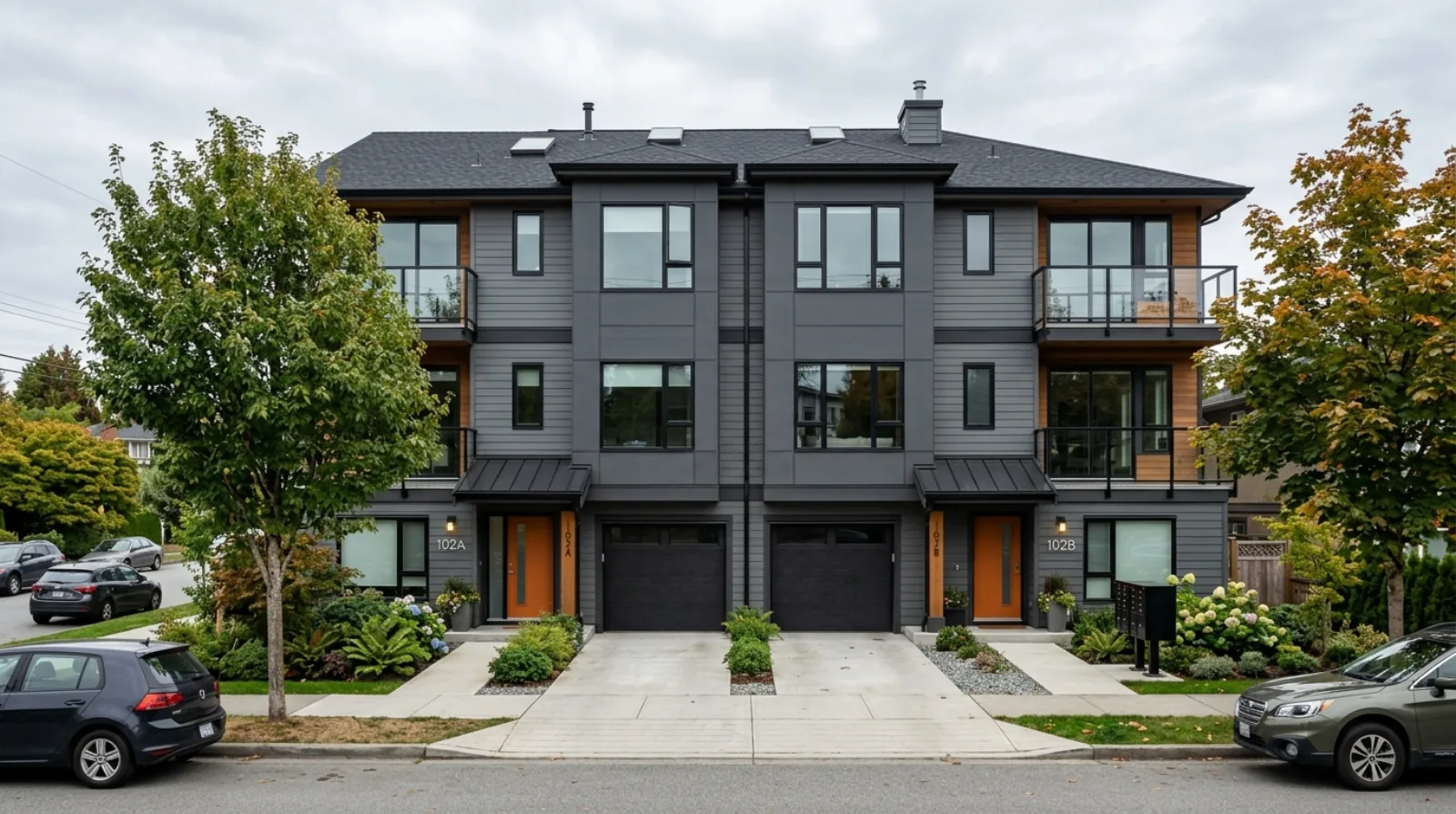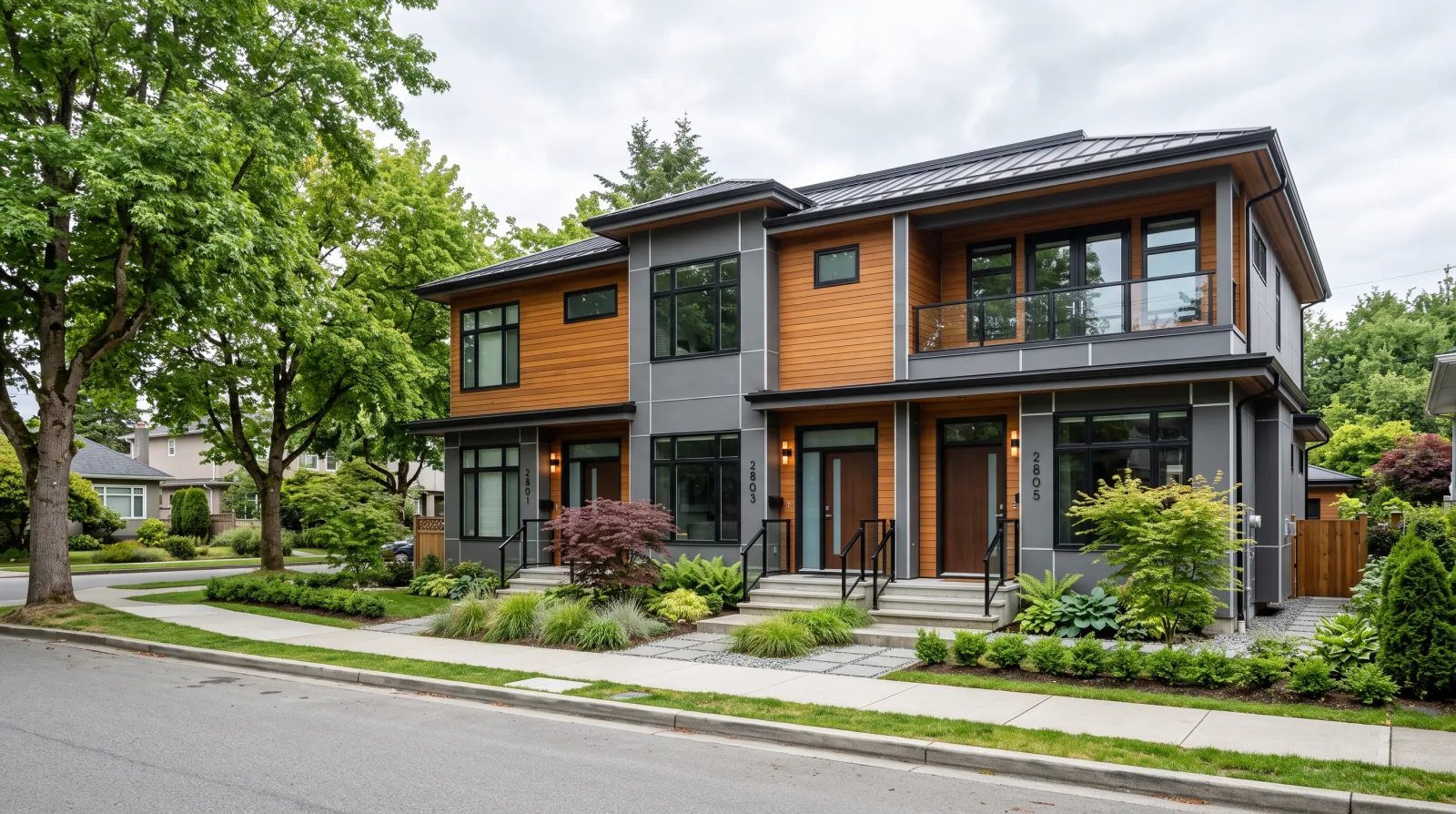

If you plan to live in one unit and rent the others, you can buy or build a BC multiplex with as little as 5% down. Most people assume multiplex financing works like commercial real estate — large down payments, personal guarantees, stiff qualification. That’s true for investor-only deals. For owner-occupied buildings with four units or fewer, the rules are much closer to a regular home purchase. This post walks the house-hack scenario end to end; for the program rules, tables, and FAQ, the reference version lives at our owner-occupied multiplex financing guide.
Two Programs, Two Thresholds
Canadian mortgage rules separate owner-occupied multiplex financing by unit count.
1–4 units (owner-occupied): Standard CMHC mortgage insurance applies if you occupy one unit as your principal residence. You need:
- 5% down on the first $500,000 of purchase price
- 10% down on any amount from $500,001 to $999,999
- 20% down on amounts at or above $1M (CMHC insured mortgages cap at $999,999 effective late 2024)
Wait — that cap matters. A new Vancouver duplex rarely sells below $1.2M. So in practice, most Metro Vancouver owner-occupied duplex or triplex purchases will need 20% down unless the price is under $1M. The 5% down rule applies on paper; the purchase price ceiling means it’s effectively irrelevant for most Vancouver properties. In Fraser Valley and Interior BC, prices are lower and the 5% down threshold actually helps.
5+ units (purpose-built rental): CMHC MLI Select applies. This program targets non-stratified rental buildings. You can access 95% LTV (5% down) and up to 50-year amortization — but you do not need to live on-site. Living in one unit helps operationally but doesn’t change which program you use. The building must meet MLI Select’s point-scoring system (minimum 50 points across energy, affordability, and accessibility) to qualify for enhanced terms.
How Rental Income Helps You Qualify
For a 1–4 unit owner-occupied purchase, lenders will include a portion of the rental income from non-owner-occupied units in your total income for qualification. The standard is:
- Rental offset method: The lender uses market rents from the non-owner-occupied units to offset the property’s carrying cost. Gross Debt Service (GDS) and Total Debt Service (TDS) ratios improve because the rental income reduces the net mortgage payment that counts against your income.
- Income inclusion method: Some lenders add 50% of rental income to your qualifying income. This can be better for applicants with limited employment income.
Example: You buy a triplex in Burnaby for $1.6M, put 20% down ($320K), and borrow $1.28M at 5.5% with a 25-year amortization. Monthly payment: ~$7,700. You live in the basement suite; the two upstairs units rent at $2,600/month each. The lender sees $5,200/month in rental income, which significantly offsets the carrying cost and can allow qualification that would not be possible on employment income alone.
The 5-Unit Cliff: What Changes
Going from a fourplex to a fiveplex is not a small step. It is a program change:
| Feature | 1–4 units (owner-occupied) | 5+ units (MLI Select) |
|---|---|---|
| CMHC program | Standard multi-unit insurance | MLI Select |
| Min down payment (under $1M) | 5% | 5% |
| Min down payment (Vancouver prices) | 20% (insured max $999,999) | 5% (no cap) |
| Amortization | Up to 30 years | Up to 50 years |
| Point system | None | Required (min 50 points) |
| Must live on-site | Yes | No |
| Eligible tenure | Strata or rental | Rental only (no strata) |
The irony: a fiveplex can access better financing terms (50-year amortization, no purchase price cap) than a fourplex — but only if it’s rental, and only if it scores enough MLI Select points. If you want strata ownership, you are stuck at four units for CMHC eligibility.
BC-Specific Context: Bill 44 Lots
Under BC’s Bill 44, most Metro Vancouver residential lots now permit 4–6 units as-of-right depending on lot size and transit proximity. The financing landscape for each case:
3-unit triplex (owner in one unit): Standard CMHC, 5% down if under $1M. Most Vancouver triplexes price above $1M, so 20% down in practice. Fraser Valley and Kelowna: 5% down is realistic.
4-unit fourplex (owner in one unit): Same as triplex — standard CMHC. This is the most common owner-occupied multiplex in Metro Vancouver.
5-unit fiveplex or 6-unit sixplex (build-to-rent, owner lives in one): MLI Select applies. Living in one unit doesn’t change program eligibility — unit count does. You still need to satisfy MLI Select’s point requirements. If the building is rental (non-strata), you benefit from the 50-year amortization and no purchase price cap. Energy efficiency improvements are the easiest path to MLI Select points for most BC builders (Step Code 3 or 4 compliance earns 20 points; Step Code 5 earns 50 points).
What Lenders Actually Look At
Owner-occupied multiplex applications are evaluated like residential mortgages with an income supplement from rents. The practical requirements:
- Employment income or verified rental history: Lenders want to see that you can carry the property in months when a unit is vacant. Self-employed borrowers should plan for two years of T1 Generals showing stable income.
- Market rents: Most lenders want an appraisal that includes a market rent schedule, or they use a fixed rental offset from the neighbourhood. CMHC requires an appraisal for insured loans.
- Strata vs rental: If you buy a strata multiplex unit (common in newer Vancouver fourplexes), you’re buying a single unit — your mortgage covers one unit, not the building. Owner-occupied financing for the whole building only works for buildings with a single title or a bare land strata.
- GDS/TDS ratios: Standard CMHC ratios apply: GDS ≤ 39%, TDS ≤ 44%. Rental income from non-owner units feeds the calculation.
The “House Hack” Case
The most common owner-occupied multiplex scenario in Metro Vancouver: a homeowner converts their existing single-family home to a triplex or fourplex under R1-1 zoning, lives in one unit, and rents the rest.
In this case, you’re not purchasing — you’re building. Construction financing works differently:
- Draw-based construction loan from a lender who understands BC multiplex development
- Converted to a standard mortgage at completion
- Rental income counts from the day units are leased (usually within 30–60 days of occupancy permit)
The financing challenge is the construction period: your existing property generates no income while under construction. Budget for 14–18 months of construction financing at higher rates, then convert.
Practical Steps
- Confirm the unit count you’re building or buying. 1–4 owner-occupied or 5+ rental — these determine which path you’re on.
- Get a pre-approval from a lender experienced with multiplex projects. Not every bank mortgage specialist has done a fourplex. The same product exists; you need someone who has run the GDS/TDS calculation with rental offsets before.
- Commission a market rent appraisal early. It supports both your financing and your feasibility analysis.
- If building 5+ units, plan for MLI Select scoring from the design stage. Energy efficiency points are the fastest path; retrofitting for Step Code after design is expensive.
Run your property address through VanPlex to see how many units your lot qualifies for and what the financing looks like for your specific situation at vanplex.ca.