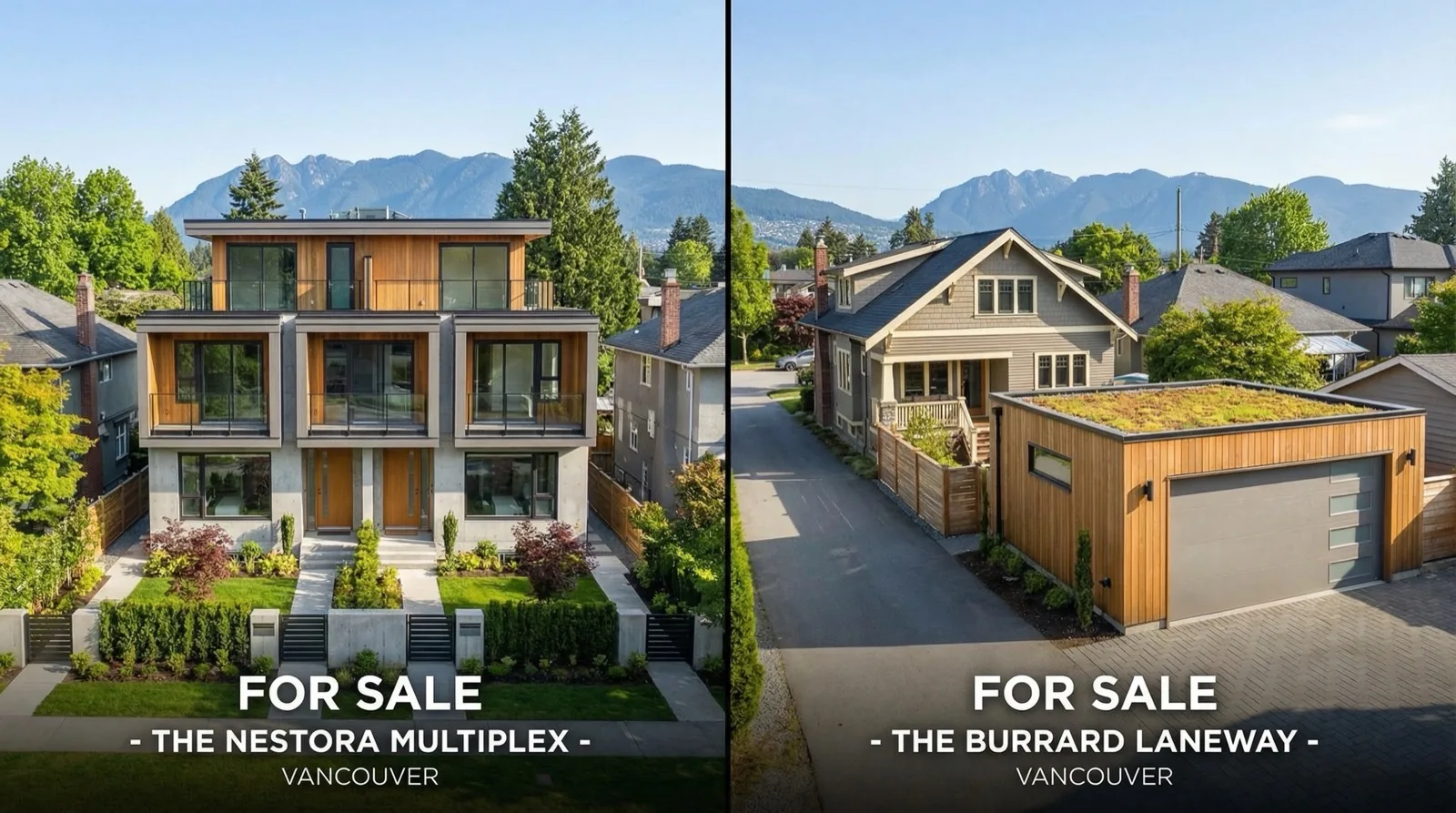

Vancouver homeowners often ask: should I add a laneway house or develop my entire property into a multiplex? The answer depends on your goals, timeline, and risk tolerance. Here’s a data-driven comparison to help you decide. You can also run the numbers on your specific property using our advanced pro forma calculator.
TL;DR (Key Takeaways)
- Laneway House: Lower cost ($350-500K), faster timeline (8-12 months), limited return ($150-250K equity gain)
- Multiplex: Higher cost ($2-3M total), longer timeline (18-24 months), larger return ($500K-2M+ equity gain)
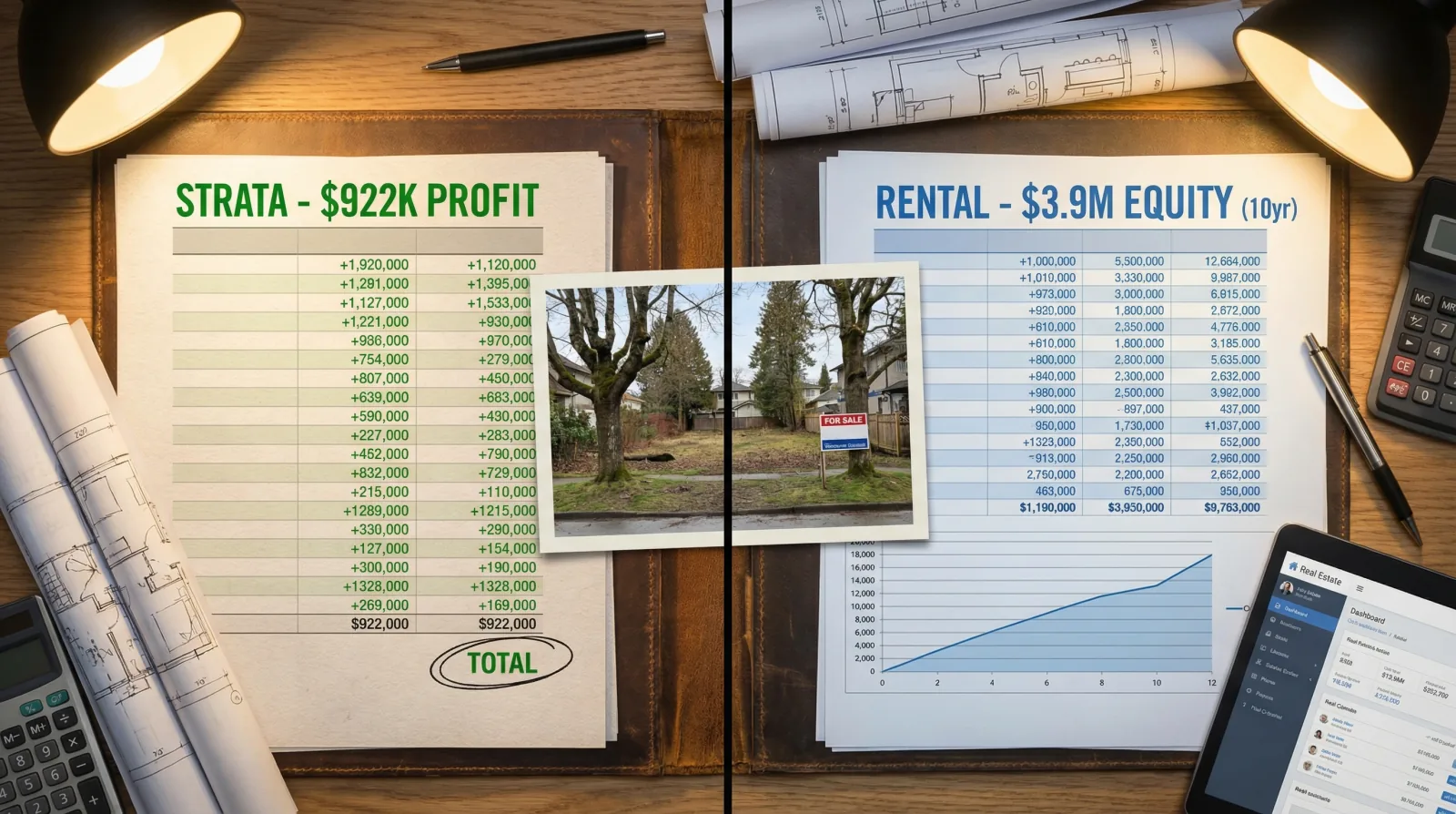
- ROI comparison: In proforma modeling, laneway projects usually fall in the 40-60% ROI range, while multiplex projects on strong lots can reach 60-100%+ ROI on equity. Actual results depend on the specific lot, construction costs, and market conditions at completion.
- Risk profile: Laneway is lower risk; Multiplex requires more capital but offers greater reward
- Best for: Laneway suits incremental wealth building; Multiplex suits transformational wealth creation
The Two Paths: An Overview
| Factor | Laneway House | Full Multiplex |
|---|---|---|
| Total Cost | $350,000-$500,000 | $2,000,000-$3,000,000 |
| Timeline | 8-12 months | 18-24 months |
| Equity Gain | $150,000-$250,000 | $500,000-$2,000,000+ |
| Cash Required | $100,000-$200,000 | $200,000-$500,000 |
| Units Created | 1 additional | 3-5 additional |
| Complexity | Moderate | High |
| Risk Level | Lower | Higher |
Option A: The Laneway House Path
How It Works: You build a detached secondary dwelling (typically 750-1,000 sf) in your backyard, accessed from the lane. Your main house remains unchanged.
Financial Example (Vancouver East Side):
| Component | Amount |
|---|---|
| Construction Cost | $400,000 |
| Design & Permits | $50,000 |
| Landscaping & Finishing | $30,000 |
| Total Investment | $480,000 |
| Property Value Increase | $650,000-$750,000 |
| Net Equity Gain | $170,000-$270,000 |
| ROI | 35-56% |
Ongoing Value:
- Rental income: $2,500-$3,500/month
- Annual cash flow: $30,000-$42,000 (before expenses)
Pros:
- Lower barrier to entry
- Faster completion
- Keep existing home intact
- Simpler financing
- Less construction disruption
Cons:
- Limited wealth creation potential
- Cannot be sold separately (typically)
- Lower total return
- Still require demolition for future multiplex
Option B: The Full Multiplex Path
How It Works: You demolish your existing home and build a new multiplex with 4-6 units. You can sell all units, keep some, or retain the entire building.
Financial Example (Same Vancouver East Side Location):
| Component | Amount |
|---|---|
| Starting Property Value | $2,200,000 |
| Construction Cost | $2,000,000 |
| Soft Costs | $300,000 |
| Total Project Cost | $4,500,000 |
| Unit Sales (4 × $1,400,000) | $5,600,000 |
| Net Equity | $3,300,000 |
| Equity Gain | $1,100,000 |
| ROI on Starting Equity | 50% |
Pros:
- Transformational wealth creation
- Multiple exit options
- Can retain units for yourself
- Units can be sold individually
- Modern, purpose-built construction
Cons:
- Higher complexity
- Longer timeline
- Requires temporary relocation
- More capital required
- Higher risk during construction
Side-by-Side: The Same Property, Two Paths
Let’s compare both approaches on a typical 33’ x 122’ Vancouver lot valued at $2.2M:
Scenario A: Add Laneway House
| Timeline | Action | Cumulative Value |
|---|---|---|
| Start | Property worth $2.2M | $2,200,000 |
| Month 12 | Laneway complete ($480K spent) | $2,850,000 |
| Year 2+ | Rental income ($36K/year) | $2,886,000+ |
| Net Position | +$686,000 |
Scenario B: Develop Multiplex
| Timeline | Action | Cumulative Value |
|---|---|---|
| Start | Property worth $2.2M | $2,200,000 |
| Month 24 | Multiplex complete ($2.3M spent) | $5,600,000 |
| Post-Sale | Net equity after costs | $3,300,000 |
| Net Position | +$1,100,000 |
The multiplex path creates $414,000 more wealth in 24 months—but requires 18 months of living elsewhere and managing a more complex project.
When to Choose Laneway
A laneway house is the right choice if:
✅ You want to stay in your current home ✅ You have $100-200K available, but not $300K+ ✅ You want passive rental income ✅ Your timeline is flexible but you want results faster ✅ You’re testing the waters before a larger project ✅ Your lot configuration limits multiplex potential ✅ You’re within 5-10 years of needing the property
When to Choose Multiplex
Full multiplex development is the right choice if:
✅ You’re mortgage-free or nearly so ✅ You can relocate for 18-24 months ✅ You want maximum wealth creation ✅ You plan to keep 1-2 units for yourself/family ✅ Your lot supports 4+ economically viable units ✅ You’re making a once-in-a-lifetime wealth decision ✅ You’re planning for multigenerational housing needs (see our homeowners guide for how families use multiple units)
The Hybrid Approach: Laneway Now, Multiplex Later?
Some homeowners consider building a laneway house first, then developing a multiplex later. This approach has significant drawbacks:
Problems with Sequential Development:
- Laneway must be demolished for multiplex (wasted investment)
- $480K laneway becomes $0 when demolished
- Two permit processes instead of one
- Two construction periods instead of one
- Total timeline: 3+ years instead of 24 months
Our Recommendation: If multiplex development is your ultimate goal, skip the laneway and go directly to multiplex. The numbers strongly favor the direct path.
The Numbers Don’t Lie: 5-Year Comparison
| Metric | Laneway Path | Multiplex Path |
|---|---|---|
| Initial Equity | $2,200,000 | $2,200,000 |
| Investment | $480,000 | $2,300,000 |
| Year 1 | Construction | Construction |
| Year 2 | +$36K rental | Completion, sale |
| Year 3 | +$36K rental | Equity invested |
| Year 4 | +$36K rental | Equity compounding |
| Year 5 | +$36K rental | Equity compounding |
| 5-Year Rental Income | $180,000 | $0 (or retained units) |
| Final Equity Position | $3,030,000 | $3,300,000+ |
Even accounting for 5 years of laneway rental income, the multiplex path creates more wealth—and that’s before considering:
- Multiplex units can also generate rent if retained
- Multiplex equity can be reinvested
- Multiplex creates saleable assets (individual units)
Making Your Decision
The right choice depends on your specific situation:
Choose Laneway if:
- Capital constraints prevent multiplex
- Timeline urgency favors faster completion
- You want to stay in your current home
- You’re risk-averse
Choose Multiplex if:
- You’re positioned for maximum wealth creation
- 18-24 month timeline is acceptable
- You can manage temporary relocation
- Long-term wealth matters more than short-term convenience
Visit vanplex.ca to see which path makes sense for your specific property—and what the numbers look like for both options. Investors looking beyond a single project can also explore our investment opportunities.
David Babakaiff, Co-Founder of VanPlex
PlexRank™ | Profit with Multiplex