
“What’s a fair equity split for a Vancouver multiplex JV?”
It is the most common question we get from landowners considering a partnership. And it is also the wrong question — because the answer depends entirely on what each side is contributing and how much risk each side is carrying. Anyone who tells you “the market is 50/50” is selling, not advising.
Here is how splits actually get set in real BC multiplex deals.
The four principles
Before any percentage gets discussed, four principles drive the math:
Land is rarely worth half. In Vancouver, where land is the single biggest input cost, landowners often anchor on 50% as a starting position. They are wrong. Once you account for capital risk, build risk, and the months of sponsor work it takes to actually deliver the project, the typical landowner share lands between 30 and 45 percent.
Capital wants pref plus share. Capital partners almost always negotiate a preferred return — typically 8% IRR — before any common-equity profit is shared. The “split” therefore has two layers: the pref and the post-pref split. Ignoring the pref distorts the comparison.
Sponsor share scales with risk. A builder taking pure fees gets ~5% equity. A builder taking the GC role plus signing the construction loan personal guarantee gets 25–35%. The split should track the actual risk delta, not a round number.
Contributions get re-priced at refinance. When the project refinances at stabilization, the lender will re-test the equity stack. Splits that were “fair” on day one can compress sharply if the appraisal comes in low.
Four realistic scenarios
Scenario 1: Land-rich, capital-poor owner + well-capitalized builder
A Vancouver homeowner with a $1.8M lot, modest savings, and no construction experience teams up with a builder who can self-fund the equity gap.
- Landowner: 40–55%
- Capital: 0–15% (third-party debt covers most of the equity needed)
- Builder: 35–50% including market-rate GC fees plus carried interest
Land is credited at appraised value. Builder earns full fees through the GC contract and adds carry on top. This is the cleanest two-party structure when the builder has the balance sheet to back it.
Scenario 2: Three-way deal with separate capital partner
A Vancouver landowner brings a $2.0M lot. A passive capital partner brings $800k. A builder brings construction capacity plus $300k of deferred fees.
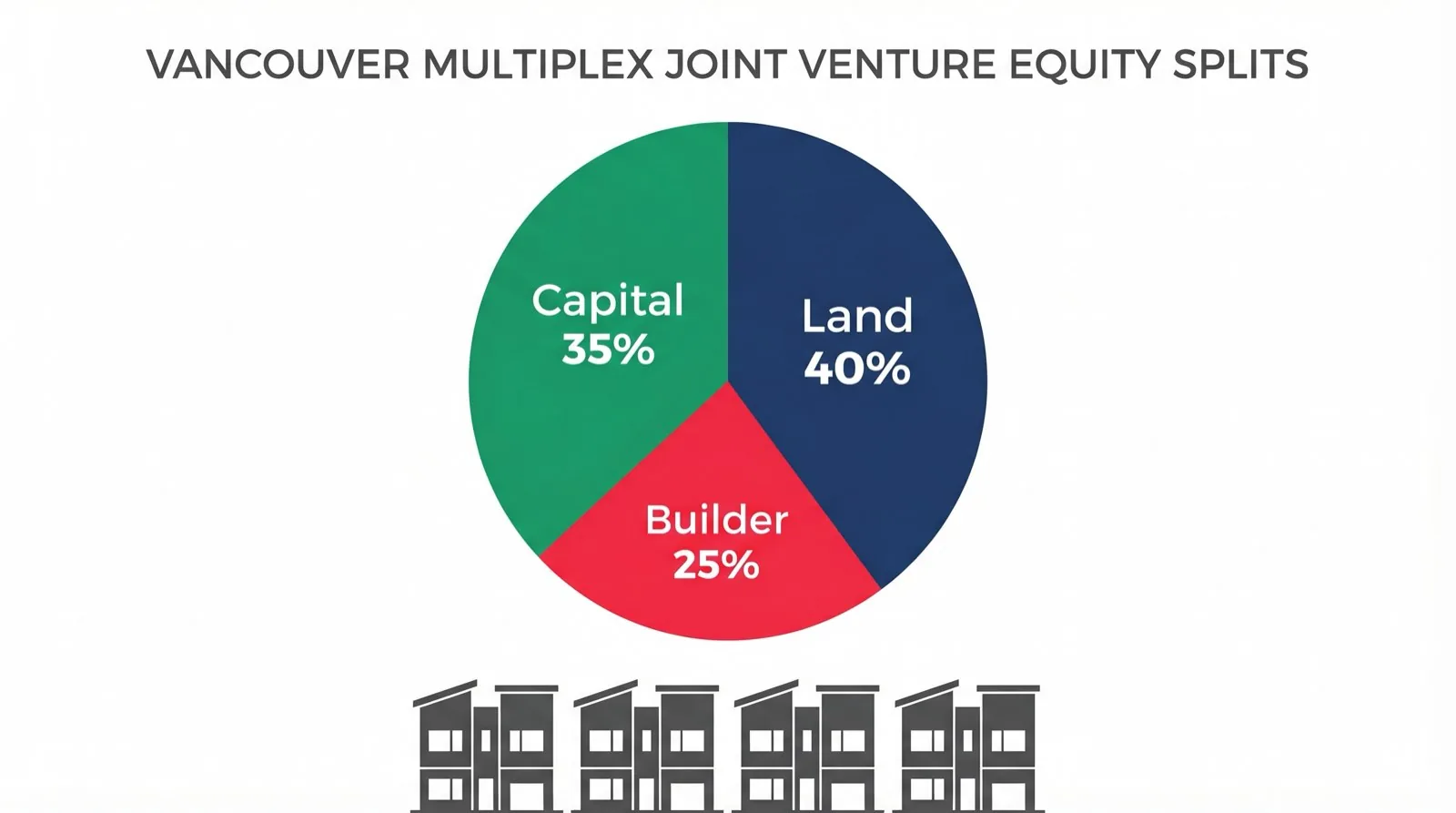
- Landowner: 30–40%
- Capital: 30–40% (with 8% pref before any sponsor profit)
- Builder: 25–35%
This is the most balanced structure for deals over $4M total project cost. The pref protects capital. The promote rewards the builder for execution. The landowner gets a meaningful position without writing the construction cheque.
Scenario 3: Capital-led, landowner sells with back-end kicker
A landowner wants most of the proceeds upfront. A well-capitalized sponsor offers $1.5M cash plus a 10% kicker on the back end.
- Landowner: 5–15% kicker on back-end
- Capital: 55–70%
- Builder: 20–35%
This is functionally a sale, not a JV, but the structure preserves enough upside to keep the landowner aligned. Used when the landowner needs liquidity but believes in the upside.
Scenario 4: Builder-led, landowner contributes with fee-for-service GC
The landowner has the capital, the time, and the patience to be the principal. The builder is hired as a hybrid GC-partner with a small equity slice.
- Landowner: 55–70%
- Capital: 0–20% (often the landowner is also the capital)
- Builder: 15–30% equity plus market-rate GC fees
The owner keeps most of the upside. The builder is incentivized to deliver but does not have control. Works when the owner has development experience or a strong owner’s rep.
The waterfall matters more than the split
Two deals can have identical 50/50 splits and produce dramatically different outcomes. The waterfall is the order in which money flows out of the JV after the loan is repaid.
The standard four-tier multiplex JV waterfall is:
- Return of contributed capital (land + cash, pro-rata)
- Preferred return at 8% IRR on contributed capital
- Catch-up to the sponsor at 50/50 or 100% until sponsor reaches their pref share
- Promote above pref + catch-up, typically 70/30 or 80/20 (capital / sponsor)
Run a $1.2M profit through that waterfall on a Vancouver 6-plex with $2.0M land, $0.8M capital, and $0.3M sponsor:
- Return of capital: $2.8M paid back first
- 8% pref on $0.8M for 24 months: $128k to capital
- Catch-up: $128k to sponsor
- Remaining $944k split 70/30: $660,800 to capital, $283,200 to sponsor
The capital partner gets $788k out of a $1.2M profit pool. The sponsor gets $411k. That math is invisible in a one-line “50/50 equity split” headline.
Where splits get re-set
Three events can re-set a JV equity split mid-project:
- Capital call default. A partner misses a tranche. Default remedies in the agreement determine the dilution formula. A non-defaulting partner who funds the gap can take the defaulter’s share at a discount.
- Refinance appraisal. At stabilization, the lender appraises the project. If the appraisal comes in 10% below the original pro forma, the equity stack is re-tested. Whoever has the smallest cushion gets squeezed.
- Scope or budget overrun above contingency. If the agreement requires additional capital beyond the original budget and the landowner cannot fund, the cash partner can take a larger share at a penalty rate.
The protection against all three is mechanical, written-out default remedies in the JV agreement. Vague language is the same as no language — it just gets argued in court instead of arbitration.
What to do now
If you are a landowner negotiating your first split:
- Get an independent lot appraisal before any equity conversation
- Ask the sponsor to walk you through the waterfall, not just the headline split
- Stress-test the split: what happens if the project comes in 10% over budget?
- Insist on a floor on your ownership percentage that survives dilution
If you are a capital partner reviewing a sponsor proposal:
- Ignore the headline equity split. Model the waterfall yourself.
- Confirm the pref accrues even during construction
- Negotiate the catch-up percentage, not just the promote percentage
- Get a buy-out right if the sponsor is removed for cause
If you are a builder pitching a new deal:
- Pitch the waterfall, not the split. Sophisticated partners will respect it.
- Be transparent about your fees, your equity ask, and the downside scenario
- Offer reciprocal protections — the builder who only protects themselves does not get the second deal
The full hub on equity splits and profit waterfalls goes deeper on each scenario. Bring real questions. Then negotiate with eyes open.