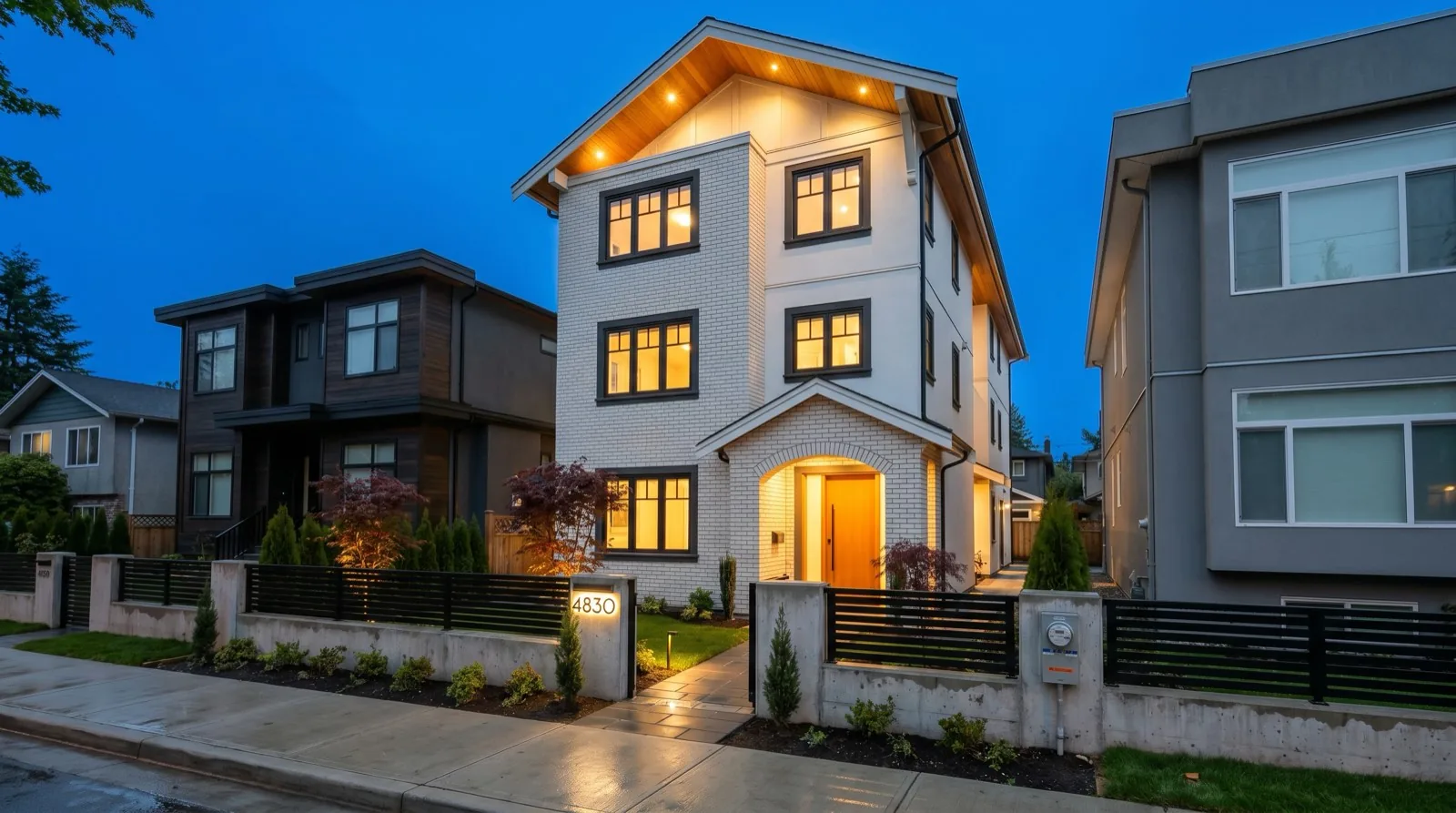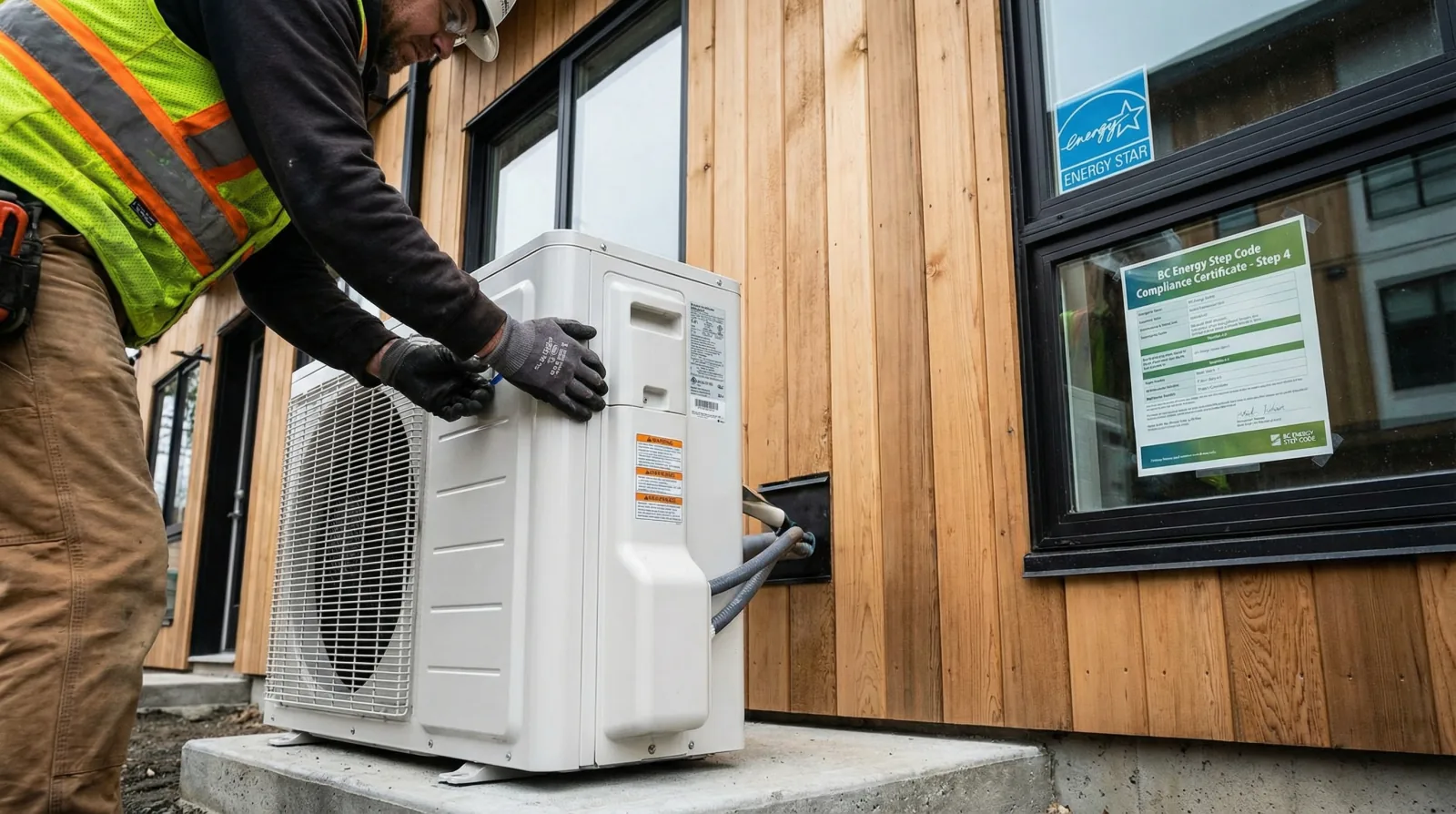

Nobody passed a law banning gas furnaces in new BC multiplexes. They did not have to. Step Code 3 airtightness requirements and the zero-carbon energy step make gas heating nearly impossible to specify in a new multiplex. Air-source heat pumps are now the default mechanical system, and the economics are better than most builders realize.
Why Gas Does Not Work in New Multiplex
The issue is not regulation banning gas connections, though Vancouver has effectively done that for new buildings. The issue is physics.
Step Code 3, the current minimum for new Part 3 buildings across BC, requires airtightness testing. Buildings must achieve no more than 3.0 ACH@50Pa (air changes per hour at 50 Pascals of pressure). Combined with improved insulation requirements, this creates buildings with dramatically reduced heating loads.
A gas furnace sized for a well-insulated, airtight unit is absurdly small. The minimum-output gas furnace available on the market delivers far more heat than a Step Code 3+ unit needs. It short-cycles, running for a few minutes and shutting off, then running again. This wastes energy, creates uneven temperatures, and accelerates equipment failure.
Heat pumps, by contrast, modulate. An inverter-driven heat pump adjusts its output continuously, delivering exactly the amount of heating or cooling the space needs. In a tight, well-insulated building, this is the right tool for the job.
Then there is the carbon question. Vancouver and an increasing number of BC municipalities require zero-carbon or near-zero-carbon energy for new buildings. Gas combustion produces carbon. Heat pumps running on BC’s 98% hydroelectric grid produce almost none. The path forward is electric.
Heat Pump Costs: The Real Numbers
The installed cost of heat pump systems for a new multiplex depends on the system type, unit count, and building configuration.
Per-unit installed costs:
| System Type | Cost Per Unit | Best For |
|---|---|---|
| Ductless mini-split (single zone) | $8,000-$10,000 | Studios, 1-bedrooms |
| Ductless mini-split (multi-zone) | $12,000-$15,000 | 2-3 bedroom units |
| Central ducted heat pump | $10,000-$14,000 | Larger units with duct runs |
| Shared central system (per unit share) | $8,000-$12,000 | 6+ unit buildings |
Comparison to gas:
A gas furnace with air conditioning runs $4,000-$6,000 per unit installed, plus $2,000-$4,000 for the gas service connection to the building. So the true gas comparison is $6,000-$10,000 per unit when you include infrastructure.
The heat pump premium over gas is $2,000-$5,000 per unit in real terms. On a 6-unit building, that is $12,000-$30,000, not the dramatic gap most people assume.
Operating Savings: 40-60% Energy Cost Reduction
Heat pumps deliver 2.5 to 4.0 units of heat for every unit of electricity consumed. Gas furnaces deliver 0.92 to 0.96 units of heat per unit of gas consumed. The efficiency gap is massive.
Annual heating and cooling costs per unit (Metro Vancouver climate):
| System | Annual Cost | Savings vs Gas |
|---|---|---|
| Gas furnace + central AC | $1,800-$2,400 | Baseline |
| Air-source heat pump | $800-$1,200 | 40-60% reduction |
On a 6-unit building, the annual operating savings are $3,600-$7,200. Over a 25-year mortgage, cumulative savings reach $90,000-$180,000, assuming 3% annual energy price inflation.
For build-to-rent operators, these savings flow directly to the bottom line if the landlord pays utilities. If tenants pay their own utilities, the lower operating costs justify higher base rents because tenants evaluate total housing cost, not just rent.
CleanBC Rebates: $3,000-$6,000 Per Unit
The CleanBC program offers substantial rebates for heat pump installation in new construction. Current rebate levels for new multiplex:
Space heating heat pumps:
- Air-source heat pump (cold climate rated): $3,000-$4,000 per unit
- Ground-source heat pump: $4,000-$6,000 per unit
Domestic hot water heat pumps:
- Heat pump water heater: $1,000-$2,000 per unit
Stacking with BC Hydro: BC Hydro’s New Construction Program offers additional incentives for all-electric buildings. Combined with CleanBC rebates, total incentive recovery reaches $4,000-$8,000 per unit.
On a 6-unit building, that is $24,000-$48,000 in rebates, covering a significant portion of the heat pump premium over gas.
Mini-Splits vs Central: When to Use Each
The choice between ductless mini-splits and central ducted heat pumps depends on your building configuration.
Ductless mini-splits work best when:
- Building has 2-4 units
- Units are small (studios or 1-bedrooms under 700 sq ft)
- No existing ductwork or chase space in the design
- You want individual unit temperature control with no shared systems
- Budget is tight (lower installed cost per zone)
Central ducted systems work best when:
- Building has 5+ units
- Units are larger (2-3 bedrooms, 800+ sq ft)
- Floor plan accommodates duct runs
- You want a cleaner interior aesthetic (no wall-mounted heads)
- Building codes require ducted ventilation anyway (you can combine systems)
The hybrid approach: Many 4-6 unit multiplexes use a hybrid strategy. Central ducted heat pumps serve the larger units where ductwork fits naturally. Mini-splits serve smaller units or spaces where duct routing is impractical. This optimizes cost and performance without forcing one system type into the wrong application.
The All-Electric Building: Panels and Service
Eliminating gas means your building runs entirely on electricity. This has implications for electrical infrastructure that must be addressed during design, not discovered during construction.
Electrical panel sizing: A standard gas-equipped multiplex might need 200-400 amp service. An all-electric multiplex with heat pumps, electric cooking, and heat pump hot water typically requires 400-600 amp service. Budget $15,000-$25,000 for the electrical service upgrade over what a gas-equipped building would require.
BC Hydro service connection: All-electric buildings may require a larger transformer or upgraded service lateral from the utility. BC Hydro’s connection timeline runs 8-16 weeks for new service. Submit your application during the permit phase, not after construction starts.
Load management: Smart electrical panels and load management devices can reduce peak demand by 20-30%, potentially allowing a smaller service size. Products like SPAN panels or Schneider load controllers coordinate when heat pumps, water heaters, and cooking appliances draw power, avoiding simultaneous peak loads.
The upside of eliminating gas: No gas service connection saves $5,000-$10,000 in utility hookup fees. No gas piping within the building saves $3,000-$8,000 in plumbing costs. No gas meter, no combustion air requirements, no carbon monoxide risk. The all-electric building is simpler, safer, and increasingly cheaper when you account for eliminated gas infrastructure.
Making It Work
Heat pumps are not optional for new BC multiplex construction. They are the practical reality of building to current energy codes. The good news is the economics favor them: lower operating costs, substantial rebates, and a simpler building without gas infrastructure.
For detailed specifications on heat pump and solar integration for multiplex, see our solar and heat pump guide.
The builders who are still pricing gas furnaces into their multiplex estimates are working with outdated numbers. Heat pumps cost more upfront. They cost less to operate. The rebates close the gap. And the building code has made the decision for you.