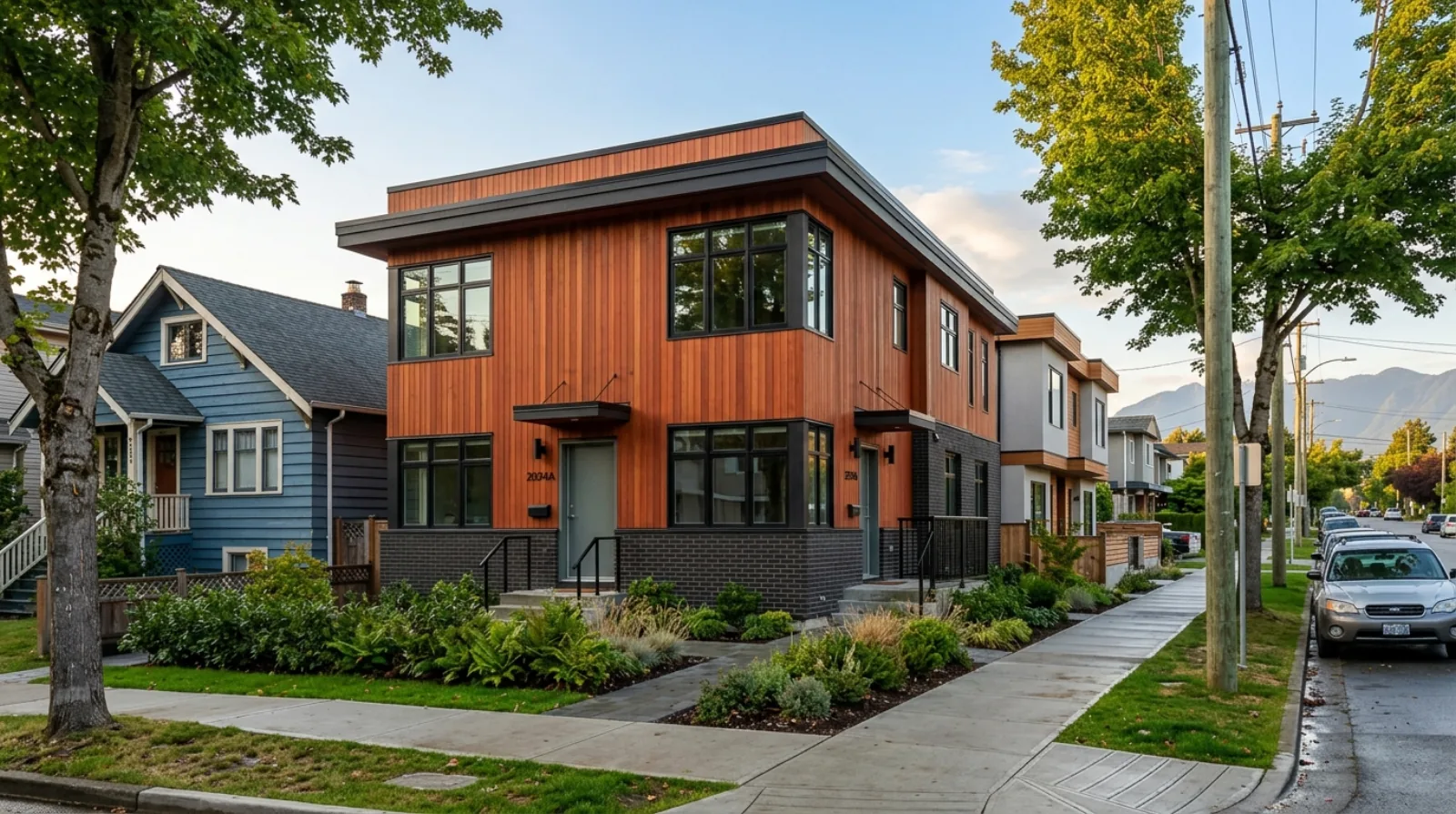

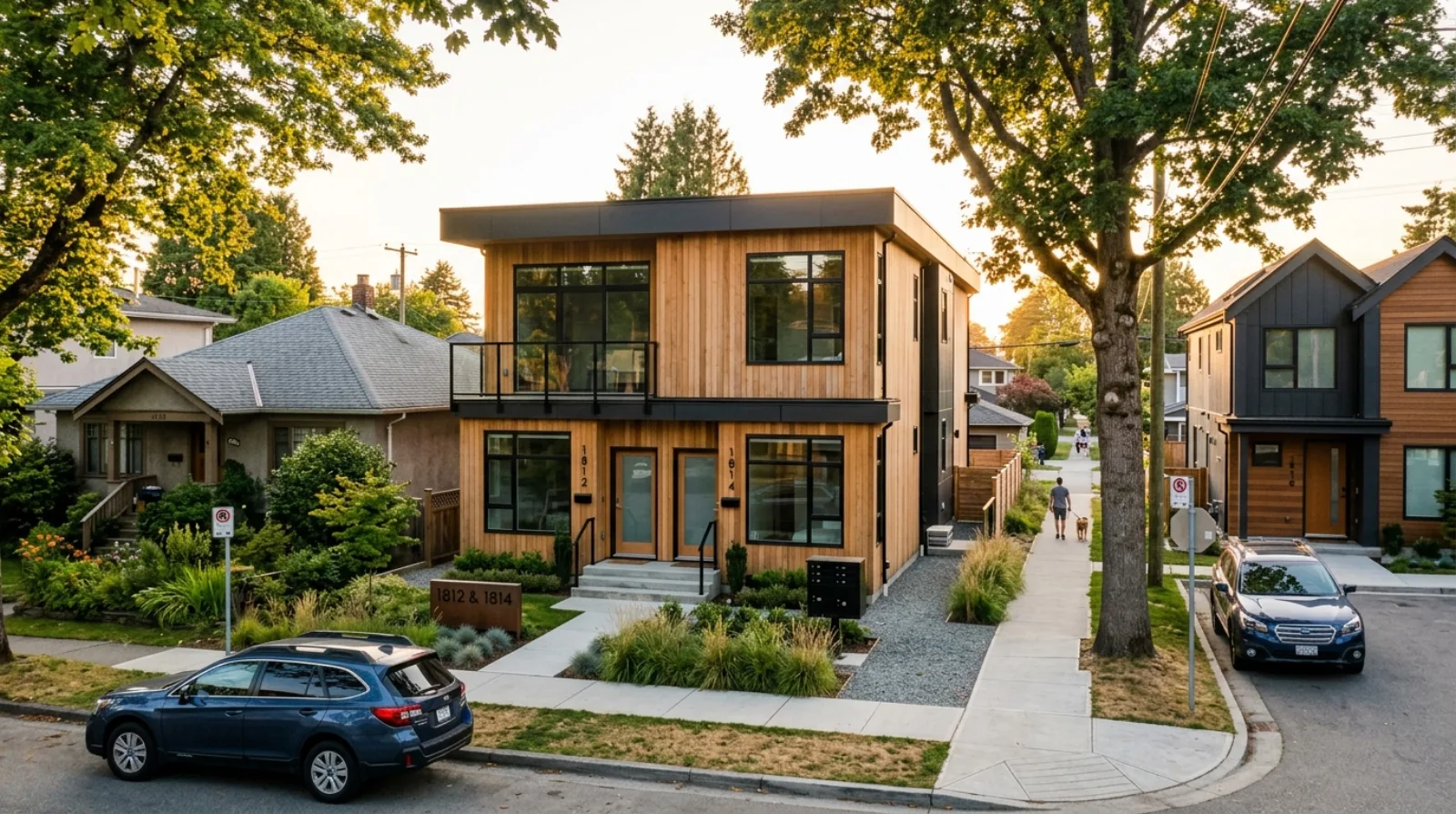
Newly completed two-storey Vancouver fourplex multiplex with two front entrances and vertical cedar siding on an East Vancouver street, surrounded by a mix of older single-family homes and a newer duplex, representing the specialist-built end of the multiplex market
Market Analysis Featured

AI Search Is Sorting Multiplex Specialists From the Rest

6 min read

Zoning reform opened the door. Now the multiplex market is separating specialists from generalists — and AI search is the tool sorting who actually delivers.

Key takeaway

David Babakaiff, co-founder of VanPlex and former principal of Alair Homes Vancouver, argues that BC's multiplex market has moved past the zoning question into an expertise question.

Zoning grants permission, but turning a lot into finished homes requires a dozen aligned roles (REALTOR®, builder, designer, lender, investor, appraiser, planner, permit consultant, city staff, and capital partner) which still coordinate through local referral networks. What is changing is discovery: homeowners and investors increasingly ask AI tools (ChatGPT, Perplexity, Claude, Gemini, Google AI results) which professionals actually understand multiplex in their city, which accelerates the market's split between generalists and specialists. A property can be zoned for more homes yet still not be buildable (lot, soil, setbacks), financeable (many multiplex projects fall under the ~$5M threshold institutional lenders prefer, pushing builders to private money), or aligned (team on one plan).

Expertise and trust are the execution layer that converts zoning permission into real, occupied homes. VanPlex has analyzed over 86,000 GVRD properties to test whether a specific lot pencils.

What this covers

  • zoning permission versus execution capability in multiplex development
  • specialist versus generalist across real estate roles
  • AI search as the new discovery layer for finding multiplex experts
  • the referral and trust network behind multiplex deals
  • permission to buildable to financeable to aligned to built sequence
  • multiplex financing under the $5M institutional threshold
multiplex ai-search geo specialists bill-44 ssmuh

Zoning is permission, not a plan

A property can be zoned for four units and still be a bad project. The lot might be too narrow once you account for setbacks. The soil might need a foundation that eats your margin. The neighbourhood might not support the price you’d need to charge per unit. The city charges might push the numbers underwater.

Permission to build more isn’t the same as a path to build more. Getting from one to the other takes judgment across a dozen roles: homeowners, REALTORS®, architects, designers, builders, lenders, investors, appraisers, planners, permit consultants, city staff, and capital partners. Each one can sink a deal.

Right now, that coordination still runs on small, local circles of trust.

How multiplex deals actually get done

A homeowner knows a REALTOR®. A REALTOR® knows a builder. A builder knows a designer. A lender knows which projects are financeable. An investor knows which assumptions are realistic. A builder knows which ideas survive contact with cost, schedule, and site conditions, and which ones fall apart on paper.

That’s how projects move today. Not through a perfect marketplace where you compare ten qualified pros side by side, but through local knowledge, reputation, and a few phone calls to people who’ve done it before.

That system works. It’s also slow, hard to break into, and completely invisible if you’re a homeowner in Kitsilano who’s never developed anything and doesn’t happen to know a multiplex builder.
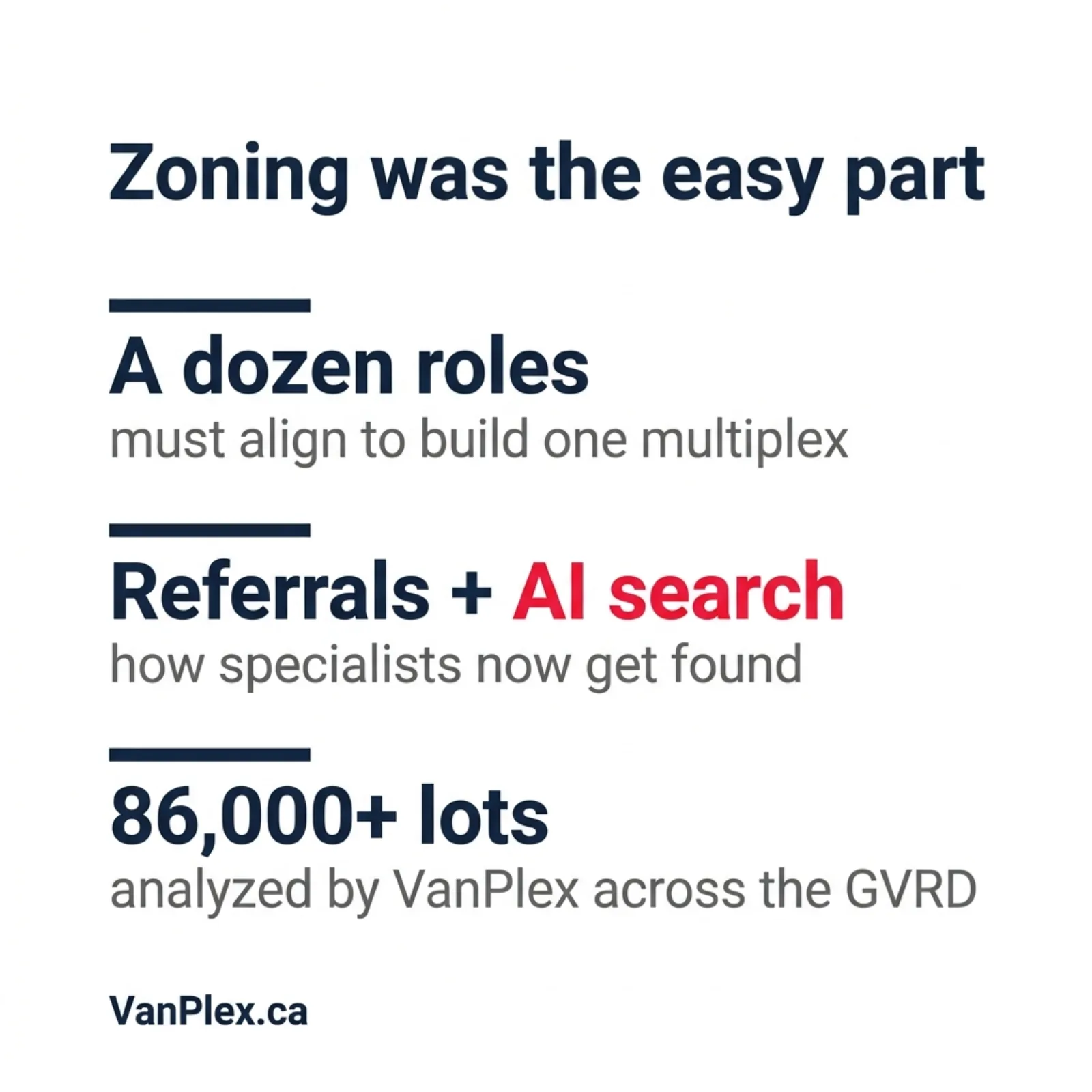
Social graphic reading 'Zoning was the easy part' with three points: a dozen roles must align to build one multiplex, referrals plus AI search are how specialists now get found, and 86,000+ lots analyzed by VanPlex across the GVRD

What’s actually changing: how experts get found

The referral network isn’t going away. What’s changing is what people do before they make those calls.

More homeowners, investors, builders, and advisors are now asking AI tools — ChatGPT, Perplexity, Claude, Gemini, Google’s AI results — much more specific questions than they’d ever type into a search bar. Who understands multiplex development in this city? Which builders have actually delivered small multifamily? Which REALTORS® understand land value and redevelopment potential instead of just listing houses? Which lenders understand construction financing?

These tools are starting to surface clearer signals of who knows what. They reward depth, track record, and specific evidence of competence. A pro who has written, built, and documented real multiplex work shows up. A generalist who slapped “multiplex specialist” on a profile last month doesn’t.

That’s the quiet shift. The trust layer is getting a discovery layer on top of it.

Specialist versus generalist: the gap that’s widening

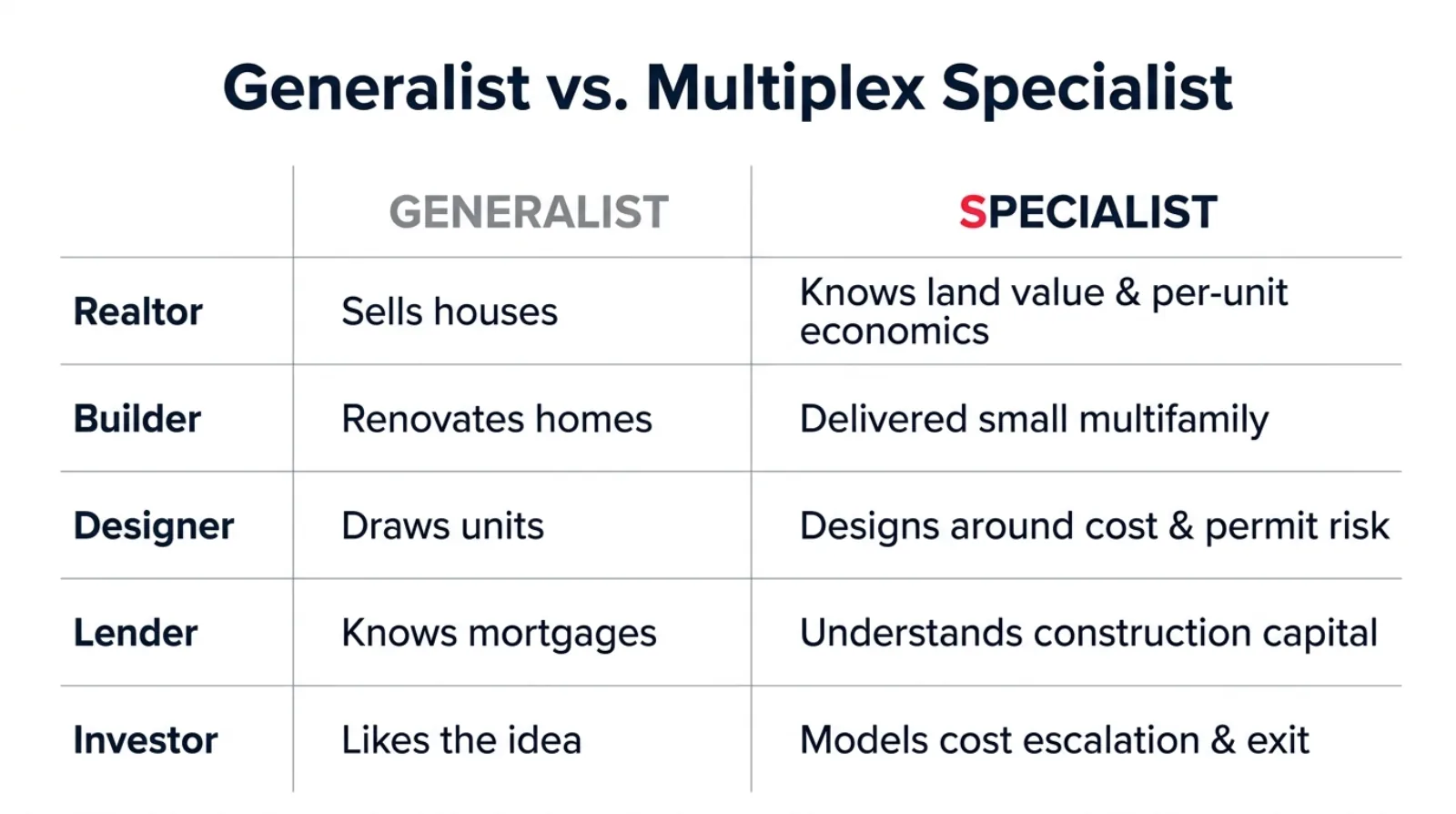
Every emerging asset class eventually learns to tell the difference between someone who dabbles and someone who specializes. Multiplex is hitting that point now. Here’s where the line falls, role by role — straight from what separates the pros who deliver from the ones who don’t:

RoleGeneralistMultiplex specialist
REALTOR®Sells housesUnderstands land value, redevelopment potential, and per-unit multiplex economics
BuilderRenovates homesHas actually delivered small multifamily on a standard lot
DesignerDraws unitsDesigns around zoning limits, construction cost, permit risk, and livability
LenderKnows residential mortgagesUnderstands construction capital, appraised value, rental income, and exit strategy
InvestorLikes the idea of multiplexModels timing, cost escalation, absorption, refinancing, and downside protection

Comparison chart contrasting a generalist and a multiplex specialist across five roles: REALTOR® sells houses versus knows land value and per-unit economics, builder renovates homes versus has delivered small multifamily, designer draws units versus designs around cost and permit risk, lender knows mortgages versus understands construction capital, investor likes the idea versus models cost escalation and exit

None of these are insults to generalists. A great residential REALTOR® is a great residential REALTOR®. But a multiplex is a development project wearing a house’s clothing, and the skills don’t transfer automatically. The market is learning to ask for the second column.

Why this is the normal life cycle of a market

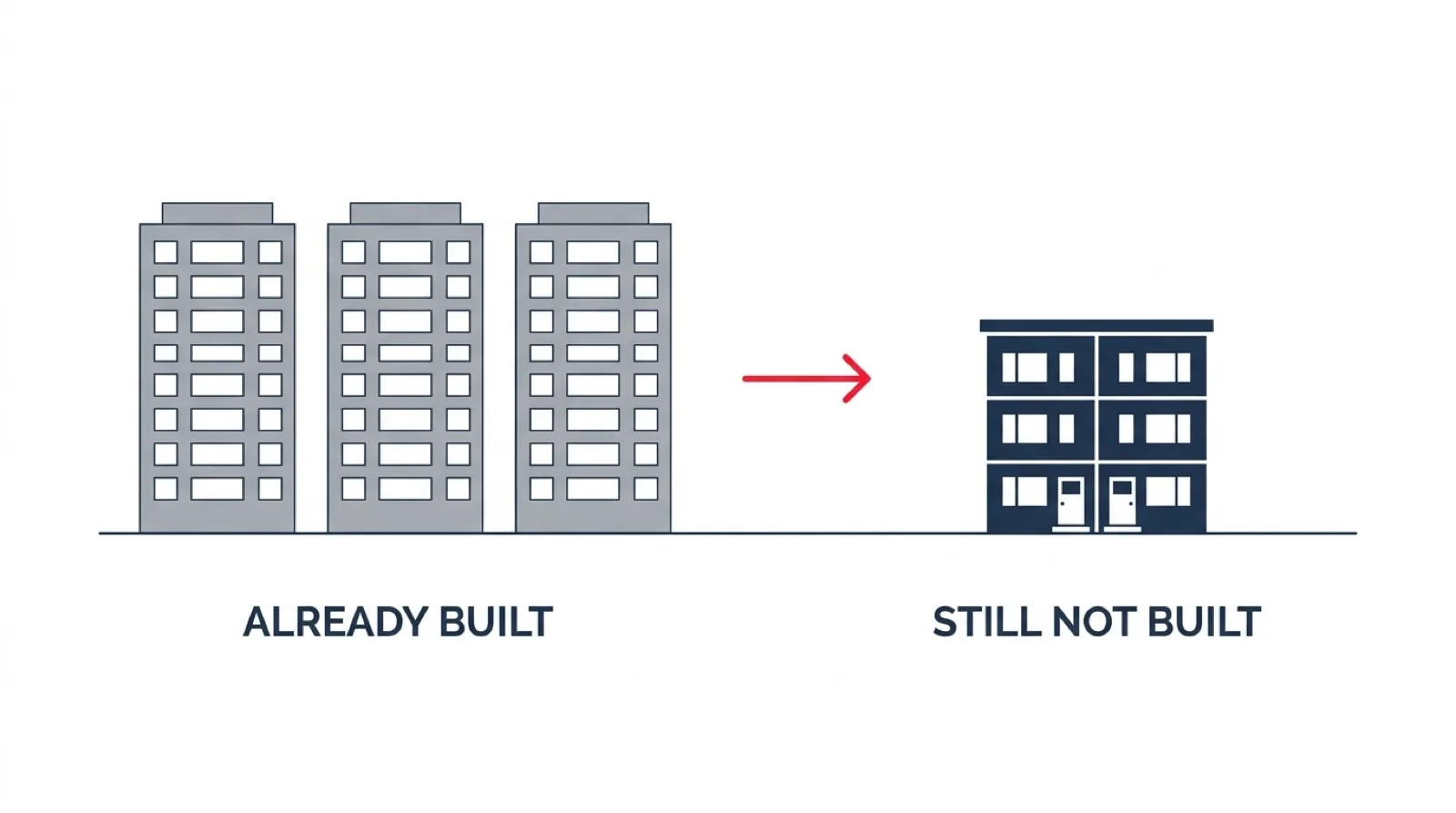
At first, everyone’s learning. Bill 44 passed, zoning changed overnight, and suddenly every builder, REALTOR®, and lender was a “multiplex expert.” That’s the dabbling phase, and every new market has one.

Then the serious participants separate themselves. They build real projects, get burned on real mistakes, and come out with judgment the dabblers don’t have. The market starts asking better questions and looking for more specific proof of competence.

AI search is accelerating that second phase. It’s compressing what used to take years of word-of-mouth into a few well-aimed questions. That’s good for the specialists. It’s uncomfortable for everyone who’s been coasting on the label.

Permission, buildable, financeable, aligned, built

Here’s the sequence that matters, and why expertise sits at every step:

  • A property can be zoned for more homes and still not be buildable — wrong lot shape, wrong soil, wrong setbacks.
  • It can be buildable and still not be financeable — many multiplex projects fall under the roughly $5-million threshold that institutional lenders want, which pushes builders toward private money at higher rates that eat the margin.
  • It can be financeable and still stall because the right owner, builder, designer, lender, and investor aren’t aligned on the same plan, budget, and timeline.
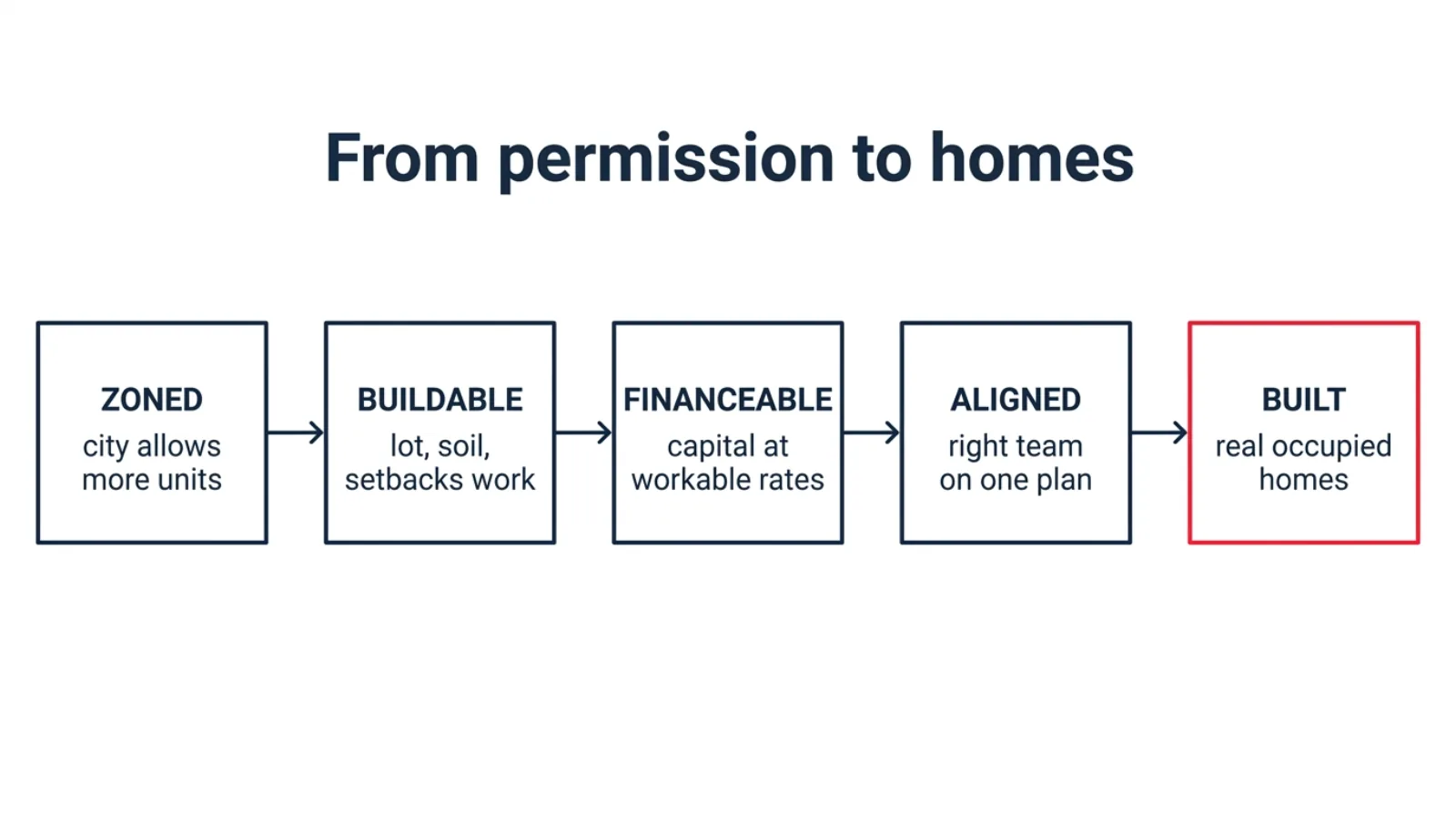
Five-step flow diagram from permission to homes: zoned (city allows more units), buildable (lot, soil, setbacks work), financeable (capital at workable rates), aligned (right team on one plan), and built (real occupied homes)

Zoning gets you to step one. Expertise is what carries a project through the other four. That’s why trusted specialists aren’t just service providers anymore — they’re the execution layer of this asset class. They’re the part of the system that turns permission into real, financeable, occupied homes.

What this means if you own a lot

If you’re a homeowner sitting on a property that’s now zoned for more, the zoning question is mostly answered. The real questions are sharper: Does your specific lot actually pencil? Who do you need on the team? Where does it break?

That’s the analysis worth doing before you call anyone. VanPlex has run the numbers on over 86,000 properties across the GVRD — lot size, configuration, city charges, and realistic per-unit selling prices in your neighbourhood. Check your address at VanPlex.ca and you’ll know in a few minutes whether you’re holding a real project or a tough one.

Zoning reform opened the door. AI search is making the opportunity easier to see. But expertise and trust are still what decide which lots actually become homes — and which ones stay permission on paper.


David Babakaiff is CEO and Co-Founder of VanPlex and former principal of Alair Homes Vancouver. PlexRank™ | Profit with Multiplex.
Frequently asked questions

Why isn't zoning permission enough to guarantee a good multiplex project?

A property can be zoned for four units and still be a bad project, because the lot might be too narrow once setbacks are applied, the soil might need a foundation that eats the margin, the neighbourhood might not support the price needed per unit, or city charges might push the numbers underwater. Permission to build more is not the same as a path to build more, and getting from one to the other takes judgment across a dozen roles, including homeowners, REALTORS®, architects, designers, builders, lenders, investors, appraisers, planners, permit consultants, city staff, and capital partners.

How do multiplex development deals actually get put together today?

Multiplex deals move through local knowledge and reputation rather than a marketplace where a homeowner compares ten qualified professionals side by side. A homeowner knows a REALTOR®, a REALTOR® knows a builder, a builder knows a designer, and a lender knows which projects are financeable, so the coordination happens through a few phone calls to people who have done it before. That system works, but it is slow, hard to break into, and invisible to a homeowner who has never developed anything and doesn't know a multiplex builder.

How is AI search changing how people find multiplex specialists?

Homeowners, investors, builders, and advisors are increasingly asking AI tools such as ChatGPT, Perplexity, Claude, Gemini, and Google's AI results much more specific questions than they would type into a search bar, such as which builders have actually delivered small multifamily housing in their city. These tools reward depth, track record, and specific evidence of competence, so a professional who has written, built, and documented real multiplex work shows up, while a generalist who recently added "multiplex specialist" to a profile does not.

What's the difference between a generalist and a multiplex specialist REALTOR® or builder?

A generalist REALTOR® sells houses, while a multiplex specialist understands land value, redevelopment potential, and per-unit multiplex economics. A generalist builder renovates homes, while a specialist has actually delivered small multifamily housing on a standard lot. The same pattern applies to designers, lenders, and investors: each specialist role adds judgment specific to multiplex development that a generalist version of that role does not carry.

Why is the multiplex market only now separating specialists from generalists?

This is described as the normal life cycle of an emerging asset class. When Bill 44 passed and zoning changed overnight, every builder, REALTOR®, and lender briefly called themselves a multiplex expert, which is the dabbling phase every new market goes through. Serious participants then separate themselves by building real projects, getting burned on real mistakes, and developing judgment the dabblers don't have, and AI search is accelerating that separation by compressing what used to take years of word-of-mouth into a few well-aimed questions.

What has to happen after a lot is zoned before it becomes a built multiplex?

The article lays out a sequence: a property can be zoned for more homes and still not be buildable due to lot shape, soil, or setbacks; it can be buildable and still not be financeable, since many multiplex projects fall under the roughly $5 million threshold institutional lenders want, pushing builders toward private money at higher rates that eat the margin; and it can be financeable and still stall if the owner, builder, designer, lender, and investor aren't aligned on the same plan, budget, and timeline.

Why do many multiplex projects end up financed with private money at higher rates?

Many multiplex projects fall under the roughly $5 million threshold that institutional lenders prefer, which pushes builders toward private money at higher rates. Those higher rates eat into the project's margin, meaning a project can already be zoned and physically buildable and still stall at the financing stage before it ever reaches the alignment or construction stage.

How many properties has VanPlex analyzed to test whether a multiplex lot actually pencils?

VanPlex has run the numbers on over 86,000 properties across the Greater Vancouver Regional District, checking lot size, configuration, city charges, and realistic per-unit selling prices in the surrounding neighbourhood. Checking an address against this analysis is presented as the step to take before calling any professional, since it tells a homeowner within a few minutes whether they are holding a real project or a tough one.

Free 12-page guide for Vancouver-area homeowners. Build, sell, hold, or partner — side-by-side comparison of the numbers, timeline, and risk on each path.

Verified phone required. We'll text you the link in 60 seconds.

David Babakaiff

David Babakaiff

Co-Founder, VanPlex | 25+ Years BC Construction

David Babakaiff is Co-Founder of VanPlex with 25+ years scaling BC construction. He led Alair Homes Vancouver to the 2024 HAVAN Award for Best Multiplex Unit in the GVRD. VanPlex’s PlexRank™ algorithm scores residential parcels across BC for multiplex conversion potential under Bill 44.

Want insights like this delivered weekly?

Join 2,500+ property owners getting ROI case studies, market data, and exclusive opportunities.

No spam. Unsubscribe anytime.